How to Make an Offer on a Used Car at a Dealership
Start with a written offer about 5% below the car’s market-based price estimate, then adjust for mileage, condition, and legitimate fees. Skip that step and you can anchor to sticker price, pay junk fees, or give up negotiating room. This guide shows how to price the car, calculate the out-the-door total, and submit a clean first offer at a dealership.
Set your out-the-door target
The number that matters is the out-the-door price, not the sticker price. Out-the-door generally includes taxes, title and registration, documentation fees, and any add-ons the dealer may try to attach. Ask for that total before you talk about monthly payment, because payment can hide a high price, a long term, or a costly APR.
Taxes, title, registration, and doc-fee rules vary sharply by state, so example totals may not transfer cleanly from one market to another. Build your ceiling before you visit. Your walk-away price should be a maximum total cost, not a vague comfort level, and it should include the car price, fees, and financing cost if you are borrowing. If the dealership can only speak in monthly numbers, keep steering back to the full amount due.
Monthly payment can mislead because the same payment can come from very different deals. A lower payment may mean a longer loan term, a higher APR, or extra products packed into the deal. Compare the complete loan cost and the total due at signing, not just the monthly figure.
Can you make a strong offer with pre-approval?
Yes. Pre-approval gives you a lending limit before you shop, so you can make an offer faster and with more certainty. It also shows the dealer that you already have financing lined up, which can reduce pressure to accept the store’s loan if the outside terms are better.
Use the pre-approval amount as a ceiling, not a target to spend. If the loan limit is below the car’s out-the-door total, your offer needs to reflect that gap. If the limit is above it, you still negotiate from the market value and your walk-away price, not from the bank’s maximum.
Dealer financing vs outside financing APR
Compare the interest rate before you decide which loan to use, because APR changes total cost. Truist offers used car dealership loans with fixed rates from 5.75% to 14.27% APR, and it says funding can happen as soon as today for dealership purchases. It also lists terms up to 84 months, loan amounts from $3,500 to $400,000, and no pre-payment penalties.
U.S. Bank says auto loans can run from 12 to 84 months. It also says it charges no origination fees and no prepayment penalty, and that pre-approved buyers can arrive with financing ready at participating dealerships. If the dealer beats your outside APR, compare the full cost, not just the payment.
Research market value before you write the offer
Check recent listings and pricing tools before you write the offer. Kelley Blue Book and CarGurus price insights help you estimate what similar cars are actually listed for, which keeps you from opening too high on a car that has room to move.
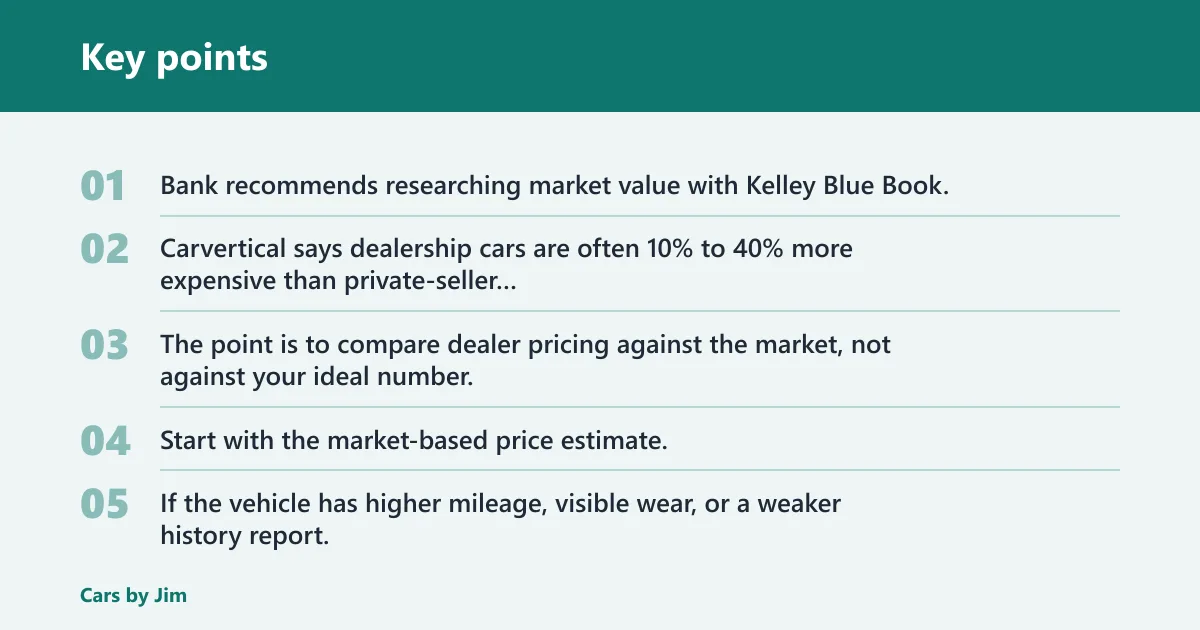
U.S. The same source recommends researching market value with Kelley Blue Book. Carvertical says dealership cars are often 10% to 40% more expensive than private-seller cars, so a dealer price can still be fair if the vehicle, paperwork, and reconditioning justify it. The point is to compare dealer pricing against the market, not against your ideal number.
Turning market data into a first offer
Start with the market-based price estimate, then open about 5% below that figure if the car is clean and the fee stack is normal. If the vehicle has higher mileage, visible wear, or a weaker history report, move the offer lower within reason. If it is unusually clean and priced near the bottom of the market range, stay closer to the market floor.
Say your target is about a $24,000 out-the-door total on a compact SUV after taxes and normal fees. A first written offer around $22,800 reflects a 5% opening discount from that figure, gives the dealer room to move, and still ties the number to market data, not to the sticker. That is cleaner than naming a payment first and hoping the math works out later.
Dealer offer worksheet

Use this as a planning tool before you step into the showroom. The numbers should come from your own market check, the dealer’s written quote, and your financing terms, then get refined once you see the fee stack.
| Asking price | Market range | Out-the-door estimate | Pre-approval limit | Trade-in value | Dealer fees | First offer | Counteroffer | Walk-away price |
|---|---|---|---|---|---|---|---|---|
| $23,900 | $22,800 to $24,400 | $26,150 | $27,000 | $4,800 | $1,250 | $24,800 OTD | $25,600 OTD | $25,900 OTD |
| $19,750 | $18,900 to $20,200 | $21,450 | $22,000 | $0 | $900 | $20,350 OTD | $20,950 OTD | $21,100 OTD |
- Cash buyer: Focus on the out-the-door total and ignore payment language. If the dealer keeps returning to financing, restate your cash offer in writing.
- Financed buyer: Keep your offer below your pre-approval limit and compare APRs before accepting the store’s loan.
- Trade-in shopper: Negotiate the purchase price first, then negotiate the trade-in as a separate transaction.
Decision rule for each scenario
- Cash buyer: If the out-the-door quote is within your walk-away price and the fee stack is ordinary, keep negotiating on price or add-ons.
- Financed buyer: If the dealer rate is higher than your outside loan and the total cost rises, keep your outside financing unless the dealer lowers the price enough to offset it.
- Trade-in shopper: If the dealer inflates the vehicle price while boosting the trade-in offer, separate the two numbers and judge the sale only by the purchase out-the-door total.
Should you ask for the out-the-door price first?
Yes. Ask for the out-the-door price before discussing monthly payment, trade-in, or down payment. That single request forces the dealer to put taxes, title, registration, and fees into one number, which makes it much easier to compare offers and spot extras that should not be there.
Ask the salesperson for the full written out-the-door figure and a breakdown of the fee stack. If the answer comes back as “What monthly payment are you aiming for?” redirect the conversation to the total due on the vehicle itself. That keeps the negotiation on the number that matters.
How to spot hidden add-ons
Look for dealer-installed accessories, protection packages, appearance products, nitrogen fill, etching, and similar extras. Some stores present them as nonnegotiable, but they are still part of the out-the-door total. If an add-on is already on the car, ask whether it can be removed from the sale or offset with a lower price.
A common first-timer mistake is accepting a “great price” and then discovering several hundred dollars in add-ons at signing. The car price may be fair, but the total is not. Make the dealer list every fee line by line before you answer with a number.
How do you make a written offer on a used car?
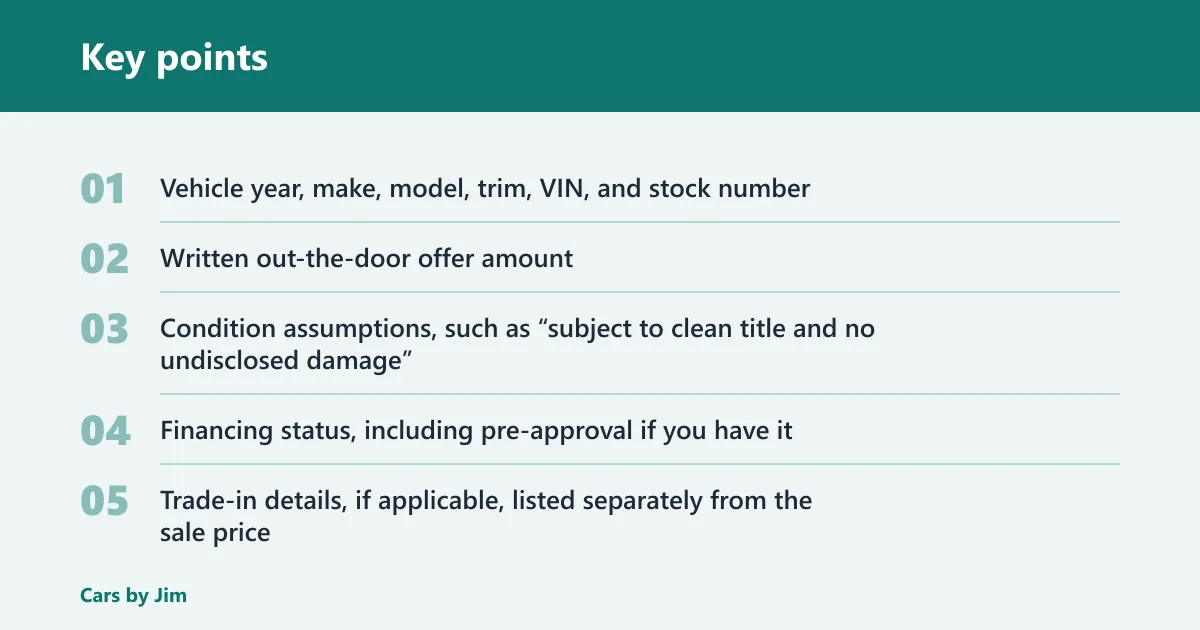
A written offer should name the exact car, the out-the-door total you are willing to pay, and the conditions attached to the offer. Put the VIN, stock number, color, mileage, and any required paperwork in writing so the deal cannot drift into a different vehicle or a different total.
If you have a trade-in, list it separately. State the purchase offer for the used car first, then the trade-in value as a separate line item, then the net amount due after both are applied. That keeps the headline number honest.
What to include in the offer
- Vehicle year, make, model, trim, VIN, and stock number
- Written out-the-door offer amount
- Condition assumptions, such as “subject to clean title and no undisclosed damage”
- Financing status, including pre-approval if you have it
- Trade-in details, if applicable, listed separately from the sale price
- Expiration date for the offer, such as the same business day
What to do if the dealer says the price is firm
If the dealership says the price is firm, ask whether the out-the-door total is also firm. Some stores mean the sticker price is fixed but still have room on fees, add-ons, trade-in, or financing. If the total is truly fixed and it exceeds your walk-away price, the answer is no.
Suppose a dealer refuses to move on a sedan priced at about $21,900 and the fees push it to about $24,100 out the door. If your walk-away price is about $23,500, the answer is already set. Do not let a firm tone replace a firm number.
Check history and condition before the final number
Run a VIN-based vehicle history report before you finalize any offer. That report helps you check accident history, prior damage, and title issues that can affect value. It does not replace an inspection, but it can keep you from paying market price for a car with an unknown past. Check recall status directly with NHTSA or the manufacturer.
Pre-purchase mechanic inspection
Schedule a pre-purchase inspection before your final offer, or make your offer contingent on passing one. A mechanic can verify condition, flag hidden wear, and identify repairs that a test drive will not catch. That matters even more on higher-mileage cars or models known for expensive service items.
If the report shows prior damage, a missed recall, bald tires, worn brakes, or signs of body repair, adjust the offer downward. If the car checks out cleanly and the dealer’s quote already sits near market, you may not have much room to negotiate, but you will know the number is grounded in condition, not guesswork.
When should you walk away from a used car deal?
Walk away when the counteroffer rises above your maximum acceptable total, when fees keep changing, or when the dealer will not separate the car price from the trade-in. Your walk-away point should be set before you enter the dealership, because pressure is easier to resist when the limit already exists.
Counteroffer response rules
A counteroffer is only useful if it moves the total into your range. If the dealer drops the price but adds a higher APR, expensive products, or a worse trade-in figure, the math may still fail. Judge the whole deal, not the one line the salesperson is emphasizing.
If the counteroffer is close, you can answer with one revised written number and ask for a final yes or no. If the store keeps changing the structure of the deal, stop negotiating and compare the numbers against other listings. There is no reason to accept a deal that only works on the dealer’s terms.
Deal-breaker fees and add-ons
Some fees are legitimate, but a fee stack can still be too high. Doc fee, registration/title, and mandatory add-ons should be visible before you agree. If the dealer will not explain the charge, will not remove an unwanted package, or will not write the out-the-door total, that is a strong signal to leave.
Frequently asked questions
How do I make an offer on a used car at a dealership?
Make the offer in writing as an out-the-door total, not as a monthly payment. Base it on the car’s market range, verified condition, and the dealership’s fee stack. Include the VIN, stock number, and any trade-in separately so the dealer can respond to one clear number.
How much should I offer on a used car at a dealership?
Start about 5% below the verified market-based out-the-door price, then adjust for mileage, condition, and fees. If the car is unusually clean and already priced near market low, stay closer to the bottom of the range. If the fee stack is high, lower your opening number accordingly.
Should I tell the dealer my budget before making an offer?
Only if you can keep it vague. A hard budget can become the ceiling the dealer works toward, even if the car is worth less. It is usually better to ask for the out-the-door price first and reveal your walk-away number only when needed.
Can I negotiate a used car price if I have financing pre-approved?
Yes, and pre-approval can help. It shows you can move quickly and gives you a hard ceiling for the deal. You still negotiate the vehicle price and out-the-door total separately, but outside financing can also keep the dealer from steering you into a higher-rate loan.
What if the dealership says the price is firm?
Ask whether the out-the-door total is firm, not just the sticker price. Some dealers have room in fees, add-ons, or financing even when the asking price stays fixed. If the full total is above your walk-away price, thank them and leave.
Should I ask for an out-the-door price before offering?
Yes. The out-the-door total is the real number you are buying, because it includes taxes, fees, and add-ons. Without that figure, you cannot compare offers accurately or know whether the dealer has padded the deal with extras you do not want.