How Do I Find the Private Party Value for My Car?
Start with a private-party valuation tool, then confirm the exact VIN and trim from the car itself or the paperwork. Set your price within roughly 5% below to 5% above the clean-condition local median, then adjust for mileage, options, and history. If you skip those checks, you can overprice the car, scare off buyers, or leave money on the table. This guide shows how to verify the estimate, compare nearby listings and completed sales, and account for accidents, title problems, and other major issues.
What private party value means
Private party value basics
Private party value is the estimated sale price between a non-dealer seller and a non-dealer buyer. It is usually higher than trade-in value and lower than dealer retail, so do not use a dealer number as your private-sale target. The goal is a defendable range, not a fantasy price.
Car and Driver says its values are based on age, mileage, condition, options, and accident history, and that it uses Black Book data. Car and Driver also notes that location can affect value. That is why the same car can price differently in two cities. (Caranddriver)
What you’ll need
- VIN from the driver-side windshield base, the driver door jamb, or title and registration paperwork.
- Mileage from the odometer.
- Title status notes: clean, salvage, rebuilt, lemon buyback, or not sure.
- Accident history details: no accidents reported, minor, major, or unknown.
- Service records and any recall or repair documentation.
- Window sticker or build sheet, if you still have it, to confirm factory equipment and options.
- Notes on condition for paint, glass, tires, warning lights, seats, and mechanical behavior.
- Access to valuation tools such as Car and Driver, CARFAX, Edmunds, Kelley Blue Book, and iSeeCars.
How do you verify the car?
Start with the 17-character VIN, then use it to confirm the trim and factory equipment. Next check mileage, title status, and any accident or title branding. A valuation tool cannot see a miswired warning light, mismatched tires, or missing service records, so those details matter.
- Record the VIN from the windshield base, door jamb, or paperwork.
- Match the VIN to the exact trim and equipment list.
- Check the odometer and compare it with the vehicle’s age and typical mileage.
- Review title status and accident history before trusting any estimate.
- Inspect the car for warning lights, uneven tire wear, dents, upholstery wear, and engine performance issues.
Suppose a 9-year-old sedan shows 68,000 miles, but the VIN lookup reveals a higher trim with factory leather and a moonroof. That difference can move the price band up because the tool is pricing the actual car, not the base model.
A clean VIN match matters even more when the seller is unsure about options. Window stickers and build sheets help confirm what left the factory, which matters if the car has upgraded audio, driver aids, or a premium package.
How do you compare local listings?
Match nearby comps by trim, mileage, condition, and title history before you trust the number on the screen. Local demand changes what buyers will pay, and a low national average is no substitute for the cars actually for sale near you. Nearby comps should carry more weight than distant listings.
Use the closest matches first. A car with the same trim but 30,000 fewer miles is not a clean comparison. The same goes for a rebuilt title, missing options, or visible damage that your car does not have.
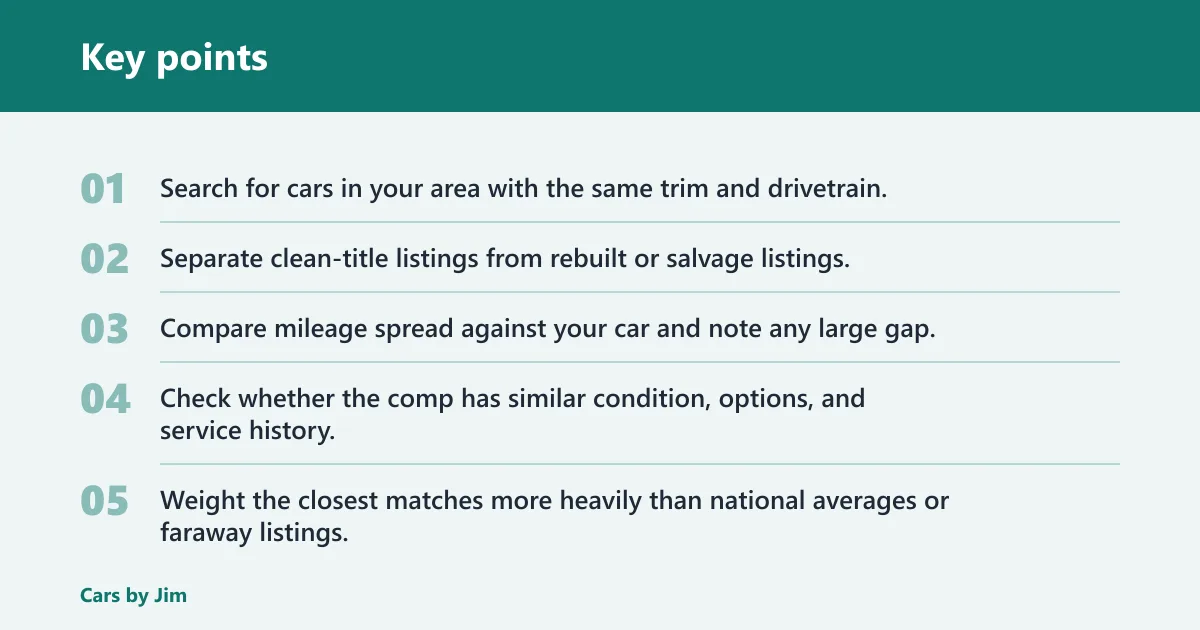
- Search for cars in your area with the same trim and drivetrain.
- Separate clean-title listings from rebuilt or salvage listings.
- Compare mileage spread against your car and note any large gap.
- Check whether the comp has similar condition, options, and service history.
- Weight the closest matches more heavily than national averages or faraway listings.
Say your hatchback has 92,000 miles and a clean title, while a nearby listing with the same trim has 124,000 miles and a missing service record. That listing should not pull your price down much. A cleaner, lower-mile example deserves more weight.
How do you set your asking range?
Start with one or two valuation tools, then adjust for your car’s real condition, history, and local market. If the car is clean and well-kept, aim near the top of the band. Leave room for negotiation, because buyers expect some movement off the asking price.
A practical range is better than a single figure. The top end should reflect a strong local example. The bottom end should be the price you would accept after a normal negotiation, not after a long series of concessions.
- Pick one valuation tool as your baseline and a second as a check.
- Adjust upward for below-average mileage, strong records, and clean cosmetics.
- Adjust downward for warning lights, worn tires, missing records, or accident history.
- Set your asking price slightly above your likely sale price so you have room to negotiate.
- Recheck the number against current local comps before listing.
A common first-timer mistake is pricing from dealer retail because it can look cleaner on the page. That overstates private-party value. Trade-in value is the dealer’s purchase estimate, not your asking target.
Private party pricing worksheet
Fill this out before you list the car. If any line item is uncertain, mark it as unknown and price conservatively until you verify it. Use the final band to guide your listing price, then keep a small buffer for negotiation.
| Field | What to enter | Decision rule |
|---|---|---|
| VIN | 17-digit VIN from windshield base, door jamb, or paperwork | If the VIN does not match the title or the equipment list, stop and verify before pricing. |
| Exact trim | Full trim name and major factory options | If trim is unclear, use the VIN or window sticker before you trust any estimate. |
| Mileage vs. average | Odometer reading and whether it is below, near, or above typical mileage for the age | Below-average mileage can support a higher band; above-average mileage usually pulls it down. |
| Condition grade | Excellent, Good, Fair, or Poor | If there are warning lights, worn tires, dents, or heavy interior wear, do not use a top-grade assumption. |
| Title status | Clean, salvage, rebuilt, lemon buyback, or not sure | Any branded title should lower the range until it is documented clearly. |
| Accident history | No accidents reported, minor, major, or unknown | Unknown history should be priced below a documented clean-history car. |
| Local comp range | Three nearby listings with similar trim and mileage | Use the closest matches, then ignore outliers with different titles, damage, or options. |
| Final asking-price band | Low and high numbers you can defend | Place the asking price near the top of the band only if the car is clean and well documented. |
| Negotiation buffer | Difference between asking price and likely final sale price | Keep a buffer so a normal offer does not force you below your target. |
For a clean car with average mileage, a sensible buffer is often a few hundred dollars on older cars and more on higher-priced ones. The exact amount should come from your local comps, not from a fixed rule. If nearby buyers are active, the buffer can be thinner.
When one estimate is enough
One valuation source is often enough when the VIN matches, the title is clean, the car has average mileage, and local comps cluster around the same number. If the source and nearby listings agree, you can list with confidence and watch the response.
If the car has an unusual trim, missing records, a branded title, or a large mileage gap, check a second source before posting. That extra check is worth it when the first estimate could be off because the car is not a plain, average example.
Common mistakes
Most pricing errors come from skipping verification. A year/make/model estimate can miss equipment, title status, or a bad history report, which leads to the wrong price band. Keep your attention on the details that a buyer will notice first.
- Using dealer retail as the asking price. Private-party value is lower.
- Ignoring mileage gaps. Above-average mileage usually lowers value.
- Ignoring title brands or accident history. These can change buyer confidence fast.
- Pricing from one national number only. Local comps matter more than a generic average.
- Assuming modifications always pay back. Most aftermarket parts do not recover full cost.
Modifications help most when they are tasteful, documented, and broadly useful, such as factory-style wheels or a quality stereo upgrade. Loud exhausts, extreme suspension changes, and custom bodywork often narrow the buyer pool. Price those cars for the market you actually have, not the money spent on parts.
Frequently asked questions
What information do I need to look up my car’s value?
You need the VIN, mileage, title status, accident history, and condition notes. A window sticker or build sheet helps verify factory equipment, and service records add credibility. If any of those items are missing, price conservatively until you confirm them.
Which valuation tools are best for private party pricing?
Use at least one VIN-based tool and one market-check source. Car and Driver uses Black Book data, while CARFAX, Edmunds, Kelley Blue Book, and iSeeCars can help you compare trims, mileage, and local demand. The best result comes from agreement across tools, not one number alone.
How accurate are online car value estimates?
They are a starting point, not a final answer. Accuracy improves when the tool has the exact VIN, trim, mileage, and history, but it can still miss local demand or visible wear. Cross-check the estimate with nearby listings before you set the final band.
Does mileage change private party value a lot?
Yes, but it is only one input. Mileage affects depreciation and helps buyers judge wear, yet condition, history, and location still matter. A low-mile car with a bad title or missing records may still sell below a higher-mile clean example.
How much do accident history and title brands hurt value?
They can lower buyer confidence and shrink the buyer pool. A clean title usually supports the strongest price, while salvage or rebuilt titles usually need a discount. If the report is unknown, assume the market will price in extra caution until the records are clear.
Why is my private party value different from trade-in value?
Trade-in value is what a dealer may pay to acquire the car, while private-party value is what a non-dealer buyer may pay. Dealers also account for reconditioning and resale risk, so trade-in is usually lower. Do not use a trade-in number as your private-sale target.