
What paperwork is needed for seller financing on a car?
By Cars by Jim Editorial Staff
Reviewed for title-transfer and disclosure accuracy using DMV/title-agency guidance, FTC Used Car Rule materials, and federal odometer disclosure rules.
For seller financing on a car, you typically need two paperwork sets: the DMV title-transfer packet and a separate loan packet with the promissory note, bill of sale, lien or security agreement, and payment terms. Missing either one can delay the title transfer or leave you with an unsecured loan. This guide covers what to sign, what to file, and what to keep. For federal odometer disclosure rules, see the NHTSA/FTC disclosure requirements; for title and lien handling, check your state DMV or title agency before closing because notarization, lien notation, and transfer forms vary by state.
Seller financing paperwork: the two stacks
Think of seller financing as two separate jobs. One packet moves ownership through the title system. The other packet records the debt, the collateral, and what happens if the buyer stops paying. Keep those stacks separate, but make sure they match on the same vehicle, the same parties, and the same sale date. DMV/title agencies typically want the ownership packet to be complete before or at the time of transfer, while the loan packet should be fully signed at closing so the security interest and repayment terms are enforceable.
What belongs in the title-transfer packet
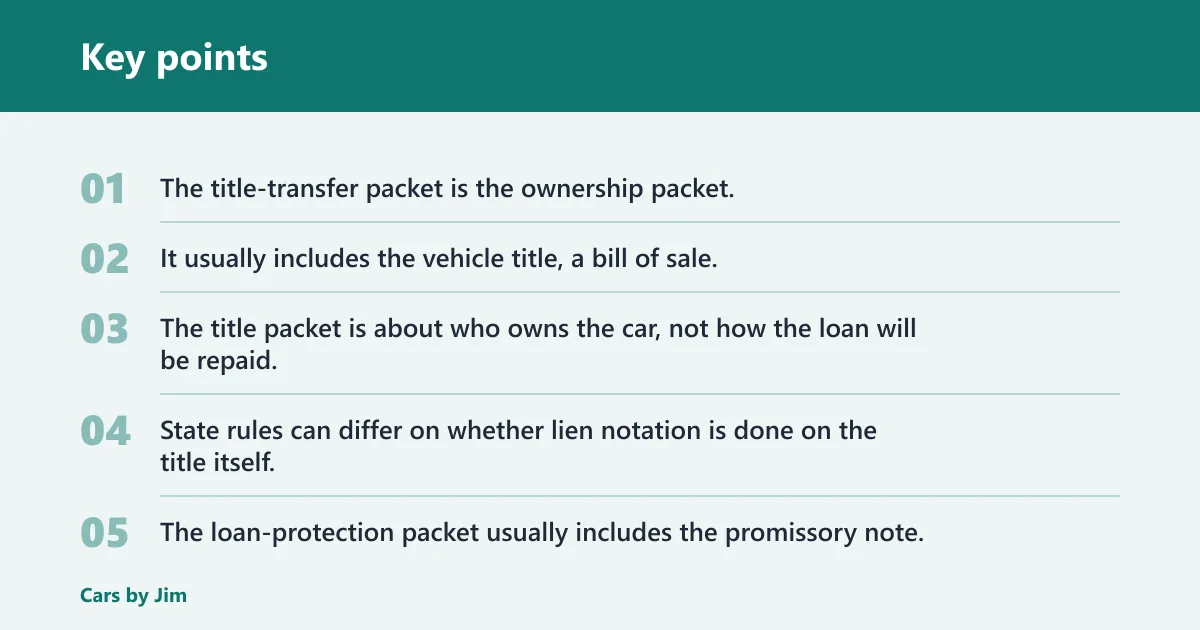
The title-transfer packet is the ownership packet. It usually includes the vehicle title, a bill of sale, an odometer disclosure when required, any lien release if the car still has an active lender, and any state transfer forms that the DMV or title system requires. The title packet is about who owns the car, not how the loan will be repaid. State rules can differ on whether lien notation is done on the title itself, through an electronic title system, or by a separate filing such as a UCC record for certain vehicles or collateral structures, so the title agency’s instructions matter.
What belongs in the loan-protection packet
The loan-protection packet usually includes the promissory note, a security agreement or lien language tied to the car, a payment ledger, insurance proof, and identity checks. This packet sets the repayment terms and the remedies if the buyer defaults. It does not replace the title paperwork. If your state uses title-system liens, the security agreement should line up with the lien notation process; if it uses separate perfection steps, the paperwork must reflect that state-specific filing path.
When both stacks must be signed before the car leaves
Both stacks should be signed before delivery if the seller wants clean paperwork and a clear paper trail. That is especially important when the buyer is taking the car before the loan is paid in full. A common first-timer mistake is handing over the keys after signing only the note, then trying to reconstruct the title paperwork later. In most states, ID and insurance should be verified before signing, while the title, bill of sale, note, and security agreement should be signed at closing. If your state requires notarization or a separate title form, include it in the same appointment so the closing is not split into multiple steps.
Picture a buyer who signs the note, drives away, and later claims the title “will be filled in after the first payment.” That creates avoidable risk. Complete the ownership forms and the loan forms at the same closing, then keep copies of everything. If the vehicle is older, verify whether the federal odometer disclosure exception applies by age; the cutoff and form requirements can differ by state title process, but federal disclosure rules generally exempt vehicles 10 model years old or older from the standard disclosure requirement.
Bill of sale and title
The bill of sale and title are the core ownership documents. The bill of sale records the transaction details. The title proves who owns the car and where any lien is recorded. If either one is incomplete, the transfer can stall even if the loan terms are already agreed. State title agencies often reject transfers when the title assignment is altered, the odometer disclosure is missing where required, or the seller’s name does not match the record owner exactly.
Bill of sale fields you should not skip
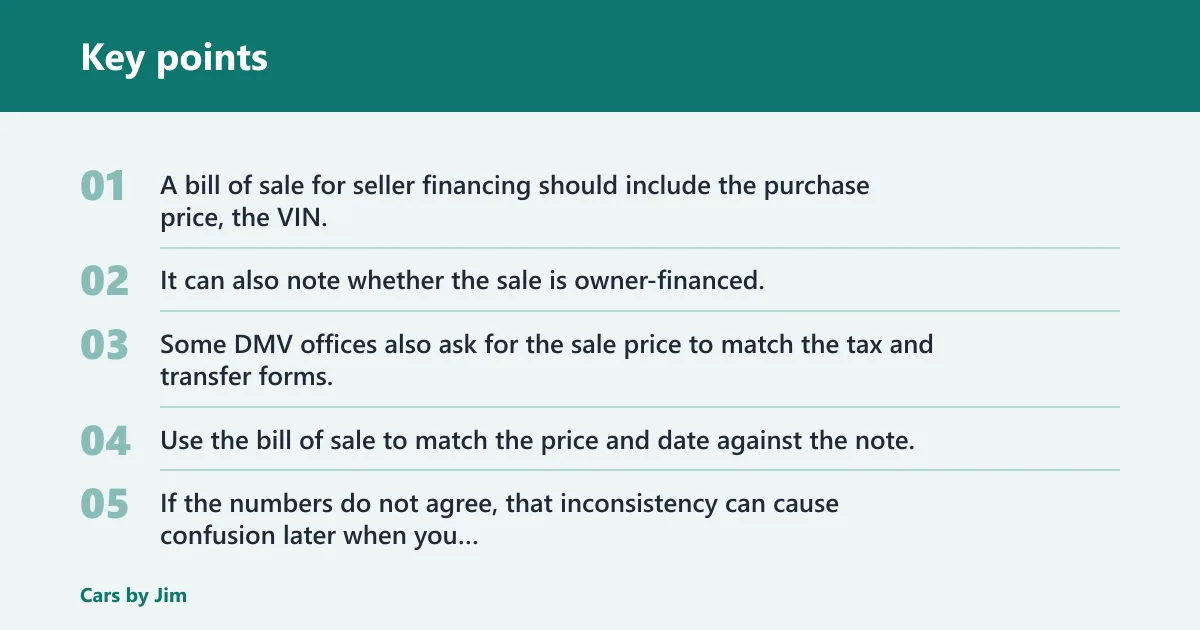
A bill of sale for seller financing should include the purchase price, the VIN, the date of sale, the buyer’s legal name, the seller’s legal name, and signatures from both parties. It can also note whether the sale is owner-financed, but the legal names and the VIN are not optional if you want a clean transaction record. Some DMV offices also ask for the sale price to match the tax and transfer forms, so keep the bill of sale consistent with the title paperwork.
Use the bill of sale to match the price and date against the note. If the numbers do not agree, that inconsistency can cause confusion later when you compare the payment ledger, the title transfer, and the payoff history. FTC guidance on used-car sales also treats clear written disclosures as important evidence of what was promised and sold.
Title assignment, odometer section, and lienholder section
The vehicle title should show the seller as the current owner, include the odometer disclosure section when required, and have the assignment section completed exactly as the title form instructs. If the title has a lienholder section, that area matters too. A signed title with missing assignment language is not the same as a completed transfer. States vary on whether the lien is shown on the paper title, the electronic title record, or a separate lien filing, so follow the issuing state’s title instructions.
The odometer disclosure section belongs on the title or on the separate federal disclosure form where the title system requires it. The mileage reading, date, and signed certification must be consistent. Federal odometer disclosure rules apply differently by vehicle age, and many states mirror those rules but still keep their own title form requirements. If the title has a lienholder section, do not ignore it because it often controls whether the DMV will accept the transfer. See the FTC’s Used Car Rule materials and NHTSA odometer disclosure guidance for the federal baseline, then confirm any state-specific form or notarization requirement with your DMV or title agency.
When a lien release is required before transfer
If the seller still owes money on the car, a lien release is typically needed before the title can transfer cleanly. That release comes from the existing lender after payoff, and the timing matters. Do not assume the seller can pass along a clean title if the current lien has not been released or properly updated in the title system. State DMV instructions usually require the release document, an updated electronic record, or both before a buyer can receive a clear title.
Say your title shows an active lender name and the seller has not paid it off. The buyer can sign every private contract in the folder, but the DMV side may still stop the transfer until the lender’s release is processed. That is why payoff documents belong in the closing packet before delivery. If the lien is recorded on a title system rather than a paper title, ask the DMV how the release is updated and whether the buyer should receive a printed confirmation.
What paperwork do you need to protect the loan?
To protect the loan, you need a promissory note that sets the debt terms, a security agreement that ties the car to the debt, and a payment ledger that tracks each payment. Those documents answer three different questions: how much is owed, what secures it, and what happens if the buyer defaults. In title-based states, the lien or security interest usually must be noted on the title; in UCC-based or hybrid setups, the filing path can differ, so the state title agency’s process controls perfection.
Promissory note terms to include
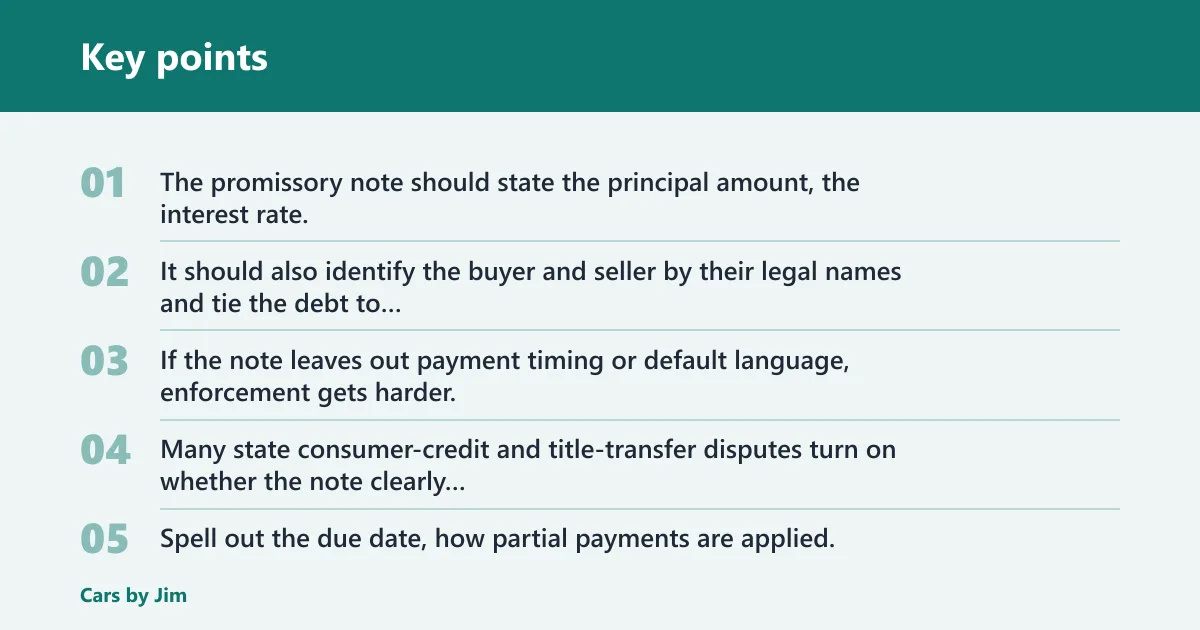
The promissory note should state the principal amount, the interest rate, the payment schedule, the late fee terms, and the default terms. It should also identify the buyer and seller by their legal names and tie the debt to the same vehicle described in the title paperwork. If the note leaves out payment timing or default language, enforcement gets harder. Many state consumer-credit and title-transfer disputes turn on whether the note clearly matches the sale documents and the collateral description.
Keep the note plain and specific. Spell out the due date, how partial payments are applied, and when a missed payment becomes default. If the note is vague, the buyer can argue over what was due and when.
Security agreement terms to include
The security agreement should describe the collateral, state the repossession rights, identify the default trigger, and include lien language tied to the vehicle. Where state title rules require lien notation or another filing step, the agreement should reflect that requirement. Do not rely on a generic promise when the car itself is the collateral. If the state uses a separate UCC filing for perfection in some transactions, confirm whether that filing supplements or replaces title notation for your vehicle type.
The collateral description should match the VIN, year, make, and model on the title. If the description does not match, you create a gap between the debt and the car that secures it.
Payment ledger and default tracking
A payment ledger should show due dates, how each payment was applied to principal and interest, and any late payment history. Keep it with the signed note and the bill of sale. If a dispute comes up, the ledger is what shows whether the buyer paid on time and how much remains unpaid.
List each payment in date order. Record any late fee separately. If the buyer pays extra, note how that extra amount is applied so the payoff balance stays clear. Update the ledger after each payment, not just at the end of the loan, so the balance is always current if the buyer requests a payoff quote or defaults midstream.
Do you need proof of insurance before delivery?
Yes. Insurance should be in place before the vehicle leaves the seller’s control, and the declarations page is the document to ask for. At minimum, the policy should show an effective date before delivery. If the seller is acting like a lender, it is reasonable to require more than the state minimum when the loan documents call for it. Insurance requirements can also affect lienholder loss-payee language, so the note and security agreement should say exactly what coverage is required.
What to ask for on the declarations page
Ask for the policy declarations page, not just a verbal promise. It should show the named insured, the vehicle, and the effective date. That page is the clearest proof that the buyer has active coverage before handoff. If your financing terms require the seller to be named as lienholder or loss payee, verify that the policy reflects that instruction.
When liability coverage is enough
Liability coverage may be enough for the sale itself if no loan document requires more. Even then, the policy should be active before delivery. If the buyer cannot show current liability coverage, the car should not leave on the spot. Some states and insurers treat proof of insurance differently at transfer, so check the DMV’s transfer checklist and the insurer’s declarations page requirements before closing.
When a lender-style policy requirement applies
If the promissory note or security agreement requires comprehensive or collision coverage, the buyer should provide proof of that coverage too. The requirement belongs in the loan documents, not in a verbal side deal. Check the declarations page for the coverage types actually listed. If the seller is retaining a lien, the insurance clause should also state whether a deductible cap or lapse notice is required.
Photo ID and address verification
Verify identity before signing anything. A valid government-issued photo ID is required for every buyer, and the name should match the contract. Address verification matters too because many transfer and lending forms depend on a current address on file. DMV title offices often use the address for mailed titles, lien correspondence, and transfer notices, so an outdated address can create delays even when the deal itself is valid.
What counts as valid ID
The ID should be government-issued, valid, unexpired, and readable. A faded card or expired license is not enough. If the buyer is signing in a legal name that differs from the ID, stop and fix the mismatch before the paperwork is completed. If your state accepts a passport, military ID, or state ID card for title transfer, follow the DMV’s acceptable-ID list rather than assuming a driver’s license is the only option.
Why the name must match the contract
The name on the ID should match the buyer name on the bill of sale, promissory note, and security agreement. Matching names reduce the risk of disputes over who owes the debt or who signed the transfer. If the buyer uses a different legal name, update the forms accordingly. A mismatch can also complicate lien notation and title mailing if the DMV records do not match the signed documents.
When to verify the current address
Verify the address before final signing, especially if the title transfer or the note requires a current mailing address. A recent utility bill or lease can help confirm residence. For financed used-car deals, proof of residence is typically requested, and a recent address document is usually expected. If the state title agency mails the new title to the buyer, verify where it will be sent before the handoff.
Proof of income and proof of banking are also common in financed used-car deals. A recent bank statement is standard proof of banking. W-2 employees usually provide recent pay stubs, while self-employed buyers may use tax returns, bank statements, or a profit and loss statement. Some lenders request personal references for non-prime or first-time buyers.
Seller financing checklist
This checklist keeps the ownership packet and the loan packet from getting mixed together. Use it as a one-page closing list, then keep copies of every signed document with the payment records. For a clean closing, the ID and insurance proof should be checked before signing, while the title, bill of sale, note, security agreement, and required transfer forms should be completed at signing. The payment ledger should be updated after each payment, and any lien release should be added after payoff.
| Document | Who signs it | When it is completed |
|---|---|---|
| Vehicle title | Seller and buyer, as required by the title form | At signing |
| Bill of sale | Seller and buyer | At signing |
| Promissory note | Buyer and seller | At signing |
| Security agreement | Buyer and seller | At signing |
| Odometer disclosure | Seller and buyer, where required | At signing |
| Lien release, if applicable | Existing lender, then kept by seller and buyer | After payoff |
| Insurance proof | Buyer supplies the declarations page | Before signing |
| Payment ledger | Seller maintains it; buyer should receive a copy | After each payment |
| Government-issued photo ID | Buyer presents it; seller verifies it | Before signing |
Check the title status, signatures, insurance proof, ID, and completed transfer forms before releasing the car. If the title is incomplete, the odometer disclosure is missing, or the insurance proof is absent, stop the handoff and fix the paperwork first. In some states, the title transfer also requires notarization or a separate state form, so verify those steps before the closing appointment.
- Confirm the title is in the correct seller name and has no unresolved lien problem.
- Complete the bill of sale with the VIN, price, date, and legal names.
- Sign the promissory note and security agreement with matching terms.
- Check the buyer’s valid government-issued photo ID and current address proof.
- Collect insurance proof with an effective date before delivery.
- Copy or scan every signed page, then keep the payment ledger with the loan file.
Can you seller-finance a car with an existing loan?
Yes, but only if you handle the existing lien first. The payoff and lien release usually have to happen before the title can transfer cleanly. If money is still owed, the title transfer may depend on the lender’s release document and the state’s title system rules. DMV/title agencies often require the original lender’s release or an electronic lien update before the new owner can receive a clean title.
Why payoff comes first
When the seller still owes money, the current lender’s claim has priority on the title. That means you need payoff information before closing, and you need the release document once the loan is satisfied. Trade-in paperwork may also include the title if the vehicle is owned outright, or loan payoff information if money is still owed. A buyer who finances a car without confirming the payoff amount can end up waiting for a release that is delayed by the seller’s missing balance payoff.
What to keep after the lien is released
Keep the payoff statement, the lien release, the updated title paperwork, the bill of sale, the note, and the security agreement. Those documents show that the old lien was cleared and the new seller-financed loan was properly documented. If the title system requires a separate filing step, keep proof that it was completed. If the lien was recorded through a DMV electronic title system, keep the confirmation showing that the lender’s interest was terminated.
How title transfer changes if the seller still owes money
If the seller still owes money, the transfer cannot be treated like a simple owner-to-owner handoff. The lender release has to fit into the chain of paperwork before the DMV side is finished. Until that happens, the buyer should not be handed an incomplete packet and told to sort it out later. State rules also vary on whether a release must be notarized, electronically submitted, or attached to a paper title, so the title agency instructions control the closing sequence.
Frequently asked questions
What paperwork do I need to sell a car with seller financing?
You usually need the title, a bill of sale, a promissory note, a security agreement, an odometer disclosure where required, proof of insurance, ID verification, and a payment ledger. If there is an existing loan, add payoff and lien release documents before the title transfer is treated as complete. Check your state DMV/title agency for any required transfer form, notarization, or lien-notation step.
Do I need a bill of sale for seller financing on a car?
Yes. The bill of sale records the purchase price, VIN, date of sale, buyer and seller legal names, and signatures. It does not replace the title or the note, but it helps tie the ownership transfer to the loan documents and the payment record. It also helps explain the transaction if the DMV, insurer, or lender later asks for supporting paperwork.
Should the buyer sign a promissory note when I finance the car myself?
Yes. The promissory note is the document that spells out the principal amount, interest rate, payment schedule, late fee terms, and default terms. Without it, you may have a hard time proving the repayment terms of the private loan. A note paired with a security agreement is stronger than a handshake promise or a text message.
How do I protect myself if I carry the loan on a car sale?
Use a promissory note, a security agreement tied to the vehicle, and a payment ledger. Match the collateral description to the VIN, keep insurance proof on file, and make sure the buyer’s ID and legal name match every signed form. If state title rules require lien notation, follow that process. Also confirm whether your state requires notarization or a separate title form at closing, because skipping that step can weaken the lien.
What title and lien paperwork should I keep after a seller-financed sale?
Keep the signed title, bill of sale, promissory note, security agreement, insurance proof, ID copy, and payment ledger. If there was an existing loan, keep the payoff statement and lien release too. Those records show both ownership transfer and debt terms in one file. If your state uses electronic title records, keep the DMV confirmation page or receipt as well.
Can I seller-finance a car if I still owe money on it?
Usually only after you handle the existing lender first. The payoff and lien release have to be addressed before the title can move cleanly to the buyer. If the title still shows an unpaid lien, do not treat the sale as finished until that issue is cleared. State title agencies may reject the transfer if the lien is still active or if the release is missing the required form or endorsement.