Which VIN Check Is Best for a Used Car Buyer?
By Cars by Jim Editorial Team
For most used-car buyers, the best VIN check is the one that fits the risk: a specs-only decode for identity, a recall lookup for safety, or a full history report for crash, title, theft, and odometer checks. Pick the wrong one, and you can miss hidden damage, open recalls, or a bad title that costs far more than the report. This guide compares those VIN check types and shows which one fits your purchase.
We compared VIN check types by the questions a buyer needs answered before signing: Does the VIN match the vehicle? Are there open safety recalls? Is there title-brand, odometer, theft, lien, or accident risk? We relied on official data sources for the free checks, including the NHTSA vPIC decoder, the NHTSA recalls lookup, and NHTSA crash ratings, and we treated theft checks as a separate issue that buyers should verify through the NICB VINCheck when theft exposure is part of the purchase risk. For paid report comparisons, we focused on the feature set a buyer can actually use: title brands, odometer history, theft records, lien records, accident history, and auction photos.
VIN check options at a glance
A VIN check can mean three different things: decoding factory specs, checking safety recalls, or pulling a vehicle history report. Those jobs are different. Choose based on whether you need to verify the car’s identity, screen for open safety issues, or check for title, mileage, theft, and lien problems before you buy.
| Option | What it reveals | What it misses | Best use case | When it is not enough before buying |
|---|---|---|---|---|
| Free VIN decoder | Factory specs such as make, model year, engine, body style, and assembly plant | Ownership, accident history, title status, odometer history, theft records, and lien records | Checking that the VIN matches the car you are looking at | Any purchase where you need to screen for damage, branded title, mileage issues, or theft risk |
| Free recall lookup | Open safety recalls and recall campaign status | Accidents, title brands, odometer problems, liens, auction history, and ownership issues | Safety screening before test drive or deposit | Any used car purchase that needs title and mileage risk screening |
| Low-cost history report | Title brands, odometer timeline, lien records, theft records, and often auction photos | May still miss some records, non-U.S. vehicles, or VINs not found in databases | Most private-party and dealer purchases with moderate risk | Higher-risk cars with salvage exposure, imported vehicles, or weak service records |
| Premium history report | Deeper record set, often including more history points and more context around prior use | Still not a guarantee; data can be incomplete or absent for some vehicles | Higher-risk purchases, luxury cars, import checks, and vehicles with a murky past | Not enough if the VIN is missing from databases or the car has no traceable records |
That table is the shortest route to the right choice. If you only need to decode the car, a free tool can be enough. If you need to know whether the car has a salvage title, odometer rollback, or theft flag, pay for history data.
Which VIN check is best for your risk?
The best VIN check depends on what could go wrong with the purchase. If the main concern is identity, use a decoder. If the main concern is safety, use a recall lookup. If the main concern is avoiding a bad used-car purchase, choose a history report that covers title brands, odometer timeline, theft, and liens.
Specs only: decode a car’s identity
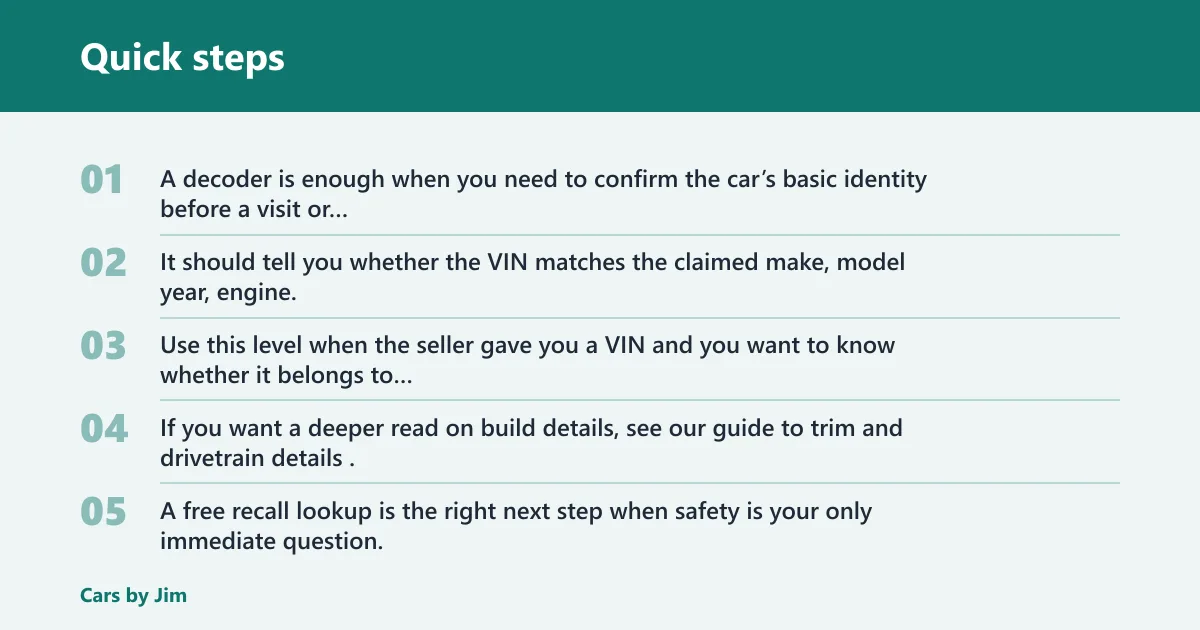
A decoder is enough when you need to confirm the car’s basic identity before a visit or a call. It should tell you whether the VIN matches the claimed make, model year, engine, and body style. It does not prove the car has a clean past.
Use this level when the seller gave you a VIN and you want to know whether it belongs to the vehicle in front of you. It helps catch simple mismatches. It does not solve the larger purchase risks. If you want a deeper read on build details, see our guide to trim and drivetrain details.
Recall only: verify open safety issues
A free recall lookup is the right next step when safety is your only immediate question. It tells you whether the vehicle has open recalls that still need repair and whether a campaign is active or historical. That matters before you put down money or drive the car home.
This check is useful even on a clean-looking car. A car can have no obvious body or title red flags and still carry an unrepaired safety recall. If a safety issue is already known, the official source is the NHTSA recalls lookup.
Full screening: check title, mileage, theft, and liens
Choose a history report when the purchase price is high enough that hidden problems would hurt. A full report is the only option in this list aimed at title brands, odometer timeline, lien records, theft records, and sometimes auction photos. That is the screening layer most buyers need before signing. If theft exposure is part of the concern, buyers should also verify the VIN through the NICB VINCheck.
Say your budget is tight and the car is a cheap commuter with a clean seller story. A decoder plus recall lookup may be enough to avoid obvious mismatches and open safety defects. But if the car is a late-model SUV with a suspiciously low price, a history report is the safer choice.
What a VIN decoder shows
A VIN decoder reads the 17-character vehicle identifier and returns factory-level details.
Before you decode, find the VIN on the dashboard near the windshield, the driver door jamb, the title, the registration, or the insurance card. That helps avoid typing the wrong number into a lookup tool.
NHTSA vPIC as the official decoding source
The NHTSA vPIC database is commonly used as an official VIN decoding source. It provides vehicle-spec data and manufacturer-reported details. That makes it the right reference for decoding, but not for proving a car’s condition history.
For buyers, that distinction matters. vPIC tells you what the vehicle is. It does not tell you what happened to it.
Factory specs: make, model year, engine, body style, and assembly plant
A decoder can often identify make, model year, engine information, body style, drivetrain, fuel type, transmission, and assembly plant. Those details help spot a bad listing or a swapped-part story. They are not a substitute for history data.
What a decoder cannot tell you about condition or ownership
A decoder does not confirm ownership, accident history, title status, mileage, or service records. It also does not prove theft status or liens by itself. Keep the line clear: decoding is about identity, not risk screening.
That is why a clean decode should never be treated as a clean purchase.
What a history report adds
A vehicle history report fills in the purchase-risk side of the picture. Unlike a decoder, it is built to reveal title brands, an odometer history, lien records, theft records, and often auction photos. Some reports also include accident history, service history, or mileage rollback detection.
Title brands and salvage flags
Title brands are one of the first things to check because they can change what the car is worth and how hard it will be to insure or resell. A report may show salvage, rebuilt, flood, or other branded-title events.
That extra step is worth paying for when the vehicle is priced below market or the seller story sounds too neat. If a title-brand question comes up, a related explainer on title brands and what they mean can help interpret the result.
Odometer timeline, theft records, and lien records
History reports are the main place to look for mileage jumps, rollback clues, theft records, and liens. Those fields matter because they answer questions a decoder cannot touch. A car can decode correctly and still be a title problem.
For theft screening, buyers should treat the NICB VINCheck as a separate verification step when the seller’s story or market pricing suggests theft exposure.
Auction photos and record gaps
Auction photos can reveal damage that does not show up in a short summary line. That is useful when the car was sold through insurance or a wholesale channel. But history reports are still only as complete as the records tied to the VIN.
Picture a 2019 sedan priced like a base trim car but wearing premium wheels and a fresh bumper. A decoder can confirm the trim and engine. A history report can help show whether the car passed through auction with prior damage or title changes.
Can you check recalls and crash data for free?
Yes. You can check recalls and crash data for free, but those checks answer different questions than a history report. The NHTSA recalls database is the official U.S. source for open safety recalls and for active or historical campaigns. NHTSA crash ratings cover frontal crash, side crash, rollover, and overall safety.
NHTSA recalls database for open safety recalls and campaign status
If a buyer only wants to know whether the car still has an open safety recall, the NHTSA recalls database is the right free source. It is the official U.S. government source for recall status. That makes it a smart first step before paying for anything else.
VIN Check Engine says its data sources include NHTSA vPIC, Recalls, Complaints, and SaferCar APIs. That lines up with the idea that safety data can be checked separately from broader history data.
NHTSA crash ratings for frontal, side, and rollover results
NHTSA crash ratings help you compare structural safety, not title quality or ownership history. The ratings include frontal crash, side crash, rollover, and overall safety. Crash ratings can be helpful, but they are still separate from title and mileage records.
That means a strong crash score does not erase a salvage title, and a weak score does not prove the car has hidden paperwork problems.
Why free safety data still does not replace a full history report
Free safety data is useful, but it does not tell you enough about the purchase itself. A recall lookup will not show lien records. Crash ratings will not show odometer problems. Neither one will tell you whether the car has a branded title or prior theft record.
That is why a free safety check is a filter, not a finish line.
Choose a free decoder or paid report
The decision comes down to what you need to remove from the deal. A free decoder is the cheapest way to verify identity. A free recall lookup is the cheapest way to check safety. A paid history report is the better choice when the risk is hidden damage, bad title status, or mileage fraud.
| Buyer situation | Best first check | Why |
|---|---|---|
| VIN not yet verified against the car | Free decoder | Confirms make, model year, engine, and body style |
| Safety concern before test drive | Free recall lookup | Shows open recalls and campaign status |
| Private-party sale with average risk | Low-cost history report | Checks title brands, odometer timeline, liens, theft, and auction clues |
| Salvage risk, luxury car, or import | Premium history report | Deeper record check is worth paying for when the downside is larger |
Choose a free decoder if you only need specs
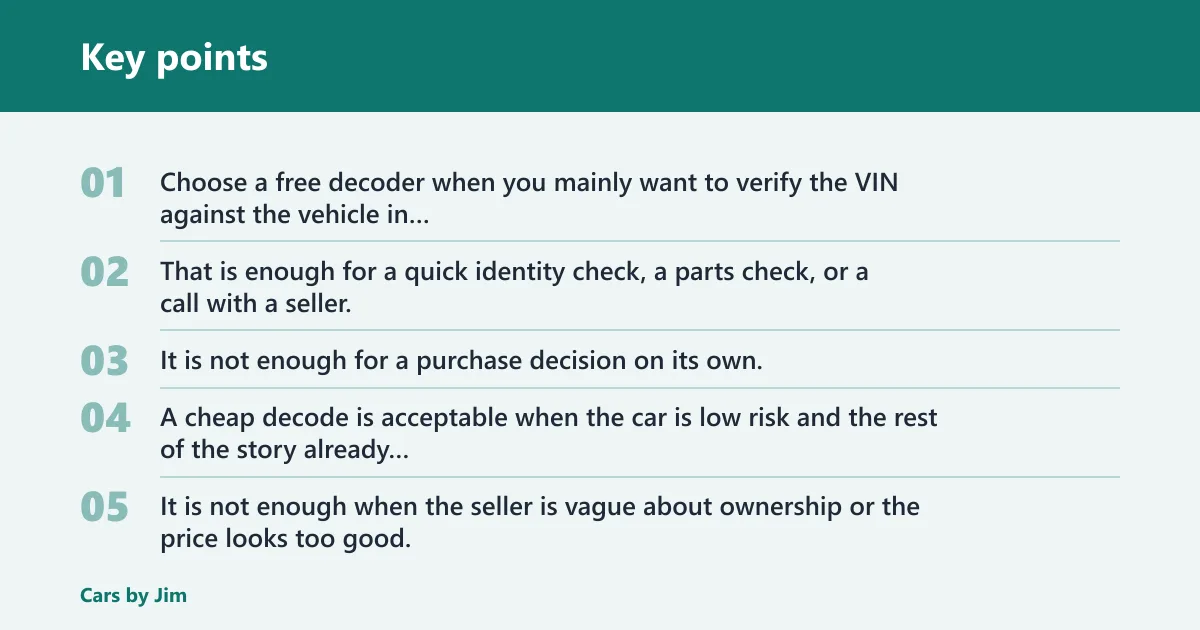
Choose a free decoder when you mainly want to verify the VIN against the vehicle in front of you. That is enough for a quick identity check, a parts check, or a call with a seller. It is not enough for a purchase decision on its own.
A cheap decode is acceptable when the car is low risk and the rest of the story already makes sense. It is not enough when the seller is vague about ownership or the price looks too good.
Choose a free recall lookup if safety is the main concern
Choose a free recall lookup when you want to know whether the vehicle still has open safety work outstanding. That is especially useful before a deposit or a long drive home. It is a narrow check, but it answers one important question well.
A recall lookup is not a title check. It is not a mileage check. It is not a theft check.
Choose a low-cost or premium report if you need title and mileage risk screening
Choose a paid report when the downside of a bad purchase is higher than the report price. That is the case for salvage risk, luxury cars, imported vehicles, and cars with missing service context. Those situations benefit from title brands, odometer timeline, lien records, theft records, and auction photos.
Some reports miss non-U.S. vehicles, incomplete records, or VINs not found in databases. Coverage can vary by provider and by vehicle, so buyers should verify the specific report feature list before paying. No report is complete by default.
What to compare before paying for a VIN check
Before you pay, compare the exact data fields you need. If the tool only decodes the VIN, it will not screen for title risk. If it only checks recalls, it will not tell you whether the car has mileage problems or a branded title. If it offers history data, check whether that includes accidents, title status, odometer, liens, theft, and auction photos.
| Provider / source | Core feature | Best for | Buyer risk it can catch | What it can miss |
|---|---|---|---|---|
| NHTSA vPIC | VIN decoding | Verifying identity and factory specs | Wrong VIN, swapped listing details, mismatch between claimed trim and factory build | Accidents, title brands, odometer rollback, theft, liens, service history |
| NHTSA recalls | Open safety recall lookup | Safety screening before purchase | Unrepaired recalls, active safety campaigns | Title problems, odometer issues, theft, liens, accident history |
| NHTSA crash ratings | Frontal, side, rollover, overall safety | Comparing crash performance | Safer-vs-weaker structure for similar vehicles | History, title, theft, mileage, repairs, and ownership issues |
| NICB VINCheck | Theft-related verification | Checking theft exposure | Stolen vehicle or theft-related red flags where available | Full accident, title-brand, odometer, and lien detail |
| Paid vehicle history report | Title, mileage, theft, lien, accident, auction data | Purchase-risk screening | Branded title, mileage jumps, theft records, liens, prior damage | May still have incomplete records or missing events |
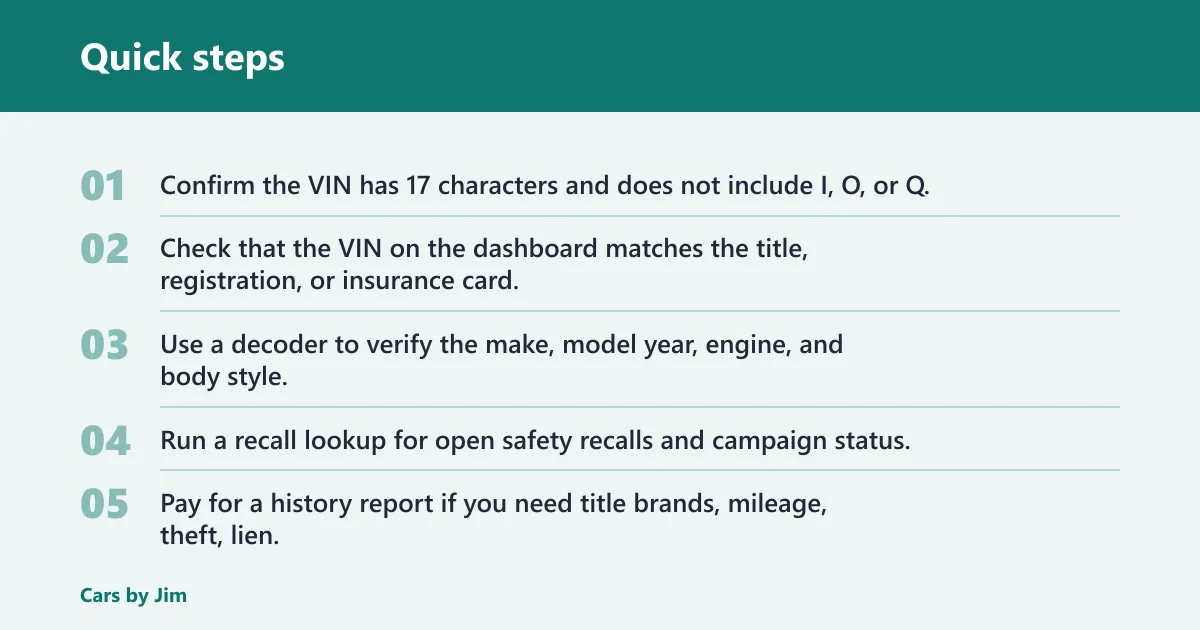
- Check that the VIN on the dashboard matches the title, registration, or insurance card.
- Use a decoder to verify the make, model year, engine, and body style.
- Run a recall lookup for open safety recalls and campaign status.
- Pay for a history report if you need title brands, mileage, theft, lien, or accident screening.
- Review any gaps or missing records before making an offer.
A common first-timer mistake is buying the first report that appears after typing the VIN. The better move is to match the report depth to the purchase risk. A $30 history report can be cheap compared with a bad title or a car that cannot be insured the way you expected.
Choose free decoder if… / Choose paid history report if…
Choose free decoder if you only need to confirm the car’s identity, the VIN has been entered correctly, and the seller’s story already seems consistent. It is also a good first step before any deeper lookup.
Choose paid history report if the car is priced below market, the mileage seems low for its age, the seller has little paperwork, the vehicle has been in an accident, or the car is a luxury or imported model with higher downside risk. In those cases, specs alone are not enough.
Frequently asked questions
Which VIN check is best for a used car buyer?
The best VIN check is the one that matches your risk. Use a decoder for specs, a recall lookup for safety, and a history report when you need title, mileage, theft, lien, or accident screening. For most purchases, a history report is the strongest buying check because it covers the broadest risk set.
How do I check a VIN before buying?
Start by finding the 17-character VIN on the dashboard, driver door jamb, title, registration, or insurance card. Then run a decoder to confirm the car’s identity, check recalls for open safety issues, and buy a history report if you need title and mileage risk screening.
What does a free VIN check show?
A free VIN check often shows factory specs such as make, model year, engine, body style, and assembly plant. Some free tools also show open recalls. A free decode does not prove ownership, accident history, title status, mileage accuracy, theft records, or liens, so it should be treated as a starting point only.
What will a cheap VIN check miss?
A cheap VIN check can miss the exact issues that hurt buyers most: branded title status, odometer rollback, lien records, theft records, auction history, and accident details. It may also miss non-U.S. vehicles or have incomplete records. That is why price alone should not decide the report type.
Is a VIN decoder the same as a vehicle history report?
No. A VIN decoder gives you factory specs and manufacturer-reported details. A vehicle history report adds title brands, odometer timeline, lien records, theft records, and sometimes auction photos. The two tools solve different problems, and a decoder by itself cannot tell you whether a used car is a risky purchase.
How do I know if a VIN report covers accidents and title issues?
Look for specific fields such as accident history, title brands, odometer timeline, theft records, lien records, and auction photos. If the product page only mentions specs or recalls, it is not a full history report. Those are the features buyers should compare before paying.
For a deeper look at what belongs in a pre-buy inspection, see our guide to a pre-purchase inspection.
Sources: NHTSA vPIC; NHTSA recalls; NHTSA crash ratings; NICB VINCheck.