
What Seller Disclosure Paperwork Is Needed to Sell a Car?
Byline: Staff Writer, Auto Title & Registration
A private seller usually needs three disclosure items: the signed title, a mileage disclosure, and any required damage or salvage disclosure. A bill of sale is often smart, and some states require it. Missing one can delay transfer, trigger DMV rejection, or leave you exposed to disputes. This guide lists the papers to prepare, what each one proves, and what copies you should keep after handing over the car.
What paperwork do you need to sell a car privately?
Start with the title, the odometer disclosure, the bill of sale, and the release of liability. Add any lien release, state DMV transfer form, or required signatures before you hand over the keys. The goal is to sort required documents from records you should keep, so the handoff is accepted the first time.
The Certificate of Title is the main ownership document. It must be signed over to transfer ownership, and the seller name should match the title exactly. If the title is missing, order a duplicate before the sale instead of trying to improvise at pickup.
The odometer disclosure is a federal mileage statement tied to 49 U.S.C. § 32705, and the implementing rules appear in 49 CFR Part 580. The federal rules require a written mileage statement in covered transfers, but some transfers are exempt and older vehicles may fall outside the federal rule. False statements are a serious offense. When a state uses its own form, the state paper still has to satisfy the federal rule.
The bill of sale is the transaction record. It captures the sale date, price, buyer and seller names, VIN, and mileage. Some states use it to mark the exact point of transfer. If your state’s DMV asks for a specific form, use that exact version.
The release of liability, sometimes called a notice of sale, is the filing that tells the state you no longer control the car. File it by your state’s deadline, because the filing helps separate later tickets, tolls, and accidents from the seller, though the legal effect can vary by state. California requires the seller to notify DMV within 5 days of transfer, Florida uses its own notice deadline for many private transfers, and Texas imposes late-transfer penalties if the paperwork is not handled promptly.
If there is a lender, the lien must be cleared before you can promise a clean transfer. A lien release shows payoff or lien satisfaction and may be needed before the DMV will treat the title as free of claims. State forms may also require notarization, inspection, emissions proof, or tax paperwork, depending on the vehicle and jurisdiction.
What if the car has a lien or defect?

Certificate of title and ownership proof
The title is the central document because it shows who can legally transfer the vehicle. Make sure the seller name matches the title exactly, including middle initials, suffixes, or business names if those appear on the record. If the name does not match, stop and fix that before sale day, because mismatched ownership information is one of the fastest causes of DMV rejection.
Sign only the assignment section that your state allows. Do not cross out printed fields unless the DMV instructions permit it. If the title is branded as salvage or rebuilt, the brand stays part of the disclosure and should not be hidden in the assignment section. For salvage-branded vehicles, review our salvage title rules before you meet the buyer.
A missing title usually means a duplicate title first, not a workaround at the curb. If the title has been lost, the owner may need to request a replacement from the DMV. If you are selling for someone else, title authority needs to be obvious, and a power of attorney may be required. Where the estate, trust, or business is the owner, bring the document that proves who can sign.
Picture a seller whose title shows “Maria R. Lopez” but the insurance card lists “M. Lopez.” That small mismatch can slow the transfer if the DMV cannot connect the signatures to the same owner. The practical fix is to bring the paperwork that explains the name variation, such as a marriage certificate or court order, before meeting the buyer.
Odometer disclosure and mileage statement
Odometer disclosure is separate from defect disclosure. Federal law requires the mileage statement in many transfers, and the form language comes from 49 CFR Part 580. You usually must mark actual mileage or not actual mileage exactly as the form asks, and the seller should not guess when the reading is uncertain.
Complete it before signing if your title or state instructions require that order. A title assignment signed first can create a rejected transfer if the odometer line was supposed to be filled in beforehand. If the odometer has rolled over or the reading is not trustworthy, do not guess. The right answer is the one the form specifically allows for that situation.
Suppose the cluster reads 84,216 but the car has a replaced instrument panel and the seller cannot verify the true mileage. That is not a place for a rounded number. Mark the form as not actual mileage if the instructions call for that choice, and keep a copy of the signed statement. That copy protects the seller if the buyer later claims the number was hidden.
Federal mileage disclosure is not the same as defect disclosure. One records the reading and whether it is believed to be actual. The other covers known problems, branded title history, flood damage, or other condition issues that could affect the buyer’s decision. Both disclosures can matter in the same sale, but they serve different legal purposes.
Seller disclosure matrix
This one-page matrix shows the core papers to complete before handoff. Use it as a checklist, not as a substitute for your DMV’s instructions. Some states add extra forms, notary rules, inspection slips, or tax pages, and the exact filing office can vary by vehicle type or county process.
| Disclosure item | Required or optional | Who signs | When to complete | Notarization needed? | Where filed | What copy to keep |
|---|---|---|---|---|---|---|
| Title assignment | Required | Owner(s) listed on the title | Before or at handoff, per title instructions | Only if state form or title instructions require it | DMV or title agency with the transfer packet | Photo or scan of the signed front and back of the title |
| Odometer disclosure | Required in covered sales | Seller, and buyer if the state form calls for it | Before title transfer is finalized | Usually no, unless the state form requires notarization | On the title, state transfer form, or DMV mileage form | Signed odometer form or title section showing the mileage entry |
| Bill of sale fields | Optional in some states; required in many for registration or recordkeeping | Buyer and seller | At sale, before payment is completed | Sometimes, if state law or the form requires it | Usually kept by both parties; sometimes submitted with registration | Signed copy with date, price, VIN, and both names |
| Lien-release evidence | Required if a lender still has an interest in the car | Lender, or seller if the release is already issued | Before the buyer can receive a clean transfer | No, unless the lender’s form or state process says otherwise | With the title transfer packet or retained for DMV review | Payoff letter, lien release, or lender satisfaction notice |
| Defect notes | Required when state law or the title brand requires disclosure | Seller | Before delivery of the vehicle | Usually no | Kept with the sale packet; sometimes given to the buyer with the bill of sale | Signed defect disclosure or a copy of the written note given to the buyer |
| Release of liability filing | Required in states that mandate post-sale notice | Seller | By the state deadline after sale | No | DMV or state online notice system | Receipt, confirmation number, or printed filing acknowledgement |
State-specific DMV transfer forms
Most states add their own forms to the title package. Some want notarized signatures. Others want an inspection certificate, emissions proof, or a tax form with the transfer packet. Pennsylvania requires notarization or verification on many vehicle title transfers through its title procedures, while Louisiana, Maryland, Montana, Nebraska, West Virginia, and Wyoming are among the states that require notarization on some bill of sale or title documents under their own DMV or titling rules. Check the exact form instructions before signing.
California’s DMV says the seller should notify the department within 5 days after the sale or transfer, and the buyer has a separate window to complete registration tasks. Florida’s transfer paperwork rules can require a different timeline. Texas also has its own title transfer timing and penalty structure. These deadlines are not interchangeable, so use your state’s own timing rules instead of a generic checklist.
Do not rely on broad examples from another state or on forum summaries that omit the filing step. A vehicle can be sold legally while still being unreleased in DMV records if the seller skips the state notice. The safer workflow is always: complete the title packet, file the state notice, and retain proof immediately after handoff.
Another common question is whether expired registration creates a problem at handoff. Usually it does not, as long as the title is valid and the paperwork is complete. The buyer may face separate registration steps later, but the seller still needs to document the sale correctly. If a state form asks for the current registration number, include it only if the document specifically requests that information.
Photo ID and identity match
The name on the title should generally match the person signing. Photo ID helps the buyer, the notary, and the DMV confirm that the signer is the true owner. If someone else is signing, bring the authority document the state accepts, such as a power of attorney. A clean ID match avoids a delay that can otherwise push the handoff into another appointment.
This matters most when the title lists two owners, an estate, or a company name. Check whether both signatures are required. If one owner is missing and the DMV does not accept a solo signature, do not guess at the closing table. Handle the missing signature before the vehicle changes hands, because many states will not accept a later correction without a new notarized form.
If the seller is acting under power of attorney, keep the document with the sale packet. It should clearly authorize the transfer. Without that proof, a title assignment can be rejected even if the rest of the paperwork looks complete. The buyer should receive the title and the needed transfer documents together, not in separate follow-up emails.
Do you need a bill of sale?
Often yes, and even when it is not legally required, it is still one of the best records to keep. A bill of sale records the exact point of transfer, the price, the VIN, the buyer and seller names, and the sale date. It can also help when the DMV asks for proof of ownership transfer or when either party later needs to show what was sold.
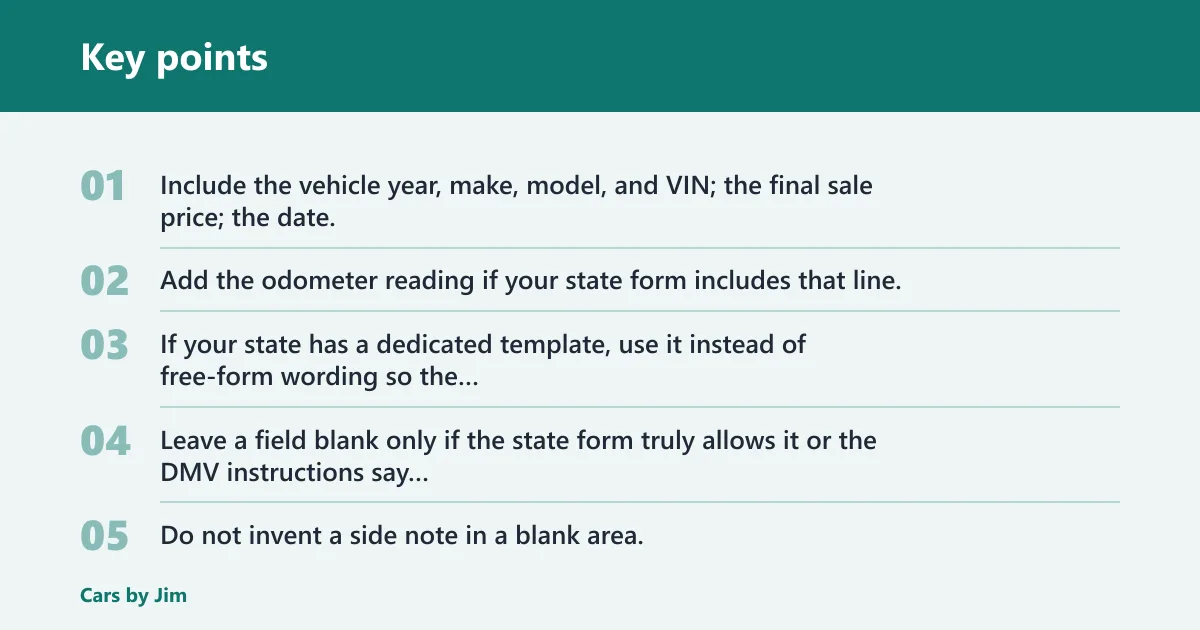
Use plain, complete fields. Include the vehicle year, make, model, and VIN; the final sale price; the date; and both parties’ full legal names and addresses if the form asks for them. Add the odometer reading if your state form includes that line. If your state has a dedicated template, use it instead of free-form wording so the document matches local filing expectations.
Leave a field blank only if the state form truly allows it or the DMV instructions say to do so. Do not invent a side note in a blank area, because some offices treat that as an altered form. If the form includes a condition line, keep it factual and short. A precise form is easier to accept than a long explanation that mixes sale terms with personal remarks.
A common first-timer mistake is writing “sold as is” in a bill of sale and assuming that covers every disclosure duty. It does not. An as-is statement can help with warranty issues, but it does not erase a mileage statement, a lien, or a known defect that state law requires you to disclose. Use the bill of sale as one part of the proof package, not as a replacement for the rest.
What to write on the bill of sale
Keep the wording simple: vehicle description, VIN, sale date, price, odometer reading if required, buyer and seller names, and a brief condition note if the form includes one. If the car has cosmetic damage, say so plainly. If the air bag light is on, write that down. If the form asks for payment method, include it exactly as completed.
Some sellers also attach a copy of the title assignment to the bill of sale packet. That is smart because it gives the buyer and the seller a matched paper trail. If your state requires notarization, sign in front of the notary only after the form is complete. If the buyer is paying with a cashier’s check or wire, confirm the payment cleared before releasing the title and keys.
What if the car has a lien or defect?

A lien must be addressed before you promise a clean transfer. If a lender still holds the title, get the payoff amount, confirm how the lender will release the lien, and keep the release paperwork with the sale records. Without that step, the DMV may not treat the transfer as complete, and the buyer may not be able to register the vehicle promptly.
Known defects belong in writing. That includes damage, flood history, warning lights, missing equipment, or a salvage or rebuilt brand. State laws differ, so check your DMV before you sell. Silence on a known issue is a bad position in a private sale. If you are unsure which form applies, use the DMV’s written disclosure form rather than relying on a verbal explanation alone.
Do not blur a defect disclosure with the odometer form. The mileage line tells the buyer what the car shows. The defect note tells the buyer what the seller already knows about the car’s condition or history. Those are different records and should stay separate. Keeping them separate also makes it easier to prove later that the buyer received both kinds of information.
What if the title has a lien and the buyer wants the car today? Then the safest answer is to wait until the lien release is in hand or use a sale process that your DMV and lender both accept. Handing over the car before the lien is cleared can leave the transfer stuck. In practice, sellers either complete the payoff first or meet the buyer only after the lender issues the release.
What if the lien is being paid off at closing?
If the buyer’s funds are being used to satisfy the lender, the handoff should be coordinated so the payoff, release, and title transfer happen in the same workflow. The usual sequence is: confirm the payoff amount, deliver payment to the lender, obtain the release instructions, and only then complete the title assignment. If the lender needs several business days, delay delivery of the vehicle until the process is secure.
What if the defect is serious or the title is branded?
Serious damage, flood history, or a branded title should be disclosed in the written packet and, where applicable, on the state form that covers damage history. A generic “sold as is” line is not enough for a brand that must travel with the title. If the title is salvage or rebuilt, the buyer should receive that information before payment is accepted.
Frequently asked questions
What paperwork do I need if I sold a car with expired registration?
Expired registration usually does not stop a sale if the title is valid. The key papers are still the signed title, odometer disclosure if required, bill of sale, and release of liability. Keep the expired registration record only if your state asks for it or it helps explain the vehicle status. The buyer may need to handle registration separately after the transfer.
How do I document known defects when selling my car?
Write the defect in plain terms before handoff. List damage, warning lights, flood history, salvage branding, or missing parts on a signed note or on the bill of sale if the form allows a condition line. Keep a copy. Do not rely on an informal verbal mention when state law expects written disclosure. If the vehicle has a branded title, use the brand-specific disclosure required by your state.
What happens if the title has a lien or I still owe money?
If a lender still has an interest in the car, the transfer may not be clean until the lien is released. Ask for the payoff instructions, get the lien release or satisfaction letter, and keep it with the sale records. The DMV may refuse a clear transfer without that evidence. See our lien payoff process for the handoff sequence and document order.
What should I keep after I hand the car over?
Keep copies of the signed title, the bill of sale, the odometer form or odometer section, the lien release if there was one, the release-of-liability receipt, and any defect disclosure. Store them together with the buyer’s name and the sale date. That file is your proof if a later ticket or DMV question comes up, and it helps match the transaction if you need to respond to a state notice.
Is a bill of sale required when selling a car?
Not always, but it is often recommended and a bill of sale can be required in some states. It records the exact point of transfer and gives both sides a dated record of price, VIN, and names. If your state does not require it, it is still worth keeping. Use a template that matches your state’s filing preferences when possible.
Do I need to disclose odometer mileage when I sell my car?
Yes, in many covered private sales. Some transfers are exempt, and older vehicles may fall outside the federal rule. You usually must mark actual mileage or not actual mileage exactly as the form requires, and false statements can bring fines or imprisonment. If the mileage is uncertain, use the form’s permitted “not actual” option instead of estimating.