
How Do I Compare Used Car Reliability by Year and Trim?
Compare used-car reliability within one generation first, then rank years and trims by problem history, powertrain changes, and expensive options. The safest pick is usually the newest low-complexity trim with the fewest known faults. Skip that order and you can buy the same badge with a weaker transmission, pricier parts, or a trim that hides costly features. This guide shows how to identify the exact generation, compare year-by-year reliability, and avoid trims with higher repair exposure.
Byline: Editorial review by an automotive research editor with experience comparing used-vehicle reliability, title history, recalls, and pre-purchase inspection workflows across mainstream and hybrid models.
Methodology: Evaluate the exact model year first, then the trim, then the powertrain. Use the VIN or listing to confirm the vehicle’s configuration, check recalls and title history, and compare complaint patterns and reliability data only for the same year-and-trim combination whenever possible. Brand averages help with screening, but they cannot reliably predict the condition of a specific used car.
Why model year matters more than brand average
Brand averages are a place to start, not a verdict. A strong brand can still have a bad redesign year, and a weaker brand can have one or two used model years that are clearly better than the rest. Compare the exact year first, then the trim, then the powertrain.
How redesigns and mid-cycle updates change reliability
Reliability often shifts at generation changes because engines, transmissions, electrical systems, and software are new all at once. Early redesign years carry more unknowns, while later years may benefit from revised parts and software updates. Mid-cycle refreshes can change infotainment hardware, driver-assistance content, or hybrid components even when the body looks familiar.
That is why a late-year example from the same generation can be a smarter buy than an early redesign. The badge is the same. The failure risk may not be.
Why sample size and rating coverage matter
A reliability score only helps if it has enough data behind it and matches the exact year you are shopping. Consumer Reports says it ranks 26 car brands based on the reliability of their 5- to 10-year-old models, uses about 380,000 vehicles from the 2000 to 2025 model years, and omits some models when there is not enough data to meet its threshold. It also says it asks members about problems over the previous 12 months. (Consumerreports) (Consumerreports)
That means a score can be thin for a low-volume trim or a newly redesigned year. If the exact year-and-trim combination has limited coverage, treat the rating as a signal, not a final answer.
When a brand-wide ranking hides a bad year
Brand rankings can miss outliers. The same source says Lexus and Toyota top its used-car brand reliability list, while Ram, Jeep, and Tesla are among the least reliable in that ranking. Even so, the brand average comes from model-year data, and Consumer Reports says it calculated brand-level used-car reliability by averaging overall reliability verdict scores for 2016 through 2021 model years. (Consumerreports)
That matters because a brand can look good overall while one model year or one trim sits far below the average. Used-car buyers need the bad year, not the brand headline.
How trim changes reliability on the same model
Trims are not only about seat material or wheels. They can change the engine, transmission, driveline, hybrid system, infotainment stack, and option content. Those differences change the number of things that can fail and the cost to fix them.
Engine and transmission differences by trim
Some trims get a base gas engine while others move to a turbocharged setup, a hybrid system, or a different transmission. That can change both the number of repair points and the severity of a failure. The same source says it tracks 20 specific trouble areas and weighs serious issues such as engine and transmission problems.
If two trims share the same body but not the same powertrain, do not compare them as if they are the same vehicle. A trim with a more complex transmission or a different hybrid system is a different repair-risk proposition.
Tech-heavy trims and added failure points
Higher trims often add more sensors, larger touchscreens, more cameras, premium audio, power accessories, and more driver-assistance hardware. More equipment can mean more comfort and more repair exposure, especially as these parts age beyond warranty.
Infotainment and software problems are not minor if they disable backup cameras, climate controls, or connected features you rely on every day. A stripped-down trim can be easier to live with from a repair standpoint.
When a higher trim raises repair exposure
A higher trim is not automatically worse. But it can be more expensive to own if it adds air suspension, panoramic glass, a more complex AWD system, or a plug-in hybrid battery pack. The question is not whether the trim is nicer. The question is whether the added equipment creates a larger repair bill when something fails.
Suppose two listings are the same model year. One is a base gas trim with cloth seats and the other is a top trim with a panoramic roof and a different transmission. The expensive trim may still be the better car, but only if its known trouble history and asking price justify the added complexity.
Year-trim comparison worksheet
Use this worksheet for each listing you are considering. Fill it in from the exact ad, the VIN-based history report, the recall lookup, and the reliability source you trust for that model year. The final column forces a decision instead of a vague “maybe.”
| Model year | Trim | Engine / powertrain | Known trouble areas | Typical repair-risk flags | Mileage band | Asking price | Final pick recommendation |
|---|---|---|---|---|---|---|---|
| 2020 | Base gas trim | 2.5L gas, conventional automatic | Transmission complaints, infotainment glitches, recall checks needed | Fewer options, simpler driveline, cleaner service record preferred | 40,000–60,000 miles | Varies by local market | Best if history is clean and rating is above the later redesign year |
| 2021 | Mid trim | 2.5L gas or hybrid, depending on listing | Hybrid battery concerns, software updates, brake or sensor faults | More equipment, verify battery health and software campaign status | 30,000–50,000 miles | Varies by local market | Pick if the exact trim has fewer reported problems than the newer year |
| 2022 | Top trim | Turbo gas or plug-in hybrid, depending on listing | Added electrical complexity, battery exposure, higher repair costs | Loaded options, more failure points, premium features to inspect | 20,000–40,000 miles | Varies by local market | Only if price is strong and trouble history is clearly better |
Use the mileage band as context, not a score by itself. A higher-mileage vehicle with a documented maintenance history can be the better buy than a lower-mileage one with missing records, prior collision damage, or open recalls.
How to score trouble areas and repair risk
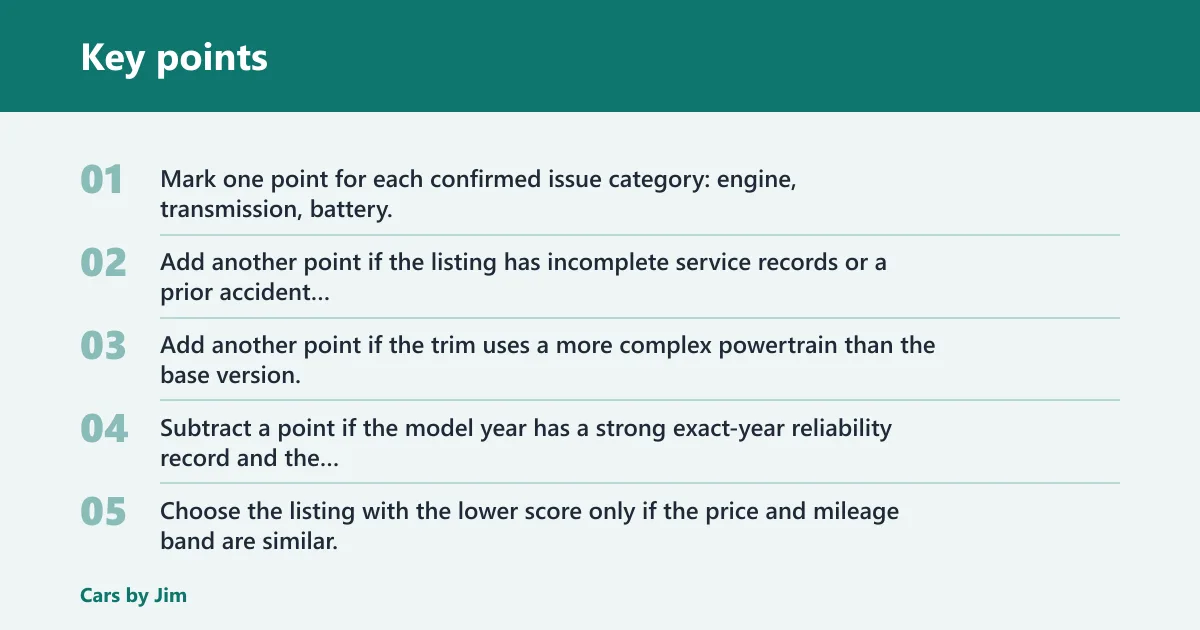
- Mark one point for each confirmed issue category: engine, transmission, battery, electric motor, infotainment/software, and recall-related defect.
- Add another point if the listing has incomplete service records or a prior accident disclosure.
- Add another point if the trim uses a more complex powertrain than the base version.
- Subtract a point if the model year has a strong exact-year reliability record and the recall history is closed.
- Choose the listing with the lower score only if the price and mileage band are similar.
A common first-timer mistake is to call a lower-mileage car the safer buy without checking whether it is a first-year redesign or a high-content trim with more failure points. Mileage helps. It does not erase a bad trouble history.
How to use the final recommendation column
The final recommendation should be short and specific: “buy,” “buy only if discounted,” or “pass.” If the exact year-and-trim combination has weak reliability data, open recalls, or several high-cost trouble areas, “pass” is a valid result. If two listings are close, give the edge to the one with better records and fewer complex systems.
Which sources should you check first?
Start with exact-year reliability data, then verify the vehicle’s records. You want the score, the complaint pattern, the service history, and the title status before you compare asking prices. A clean history can move a borderline car up; a bad history can sink an otherwise good-looking one.
Reliability ratings for the exact year and trim
Use a source that identifies the model year, not just the brand. The same source says its used-car rankings are based on 5- to 10-year-old models and that it weighs serious issues such as engine and transmission problems. For resale context, use a value guide only as a supplement to reliability screening, not a replacement for it.
That is useful because reliability and value are not the same thing. A vehicle can hold value well and still have a weak year, or it can depreciate faster while remaining mechanically simple and relatively trouble-free.
Owner complaints and service bulletins
Look for patterns, not one-off gripes. Repeated complaints about the same transmission, infotainment module, or hybrid system matter more than isolated noise. A cluster of similar reports across the same model year is more useful than a broad brand reputation.
Recalls, maintenance records, and title history
Open recalls should be closed before purchase. Maintenance records should show regular fluid service, brake work, tire rotation, and any model-specific maintenance the manufacturer calls for. Title history should be clean or clearly explained. Flood, salvage, and rebuilt titles change the risk profile fast.
For a deeper buy/no-buy workflow, see VIN checks, recall lookups, pre-purchase inspection guides, hybrid battery checks, and title-history guidance.
Safety note: follow the vehicle manual and the recall repair procedure exactly. Never work under a vehicle held only by a jack, never exceed the vehicle’s rated roof, hitch, or tow limit, keep items out of airbag zones and the driver’s view, and check local laws before any equipment or inspection work.
How do mileage, price, and powertrain change the call?
Powertrain choice can change both reliability exposure and ownership cost. Gas, hybrid, plug-in hybrid, and EV versions do not carry the same trouble history or repair profile. Price matters too, because a cheaper listing can still be the worse buy if it has a known weak system or poor history.
Gas, hybrid, plug-in hybrid, and EV comparisons
Gas models usually have the simplest powertrain, but “simplest” is not the same as “best.” A hybrid adds battery and electric-drive components. A plug-in hybrid adds charging hardware and more complexity. An EV removes engine and transmission issues but introduces battery, inverter, and motor concerns that need a different inspection mindset.
The same source says it tracks 20 specific trouble areas, so the powertrain you choose changes which of those areas matter most. A reliability comparison that ignores the powertrain is incomplete.
Why a cheaper listing can still be the worse buy
A low asking price can hide repair exposure. If the cheaper car has a weaker transmission, a known infotainment fault, or a poor service record, the discount may vanish after the first repair. Used-car value and reliability are related, but they are not the same thing.
If you are also shopping resale value, compare it separately from reliability. A model can retain value well and still have a year or trim that you should avoid.
How local supply affects asking price and bargaining room
Observed asking prices move with local supply and demand. If a model is common in your area, you may have more bargaining room. If there are only a few listings, sellers can hold firmer on price. Compare several ads before deciding that one listing is “cheap” or “overpriced.”
Worked example: comparing two years and two trims
Picture four listings for the same real model: a Toyota RAV4 LE from 2020, a Toyota RAV4 Hybrid XLE from 2021, a Toyota RAV4 Limited from 2022, and a Toyota RAV4 LE from 2023. The worksheet changes the recommendation because it forces you to compare complexity, records, and price instead of chasing the newest badge.
Step 1: identify the generation break
First, confirm whether the newer listing is the first year of a redesign. If it is, treat it with extra caution unless the rating data and complaint history are clearly better than the earlier year. First-year redesigns often change enough hardware to reset the risk picture.
Step 2: compare known trouble areas
Next, compare the exact year-and-trim trouble areas. If the LE uses the simpler setup and the Limited or Hybrid XLE adds more equipment, more electronics, or a more complex drivetrain, the simpler trim may score better on repair risk even if it is not the fanciest listing. Review engine, transmission, battery, software, and recall status side by side.
Step 3: choose the better listing
Then compare records and price. A cleaner service history, fewer open recalls, and fewer repair-risk flags can outweigh a modest mileage advantage. If both cars are close, choose the one with the simpler powertrain and the stronger exact-year reliability record. If the newer trim adds cost without a clear reliability gain, pass.
In this example, the worksheet would usually push you toward the 2020 LE or 2023 LE if their records are clean and the price gap is reasonable. The 2021 Hybrid XLE becomes attractive only if it has a strong service file, closed recalls, and a price that reflects its added complexity. The 2022 Limited needs the most scrutiny because its extra features can raise repair exposure without guaranteeing better reliability.
Frequently asked questions
How do I compare used car reliability by year and trim?
Start with the exact model year, then check whether it sits inside a redesign or refresh. After that, compare the trim’s engine, transmission, hybrid system, and option content. Finish by checking recalls, maintenance records, accident history, and title status. Do not rely on the brand average alone.
Which model year is the most reliable for this used car?
The most reliable year is usually the one with the fewest complaint patterns, the best exact-year reliability data, and the least added complexity in its trim lineup. A later year is not automatically best. A redesign year can be worse than an older, better-sorted version of the same model.
Are some trims less reliable than others on the same car?
Yes. Trims can differ by engine, transmission, hybrid system, and technology content, so their failure exposure can differ too. A top trim with more electronics or a different drivetrain may cost more to repair than a base trim even if both wear the same badge.
Does a newer used car always mean better reliability?
No. Newer can mean fewer miles, but it can also mean a first-year redesign with unproven parts or software. Compare the exact year’s trouble history before assuming newer is safer. Mileage matters, but it does not cancel a weak year or a complicated trim.
How do I check reliability before buying a used car?
Check the exact-year reliability rating, look for repeated complaint patterns, verify open recalls, review service records, and confirm a clean title and accident history. If the listing lacks records or the year has known trouble areas, price it with extra caution or move on.
How much can trim level affect used-car ownership costs?
Quite a bit. A higher trim can add costly electronics, larger wheels, more sensors, or a more complex powertrain. Those features can raise repair bills and long-term ownership cost even when the purchase price looks reasonable. Compare the added equipment against the known trouble history before you pay more.