VIN Check vs Carfax: What Is the Difference?
A VIN decoder is best for confirming what a vehicle was built as: year, make, model, trim, engine, transmission, drivetrain, build plant, and body style. For safety and compliance questions, official sources matter more: NHTSA VIN lookup tools cover recalls, NMVTIS is the federal framework for title and brand data, and NICB VINCheck can help flag certain theft and salvage records reported by participating insurers. Carfax and AutoCheck are paid history products that can add broader recorded history, but coverage varies and no report is complete. This guide splits the choice into four jobs: identity, specs, recalls, and hidden-history risk, so you can match the tool to the question.
Author: Editorial team. Reviewed by: Automotive research reviewer with experience in used-vehicle intake, VIN verification, and pre-purchase inspection workflows.
For related guides, see our VIN decoder, recall lookup, AutoCheck comparison, VIN verification, and used-car inspection pages.
| Factor | VIN check | Carfax | Winner |
|---|---|---|---|
| Identity and specs | Checks the 17-character VIN and can decode year, make, model, trim, engine, transmission, drivetrain, build plant, and body style. | May show the same vehicle identity details, but that is not its main job. | VIN check |
| Recall lookup | Often shows open recalls tied to the VIN, usually through NHTSA-backed or OEM-backed data. | Can include recall data when available, but not as a standalone reason to buy the report. | VIN check |
| History depth | Usually limited to a decode plus a recall check. | Can add title brands, odometer timeline, accident records, ownership changes, service entries, auction photos, and prior sale prices when available. | Carfax |
| Risk of hidden history | Low visibility into prior damage, title issues, or theft events. | Better for spotting recorded red flags, but still can miss unreported repairs and off-the-books damage. | Carfax |
| Best use case | Quick identity check, spec check, and recall check before you spend money. | Used-car screening when the question is whether the car’s recorded history matches the seller’s story. | Tie |
| Cost barrier | Free options exist and may require no email. | Paid report. | VIN check |
What is the difference between a VIN check and Carfax?
A VIN check answers “Is this the right vehicle, and does it have open recalls?” Carfax answers “What recorded history follows this vehicle?” The first focuses on identity and factory data; the second is a paid history search that may surface title brands, mileage events, ownership changes, and accident records.
Identity versus history search
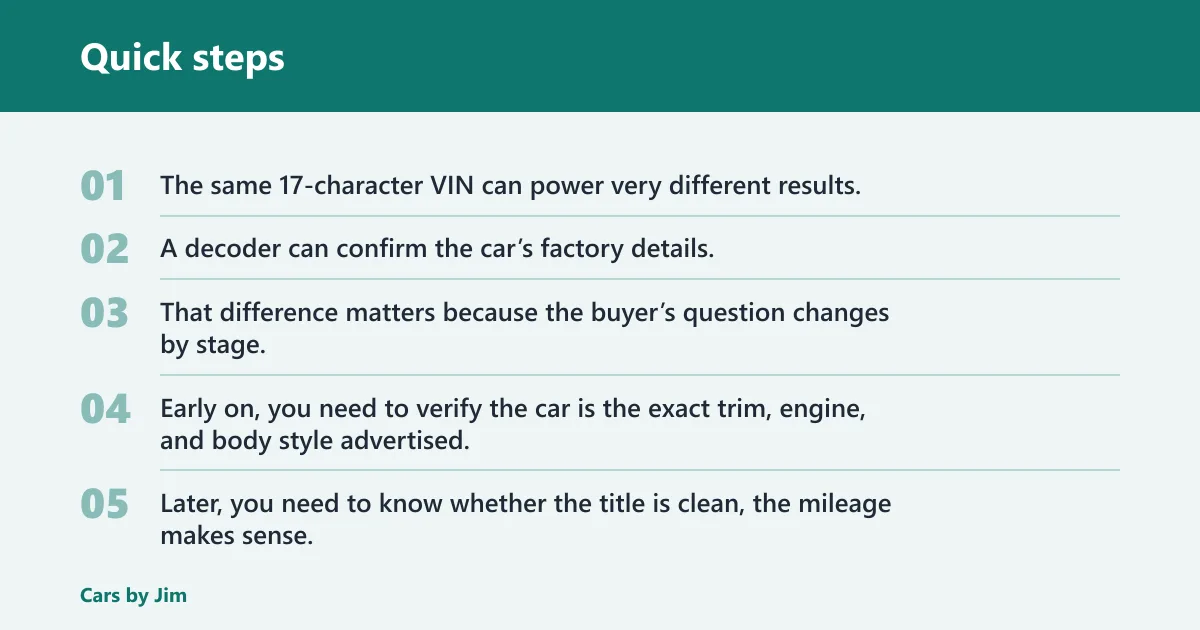
The same 17-character VIN can power very different results. A decoder can confirm the car’s factory details, while a history report tries to reconstruct what happened to that car after it left the plant.
That difference matters because the buyer’s question changes by stage. Early on, you need to verify the car is the exact trim, engine, and body style advertised. Later, you need to know whether the title is clean, the mileage makes sense, and the car was ever branded salvage or flood.
Why the same VIN leads to different results
A VIN is the key, but the databases behind each tool are not the same. A decoder leans on VIN structure and manufacturer data; commercial reports such as Carfax or AutoCheck aggregate records from multiple sources with different coverage rules.
Say your listing says “2021 Honda Civic Sport,” but the VIN decodes to a different trim or engine. That is an identity problem, not a history problem, and a free VIN lookup is the faster first filter.
Which database answers which problem?
Before you buy a report, match the question to the database. Some tools are designed to answer identity and recall questions, while others are better for title brands, junk/salvage status, odometer issues, or recorded accidents. Coverage varies by provider and state, and a missing record does not prove nothing happened.
| Database / tool | Best at answering | What it usually does not prove on its own | Notes on scope |
|---|---|---|---|
| VIN decoder | Factory identity: year, make, model, trim, engine, transmission, drivetrain, body style, build plant. | Title brands, accidents, service history, theft history, or whether the car was ever damaged. | Best first step when the seller’s listing needs to be matched to the vehicle. |
| NHTSA recall lookup | Open safety recalls tied to the VIN. | Title brand, junk/salvage status, full accident history, or ownership trail. | Use the official NHTSA VIN lookup for recall status; recall completion should still be confirmed. |
| NMVTIS | Title brands and junk/salvage indicators reported through approved channels. | Full repair history, comprehensive accident details, or every prior owner. | NMVTIS records are limited to participating/state-reported data and are not a perfect vehicle biography. |
| NICB VINCheck | Whether a vehicle has been reported as stolen or declared salvage by participating insurers. | Accident details, service records, full title history, or all theft events. | Helpful as a theft/salvage screen, but it is not a complete history report. |
| Carfax | Broad recorded history such as title events, mileage timeline, accidents, service entries, and ownership clues when available. | Unreported damage, off-the-record repairs, or any event not captured by its sources. | Official product pages describe source-based coverage and exclusions; records can be missing. |
| AutoCheck | Broad recorded history with a focus many auction buyers use for side-by-side screening. | Anything not reported to its sources, plus unreported repairs and incomplete state data. | Compare against Carfax rather than assuming one report is universally better. |
VIN check comparison matrix
Use the lightest tool that answers the question in front of you. This matrix maps the smallest useful check to the type of risk, so you do not pay for a history report when a free decode will do, or trust a free decode when the real issue is title risk.
| Scenario | Risk level | What to verify | Which tool answers it | What still needs a human inspection |
|---|---|---|---|---|
| VIN on the dash does not match the title paperwork | High | Identity, tampering signs, document consistency | VIN check, then VIN verification | Physical inspection of the plate, label, dashboard, and door jamb |
| You only want year, make, model, trim, engine, and body style | Low | Factory specs | Free VIN decode | Visual check that the car matches the listing and options |
| You need to know whether open recalls exist | Medium | Safety recalls tied to the VIN | Free VIN check | Confirm whether the recall repair was completed |
| The seller says the title is clean and the mileage is original | High | Title brands, odometer timeline, theft, lien records | Paid history report | Service records, title documents, and a test drive |
| The car has a rebuilt title or auction history in its past | High | Recorded damage, auction photos, sale history | Paid history report | Paint gaps, panel fit, underbody inspection, professional pre-purchase inspection |
| You are comparing several used cars from different sellers | Medium to high | Recorded history versus seller claims | Both | Test drive, scan for warning lights, inspect maintenance evidence |
Decision matrix
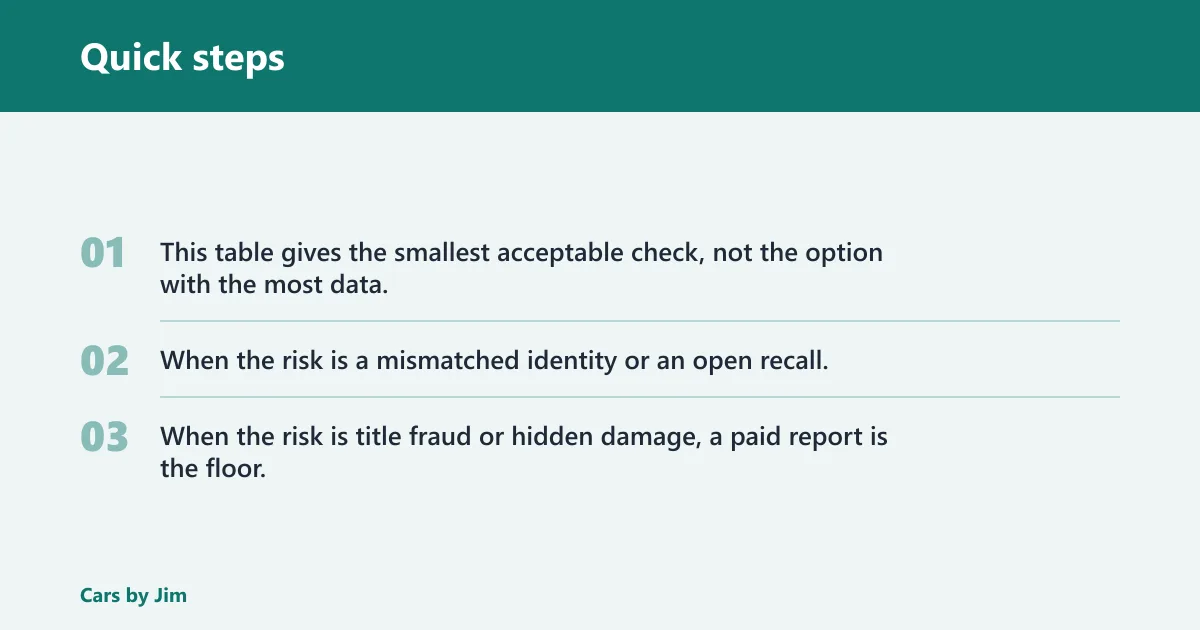
This table gives the smallest acceptable check, not the option with the most data. When the risk is a mismatched identity or an open recall, a free VIN lookup is enough to start. When the risk is title fraud or hidden damage, a paid report is the floor, not the ceiling.
| Scenario | Risk level | What to verify | Which tool answers it | What still needs a human inspection |
|---|---|---|---|---|
| Private seller offers a car with no title in hand | High | Ownership trail, liens, title status | Paid history report | Paperwork review and identity verification |
| Dealer listing shows one VIN, but the window sticker is missing | Medium | Factory configuration and body style | Free VIN decode | Check trim badges, options, and equipment on the vehicle |
| You are buying from an auction and want to know if it has prior damage | High | Auction history, damage clues, sale records | Paid history report | Frame, paint, and structural inspection |
| You only need to confirm a recall before scheduling service | Medium | Open safety recall status | Free VIN check | Dealer confirmation that the recall repair is actually done |
| The seller claims “one-owner, garage kept, no accidents” | High | Ownership and accident records | Paid history report | Paint meter use, panel inspection, service receipts |
| The VIN itself may be altered or swapped | High | Physical VIN placement and consistency | VIN verification | Door jamb, dashboard, registration, and proof of insurance comparison |
What does a VIN decoder show?
A VIN decoder is built to turn the 17-character identifier into vehicle identity and factory equipment. It can show year, make, model, trim, engine, transmission, drivetrain, build plant, and body style.
Factory specs first
That is the main strength of a decoder. It helps you confirm that the vehicle the seller is offering is the one the VIN says it should be, including the equipment level and body configuration.
Official VIN decoding resources and manufacturer build data are the most reliable references for this job. The reason is simple: factory identity is not a guess, and it is not a substitute for a history report.
What a decoder does not do
A decoder does not rebuild the car’s life story. It can tell you what the vehicle was built as; it usually cannot tell you whether a corner was repaired after a crash, whether the title was branded, or whether the odometer trail makes sense.
That is why “VIN check” and “history report” are not interchangeable. One answers what the car is. The other tries to answer what happened to it.
What does Carfax add?
Carfax is a commercial vehicle history report provider, not just a decoder. Its product pages say reports are compiled from many source types and that coverage varies by vehicle and record availability. That means it can help with recorded history, but it is not a guarantee that every event will appear.
History data beyond a decode
A history report may surface title brands, mileage events, ownership changes, service entries, accident-related records, and other reported events when available. It may also show gaps, because no database sees every repair or every seller transaction.
The practical value is not just “more data.” It is context. A mileage jump, a rebuilt brand, or a repeated registration event can change how you value the car and whether you keep shopping.
Where the extra value comes
The extra value is data depth. It gives you clues that help separate one risk from another. A title brand is not the same thing as an accident entry, and a service record is not the same thing as a confirmed repair after collision damage.
Carfax is useful when the seller’s story needs to be checked against a broader paper trail. It is less useful when you only need to know whether the vehicle is the right trim or whether an open recall exists.
Free lookup limits and blind spots

Free VIN tools are good at fast filtering, not complete due diligence. They may show only a limited preview, and a clean report is not proof the vehicle was never damaged.
A common first-timer mistake is to treat a clean lookup as a clean vehicle. That is too much trust for any report, free or paid. Unreported repairs, off-the-books damage, and some title problems never make it into a database.
Suppose a sedan shows no listed accidents, but the front bumper paint is newer than the hood and the headlight tabs look replaced. The report may still be clean. The inspection is what catches the mismatch.
Why no report replaces inspection and test drive
Carfax can reduce risk. It cannot remove it. Buyers still need to inspect the car, scan warning lights, test-drive it, and verify the seller’s claims against the paperwork and the vehicle itself.
In practice, a quick pre-purchase workflow looks like this: verify the VIN on the car, decode the VIN, check NHTSA recalls, review NMVTIS- or insurer-based history where appropriate, then inspect the car in daylight and compare the paperwork, door jamb labels, dash VIN, title, and odometer. If anything conflicts, stop and verify before you negotiate.
This is also where VIN verification matters. A VIN verification is a physical identity inspection, often used by DMVs in some registration scenarios. It is different from a history report and different from a basic decode.
Real-world mismatch examples a VIN decode can catch
A decode can expose a seller listing that says “Sport” but the VIN identifies a lower trim, or a listing that claims a gas engine while the VIN points to a different powertrain. It can also catch body-style mismatches, such as a vehicle described as an SUV when the VIN corresponds to a sedan or hatchback.
By contrast, a history report is more likely to surface issues that identity tools miss, such as branded title events, odometer inconsistencies, or repeated ownership/registration changes that do not match the seller’s story. Those are separate questions, and each tool answers a different one.
Choose VIN check if… / Choose Carfax if…
Choose a VIN check when the main question is identity, specs, or recalls. Choose Carfax when the main question is whether the recorded history supports the seller’s story. If the risk spans both, use both before you buy.
Choose VIN check if…
- You need to confirm year, make, model, trim, engine, or body style.
- You want to check open recalls before scheduling service or moving forward.
- You are screening several listings and need a free first pass.
- You suspect the listing details do not match the VIN.
Choose Carfax if…
- You need title brands, odometer history, ownership changes, or theft records.
- You are buying a used car with a seller story that needs outside verification.
- You want recorded accident, service, or auction clues before a pre-purchase inspection.
- You are comparing a higher-risk car where a bad history would change the price or your decision.
Price matters, but scope matters more. Carfax and AutoCheck are both paid reports, and each frames its coverage as source-based rather than complete. Compare what each report is designed to answer before you buy.
Free vin check carfax vs autocheck
Free VIN checks answer identity and recall questions at no cost, while Carfax and AutoCheck are paid history reports. AutoCheck is often favored by auction buyers because it uses a proprietary AutoCheck Score, while Carfax is more common with retail shoppers who want a broad history summary.
Use a free VIN check first if you are screening a car for obvious mismatch or recall issues. Pay for Carfax or AutoCheck when the next question is title risk, prior damage, mileage consistency, or auction history.
Vin lookup carfax vs autocheck
A VIN lookup is the lightest tool. Carfax and AutoCheck are history reports, and they are built for the harder question: what happened to the car before it reached you. The lookup is for identity and recalls; the reports are for recorded history.
If you are choosing between Carfax and AutoCheck, compare the car’s market path. For auction-fed inventory, AutoCheck can be a strong screen. For retail used cars, Carfax is often the more familiar choice, but the best result still comes from pairing either report with a physical inspection.
Frequently asked questions
Does a VIN check show the same things as a Carfax report?
No. A basic VIN check can confirm specs and sometimes open recalls, but it usually does not provide the deeper history that Carfax can show. Carfax may add title, odometer, ownership, service, and accident data, while the free lookup stays much narrower.
Can a free VIN check tell me if a car has accidents or title issues?
Usually not with the same depth as Carfax. A free lookup may surface some recall or limited history data, but it is not a reliable substitute for a full report when you need accident, salvage, flood, or title-brand screening. For that, a paid history report is the safer minimum.
When should I pay for Carfax instead of using a basic VIN lookup?
Pay when the decision depends on recorded history, not just identity. If the seller’s claims involve one-owner status, clean title, low mileage, no accidents, or no damage, a paid report is justified because it can reveal records a decoder will not show.
What information does a VIN decoder show that Carfax may not?
A VIN decoder is better at factory details. It can identify the exact trim, engine, transmission, drivetrain, build plant, and body style tied to the VIN. Carfax may include some of that, but its main strength is history, not factory configuration.
What can Carfax show that a free VIN check usually misses?
Carfax can show history clues that a free VIN check often leaves out, including title brands, mileage events, ownership changes, accidents, service entries, and other reported records when available. It is the better tool when you need to judge hidden-history risk, not just decode the car.
Should I use both a VIN check and Carfax before buying?
Yes, when the car is expensive enough or risky enough that both identity and history matter. Start with the free VIN check to confirm the vehicle and open recalls, then buy the report if the car is still in play. That sequence keeps you from paying for history on cars that fail the first screen.