
Are Dealer Fees Negotiable on a Used Car?
Yes, some dealer fees on a used car are negotiable, but taxes, title, registration, and other government charges usually are not; the real target is the out-the-door total, not each fee line. Miss that split, and a dealer can trim one fee while keeping your final price unchanged. This guide explains which charges you can push on, which are fixed, and how to negotiate the full deal amount.
Quick answer on dealer fees
Used-car fees split into two buckets: fixed government charges and dealer-added charges. Sales tax, title, and registration usually stay fixed, while doc fees, prep, reconditioning, and add-ons may be dealer-controlled. Start by negotiating the out-the-door price, because that number shows what you actually pay.
That matters because a dealer can waive a fee and quietly recover the same money in the vehicle price or another charge. The line item changes. The total does not.
Common fixed charges: sales tax, title, and registration. Common dealer-controlled charges: documentation fees, dealer prep, reconditioning, and some advertising or add-on fees.
Which fees are usually fixed?
Government charges are usually non-negotiable. Sales tax depends on your state and local rate. Title and registration are collected by the dealer and sent to the state, so they are not a place to bargain.
Which fees are often negotiable?
Documentation fees, dealer prep fees, reconditioning fees, and some advertising charges are often dealer-set. They may be negotiable, removable, or at least challengeable if they look padded, duplicated, or unexplained.
Why the total matters more than one line item
A lower fee line can be offset elsewhere. If a dealer drops a doc fee but raises the vehicle price by the same amount, the pre-tax total may stay about the same. The same thing can happen with tax, since tax is charged on the taxable amount.
📊 Car and Driver notes California has doc fee limits capped at $80. Source: Caranddriver.
Used car dealer fee matrix
This matrix separates who controls a fee from whether law fixes it. That distinction matters, because a fee can be capped by state law and still be padded through the vehicle price, a required add-on, or a higher taxable amount.
| Fee type | Who controls it | Legally fixed or dealer-controlled | Strongest negotiation move |
|---|---|---|---|
| Documentation fee | Dealer | Dealer-controlled in many states; state caps vary | Ask for a lower out-the-door total, then ask the dealer to remove or reduce the doc fee |
| Dealer prep fee | Dealer | Usually dealer-controlled | Question what work was already done and ask to remove duplicated prep charges |
| Reconditioning fee | Dealer | Usually dealer-controlled | Ask for a line-by-line explanation of cosmetic and mechanical work; push it into the vehicle price |
| Advertising fee | Dealer | Often dealer-added | Ask whether the advertised price already includes it and insist on the full written quote |
| Sales tax | State and local government | Fixed by law | Do not negotiate the fee; compare taxable amounts and total cost instead |
| Title and registration | State government, collected by dealer | Fixed by law | Verify the amount and timing; do not treat it as dealer profit |
| Destination fee | Manufacturer | Manufacturer-set, usually new-car related | Do not treat it as a used-car dealer fee; ask whether it should appear at all on the deal |
Are dealer fees negotiable on a used car?

Some are, some are not, and some can be offset even when they cannot be formally removed. Legal limits matter, but practical negotiation matters more. If a dealer will not lower a specific fee, it may still agree to a lower total by cutting the vehicle price or another charge.
The useful question is not, “Can this line item move?” It is, “Can the final out-the-door number move?” That is where the real deal lives.
The difference between legal limits and practical negotiation
A state may cap or disclose a doc fee, but that does not stop a dealer from building margin into the selling price. Florida has no numeric cap in the cited guide. California doc fee limits were shown as $85 with a DMV partner agreement and $70 without, and California doc fee limits were also noted at $80 in another cited source. New York requires the invoice to print “THIS IS NOT A DMV FEE” next to the charge.
Those rules matter, but they do not end the conversation. A capped fee can still be paired with a higher price, a higher taxable amount, or a required add-on.
When a waived fee still leaves you paying the same total
For example, if a dealer removes a documentation fee on a used car and raises the vehicle price by the same amount, the tax can still end up based on a higher price. If your state taxes the sale at 8%, the tax remains $1,624 either way because the taxable amount did not change. The fee disappeared. The total did not.
That is why you need the full written quote before you agree to anything. A fee change without a total change is not a win.
What to ask before you agree to a number
Ask for the vehicle price, every fee, the tax amount, and the out-the-door total in writing. Then ask one direct question: “If you remove that fee, what happens to the total?” If the answer is vague, treat the quote as unfinished.
Which fees are non-negotiable?
Sales tax, title, and registration are usually not negotiable because they are government charges, not dealer profit lines. Destination fee is also not a dealer fee in the used-car context; it is a manufacturer charge and usually belongs in new-car pricing, not a used-car negotiation.
That does not mean you ignore these charges. It means you verify them, separate them from dealer add-ons, and keep them out of your bargaining target.
Sales tax
Sales tax depends on your state rate and sometimes local rules. It can materially change the out-the-door total, which is why the taxable base matters. A higher selling price usually means higher tax.
Title and registration fees
Title and registration fees are state-mandated. OTDCheck lists license and title fees as not negotiable. The dealer may collect them, but it is not keeping them.
Destination fee in the broader fee discussion
Destination fee often appears in fee explainers, but it is manufacturer-set and tied mainly to new vehicles. If you see it on a used-car quote, ask why it is there and whether it has been folded into the advertised price already.
Which fees can you push back on?
Doc fees, dealer prep fees, reconditioning fees, and many advertising charges are the first place to push. Car and Driver notes some dealers may charge less than $100 in doc fees, while others charge hundreds. Goodcar says documentation fees vary by state and can be hundreds. The same source describes doc fee ranges of $50 to $200 and dealer prep fees at $150 to $400. (Caranddriver)
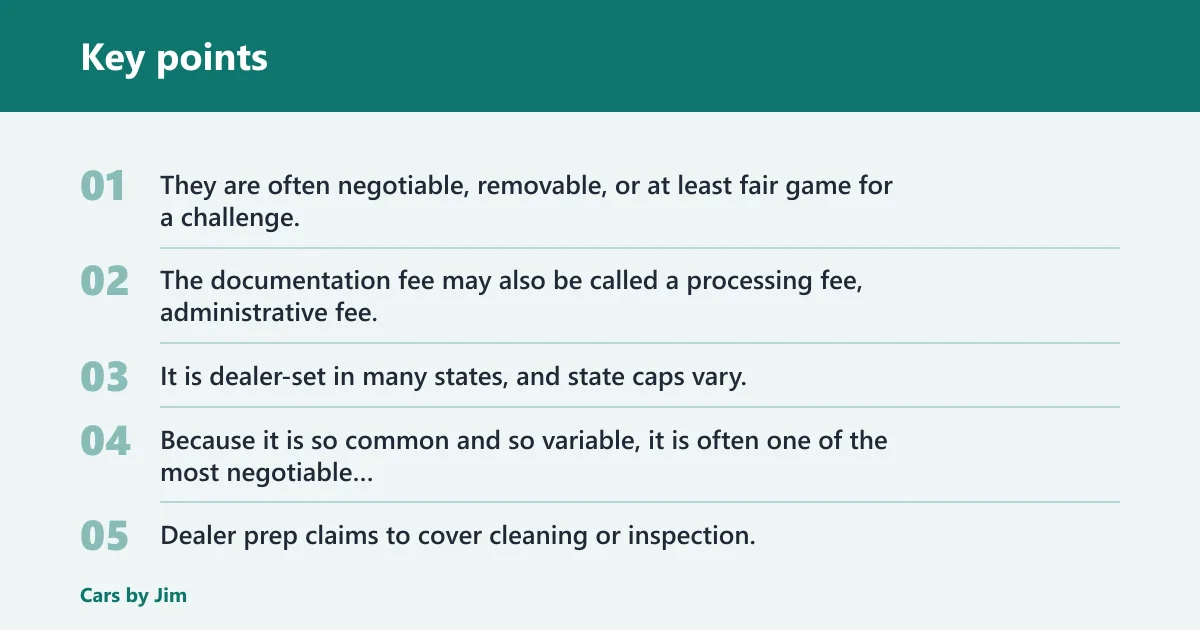
These charges are not always illegal. They are often negotiable, removable, or at least fair game for a challenge.
Documentation fee
The documentation fee may also be called a processing fee, administrative fee, or conveyance fee. It is dealer-set in many states, and state caps vary. Because it is so common and so variable, it is often one of the most negotiable dealer-added fees.
Dealer prep fee
Dealer prep claims to cover cleaning or inspection. Because normal business operations already include basic prep, this fee can be duplicated or padded. Ask what was actually done and whether that work is already reflected in the selling price.
Reconditioning fee
Reconditioning may cover cosmetic or mechanical work, but some dealers use it as bundled profit. Ask for a specific description of the work, the parts, and whether the car’s price already reflects its condition. If the answer is thin, push back.
Advertising fee
Advertising fees are sometimes passed to buyers and sometimes hidden in the listed price. If the dealer advertised a number, ask whether the fee was already baked in. If not, ask why you are paying for the dealer’s marketing.
Picture a used SUV listed at $22,900 with a $495 advertising fee added late in the paperwork. A buyer who focuses only on the sticker may miss that the real comparison point is the total, not the advertised headline.
Out-the-door price math
The out-the-door price includes vehicle price, fees, taxes, and government charges. It is the best negotiation target because it reveals the actual cost. A lower fee can be real, yet still leave the total unchanged if the dealer shifts money elsewhere.
This is also where tax bites. If the selling price rises, the tax usually rises too, which can erase part of the supposed fee concession.
How a lower fee can be offset elsewhere
For example, if a dealer waives a prep fee on a used car but raises the vehicle price by the same amount, the taxable total can still change because the price itself has gone up. If your tax rate is 7%, the extra $250 adds $17.50 in tax. The fee relief is only partly real, and the total still rises by $267.50 compared with the original price before tax.
How tax changes the final total
Tax applies to the taxable amount, so every dollar moved into the vehicle price can change the final number. That is why fee negotiation and price negotiation cannot be separated. They interact.
Why you need the full written quote
Ask for a quote that lists the selling price, each fee, tax, title, registration, and any add-ons. Compare the out-the-door total across dealers. If one store claims a lower fee but the total is the same, you have found the real bargain: none.
How to negotiate fee line items

Start with the total, then move to the itemized lines. That sequence keeps the dealer from hiding margin in a single fee while the rest of the quote stays untouched. If a fee looks excessive, ask for a reduction or a removal tied to the same out-the-door number.
- Ask for the out-the-door price before discussing monthly payments.
- Request an itemized breakdown of every charge.
- Separate government charges from dealer-added charges.
- Question doc, prep, reconditioning, and advertising fees one by one.
- Ask what happens to the total if a fee is removed.
- Use a competing written quote to press for a lower total.
- Decline add-ons you do not want, including warranties and GAP insurance.
- Walk away if the fees are excessive, unexplained, or change at signing.
Ask for an itemized breakdown
Do not accept a single blended number. Ask the dealer to separate the selling price from the doc fee, prep fee, reconditioning fee, advertising fee, tax, title, registration, and any add-ons. That makes hidden margin easier to spot.
Ask for the out-the-door number first
Monthly payment talk can bury fee inflation. The out-the-door number keeps the deal grounded in the full purchase cost. Use that number as the only number that matters until the quote is complete.
Use competing quotes and walk-away leverage
If another dealer offers the same car with a lower total, use it. If this store will not match the total or explain the difference, leave. A calm walk-away often does more than arguing line by line.
Decline add-ons you do not want
Warranties and GAP insurance can be declined. So can paint protection, VIN etching, nitrogen, and similar add-ons if you do not want them. If the dealer tries to bundle them into the deal, say no and ask for a fresh quote without them.
A common first-timer mistake is accepting a lowered doc fee while a warranty, key protection package, or another add-on appears in the final contract. That is not fee negotiation. It is replacement margin.
Frequently asked questions
Are car dealer doc fees negotiable?
Often yes, at least in practical terms. Doc fees are dealer-set in many states, and state caps vary. Even where the fee itself is hard to move, you can often negotiate the out-the-door total or the vehicle price so the same money is not coming out of your pocket.
What dealership fees are negotiable?
Documentation fees, dealer prep fees, reconditioning fees, and some advertising charges are the main ones to question. The strongest move is to ask for a full written quote and then push on the total, not just the fee line, because the dealer may recover the difference elsewhere.
Can you negotiate dealer fees?
Yes, for dealer-controlled fees. The key is to separate them from government charges first. Then ask the dealer to explain each one and show how the total changes if a fee is removed. If the total stays the same, the fee change did not help.
Do dealers negotiate used car prices?
Yes, many do. Used-car prices are often negotiable, especially when the dealer has room in the vehicle price or can move margin from one line item to another. Always compare the out-the-door number, because that is where the actual deal shows up.
How to negotiate dealership fees
Lead with the out-the-door number, then request an itemized breakdown. Separate fixed charges from dealer-added charges, challenge any fee that looks duplicated or vague, and use competing written quotes. If the dealer will not explain the math, walk away and shop elsewhere.