
How to Sign Over a Car Title to a Private Buyer
Fill in the buyer and sale fields exactly as the title requires, sign only in the seller signature space, and do not cross out or backdate anything unless your state allows it. A bad transfer can delay registration, trigger a DMV rejection, or force a duplicate-title request. This guide shows the correct signing order and the most common mistakes that send private sales back.
What you need before signing the title
Start with a valid title that matches the VIN and the seller name, then complete the sale fields exactly as the form requires before anyone signs. In a private sale, verify the title, complete mileage and sale details, collect payment, sign, and then hand over the paperwork and keys.
What you’ll need before signing
- The original vehicle certificate of title, or an approved electronic title transfer process where your state uses one.
- A bill of sale if your state requires it or recommends it.
- Odometer disclosure if the transfer is covered by federal mileage rules.
- Lien release paperwork if a lender is still listed.
- A pen that writes clearly, plus any notary or witness requirement your state adds.
- A safe place to meet, such as a vehicle licensing office.
Title signing decision table
| Title situation | What the seller should sign | What the buyer should sign | Hand over keys/title immediately? | Most common risk if skipped |
|---|---|---|---|---|
| Single-owner title | Seller assignment, odometer section if required, date, and any printed name fields | Buyer name and any buyer acknowledgment required by the title | Yes, after payment clears and the title is signed correctly | DMV rejects an incomplete or mismatched transfer |
| Joint owners | All owners sign exactly as the title instructs, using the same order the title shows | Buyer signs the buyer section | Only after every required owner signature is complete | One missing owner signature can void the transfer |
| Lien still listed | Do not sign as a finished transfer until the lien is released or the state process allows transfer with lender paperwork | Buyer signs only if the state allows transfer during payoff processing | No, not until the lender release is in hand and verified | Buyer cannot register the vehicle, and the title may stay tied to the loan |
| Out-of-state title | Follow the title-issuing state’s signature boxes and any required notary or witness line | Buyer signs the buyer section and any state-specific form | After the title is complete and any state form is filled out | Wrong form placement or missing notarization can cause rejection |
| Electronic title | Use the state-approved electronic transfer process | Buyer completes the approved electronic acceptance or transfer step | After the electronic transfer is accepted | Paper signing alone may not transfer ownership |
| Title with errors | Stop and request correction or a replacement title | Do not sign until the title is corrected | No | Cross-outs, overwrites, or mismatched names can block registration |
Sign the title in order
- Verify the title first. Check that the VIN, seller name, and ownership details match the car and the seller. If the title is missing, damaged, or has the wrong information, stop and get a replacement title or the correct state process before any signature.
- Complete the sale fields. Write the buyer name, sale date, and sale price in the spaces the title form asks for. If your state title does not include both sale date and price, add a bill of sale with those details.
- Write the mileage before signing. Complete the odometer disclosure before the seller signature if the transfer requires it under federal law. State actual mileage or state that it is unknown when the form allows that option.
- Sign only the seller line. Use the seller signature space exactly as the title instructs, and have every required joint owner sign in the required order. Do not sign in the buyer section unless your state form specifically says so.
- Collect payment, then release papers. Washington says to collect payment before signing over the title, and it recommends meeting at a vehicle licensing office for the handoff. That sequence cuts the risk of a bad transfer or a payment dispute.
- Give the buyer complete copies. Hand over the signed title, bill of sale, and any lien release or odometer paperwork the buyer needs to register the car. Keep your own copy of every document.
Say your title shows a sale price box but no separate bill-of-sale form is required in your state. Fill in the price and date on the title before signing, then keep a duplicate record for both parties. That avoids a DMV question about missing sale data later.
Do both seller and buyer need to sign?
Often, yes, but the exact answer depends on the title format and your state’s transfer rules. Many titles need a seller signature, a buyer signature, and an odometer statement. Joint-owner titles can require every listed owner to sign before the buyer signs anything.
Single-owner titles
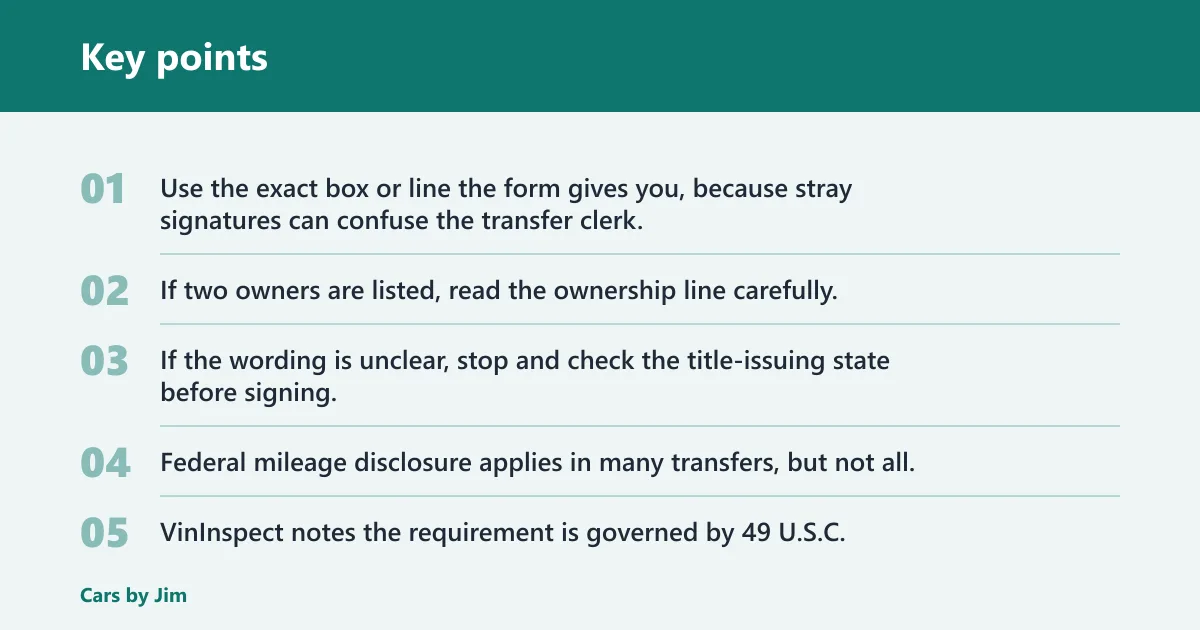
If the title lists one owner, that owner usually signs the seller section and the buyer completes the buyer section if the title has one. Use the exact box or line the form gives you, because stray signatures can confuse the transfer clerk.
Joint owners
If two owners are listed, read the ownership line carefully. Some titles require both names to sign; others allow one owner to sign only if the title or state rules say “or” between names. If the wording is unclear, stop and check the title-issuing state before signing.
Odometer disclosure
Federal mileage disclosure applies in many transfers, but not all. VinInspect notes the requirement is governed by 49 U.S.C. § 32705, and the state form may also require specific wording. Write the mileage before the signature line, and do not leave the field blank unless the form permits “unknown.”
Bill of sale
A bill of sale is often required or recommended, especially when the title does not contain both sale price and date. Include the vehicle, buyer, seller, sale date, and price. Each party should keep a copy, because it can support the transfer if the DMV asks for proof of the transaction.
What if the title has a lien or errors?
A title with a lien or a mistake is where many private sales fail. If a lender is still listed, verify the lien release before transfer. If the title has blank spaces, crossed-out entries, or a mismatched name, fix that first. Do not assume the buyer can sort it out at registration.
Open lien
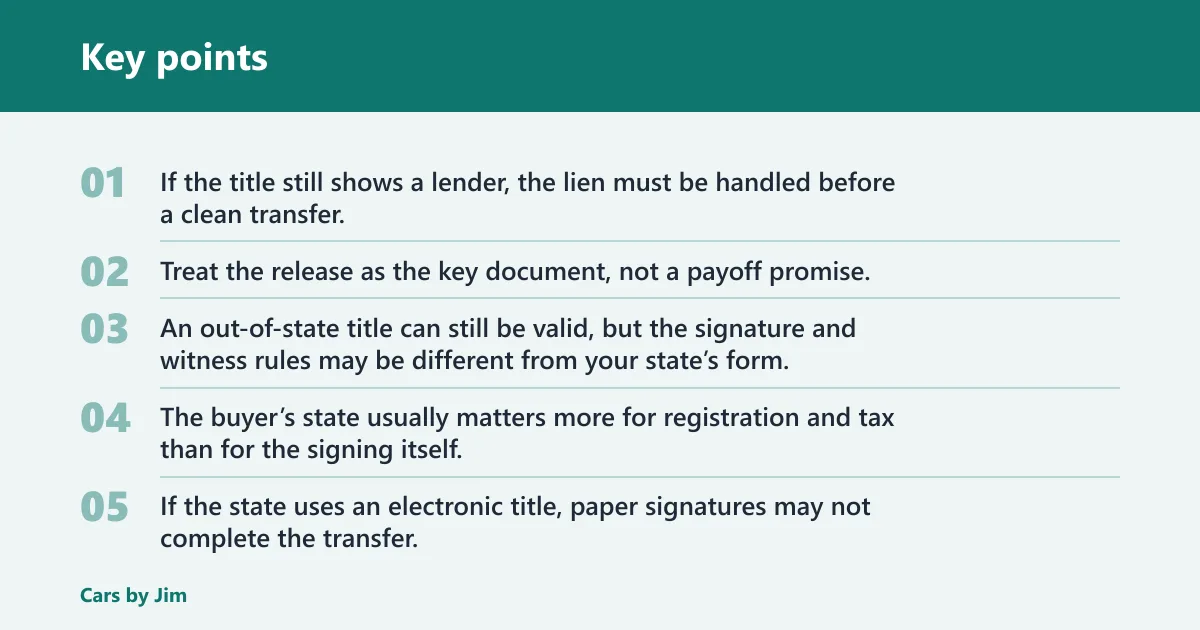
If the title still shows a lender, the lien must be handled before a clean transfer. Car and Driver says that if you still owe money, you need to pay that off before selling to a private party, and it advises getting a letter from the bank saying the lien is paid off. Treat the release as the key document, not a payoff promise.
Out-of-state title
An out-of-state title can still be valid, but the signature and witness rules may be different from your state’s form. Use the title-issuing state’s transfer boxes as written, then check the buyer’s state registration rules only after the sale. The buyer’s state usually matters more for registration and tax than for the signing itself.
Electronic title
If the state uses an electronic title, paper signatures may not complete the transfer. Use the state-approved electronic process and keep the confirmation page or transfer receipt. If the buyer wants the car the same day, verify that the electronic transfer is accepted before you release the keys.
Title errors or missing title
If the title has wrong names, unreadable sections, or overwrites, stop and get the state’s correction or replacement process. If the title cannot be found, a replacement title may be needed, which can take some time. That can take weeks, so do not promise a same-day transfer unless the state allows it.
A common first-timer mistake is filling out the title in the driveway, then spotting a spelling error in the buyer’s name after the seller has signed. If the state will not accept a correction, the seller may need to request a duplicate title and start over.
File the post-sale notice
After the title is signed and payment is complete, file the state’s post-sale notice if your state uses one. Washington requires a Report of Sale within 5 days of the sale date, and Washington warns that a missing report can leave the seller liable. That filing protects you if the vehicle later racks up tickets or tolls. (WA)
Some states let you file that notice at a vehicle licensing office. If yours does, bringing the paperwork there can reduce mistakes and create a clean record of the transfer. Keep a copy of the filed notice with your bill of sale and title copy.
Common mistakes
Most rejected private transfers come from a short list of avoidable problems. The title is either incomplete, signed in the wrong place, or supported by the wrong paperwork. Catching those issues before you hand over the keys is faster than fixing them at the DMV.
- Signing before payment clears. Collect payment first, then sign. Once the title is in the buyer’s hands, control is gone.
- Using the wrong title. A title must be valid before sale and must match the VIN and ownership record.
- Leaving lien paperwork unresolved. A payoff promise is not the same as a lien release.
- Skipping mileage disclosure. Write the odometer reading before signing when the law requires it.
- Guessing about plates. Plate retention rules vary by state. Washington says old plates must be removed by the seller, but that is not universal.
- Ignoring the seller notice. File the report of sale or release of liability on time.
Suppose the title has a clean seller signature, but the buyer name is left blank because the seller planned to “fill it in later.” That usually creates a bad transfer. Complete every required field before anyone signs, then compare the title to the bill of sale line by line.
Frequently asked questions
How do I sign over a car title to a private buyer?
Fill out the buyer, date, and price fields exactly as the title asks, complete the odometer statement if required, then sign only in the seller space. Collect payment before handing over the signed title and keys, and keep copies of every document you use in the transfer.
Where do I sign on the title when selling my car?
Sign only where the title labels the seller or transferor signature line. If the title has multiple owner signatures, use the exact format it shows. Do not sign in the buyer area unless the title or state form specifically tells you to do that.
Do both seller and buyer need to sign the title?
Often, yes. Many transfers require the seller signature, the buyer signature, and an odometer disclosure. Joint-owner titles can require every listed owner to sign, so check the ownership wording on the title before anyone writes their name.
What if the title has a lien on it?
Do not treat the transfer as complete until the lien is released or the state has a specific process for handling an active loan. Verify the lender’s release before signing over the vehicle, because a payoff letter alone may not be enough for the buyer to register the car.
Do I need a bill of sale when I sell a car privately?
Often yes. Washington requires a Bill of Sale unless sale price and date are included on the title. Even when it is optional, a bill of sale should list the vehicle, buyer, seller, sale date, and price, and each party should keep a copy.
When should I give the buyer the title?
Give the buyer the signed title only after you have payment and the title is complete. Washington recommends meeting at a vehicle licensing office to collect payment and sign over the title, which helps keep the transfer orderly and reduces the chance of a rejection later.
What if I lost the title before the sale?
Get a replacement title before you sell. The same source says to request a replacement title if you cannot find the original, and that process can take weeks. Do not try to transfer the car with missing title paperwork unless your state offers a legal replacement or electronic process.
Do I need to file anything after signing over the title?
Often yes. Many states require a post-sale notice or report of sale, and Washington requires one within 5 days of the sale date. File it on time so the state record shows you no longer own the vehicle and liability does not stay attached to you.