High Mileage vs Low Mileage Cars: Which Is the Better Buy?
Neither is automatically better: buy the car with the cleaner service history and lower 12-month repair risk, even if that means 80,000 miles instead of 30,000. Choosing by odometer alone can leave you paying for tires, brakes, fluids, and deferred maintenance that erase any price savings. This guide compares mileage, age, storage, records, and expected near-term repairs so you can decide whether high mileage vs low mileage cars are the better buy.
| Decision factor | High mileage | Low mileage | Winner |
|---|---|---|---|
| Price today | Usually discounted because the odometer reading signals more wear and less resale value. | Usually commands a premium because buyers pay for the lower odometer reading. | High mileage |
| Condition risk | Higher chance of engine, transmission, suspension, and brake wear if records are thin. | Lower wear can help, but age-related problems can still hit a car that sat unused. | Tie |
| Near-term repair spend | May need more immediate spending on wear items if maintenance was delayed. | May still need tires, battery, fluids, brakes, and seals if storage was poor. | Tie |
| Resale value | Lower resale value in most cases, even if the car is mechanically sound. | Higher resale value if the rest of the car backs up the mileage reading. | Low mileage |
Is low mileage always better?
No. Low mileage helps only when the car also has the right maintenance history, storage history, and wear-item condition. A low odometer reading can point to less driving wear, but it cannot tell you whether the car sat outside for long stretches, missed service intervals, or needs expensive catch-up work.
Age
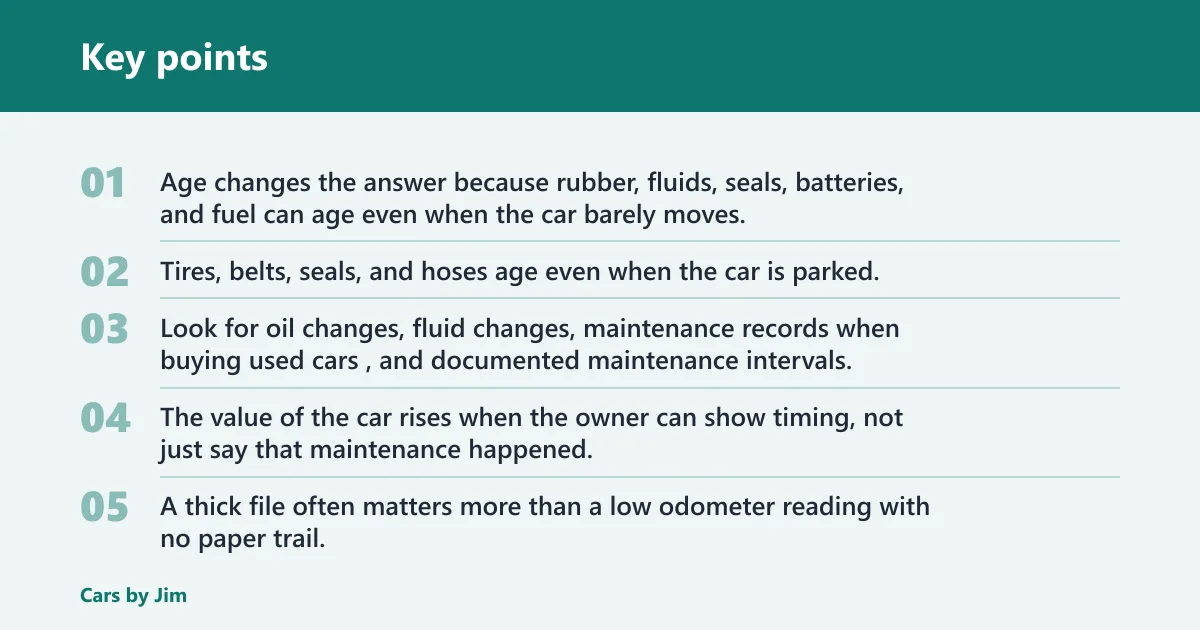
Age changes the answer because rubber, fluids, seals, batteries, and fuel can age even when the car barely moves. A 2018 vehicle in 2026 is eight years old, so its condition should be judged as an eight-year-old car, not just a low-mileage one.
Storage
Low mileage can hide age-related damage. Tires, belts, seals, and hoses age even when the car is parked. That matters because dry-rot can lead to cracking, leaks, and vibration that do not match the “low miles” story the odometer suggests.
Service history
Look for oil changes, fluid changes, maintenance records when buying used cars, and documented maintenance intervals. The value of the car rises when the owner can show timing, not just say that maintenance happened. A thick file often matters more than a low odometer reading with no paper trail.
Usage pattern
Highway miles are usually easier on brakes, transmission shifting, and suspension than stop-and-go city use. A commuter car with regular highway miles can be a better candidate than a city car with lower mileage but more heat cycles, short trips, and brake wear.
Repair risk
Neither side wins automatically because the next 12 months can bring costs that are not obvious from the odometer. Tires, batteries, fluids, brake work, and aging rubber can all land on the bill fast.
How many miles is too many?
For a used car, “too many” depends on age, condition, and how the miles were accumulated. Average American drivers cover about 12,000 miles per year, while a common planning benchmark is about 10,000 miles per year. Carwow says the UK average is 5,000 to 8,000 miles per year, so the same odometer reading can mean very different things in different markets.
Age: start with age multiplied
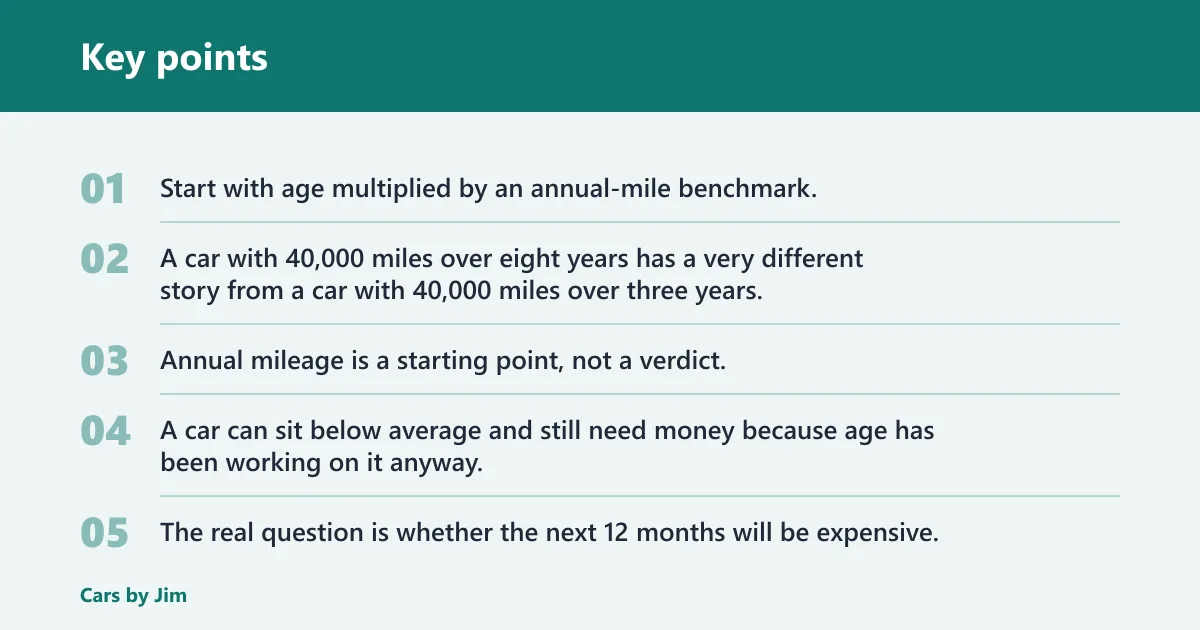
Start with age multiplied by an annual-mile benchmark. The same source recommends multiplying age by 10,000 to estimate expected mileage, and it says a five-year-old car should have no more than 50,000 miles. That gives you a simple check against the actual odometer reading.
Storage: a car
A car with 40,000 miles over eight years has a very different story from a car with 40,000 miles over three years. Low mileage over a long period can signal sitting damage, while higher mileage over the same period can point to regular use that may have helped keep the car healthier.
Service history
U.S. News also contrasts drivers at 7,000 miles and 14,000 miles per year, which shows how different annual use can be even for the same model. When the records are clean, a car above the benchmark can still be a good buy, because maintenance matters as much as the mileage reading itself. For a deeper way to compare records and mileage, high-mileage car reliability depends heavily on what was serviced and when.
Usage pattern: annual mileage is a starting
Annual mileage is a starting point, not a verdict. A car can land above the average and still be a good buy if it has clear maintenance records and the wear items check out. A car can sit below average and still need money because age has been working on it anyway.
Repair risk: there is no universal cutoff
There is no universal cutoff. Around 150,000 miles is a point where buyers should scrutinize records closely, while well-maintained cars can run past that mark if major wear items have already been handled. The real question is whether the next 12 months will be expensive.
Should I pay more?
Pay more for low mileage only when the whole car supports the premium. Mileage can help resale value, and it can reduce the chance of immediate wear-item spending, but only if the car has not been sitting long enough to develop age-related faults. Otherwise, the premium is just a more expensive repair bill in disguise.
Age: low mileage often costs more
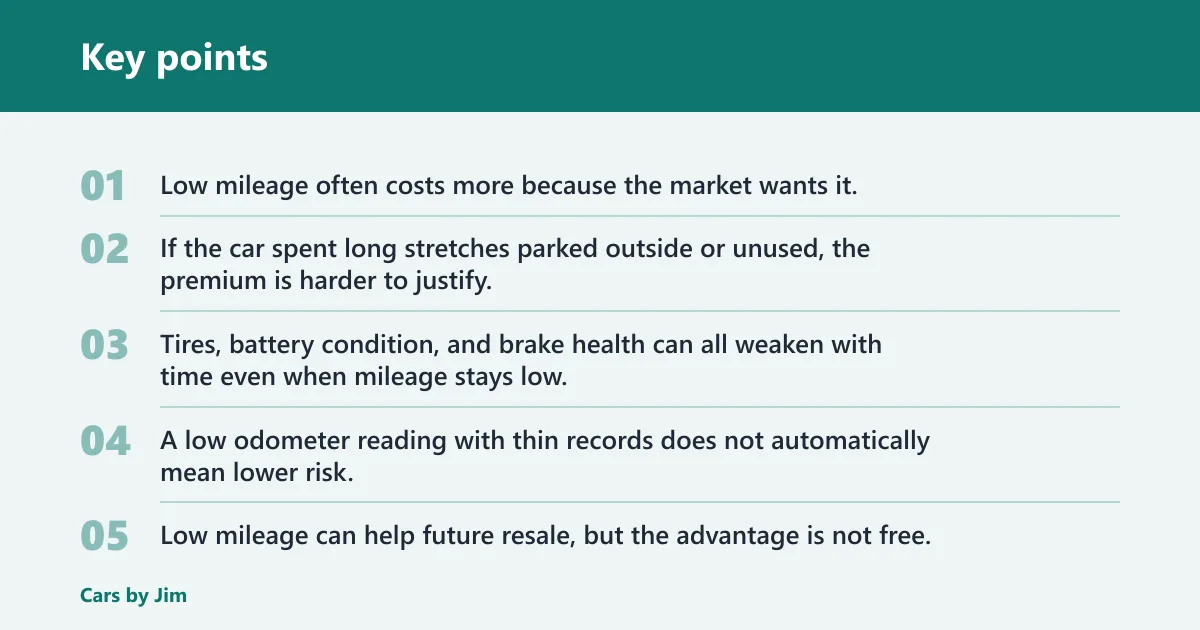
Low mileage often costs more because the market wants it. That premium makes sense when the car has clean records, even tire wear, a healthy battery, and no sign of storage damage.
Storage: if the car spent long
If the car spent long stretches parked outside or unused, the premium is harder to justify. Tires, battery condition, and brake health can all weaken with time even when mileage stays low.
Service history: the price premium is easier
The price premium is easier to justify when the seller can show oil changes, fluid service, repair invoices, and other documented upkeep. A low odometer reading with thin records does not automatically mean lower risk.
Usage pattern: low mileage can help future
Low mileage can help future resale, but the advantage is not free. If the car has mostly short-trip use, heat cycles and incomplete warm-ups can still add wear that does not show up in the odometer number.
Repair risk: negotiate when the odometer
Negotiate when the odometer is low but the maintenance file is thin, the car sat unused, or the inspection finds aged rubber and weak consumables. A low-mileage car with tired tires or an old battery should not be priced as if it were fully sorted.
Picture an SUV with 36,000 miles that spent most of the last three years parked outside. The tires are cracked, the battery is old, and the brakes pulse on the test drive. That car should be negotiated hard, not paid for as a premium example.
What matters more than mileage?
Mileage is a wear and value signal, not a standalone condition measure. Age, storage, service history, and use pattern can matter just as much. Compare the odometer reading with expected miles for age, then check whether the car has the records to support what the number suggests.
Age: older cars can need more
Older cars can need more attention even when they have low miles because time affects rubber, fluids, seals, and electrical components. The odometer cannot show how long those parts have been aging.
Storage: garage-kept, regularly driven vehicles often
Garage-kept, regularly driven vehicles often age more gracefully than cars that sat outside unused. Storage conditions can change tire condition, battery health, and brake behavior in ways mileage alone will miss.
Service history: strong records can offset higher
Strong records can offset higher mileage when the car has been maintained on schedule. Oil changes, fluid changes, repair records, and documented maintenance intervals tell you whether the previous owner protected the car. Missing records do not automatically kill the deal, but they raise the odds that deferred work is hiding in the price.
Usage pattern: city use, short trips
City use, short trips, and stop-and-go driving are often harder on many wear items than consistent highway use. A car with more miles but a steady commute can be easier to trust than a lower-mileage car that mostly sat between short errands.
Repair risk: rebuild the question around
Rebuild the question around the next 12 months, not the odometer alone. Leak checks, brake wear, tire age, battery condition, and transmission behavior are the clues that show whether the price is realistic.
What to inspect?
Before you buy, verify the car with a test drive, a pre-purchase inspection, leak checks, and noise and vibration checks. The goal is to find the money that the asking price does not show. This is where mileage becomes real.
Check the service file. Look for oil changes, fluid changes, repair invoices, and documented maintenance intervals. Missing records do not automatically kill the deal, but they raise the odds that deferred work is hiding in the price.
Scan for leaks. Look under the car, around the engine, and near the transmission for fresh oil, coolant, or fluid residue. A leak can turn a cheap high-mileage car into a costly one very quickly.
Drive it cold and warm. Test the car before and after it reaches operating temperature. Cold-start noises, rough shifting, vibration, pulling, and warning lights often show up when a car is not yet fully warm.
Listen for bad sounds. Pay attention to clunks, grinding, wheel noise, steering chatter, and brake squeal. Noise and vibration checks can point to suspension wear, brake wear, wheel-bearing issues, or drivetrain trouble.
Order a pre-purchase inspection. Ask a qualified mechanic to inspect the car before money changes hands. That step is especially useful on high-mileage cars and on low-mileage cars that may have sat unused.
Mileage comparison matrix
Use this matrix as a simple decision tool: give more weight to the car with the cleaner records, better storage, healthier wear items, and lower expected 12-month repair risk. The odometer reading matters, but it should not outrank the condition clues that predict your first year of ownership.
| Factor | Car A: High mileage | Car B: Low mileage | Pick |
|---|---|---|---|
| Age | 8 years old | 8 years old | Tie |
| Odometer reading | 92,000 miles | 28,000 miles | Low mileage |
| Service records | Oil changes, brake service, and fluid changes documented | Only two oil-change receipts | High mileage |
| Storage history | Daily commuter, mostly highway use | Sits for months at a time outdoors | High mileage |
| Tire and battery age | Tires are 2 years old, battery is 1 year old | Tires are 6 years old, battery is 5 years old | High mileage |
| Expected 12-month repair spend | $900 for brakes and fluids | $1,400 for tires, battery, and brake cleanup | High mileage |
| Recommendation | Buy | Pass | High mileage |
That matrix is realistic because the low-mileage car has age and storage risk, while the high-mileage car has proof that it has been used regularly and maintained on time. The odometer reading on its own would point the wrong way.
Verdict: High mileage or low mileage?
Choose High mileage if it comes with a thick service file, regular oil and fluid changes, and a steady highway-commute history that makes it a better buy than a lower-mileage car with thin records or stop-and-go wear.
Choose low mileage if the lower odometer reading is backed by clean maintenance records, even tire wear, a healthy battery, and no sign of storage damage, so you are not paying a premium for a car that sat unused and needs catch-up work.
Frequently asked questions
Is a low-mileage used car always better than a high-mileage one?
No. Low mileage helps only when the car also has strong service records, good storage, and no age-related damage. A higher-mileage car with documented maintenance, highway use, and recent wear-item replacement can be the safer buy.
When is a high-mileage car still a good buy?
It is a good buy when the records are complete, the test drive is clean, and a pre-purchase inspection does not find expensive wear. Highway use, regular oil changes, and proof that major wear items were already handled can make high mileage acceptable.
How many miles is too many on a used car?
There is no universal cutoff. Around 150,000 miles is a point where buyers should scrutinize records closely, while well-maintained cars can run past that mark. The real question is whether the next 12 months will be expensive.
Should I pay more for a low-mileage car?
Only if the car also has a clean inspection, strong records, and little sign of sitting damage. A low odometer reading can support a premium, but tires, battery, fluids, brakes, and storage history must justify the extra cost.
What matters more than mileage when buying used?
Maintenance history often matters more than the odometer alone. Oil changes, fluid changes, repair records, and documented intervals tell you whether the previous owner protected the car. Storage history and inspection results also matter because they reveal age-related problems mileage cannot show.
What should I inspect before buying a high-mileage car?
Start with the service file, then inspect for leaks, noise, vibration, brake wear, and transmission behavior on a test drive. A pre-purchase inspection matters because it can turn hidden wear into a clear yes or no before you commit.