Why Are Maintenance Records Important When Buying a Used Car?
Maintenance records matter because they show whether the car got scheduled service on time. A full, steady file usually lowers risk. Missing gaps should make you inspect harder and bid lower. Skipping them can hide missed oil changes, overdue timing-belt work, and repairs that show up after purchase. This guide shows how to read service history, spot warning signs, and decide when to inspect, negotiate, or walk away.
What service records reveal and miss
Maintenance records are best used as a risk filter, not proof that a car is sound. A good file shows care patterns, mileage progression, and documented major work. A thin file leaves more unknowns, so you should inspect harder, verify more details, and assume less when pricing the car.
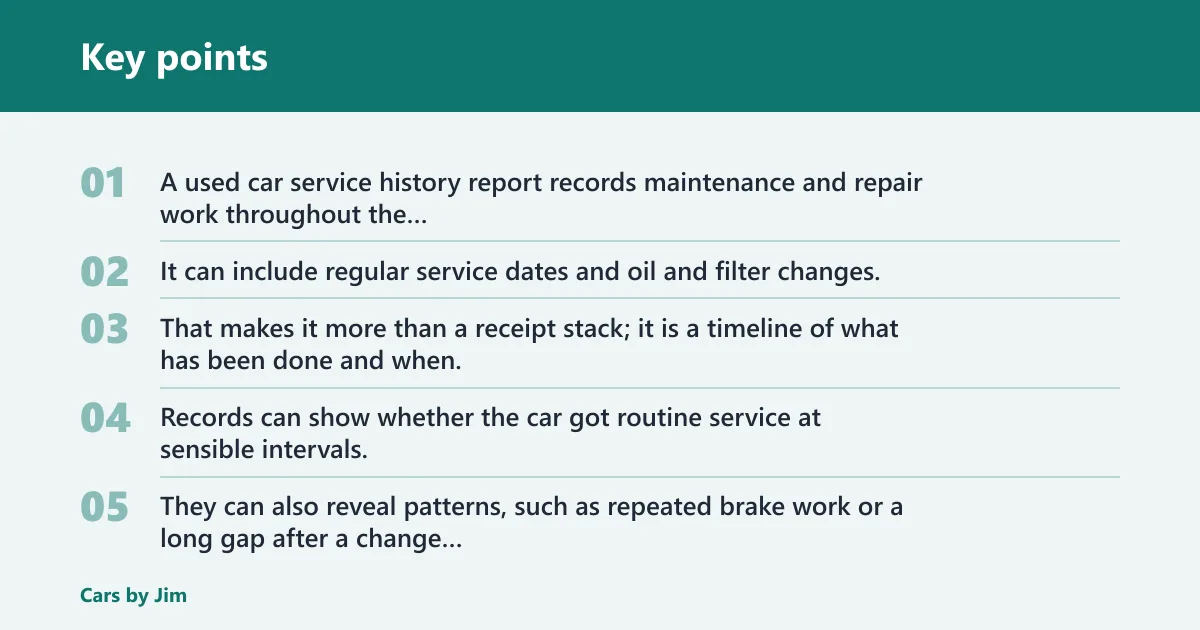
A used car service history report records maintenance and repair work throughout the vehicle’s lifetime. It can include regular service dates and oil and filter changes, brake servicing and replacement, tire replacement history, battery changes, and sometimes engine repairs, transmission service, suspension, and steering repairs. That makes it more than a receipt stack; it is a timeline of what has been done and when.
What can maintenance records tell you about a used car?
Records can show whether the car got routine service at sensible intervals, whether major systems have already been repaired, and whether the mileage makes sense across the life of the car. They can also reveal patterns, such as repeated brake work or a long gap after a change in ownership, that affect how closely you should inspect the vehicle.
They also help separate a maintained car from an unknown one. That difference matters even more on high-mileage commuter cars and fleet cars, where wear is expected but service discipline still needs to be visible.
What can maintenance records not tell you?
A complete file is not a guarantee. Records can be incomplete, false, or limited to a dealer network that missed independent garage work. A clean history can still hide worn suspension parts, a coolant leak, or past repairs that never made it into the paperwork.
Vehicle history reports also have limits. They can support checks on title history, accident damage, ownership, and recalls, but they are only a timeline and not a guarantee. Data coverage varies by country and source.
Why do maintenance records matter before you inspect the car?
Use records to decide how hard to inspect and how hard to negotiate. A car with complete service records is easier to trust and often easier to price, but value impact is usually a matter of stronger buyer confidence rather than a guaranteed dollar amount. AAA notes that detailed service records can increase a vehicle’s value.
Say your shortlist has two similar sedans with the same price. One has dealer-stamped service entries about every 8,000 to 10,000 miles; the other has one oil change entry and nothing else. The first car is worth a normal inspection. The second needs a lower offer, a tighter inspection, or both.
What should you look for in service records?
Look for service dates, mileage progression, and repairs that match the car’s age and use. A strong record set shows regular servicing, believable odometer readings, and clear documentation of oil changes, brake work, tire replacement, battery changes, and any major repairs. Compare the intervals, not just the presence of paperwork.
Which service dates and mileage patterns matter most?
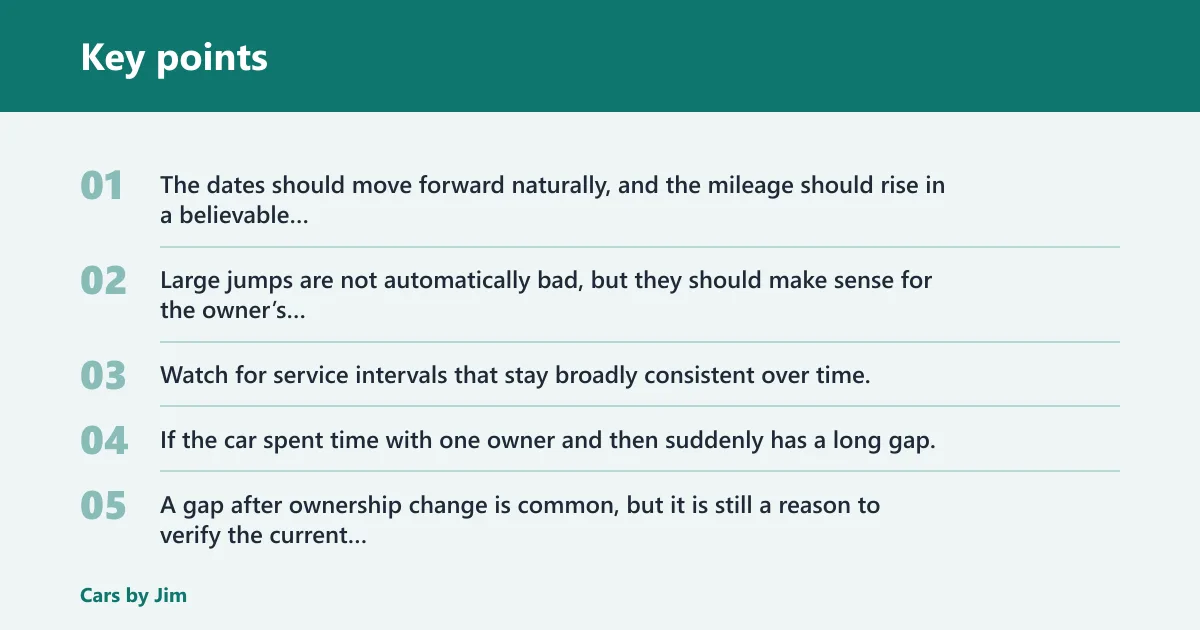
The easiest test is simple chronology. The dates should move forward naturally, and the mileage should rise in a believable pattern between visits. Large jumps are not automatically bad, but they should make sense for the owner’s driving pattern and the vehicle’s age. Watch for service intervals that stay broadly consistent over time.
If the car spent time with one owner and then suddenly has a long gap, ask what happened during that period. A gap after ownership change is common, but it is still a reason to verify the current condition more carefully.
What do oil changes, brakes, tires, and battery work tell you?
Oil and filter changes matter because they show whether basic maintenance happened on schedule. Brake entries are useful because they can show pad and rotor wear patterns, repeated brake service, or unusually frequent work that may point to driving style or a deeper issue. Tire and battery records help confirm that consumables were replaced when needed, not ignored.
How should you read major repairs and repeat repairs?
Major repair history changes the risk picture. Engine repairs, transmission failures, accident repairs, and insurance claim repairs all deserve a closer look because they can affect long-term reliability, resale confidence, and the chance of repeat problems. One documented repair is not the same as repeated repair visits for the same complaint.
Picture a compact SUV with three brake jobs in about 14 months, but no note about calipers or hoses. That pattern is different from normal pad wear. It can justify a more detailed inspection before money changes hands.
How do maintenance records change the buying decision?
Use the record pattern to rank risk, then decide whether to inspect, negotiate, or walk away. The strongest signals are consistency, believable mileage, and clear proof of major work. The weakest signals are missing intervals, repeated faults, and records that do not match the car’s age, mileage, or claimed use.
| Record pattern | Likely risk level | What it could mean mechanically | Next action |
|---|---|---|---|
| Complete dealer history with regular dates and mileage | Low | Routine service was likely done on time; some independent work may still be missing | Inspect and verify |
| Gap after ownership change, then steady records resume | Low to medium | Admin gap or a private-sale period; maintenance may still be fine | Inspect |
| Repeated brake work over a short span | Medium | Normal wear, seized parts, or an issue such as dragging brakes | Inspect |
| Missing oil-change dates for long stretches | Medium to high | Possible neglected lubrication, sludge risk, or incomplete documentation | Negotiate or inspect |
| Inconsistent mileage between service entries | High | Possible odometer error, data entry mistake, or rollback fraud | Verify |
| No records and high mileage | High | Maintenance may have happened, but there is no proof of intervals or major work | Walk away or inspect hard |
| Major repair repeat visits for engine or transmission | High | Ongoing mechanical weakness, poor repair quality, or unresolved fault | Walk away or negotiate |
| Independent repairs with invoices but no service book | Medium | Work may be real even if the dealer system did not capture it | Verify |
| Dealer-only digital records with no paper copies | Low to medium | Strong for franchise work, weaker for outside repairs that are not logged | Inspect and verify |
| Multiple accident repairs plus maintenance gaps | High | Body damage history plus uncertain upkeep raises the odds of hidden issues | Walk away |
What buyer scenarios should trigger a different action?
Use the pattern, not just the headline. A full file with steady mileage usually supports a normal purchase path. A partial file can still be workable if the gaps are short and explained. But repeated faults, missing major-service proof, or contradictory mileage should change the plan fast.
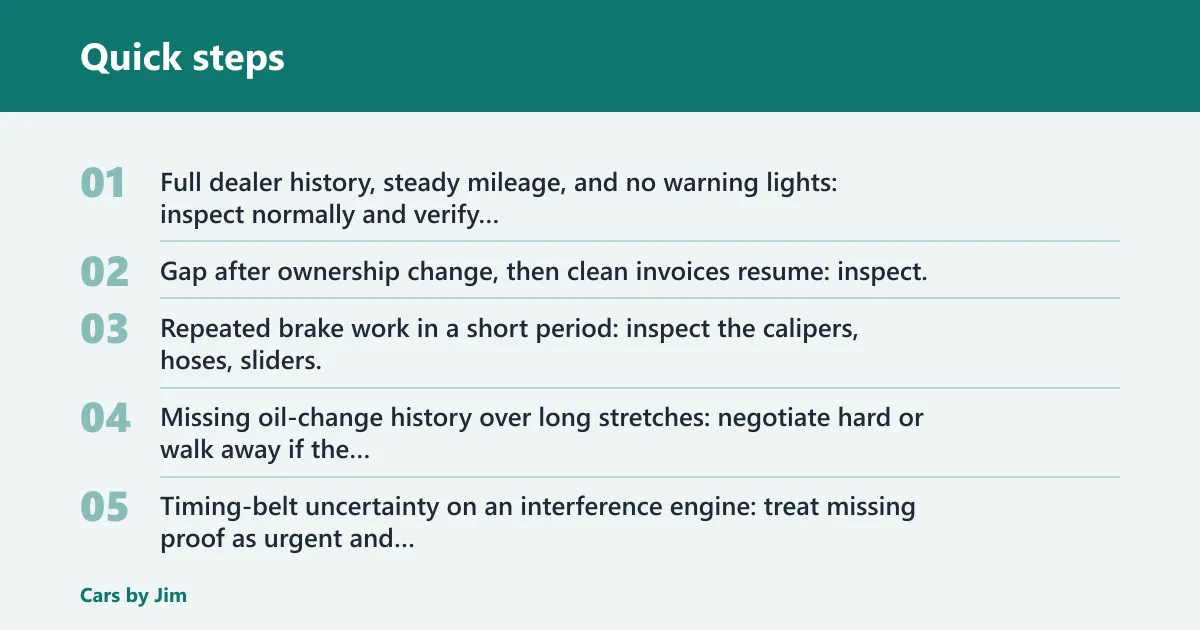
- Full dealer history, steady mileage, and no warning lights: inspect normally and verify the key services.
- Gap after ownership change, then clean invoices resume: inspect, but do not over-discount if the rest fits.
- Repeated brake work in a short period: inspect the calipers, hoses, sliders, and rotors for drag or sticking.
- Missing oil-change history over long stretches: negotiate hard or walk away if the engine shows sludge risk.
- Timing-belt uncertainty on an interference engine: treat missing proof as urgent and price in immediate service.
- Timing-chain uncertainty with noisy cold starts or stretched-service history: inspect quickly; chain wear may be expensive.
- Coolant-service gaps plus any overheating signs: prioritize inspection because neglected coolant can damage the engine and cooling system.
- Repeated check-engine visits for the same code or system: assume the repair is not solved and expect deeper diagnosis.
- No records plus low mileage: do not assume gentle use; low miles can hide age-related neglect, dead fluids, and stale rubber.
- No records plus high mileage: walk away unless the seller can produce invoices, repair bills, and a clean independent inspection.
Can records confirm the mileage is real?
Yes, sometimes. Service records can reveal odometer readings during visits, and those readings can be compared over time to check whether the mileage climbs in a believable way. That comparison can help detect odometer tampering or rollback fraud, but it is only one part of the check.
How do you compare odometer readings across entries?
Look at the mileage on each service line, not just the latest number. A 2019 oil change at 42,000 miles and a 2024 brake service at 49,000 miles may fit a low-use commuter car. A 2023 entry at 88,000 miles followed by a 2024 entry at 61,000 miles does not. Also compare the distance between services with the time between them.
How do you tell a data-entry error from rollback fraud?
Start by checking whether the error is isolated. A single digit swap, transposed number, or replacement cluster note can explain one mismatch. Fraud is more likely when the lower mileage appears in multiple documents, the pattern drops sharply across several dates, or the service timeline and vehicle age no longer line up.
What does NHTSA say about rollback risk?
NHTSA estimates more than 450,000 vehicles are sold each year with rolled-back odometers. That figure supports caution, but it does not mean every mismatch is fraud. A typo, a replacement cluster, or a data-entry mistake can also create a problem. The question is whether the whole mileage trail makes sense.
What if a used car has no records?
No records are not automatic proof of neglect, but they do leave you with more unknowns. Treat the absence as a risk signal, then decide whether the car is still worth pursuing based on mileage, price, vehicle type, and what other documents are available. The more expensive the car, the less forgiving the gap should be.
When are missing records lower risk?
Missing paperwork is less alarming when the car is older, the price is modest, and the seller can still provide invoices, repair bills, or digital dealer entries. Fleet cars and dealer-maintained vehicles often have cleaner record trails than private cars, but the source still matters.
Suppose a 10-year-old hatchback has no service book, but the seller can produce three oil-change invoices and a battery receipt from the last two years. That is not ideal, yet it is better than a blank file.
When do missing records become a deal breaker?
No records become much more serious when the car has high mileage, repeated warning lights, or signs of major work that cannot be explained. If you see missing service records plus no proof of oil changes, timing-related work, or transmission care, the risk can be high enough to skip the car.
What should you verify before you make an offer?
Before you bid, verify the service book, invoices, repair bills, odometer trail, and major-repair history. If the seller cannot explain service gaps or repeated faults, add a pre-purchase inspection to the cost of buying. Use the remaining gaps to adjust price, urgency, or your walk-away point.
- Ask for the service book, invoices, and repair bills.
- Check whether the odometer readings in the paperwork move upward in order.
- Compare the file with title, accident, and recall history.
- Look for major repairs, especially engine, transmission, and accident work.
- Decide whether the remaining unknowns fit the asking price.
How much do records affect price and confidence?
Documented maintenance can support a stronger asking price because it lowers buyer uncertainty. It also reduces negotiation friction, since a seller can point to proof rather than promising that the car was “well cared for.” Strong records do not guarantee a premium, but they usually help a car compare better against similar listings with thinner documentation.
Why does documented maintenance help resale value?
A car with complete service records is easier to trust and typically sells faster. That does not mean every receipt adds the same value, but a clear file often helps a car stand out against similar listings with thin documentation. Cars with documented maintenance records often command better prices, though the size of the effect depends on market demand and the quality of the records.
How do records change negotiation leverage?
Missing gaps, undocumented major repairs, and mileage mismatches give the buyer more room to press the price. A car with a full record still deserves a pre-purchase inspection, but the file usually supports a firmer price. A weak file should push the conversation the other way.
When should you budget for a pre-purchase inspection?
Budget for a pre-purchase inspection whenever the record set is incomplete, the mileage is high, or the car has had major repairs. If the seller cannot explain service gaps or repeated repairs, the inspection is not optional. It is part of the decision.
How do service history report use cases differ?
Different documents answer different questions. Authorized service center records, invoices, and vehicle history reports each add a separate layer, and none of them should be treated as a full substitute for the others. The strongest file usually combines all three so you can match service, ownership, and title events.
What do authorized service center records show?
Manufacturer or dealer-maintained digital records are the strongest source for servicing performed at franchise workshops. They often show dates, mileage, and dealer-performed work with good continuity. The weakness is that they may not capture independent garage work, so the file can still be incomplete.
How do maintenance invoices and repair bills help?
Invoices and repair bills show actual services performed and dates. They are especially useful when the service book is missing or blank, because they can confirm oil changes, brake work, battery changes, and major repairs that otherwise would not be visible. Keep an eye on the mileage printed on each bill.
How should you use vehicle history report cross-checks?
Vehicle history reports are useful for title history, accident damage, ownership changes, and recalls. CARFAX aggregates records from more than 100,000 sources and uses the 17-character VIN to tie records to a vehicle. That broad coverage helps, but it still does not guarantee that every repair or service event appears in the report.
Frequently asked questions
Why do maintenance records matter when buying a used car?
They matter because they show whether the car received scheduled service on time and whether major repairs were documented. A complete file lowers uncertainty, while gaps can point to skipped maintenance, hidden wear, or a need for a closer inspection before you decide to buy.
What can maintenance records tell me about a used car?
They can show service dates, oil changes, brake work, tire replacements, battery changes, engine repairs, and transmission service. They can also reveal mileage progression and repeated repairs, which helps you judge whether the car was cared for or whether a specific system may be at risk.
Can maintenance records show if the mileage is real?
They can help, yes. Compare odometer readings from different service visits and see whether mileage rises in a believable pattern. A consistent trail supports the number on the dash, while sudden drops, odd jumps, or missing stretches should prompt verification rather than blind trust.
What if a used car has no maintenance records?
Treat it as a higher-risk purchase, not an automatic rejection. If the seller can provide invoices, repair bills, or dealer digital records, the gap may be manageable. If the car is high mileage and the file is blank, the safest move is often to walk away.
Do maintenance records affect used car resale value?
Yes. Documented maintenance can help a car sell faster and often supports a better price because buyers worry less about hidden neglect. Missing records do the opposite, since buyers tend to discount the offer for the extra uncertainty and inspection risk.
Should I trust a used car with a clean history but missing service records?
Not on the basis of the history report alone. A clean title or accident timeline does not prove routine care. If the service records are missing, use invoices, mileage checks, and a pre-purchase inspection to decide whether the car is still worth pursuing or whether the risk is too high.