Does Out-the-door Price Include Interest or Only Purchase Costs?
No. Out-the-door price covers the vehicle purchase transaction, including price, taxes, title, registration, and dealer fees, but not loan interest, which belongs in the financing contract. Mix them up, and one quote can look cheaper while the loan costs more. This guide shows what belongs in each number and how to compare dealer quotes with loan offers.
What out-the-door price covers
Out-the-door price is the total amount you pay to take ownership of the vehicle. That number usually starts with the car’s sale price and then adds the required charges tied to the purchase itself. It is a buying number, not a borrowing number.
Vehicle price and taxes
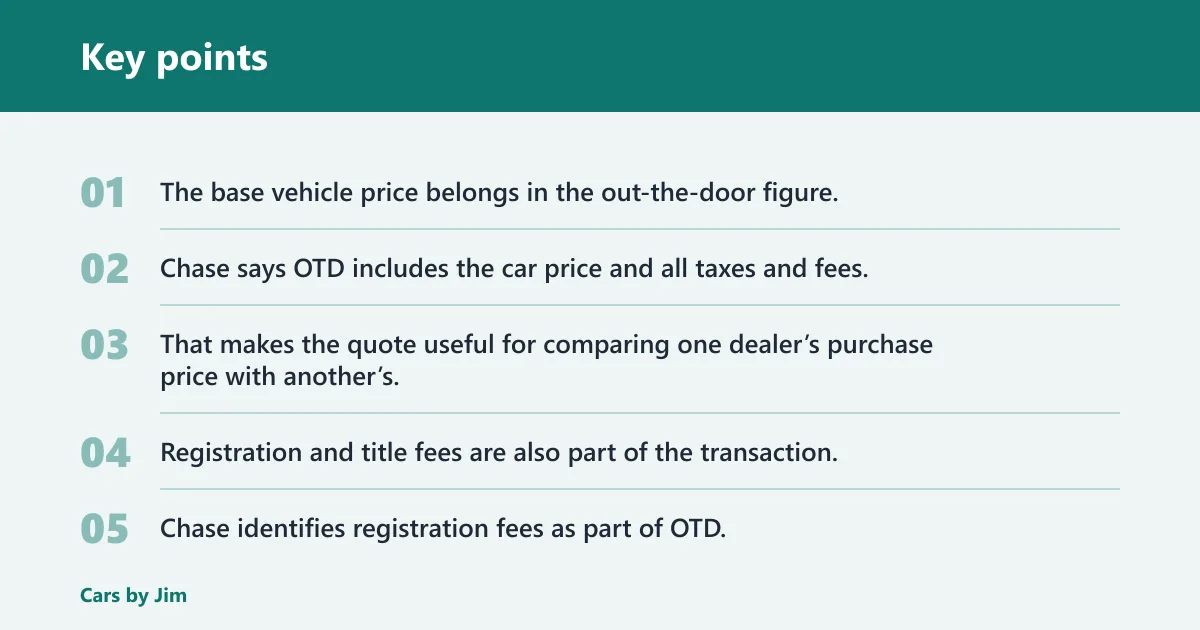
The base vehicle price belongs in the out-the-door figure, along with sales tax when your state or county charges it on the purchase. Chase says OTD includes the car price and all taxes and fees, and NerdWallet says OTD includes all taxes, fees and extras. That makes the quote useful for comparing one dealer’s purchase price with another’s.
Title, registration, and dealer fees
Registration and title fees are also part of the transaction. Chase identifies registration fees as part of OTD, and those government charges are needed before you can legally put the car on the road. Dealer documentation fees, destination charge on a new vehicle, and dealer preparation fees may also appear, but state rules and dealer policy can change whether they are fixed, capped, or negotiable.
Where dealer add-ons may fit
Some add-ons are part of the sale if you agree to buy them. NerdWallet says dealer-added extras can be included in OTD, and that warranties, gap insurance and other products you agree to purchase can be included. That means a dealer can quote a higher OTD number if those products are built into the deal, but financing still sits in a separate bucket.
What belongs in OTD vs what belongs in your loan
| Item | OTD | Loan |
|---|---|---|
| Vehicle price | Yes | No |
| Sales tax | Yes | No |
| Title | Yes | No |
| Registration | Yes | No |
| Doc fee | Usually yes | No |
| Dealer add-ons | Only if part of the sale | No, unless rolled into the loan amount after purchase |
| Down payment | No | Not a charge, but it lowers the amount you borrow |
| APR | No | Yes |
| Term length | No | Yes |
| Total interest paid | No | Yes |
Does financing add interest to the quote?
No. If you finance the car, interest is not part of the out-the-door price. It belongs to the loan agreement, where the lender sets the APR, term length, and payment schedule. The same source says a loan amount and OTD price would match if you are taking out a loan, but Car and Driver notes OTD may not represent the final amount if you finance.
Why interest sits in the loan contract
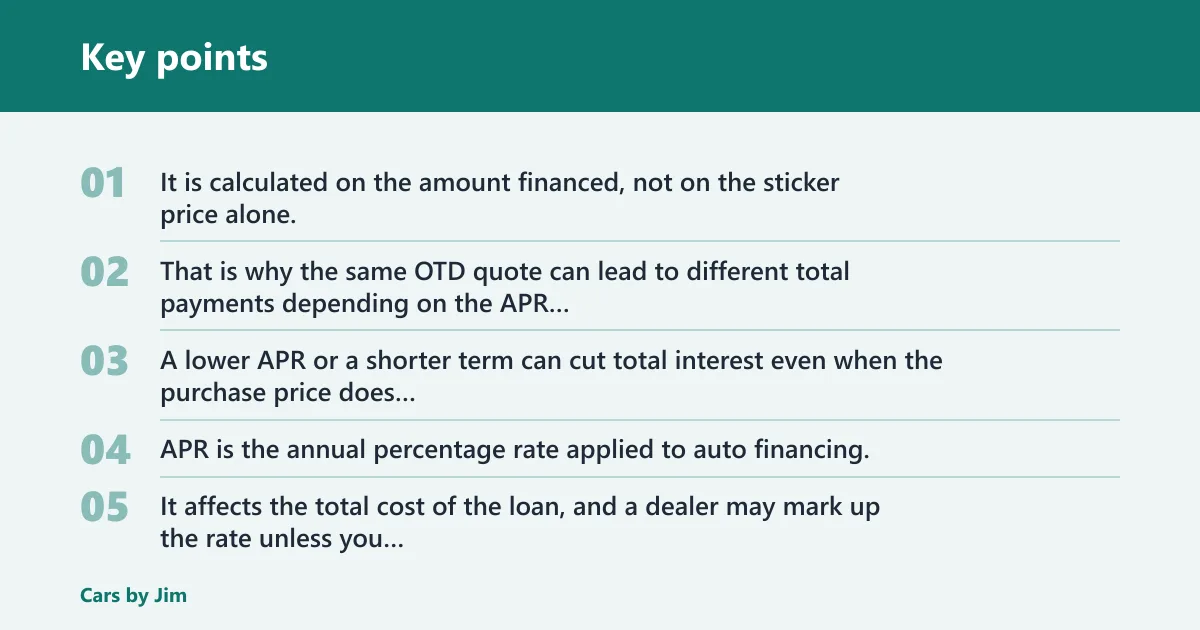
Interest is the cost of borrowing money. It is calculated on the amount financed, not on the sticker price alone. That is why the same OTD quote can lead to different total payments depending on the APR and the length of the loan. A lower APR or a shorter term can cut total interest even when the purchase price does not change.
How APR changes total loan cost
APR is the annual percentage rate applied to auto financing. It affects the total cost of the loan, and a dealer may mark up the rate unless you negotiate or bring your own financing. A quote with a low purchase price can still cost more overall if the APR is higher or the term is stretched out.
Why monthly payment can hide interest
Monthly payment is a repayment figure, not a purchase price. Chase says monthly payments can increase the total amount paid because of interest charges, and Car and Driver says monthly payments accrue interest. A long term can make the payment look easier, but it can also increase the total interest paid over time.
Say your out-the-door quote is about $34,000 and you put $4,000 down. The purchase price does not change, but the amount you borrow drops to $30,000 before interest. If the dealer then offers two loans on that same OTD number, one at about 6% for 60 months and one at about 9% for 72 months, the monthly payment and total interest will be different even though the purchase quote stayed the same.
What changes when you make a bigger down payment?
A bigger down payment lowers the amount you borrow, which can reduce the monthly payment and the total interest you pay. It does not change the dealer’s out-the-door quote itself. The same source says trade-in or down payment amounts are deducted to determine OTD in the financing context, but the purchase price, taxes, and fees remain separate from the loan math.
Lower loan balance
When you put more money down, the financed balance shrinks. That can help you qualify for better loan terms and can limit how much interest accrues. It also reduces the chance of owing more than the car is worth early in the loan.
Possible lower monthly payment
A smaller balance usually means a smaller monthly payment, assuming APR and term stay the same. That is useful for cash flow, but it should not be confused with a lower purchase price. The dealer’s OTD number still shows what the car costs to buy before financing choices are layered on top.
Less total interest over time
Because interest is charged on borrowed money, borrowing less can reduce the total interest paid. That matters most when the loan term is long. A larger down payment can be a practical way to cut the cost of financing without changing the car’s sale price.
Can dealer add-ons show up in the out-the-door number?
Yes, if you agree to them. Warranties, gap insurance, VIN etching, and market adjustment or added dealer markup can appear in the deal structure, and some of those items can be rolled into the quoted OTD amount. The key is to separate what you are buying from the dealership from what you are borrowing from the lender.
Warranties and gap insurance
The same source says warranties, gap insurance and other products you agree to purchase can be included in OTD. That means they are part of the purchase quote only when you choose them, not automatically. If a dealer includes them, ask for each item in writing so you can see whether you want to keep or remove it.
VIN etching and market adjustment
VIN etching is a dealer-added extra. Market adjustment is another dealer-added charge that raises the sale price above the base figure. Whether these items stay in the deal depends on the dealer’s policy and what you agree to sign. They are not loan interest, and they should not be confused with APR.
When add-ons are optional versus built
A common first-timer mistake is to assume every line on a quote is required. Some add-ons are optional, some are bundled, and some are treated as part of the sale once you accept them. Ask for the full itemized quote so you can separate the vehicle price, required fees, and optional products before financing starts.
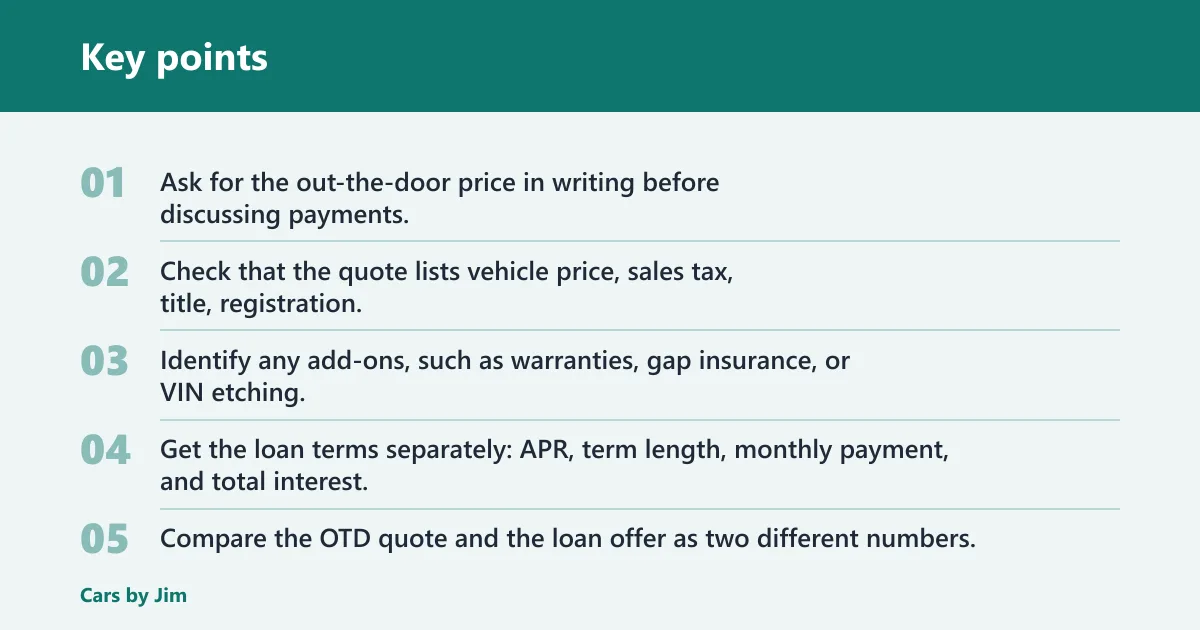
- Ask for the out-the-door price in writing before discussing payments.
- Check that the quote lists vehicle price, sales tax, title, registration, and dealer fees separately.
- Identify any add-ons, such as warranties, gap insurance, or VIN etching.
- Get the loan terms separately: APR, term length, monthly payment, and total interest.
- Compare the OTD quote and the loan offer as two different numbers.
Out-the-door price vs total cost of ownership
Out-the-door price covers the purchase transaction, but it is not the same as total cost of ownership. NerdWallet warns that OTD is not the total cost of owning a car, and says insurance and loan interest are additional ownership costs. Fuel, maintenance, depreciation, and insurance all sit outside the OTD quote.
Purchase price versus ownership costs
The OTD number tells you what it costs to acquire the vehicle. Total cost of ownership tells you what the car costs to keep and use after that. Those are different questions, and they should not be merged into one quote because doing so makes comparison shopping harder.
Why loan interest belongs in a separate bucket
Loan interest depends on financing terms, not on the car itself. Two buyers can agree to the same OTD number and still pay very different totals over time because one gets a shorter term or lower APR. That is why purchase cost and financing cost should stay separate on paper and in your comparison.
Suppose two shoppers each buy the same SUV at the same OTD price. One pays cash and stops at the transaction cost, while the other finances the same amount over a longer term at a higher APR. The second shopper’s monthly payment looks manageable, but the total paid over time is higher because interest lives in the loan contract, not the sale quote.
Frequently asked questions
Does the out-the-door price include interest on a car loan?
No. Out-the-door price is the amount needed to complete the purchase transaction, including the car price, taxes, title, registration, and dealer fees. Interest belongs to the loan, where APR and term determine how much extra you pay over time. A dealer quote and a financing contract are separate documents.
What costs are included in an out-the-door price quote?
Usually, the quote includes the vehicle price, sales tax, title, registration, and dealer fees. It can also include destination charge on a new vehicle and any dealer-added extras you agree to buy. It should not include loan interest, because that cost comes from financing, not from the sale itself.
If I finance the car, is interest part of the out-the-door price?
No. Financing creates a second cost layer. The OTD number shows what you pay to buy the car, while interest is added through the loan’s APR and term. That is why the same purchase price can produce different total payments for different borrowers, even at the same dealership.
Does the out-the-door price change if I make a bigger down payment?
No. A bigger down payment does not change the dealer’s purchase quote. It lowers the amount you borrow, which can reduce the monthly payment and total interest paid. Keep the purchase number and the financing number separate so you can see what the car costs before and after borrowing.
Are warranties and gap insurance included in the out-the-door price?
They can be, but only if you agree to buy them. The same source says warranties, gap insurance and other products you agree to purchase can be included in OTD. If the dealer adds them, ask for a line-by-line quote so you can decide whether those products belong in your deal.
Is the monthly payment the same thing as the out-the-door price?
No. Monthly payment is the amount you repay each month on the loan. Out-the-door price is the amount required to take ownership of the vehicle. A low monthly payment can still come from a high total loan cost if the term is long or the APR is high.
What’s the difference between out-the-door price and total cost of ownership?
Out-the-door price is the purchase transaction total. Total cost of ownership includes everything after that, such as fuel, maintenance, insurance, depreciation, and loan interest if you borrow money. OTD helps you compare buying quotes. Total cost of ownership helps you judge what the car will really cost over time.
Can the dealer add financing costs after giving me an out-the-door price?
Yes, but only through the loan side of the deal, not by rewriting the purchase quote. A dealer can present a separate financing offer with APR, term, and monthly payment. If you sign those loan terms, the total you pay rises because of interest, not because the OTD number changed.
Should I ask for the out-the-door price before talking about monthly payment?
Yes. Start with the out-the-door price so you can judge the actual purchase cost first. Then compare loan offers by APR, term, monthly payment, and total interest. If you start with payment alone, it is easier to miss fees, add-ons, or a longer loan that makes the car cost more overall.