What Should You Offer on a Used Car?
Start with the local fair-market price for the exact car, subtract verified reconditioning and repair costs, then set your first offer about 10% to 15% below that adjusted figure; on low-demand cars, you can move closer to 5% below. Offer too high and you leave no room to negotiate. Offer too low and the seller may stop replying. This guide shows how to set a starting offer and a firm max bid by seller type and demand.
What should you offer first?
Start from local comparable listings
Your first number should come from same-year or same-trim listings in your area, not a national average. Match the drivetrain, trim, and major options, then compare mileage and condition. A clean local market with few substitutes gives the seller more power. A crowded market gives you more room to start lower.
That is why asking price and opening offer are different numbers. The asking price is the seller’s opening position. Your opening offer should leave room for verified deductions and negotiation, but it should still fit the car’s local market.
Subtract verified repair and reconditioning costs
Take the local market price, then subtract only the costs you can support with inspection findings, service records, or visible wear. Tires, brakes, overdue fluid service, and missing maintenance records all matter. Do not subtract vague guesses. Use the car’s condition to justify every dollar you remove.
Set a separate max bid
Your first offer is not your ceiling. Set a max bid before you contact the seller, and tie that ceiling to your total budget, financing approval, and out-the-door cost. A disciplined max bid helps you avoid chasing a car that looks affordable at the sticker price but strains your monthly payment once taxes and fees are added.
📊 Average used-car listing price was $27,028 in July 2026. Source: Consumerreports.
Offer worksheet
| Worksheet field | Example entry | How to use it |
|---|---|---|
| List price | $24,900 | Start with the seller’s asking price, then compare it to local comps. |
| Comp 1 | $24,200 | Same year, same trim, similar mileage. |
| Comp 2 | $23,800 | Use a nearby listing with a similar equipment set. |
| Comp 3 | $24,600 | Check whether condition or options explain the higher number. |
| Local fair-market price | $24,200 | Use the middle of the local range if the car is average. |
| Mileage adjustment | -$500 | Subtract for above-average miles; add a little for unusually low miles. |
| Tires | -$800 | Use an actual replacement quote if tread is near the limit. |
| Brakes | -$400 | Deduct only if pads or rotors are near replacement. |
| Service | -$300 | Include overdue oil, filters, coolant, or scheduled maintenance. |
| History-report red flags | -$1,500 | Use this only for accidents, title issues, or ownership problems that affect value. |
| Taxes and fees | $1,100 | Add title, registration, and sales tax to the out-the-door total. |
| Financing ceiling | $430 per month | Keep the payment within your approved budget. |
| Private seller first offer | $21,500 | Start lower when the car needs work and the seller has more flexibility. |
| Dealer first offer | $22,200 | Leave room for dealer fees and a narrower negotiation band. |
| CPO first offer | $22,900 | CPO vehicles usually start higher because of age, mileage, and warranty value. |
| Max bid | $23,400 | Stop here even if the seller counters again. |
How do comps set your opening number?
Use local comparable listings to find what buyers are actually paying, then shape your offer from that number. Match year, trim, drivetrain, and options first. After that, adjust for mileage, condition, and equipment. A fair price in one city can be too high or too low a few miles away.
Match year, trim, drivetrain, and options
Same-year or same-trim comps are the cleanest starting point. A higher trim with leather seats, a better audio system, or advanced driver aids can justify a higher number. Two cars with the same badge may have very different values if one has 4WD, better wheels, or a rare package.
Adjust for mileage and condition
Mileage matters because wear rises with use, but condition can move the value just as much. A high-mileage car with records and clean service history may be worth more than a lower-mileage car with neglected maintenance. A scratch on a bumper is different from worn tires, dirty fluids, or warning lights.
Read the local market, not national averages
Local pricing matters more than a broad average because supply changes by area. If similar cars are sitting for weeks, your offer can start lower. If the same model is scarce and sells fast, the seller has less reason to move. Market heat should change your opening number.
For context, the average price of a 3-year-old used car was $32,461 in Q2 2026, and the average used-car listing price was $27,028 in July 2026. Those numbers help frame the market, but they do not replace a local comp check for the exact vehicle you want.
What should you deduct before you offer?
Deduct only the issues you can verify. Start with the vehicle history report, then use a pre-purchase inspection to confirm hidden wear, and finally price out tires, brakes, and near-term service. Those deductions belong in the offer because they become your cost the moment you buy the car.
History-report red flags
Run a VIN-based vehicle history report before you make a serious offer. Check for accident records, title issues, odometer problems, and repeated ownership changes. A clean report does not make the car perfect, but a troubling report can change both price and your willingness to continue.
If the report shows a branded title, airbag deployment, or unresolved ownership issue, the car is no longer a simple price comparison. The offer should reflect the added risk, or you should stop there.
Pre-purchase inspection findings
Ask for a pre-purchase inspection before you accept the deal. A mechanic can spot seepage, worn suspension parts, cooling-system problems, or evidence of crash repair that a quick walkaround misses. Use the inspection to convert condition into dollars, not vague concern.
Say your inspection finds front tires near the wear bars, rear brake pads close to minimum, and a transmission fluid service overdue. That gives you a concrete deduction. Another car with no warning lights and recent maintenance deserves a smaller haircut, even if the asking prices are similar.
Near-term tires, brakes, and service
Do not ignore work that is due soon. Tires, brake pads, rotors, oil changes, filters, and scheduled fluid service all affect the real cost of ownership. If the seller has no maintenance records, that uncertainty should also push your number down.
A common first-timer mistake is to negotiate only from the dashboard. The car can look clean and still need $1,000 in immediate upkeep. That amount belongs in the offer because you will pay it soon after purchase.
Dealer, private seller, or CPO?
Offer strategy changes with the seller. Private sellers often have more price flexibility, dealers have more fee structure and a narrower back-and-forth window, and CPO listings usually start higher because the car is newer, lower-mileage, and may include warranty coverage and special financing.
Private-party flexibility and limits
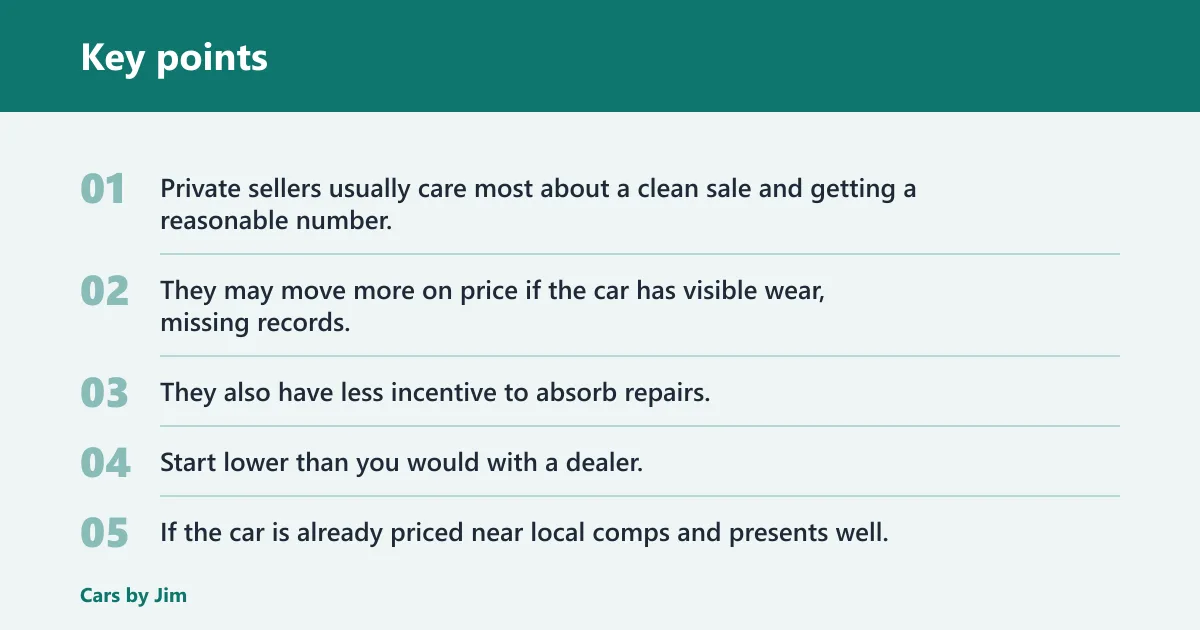
Private sellers usually care most about a clean sale and getting a reasonable number. They may move more on price if the car has visible wear, missing records, or an inspection finding. They also have less incentive to absorb repairs, so your deductions should be specific and fair.
Start lower than you would with a dealer, but do not insult the seller with a number that ignores the market. If the car is already priced near local comps and presents well, a very low offer can end the conversation fast.
Dealer negotiation room and fees
Dealers may have more room to negotiate on the vehicle price, but they often add fees that change the out-the-door number. Ask for the full figure, including documentation charges, title, registration, and sales tax. A deal that looks strong on the screen can become expensive once those items are added.
Dealers may also move on financing, not only price. If your bank or credit union has already approved you, you can compare that offer to the dealer’s rate without letting the payment hide the real cost.
Why CPO cars usually start higher
CPO cars usually command a higher price because they are generally newer, have lower mileage, and may include a warranty and special financing. That means less deduction room than a typical used car. Your opening offer should still be based on local comps, but the discount band is usually tighter.
If the CPO car already includes strong warranty coverage, your repair deductions should be smaller than they would be on an as-is listing. You are paying for some peace of mind. That changes the math.
How much below asking should you start?
Start about 10% to 15% below your adjusted fair-market number, not the raw asking price, then move based on seller type and demand. On low-demand cars, a 5% opening gap can be enough. On hot listings, a smaller opening gap keeps the seller engaged and protects your chance to buy.
Opening-offer bands by condition and demand
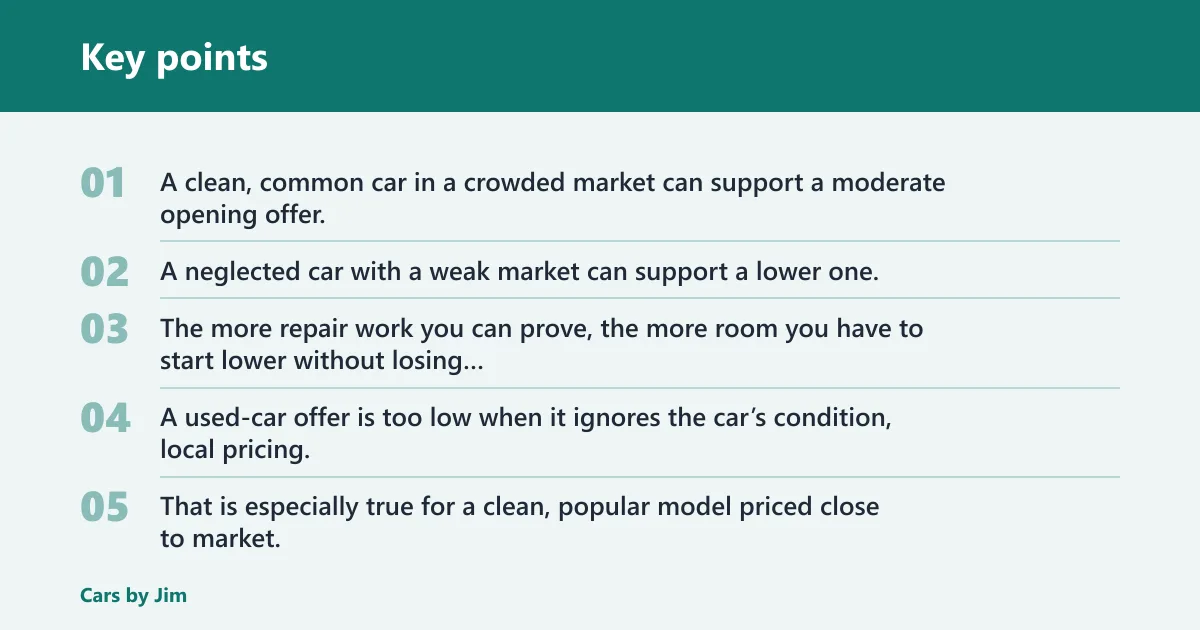
A clean, common car in a crowded market can support a moderate opening offer. A neglected car with a weak market can support a lower one. The more repair work you can prove, the more room you have to start lower without losing credibility.
| Market and condition | Good first-offer band | Max-bid cap |
|---|---|---|
| Low demand, needs work | 10% to 15% below adjusted fair-market price | 3% to 5% below asking price |
| Average demand, average condition | 7% to 10% below adjusted fair-market price | Near fair-market price after deductions |
| High demand, clean car | 5% to 7% below adjusted fair-market price | At or slightly above adjusted fair-market price if the car is scarce |
When a low offer will fail
A used-car offer is too low when it ignores the car’s condition, local pricing, or current demand. That is especially true for a clean, popular model priced close to market. A seller with multiple interested buyers may skip a weak first offer instead of countering it.
How high-demand cars change the strategy
Scarce inventory changes the negotiation. If the listing is priced fairly, a tiny opening discount may be the right move. In that setting, your advantage comes from being ready to buy, not from starting far below ask. A strong pre-approval and a fast response can matter more than a large opening gap.
Suppose a compact SUV is priced right at local market and has only 18,000 miles, one owner, and a clean report. A 15% lowball offer is likely to fail. A smaller opening offer with quick paperwork may work better than a deep discount request.
What paperwork and budget should you have ready?
Have the VIN check, service records, financing approval, and budget limits ready before you negotiate. Your payment ceiling should reflect more than the sticker price. Include taxes, title, registration, insurance, and any immediate repair work so you know the real monthly and total cost.
VIN check and service records
Bring the vehicle history report and ask for service records. You want proof of oil changes, brake work, tire replacement, and major service. Missing records do not always kill a deal, but they do raise uncertainty, and uncertainty belongs in the offer.
Financing pre-approval and payment ceiling
Get pre-approved by a bank or credit union before you negotiate so you know your ceiling. That keeps the monthly payment from creeping past what fits your budget. A common monthly-payment target is 10% of take-home pay, and total monthly car expenses should stay under 20% of take-home pay.
Average used-car interest rate exceeded 11% in Q1 2026, so rate shopping can materially change the deal. A lower purchase price is helpful, but a better loan can matter just as much over the life of the car. (Consumerreports)
Down payment, trade-in, and total out-the-door cost
A down payment of 10% to 20%. A trade-in can count toward that amount at a dealership, but you should still track the full out-the-door total. Sales tax, title, and registration alter the final number more than many shoppers expect.
U.S. News says title and registration fees typically run $200 to $500. Add those to your planning number before you say yes. If the car needs tires or brakes right away, include that too.
What should I offer on a used car?
Start with the local fair-market price for that exact car, subtract verified repair and reconditioning costs, and then make your first offer about 10% to 15% below that adjusted number. If the car is scarce and priced fairly, keep the opening gap smaller. Set a separate max bid before you negotiate.
What is a fair first offer on a used car?
A fair first offer is one that leaves room to negotiate without ignoring the market. For many cars, that means starting below the adjusted fair price, then moving toward it if the seller is reasonable. For a clean, in-demand vehicle, a smaller opening discount is often more realistic.
How much below asking price should I start?
Start about 10% to 15% below your adjusted fair-market number on a typical car, and closer to about 5% below when demand is strong. If the car needs tires, brakes, or overdue service, you can start lower only if those deductions are real and well supported.
What makes a used-car offer too low?
An offer is too low when it would never be taken seriously given the car’s condition, the seller type, and local market demand. Deep lowball numbers often fail on well-priced dealer inventory and desirable private-party listings. If the offer ignores history, mileage, or repairs, it is likely too low.
Should I offer differently at a dealership vs private sale?
Yes. Private sellers often have more flexibility on price, while dealers may have more room to move on the vehicle itself but less on fees. Dealers also require a full out-the-door view. With a private seller, condition and convenience often matter more than fee structure.
When should I ask for an inspection before making an offer?
Ask for a pre-purchase inspection before you accept a deal, and before you make a serious offer on any car that could have hidden wear. If the seller resists inspection, that is a warning sign. The inspection report is what turns concern into a usable price deduction.
What paperwork should I have ready before I negotiate?
Have the VIN report, service records, proof of financing pre-approval, and a clear budget ceiling ready. You should also know your planned down payment and expected taxes and fees. That lets you negotiate from a complete out-the-door number, not a sticker price that hides the real cost.
How do I know if a used-car price is already fair?
Compare the asking price to three local listings with the same year, trim, drivetrain, and similar mileage. Then adjust for condition and immediate repairs. If the car is priced near the local range and has a clean history, the fair offer may be close to ask, especially on a desirable model.
When should I walk away from a used-car deal?
Walk away if the seller is evasive, the history report shows serious red flags, or the car needs more work than your budget can absorb. Walk away too if the price only looks good because it ignores taxes, fees, or repair bills. A bad deal can still be a bad deal at a lower price.
Can I negotiate a used car price if the listing says firm?
Sometimes, but treat “firm” as a signal that the seller has little room or little interest in haggling. If the car is overpriced, has visible issues, or sits on the market, a respectful offer may still work. If the car is well priced and in demand, a firm listing may stay firm.
What used car should I buy?
Buy the one that fits your budget, meets your needs, and has the strongest records for condition, ownership, and maintenance. Good used-car shopping starts with a model you can afford to own, not only to buy. A clean history and a solid inspection matter more than a flashy badge.
Choose a car with local comps you can verify, a history report that is free of major problems, and an inspection that does not reveal expensive surprises. Then compare the out-the-door total to your financing ceiling. If the numbers still work, your offer has a real chance.