Can a Car Run Fine and Still Have Hidden Flood Damage?
Yes, a car can drive normally on a short test and still have hidden flood damage, especially if water reached wiring, modules, or connectors. Ignore it, and you can buy a car that fails weeks later with electrical faults, airbag problems, corrosion, or a salvage title surprise. This guide shows the warning signs, the checks that matter, and the proof you should get before you buy.
What a smooth drive can hide
Yes. A flood-damaged car can start, idle, shift, and drive perfectly on the day of the test drive, then develop problems later as moisture, silt, and corrosion spread through wiring and modules. A clean short drive does not rule it out, because the most expensive damage often sits where you cannot see it.
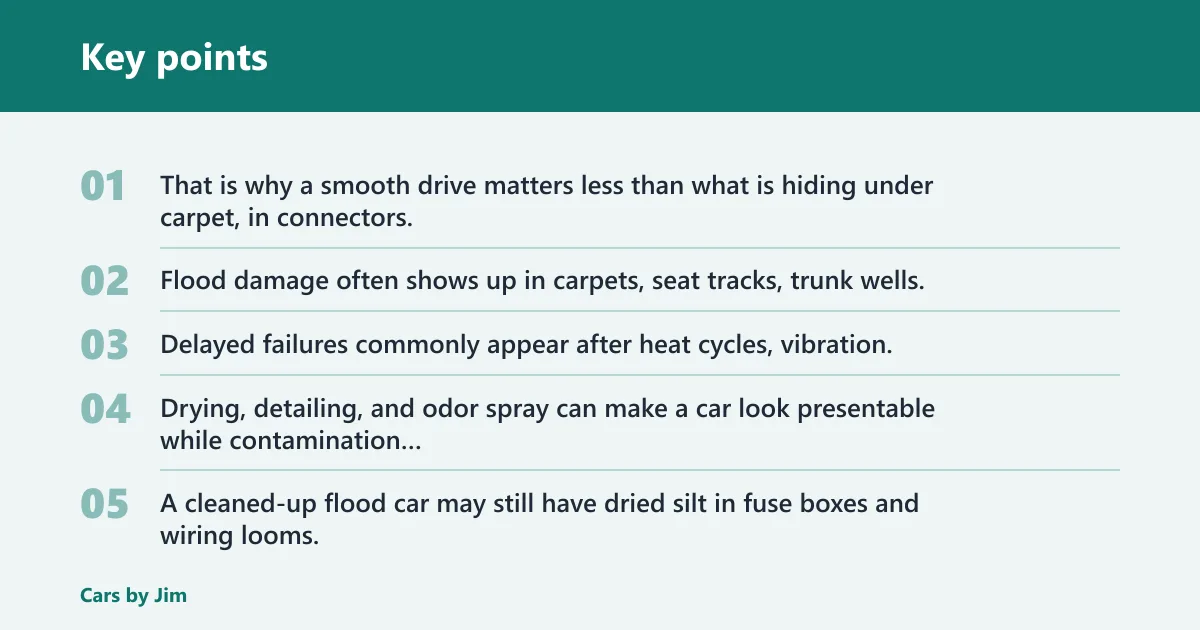
That is why a smooth drive matters less than what is hiding under carpet, in connectors, and inside control units. Flood damage often shows up in carpets, seat tracks, trunk wells, and under the dashboard, while the real risk sits in wiring looms, sensors, and safety electronics. Delayed failures commonly appear after heat cycles, vibration, and repeated parking because corrosion and trapped moisture keep working after the seller’s cleanup is done.
What “normal” can hide
Drying, detailing, and odor spray can make a car look presentable while contamination stays inside the vehicle. A cleaned-up flood car may still have dried silt in fuse boxes and wiring looms, and floodwater can leave odors in seat foam, carpet padding, and headliner materials. Those are not cosmetic issues. They can become electrical and mold problems later.
A brief lot test can still miss flood damage. That does not clear it. If the spare tire well holds a mud line or the under-dash hardware shows rust, the car may be carrying evidence of a low-point flood that a quick drive will never expose.
Damage often matters most after the vehicle has sat, heated up, cooled down, and been shaken by normal use. That is when intermittent faults start: a module drops offline, a lock stops responding, or the dash lights flicker. Flood exposure can cause cascading electrical failures months later.
Runs fine vs hidden flood damage
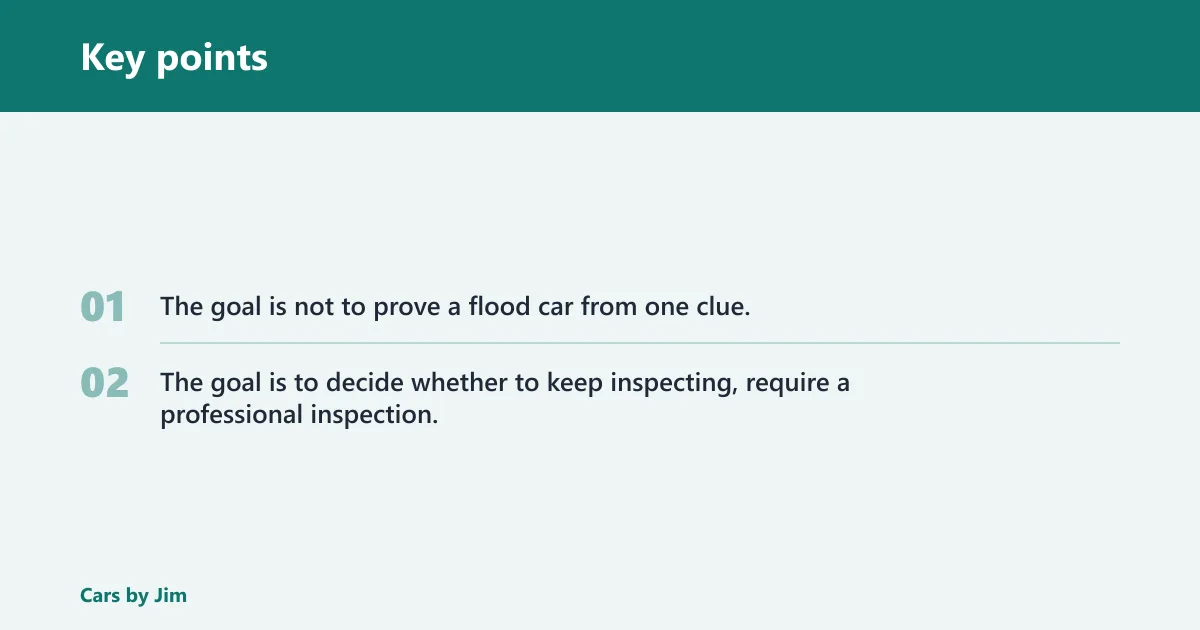
Use this table as a lot-side decision tool. The goal is not to prove a flood car from one clue. The goal is to decide whether to keep inspecting, require a professional inspection, or walk away before a hidden problem becomes your problem.
| Observable clue | Likely flooded area | Likely delayed failure | Severity score | Action |
|---|---|---|---|---|
| Musty odor that returns after the A/C runs | HVAC ducts, foam, carpet padding | Mold, mildew, lingering odor, repeated interior contamination | 4 | Professional inspection required |
| Heavy air freshener trying to mask smell | Seats, headliner, carpet, HVAC | Odor returns after heat or fan use | 3 | Continue inspection |
| Water lines, tide marks, or dirt above the floor | Doors, trim, under seats, dashboard lower edge | Hidden corrosion, trapped moisture | 5 | Walk away |
| Rust on seat rails, bolts, or under-dash hardware | Interior metal hardware | Progressive corrosion, seized fasteners, module issues | 4 | Professional inspection required |
| Wet-looking carpet, stiff padding, or uneven floor feel | Carpet backing, insulation, padding | Mold growth, wiring corrosion, smell that returns | 5 | Walk away |
| Mud, silt, or dried residue in crevices | Seat tracks, trim seams, fuse boxes, trunk seams | Corroded connectors, electrical faults | 5 | Walk away |
| Fogging or trapped moisture in headlights or taillights | Exterior lamp housings | Water intrusion, bulb socket corrosion, lighting faults | 3 | Continue inspection |
| Windows, locks, or dash functions act erratically | Switches, wiring looms, body control module | Intermittent electrical faults, module failure | 4 | Professional inspection required |
| Airbag, ABS, or warning lights appear or flicker | Safety modules, sensors, connectors | Airbag or ABS failure, stored fault codes | 5 | Walk away |
| Standing water marks or mud in the spare tire well | Rear low-point area and trunk floor | Hidden rear-body corrosion, wiring damage | 4 | Professional inspection required |
What flood damage hides in a car
The worst damage is often buried. Wiring looms can trap moisture and contaminants, then corrode inside insulation and connectors. Control modules can fail later after water exposure, including the airbag control module, body control module, and ABS-related electronics. Those failures can appear long after the car seemed fine.
Under-carpet padding and seat foam also matter. They can hold water, mud, and odor even after the surface looks clean. That is why hidden flood damage can survive a detail job and still leave a car electrically unsafe or expensive to repair later. A mechanic will also look for connector verdigris, corrosion on ground points, and green or white deposits where pins and terminals should stay clean.
Why the low points matter
Water settles in the places a seller can hide most easily. The spare tire wheel well is a key place to inspect for standing water and mud lines. The same is true for under-dash hardware, carpet edges, and the bottoms of seat tracks. Those areas often tell the truth before the dash does.
Low points also reveal whether flooding reached safety systems. Seat-belt pretensioner concerns matter because water can corrode connectors and trigger faults in restraint components even when the belt still moves normally. Stored communication codes and U-codes can be just as important as visible rust because they show modules have already lost clean data pathways.
What flood clues should you check first?
Start with the clues that survive cleaning: smell, residue, rust, and dampness. Musty odor, water lines, mud or silt in crevices, rust on seat rails or bolts, and residue in the trunk or spare tire well are all stronger signs than a spotless dashboard. A car can smell heavily of air freshener and still have flood damage underneath.
Check every area where water would pool or settle. That includes carpet edges, the lower dashboard, seat rails, trunk seams, and the spare tire wheel well. Floodwater can leave odors in seat foam, carpet padding, and headliner materials, so the smell may return when the cabin heats up or the fan runs.
- Open the doors and smell the cabin before touching anything.
- Lift carpet edges where possible and check for damp padding or staining.
- Inspect seat rails, bolts, and under-dash fasteners for rust or silt.
- Lift the trunk floor and check the spare tire well for mud lines or residue.
- Run the A/C, heat, and fan to see whether a musty smell returns.
Picture a crossover with clean seats and a polished dash, but the spare tire well has dried mud in the seam and the rear lamp housings are fogged. That combination is far more serious than the cosmetic condition suggests, because the water has already reached low electrical and storage areas.
Will a vehicle history report always show flood damage?
No. A vehicle history report can help, but it is not complete proof. Title records may reveal salvage, rebuilt, flood, or total loss history, though they can miss washed titles or incomplete state reporting. A clean report does not prove the car is flood-free, and the National Motor Vehicle Title Information System is still only as complete as the data that gets reported into it.
The limits matter because state title systems do not always move in lockstep. Flood branding and other title brands can get missed when vehicles change states or when paperwork trails behind the car. That is why title records help but do not settle the question on their own. Federal and state systems can reduce risk, but they do not eliminate title-washing realities.
How to use the report correctly
Treat the report as one layer of proof, not the last word. If the report is clean but the interior clues are mixed, assume the paperwork may be incomplete and move to physical inspection. If the report shows any flood, salvage, rebuilt, junk, or total loss history, the bar for buying should be much higher.
For extra context, a VIN check from NICB can help identify theft and total-loss signals, but it still does not certify a vehicle as flood-free. Insurance and vehicle history data are screening tools, not guarantees. If the paperwork and the car do not match, trust the car more than the ad.
What electrical problems can show up later?
Flood damage often starts with small electrical glitches and ends with larger system failures. Intermittent window, lock, and dash faults are common early signs. Later, ABS, airbag, and body-control issues can appear when corroded connectors or modules begin to fail under vibration, heat, or moisture.
Lighting can also reveal hidden water intrusion. Headlights and taillights may show fogging or trapped moisture inside the housing. That can mean the seal has already been compromised, and the same water path may have reached nearby wiring. A lamp that looks only slightly cloudy can still point to a broader problem.
Why safety systems deserve extra weight
Flood water can damage airbag control modules, ABS sensors, and body control modules. Those are not optional comfort parts. If any safety-related warning light is on, or if it flickers during the test drive, treat that as a serious warning rather than a minor annoyance. NHTSA guidance also treats water-damaged vehicles as a safety concern because hidden electrical and restraint-system damage can emerge later.
A common first-timer mistake is to dismiss one odd power window or one flickering warning lamp because the car still drives straight. That is exactly how flood cars get sold. The short drive feels normal while corrosion continues inside the system.
What should a mechanic inspect before you buy?
A mechanic should inspect the areas that hide water and the systems that fail later. That means under-carpet and under-dash inspection, connector corrosion checks, loom condition, module scans for stored faults, and HVAC odor and moisture checks. Professional inspection can save buyers from expensive repairs and reliability risks.
The inspection should include the trunk and spare tire well, seat tracks, lower dash, fuse boxes, and accessible connectors. A thorough scan matters because some flood damage will not show as a warning light right away. Others show only after the vehicle has been driven, parked, and re-started several times.
What a good inspection should include
- Pull back carpet edges and inspect padding for dampness, staining, or dried silt.
- Check under-dash brackets, wiring, and connectors for rust or residue.
- Inspect the spare tire well and trunk seams for standing water marks.
- Scan all modules for stored or pending faults, especially airbag and ABS systems.
- Run the blower, heat, and A/C to check for mildew odor from the HVAC system.
Suppose a compact SUV looks clean inside, but the scan tool finds module communication faults and the rear floor feels slightly damp under the carpet edge. That is not a cosmetic issue. It is a sign that the car needs a specialist inspection before any purchase decision. If the scan also shows U-codes or repeated communication losses, the risk is higher because those faults often point to corrosion in data lines, grounds, or connectors.
How do flood-damage warning signs turn into a buy-or-walk decision?
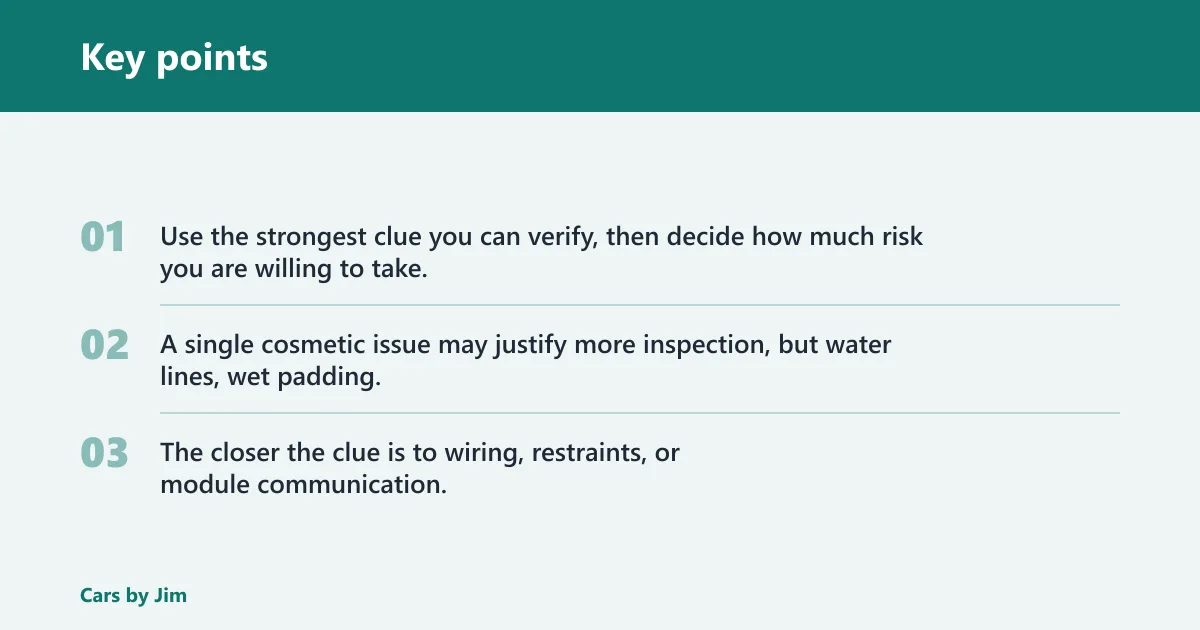
Use the strongest clue you can verify, then decide how much risk you are willing to take. A single cosmetic issue may justify more inspection, but water lines, wet padding, silt in connectors, or safety-module warnings push the car into walk-away territory. The closer the clue is to wiring, restraints, or module communication, the more urgent the decision should be.
| Observable clue | Likely flooded area | Likely delayed failure | Severity score | Action |
|---|---|---|---|---|
| Musty odor that returns after the A/C runs | HVAC ducts, foam, carpet padding | Mold, mildew, lingering odor, repeated interior contamination | 4 | Professional inspection required |
| Heavy air freshener trying to mask smell | Seats, headliner, carpet, HVAC | Odor returns after heat or fan use | 3 | Continue inspection |
| Water lines, tide marks, or dirt above the floor | Doors, trim, under seats, dashboard lower edge | Hidden corrosion, trapped moisture | 5 | Walk away |
| Rust on seat rails, bolts, or under-dash hardware | Interior metal hardware | Progressive corrosion, seized fasteners, module issues | 4 | Professional inspection required |
| Wet-looking carpet, stiff padding, or uneven floor feel | Carpet backing, insulation, padding | Mold growth, wiring corrosion, smell that returns | 5 | Walk away |
| Mud, silt, or dried residue in crevices | Seat tracks, trim seams, fuse boxes, trunk seams | Corroded connectors, electrical faults | 5 | Walk away |
| Fogging or trapped moisture in headlights or taillights | Exterior lamp housings | Water intrusion, bulb socket corrosion, lighting faults | 3 | Continue inspection |
| Windows, locks, or dash functions act erratically | Switches, wiring looms, body control module | Intermittent electrical faults, module failure | 4 | Professional inspection required |
| Airbag, ABS, or warning lights appear or flicker | Safety modules, sensors, connectors | Airbag or ABS failure, stored fault codes | 5 | Walk away |
| Standing water marks or mud in the spare tire well | Rear low-point area and trunk floor | Hidden rear-body corrosion, wiring damage | 4 | Professional inspection required |
Frequently asked questions
Can a car run fine and still have hidden flood damage?
Yes. A car can start, shift, and drive normally while hidden flood damage continues inside wiring, connectors, carpet padding, and control modules. A short test drive mainly proves that the car can behave normally for a short period, not that it will stay reliable after weeks or months.
How long can a flood-damaged car seem normal before problems show up?
It can seem normal for days, weeks, or longer, especially if the water exposure was cleaned up and the car is still drying internally. Flood exposure can cause cascading electrical failures months later, so delayed problems are common. A smooth drive today is not a safety guarantee.
What hidden flood damage signs should I check if the car drives normally?
Check for musty odor, heavy air freshener, water lines, mud or silt in crevices, rust on seat rails and bolts, and residue in the trunk or spare tire well. Also check headlights, taillights, and the HVAC system for fogging or mildew smell when the fan runs.
Can flood damage hide behind a clean title and good-looking interior?
Yes. Title washing can make a flood car appear to have a clean title, and cosmetic cleaning can hide obvious stains or smells. A clean-looking title and a tidy cabin do not prove the car is flood-free. Physical evidence still matters, especially in low areas and electrical parts.
What electrical problems can a flood-damaged car develop later?
Delayed problems often include intermittent windows, locks, dash faults, ABS issues, airbag warnings, and module failures. Headlights and taillights can also fog or trap moisture. Because flood water can damage airbag control modules, ABS sensors, and body control modules, the risk extends beyond convenience features.
Is it safe to buy a car that starts and drives after flooding?
Not on that fact alone. A car that starts and drives after flooding can still have corrosion, mold, and safety-system damage hidden in wiring and modules. If the clues are mixed or the car is otherwise appealing, a professional pre-purchase inspection is the safer next step before you buy.
Sources
- National Motor Vehicle Title Information System (NMVTIS) vehicle history
- NICB VINCheck
- FEMA: How to Spot a Flood-Damaged Vehicle
- NHTSA vehicle safety information
- Consumer Reports on spotting flood-damaged cars