Selling Price vs Out-the-door Price: What’s the Difference?
Selling price is the agreed-on price for the car before taxes, fees, and add-ons. Out-the-door price is the full amount due to take delivery. If you compare quotes without converting them, you can miss hundreds or thousands in mandatory charges and dealer extras. This guide shows how to separate required fees, negotiable charges, and optional products so you can compare offers correctly.
| Decision factor | Selling price | out-the-door price | Winner |
|---|---|---|---|
| Final budget comparison | Useful, but incomplete | Shows the total drive-off cost | out-the-door price |
| Room to negotiate | Usually the main negotiation point | Includes items that are often fixed by law | Selling price |
| Quote consistency across dealers | Can hide fees and add-ons | Better for apples-to-apples comparison | out-the-door price |
| Use at signing | Not enough by itself | Closer to the amount that should match the contract | out-the-door price |
Why out-the-door price matters more
The selling price is the negotiated vehicle-only amount. The out-the-door price adds the charges needed to complete the purchase, including taxes, title, registration, documentation fees, and any dealer add-ons. For comparison shopping, the out-the-door number is the one that tells you what the car actually costs to take home.
Why the selling price is not the final amount
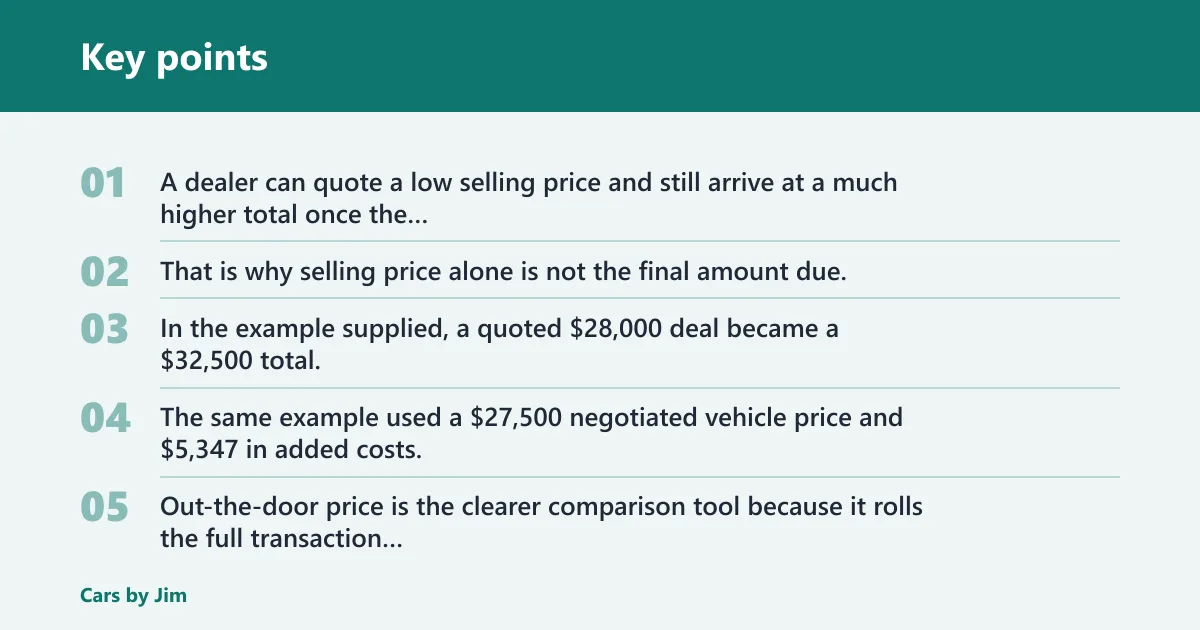
A dealer can quote a low selling price and still arrive at a much higher total once the tax base, mandatory government charges, and dealer-controlled fees are added. That is why selling price alone is not the final amount due.
In the example supplied, a quoted $28,000 deal became a $32,500 total. The same example used a $27,500 negotiated vehicle price and $5,347 in added costs, which shows how fast the gap can widen once the non-vehicle charges are counted.
Why out-the-door price is the better comparison figure
Out-the-door price is the clearer comparison tool because it rolls the full transaction into one number. OTD is typically 10-15% higher than selling price, so a quote that looks cheaper on the front end can still cost more at delivery.
Say two dealers quote the same trim. One advertises a lower selling price, but its documentation fee and add-ons are higher. The other shows a higher selling price but a lower total. The lower front-end number is not the better deal unless the full OTD total is lower too.
What is included in an out-of-the-door quote?
An out-of-the-door quote should include the vehicle selling price plus sales tax, registration, title, documentation fees, and dealer add-ons. Some dealers also list processing or similar administrative charges, which should be identified line by line so you can tell whether they are mandatory, dealer-controlled, or optional.
Taxes, title, and registration
Sales tax is set by state and locality. It is non-negotiable in the usual sense and can vary by registration address. Registration and title fees are government-mandated charges required for legal ownership transfer, and they are not negotiable.
The guide’s example used sales tax of 7% on a $27,500 vehicle price, plus registration of $350 and title fee of $75. Those charges belong in the OTD total, even if the dealer does not control them.
Dealer documentation fees
Documentation fees are dealer administrative charges. They vary widely by dealer and state, and some states cap them by law. The guide gives a documentation fee range of $150-$700, which is why you should never assume a doc fee is fixed from one store to the next.
The example also included a $399 doc fee and a $199 processing fee. Those are dealer-controlled charges, so they should be separated from government fees when you compare quotes.
Dealer add-ons and optional products
Dealer add-ons are optional dealer-installed products, such as paint protection, VIN etching, and nitrogen tires. They are often overpriced and can add $1,000-$5,000+ to the price. Because they are optional, they should not be buried inside a quote that is supposed to reflect the base purchase.
If a quote includes add-ons, list them separately. That makes it easier to decide whether the price is genuinely competitive or only looks lower because the extras were hidden until finance.
Selling price, MSRP, and sticker price
MSRP is the manufacturer’s suggested retail price on the window sticker for new cars. It includes factory options and the destination charge on new cars, so it is a reference point, not the amount you must pay. A car can sell below, at, or above MSRP. (Wikipedia)
How MSRP and sticker price work
On new cars, the Monroney label is the official sticker reference. It lists MSRP and options, which helps you compare equipment across cars before you get to tax, title, and dealer fees. The sticker is useful, but it is not the final transaction figure.
One sample table shows MSRP at $34,000 and OTD at $38,575. That gap is normal once taxes, fees, and add-ons are included. A sticker price is only a starting point for the conversation.
Why a car can sell below or above MSRP
Inventory, incentives, and dealer markups can move the selling price below or above MSRP. The sticker remains the reference number, but the transaction depends on the negotiated vehicle price and the charges layered on top of it.
That is why a quote that says “under MSRP” is not enough. You still need the OTD total before you can tell whether the offer is truly better.
Selling price vs out-the-door price worksheet
This worksheet helps you turn a dealer quote into three buckets: selling price, mandatory government fees, and dealer-controlled charges. Fill it out line by line before you compare stores or sign anything.
| Line item | Negotiable? | Taxed? | Should appear in the first OTD quote? |
|---|---|---|---|
| Selling price | Yes | Usually the tax base for the vehicle amount | Yes |
| Sales tax | No | No, it is the tax itself | Yes |
| Registration fee | No | Usually not taxed as a line item | Yes |
| Title fee | No | Usually not taxed as a line item | Yes |
| Documentation fee | Sometimes | Depends on state and dealer treatment | Yes |
| Processing fee | Sometimes | Depends on state and dealer treatment | Yes, if charged |
| Dealer add-ons | Yes, if optional | Depends on state and tax base rules | Yes, itemized separately |
| Trade-in allowance | Yes | Varies by state and deal structure | Only if part of the quote structure |
| Rebates or incentives | No, if manufacturer-set; sometimes dealer promotions vary | Varies by state and program | Yes, if used in the quote |
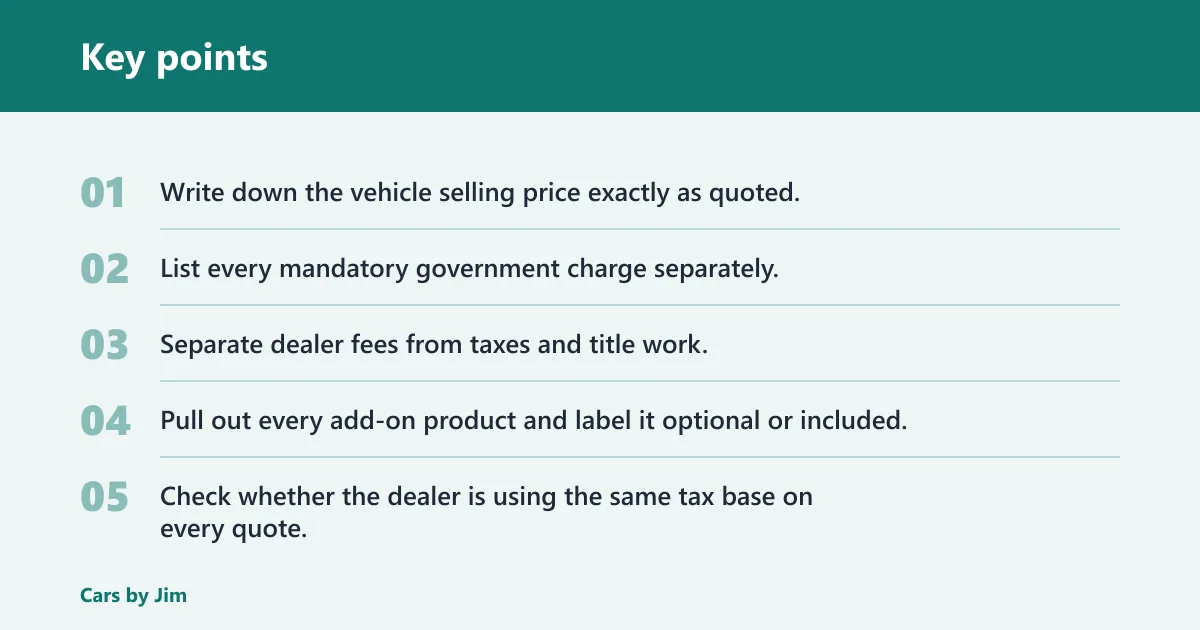
- Write down the vehicle selling price exactly as quoted.
- List every mandatory government charge separately.
- Separate dealer fees from taxes and title work.
- Pull out every add-on product and label it optional or included.
- Check whether the dealer is using the same tax base on every quote.
- Compare the final out-the-door total, not the monthly payment.
Suppose a quote shows a $35,000 selling price. If the dealer then adds tax, title, registration, and fees, the guide’s example shows that figure becoming $38,650 OTD. The vehicle price did not change; the full transaction did.
Which number should you negotiate first?
Negotiate the selling price first when you are still shopping the vehicle itself, because that is the part most directly tied to the car’s market price. Then ask for a written out-the-door quote so you can verify the full amount before you agree to anything. The total is what matters at the end.
When a low selling price can mislead you
A lower selling price can still be a worse deal if the dealer offsets it with higher fees or add-ons. That is why a low front-end number should never end the conversation. You need the total, line by line.
One example showed a dealer quote of $28,500 versus another dealer’s $29,200 OTD. The lower-looking price is not automatically the better offer because the second dealer already disclosed the full total.
How to compare two dealer quotes correctly
Convert both quotes into the same format before you compare them. If one dealer quotes only a selling price and the other quotes an OTD total, ask the first dealer to itemize taxes, title, registration, doc fees, and add-ons. Without that conversion, the quotes are not comparable.
Use the same registration address, same trade-in assumption, and same rebate treatment on both quotes. If those inputs differ, the OTD totals can differ for reasons that have nothing to do with the car’s real price.
Can a dealer change the OTD price at signing?
Yes, a dealer can try to change the total at signing if the quote was incomplete, if the tax base changed, or if late-added fees appear in finance. That is why the written OTD quote matters. It creates a paper trail for the numbers that should match the contract.
Common quote mismatches
Watch for different tax bases, hidden add-ons, and fees that appear only after you reach the finance office. A quote that looked complete on paper can shift if the dealer treats accessories, rebates, or trade-in credits differently at signing.
The example with a $27,500 negotiated vehicle price included $5,347 in added costs. If those numbers change late in the process, the final total changes too.
Different tax bases and late fees
Sales tax is not always applied to the same base in every deal. Trade-ins, rebates, and accessories may be treated differently depending on the deal structure and the state. That is why you should ask which amount the dealer is taxing before you agree to the quote.
Late-added fees are a red flag because they often appear only after the sales desk has already quoted a total. If the dealer cannot explain the change line by line, stop and ask for a corrected written quote.
What to check before you sign
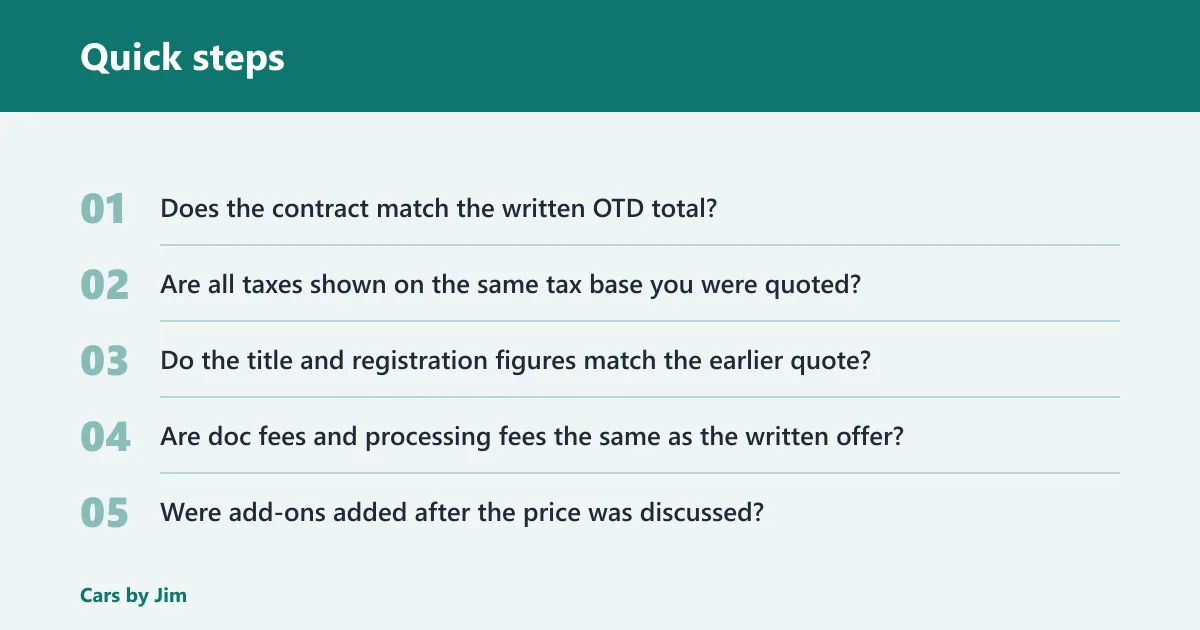
Use this quick mismatch check before signing any purchase papers.
- Does the contract match the written OTD total?
- Are all taxes shown on the same tax base you were quoted?
- Do the title and registration figures match the earlier quote?
- Are doc fees and processing fees the same as the written offer?
- Were add-ons added after the price was discussed?
- Did any rebate or trade-in figure change without explanation?
FTC Act Section 5 still matters in 2026, even after the CARS Rule withdrawal. Deceptive hidden pricing can still raise consumer-protection problems if a dealer buries charges, changes the quote late, or presents a misleading total.
Verdict: Selling price or out-the-door price?
Choose Selling price if you are still shopping the vehicle itself and want the part most directly tied to the car’s market price, like negotiating the negotiated vehicle-only amount first.
Choose out-the-door price if you are comparing dealer quotes, because it shows the full drive-off cost with taxes, title, registration, documentation fees, and dealer add-ons, and it is the number that should match at signing.
Frequently asked questions
What is the difference between selling price and out-the-door price?
Selling price is the negotiated vehicle-only amount. Out-the-door price adds taxes, title, registration, documentation fees, and dealer add-ons. If you compare only the selling price, you can miss the charges that determine the actual total needed to take the car home.
Does the out-the-door price include taxes and fees?
Yes. OTD includes the vehicle selling price plus sales tax, registration, title, documentation fees, and dealer add-ons. That is why OTD is the better figure for budget comparison, while the selling price is only one part of the transaction.
Is the selling price the same as the final price I pay?
No. The selling price is the base vehicle amount before the transaction fees are added. Your final amount may be much higher once government charges and dealer-controlled fees are included, so do not treat the selling price as the finished number.
Why is the out-the-door price higher than the advertised price?
Advertised prices often focus on the vehicle amount alone. OTD is higher because it includes tax, title, registration, doc fees, and sometimes add-ons. That gap is normal, but it should be explained in writing before you sign.
Which number should I negotiate first, selling price or out-the-door price?
Start with the selling price if you are comparing the vehicle itself, then demand a written out-the-door quote so you can confirm the full total. For the final decision, the OTD number matters more because it captures the complete cost of the deal.
How much higher is out-the-door price than MSRP or sticker price?
There is no universal spread because taxes, registration, title fees, doc fees, and add-ons vary by state and dealer.