Trade-in Value Calculator Accuracy: What to Trust
Online trade-in value calculators can help set expectations, but they are estimates, not appraisals. Kelley Blue Book, Edmunds, and J.D. Power all frame vehicle values as market-based guides that depend on the exact car, mileage, condition, and location. For planning, the key question is how accurate are online trade-in value calculators when you actually take the car to a dealer?
How accurate are online trade-in value calculators?
They are usually accurate enough for planning, especially for common cars with complete details, but they are still estimates. The closer the tool gets to the exact VIN, trim, mileage, condition, accident history, and local market, the tighter the result tends to be. If those inputs are generic, the number should be treated as a rough range.
Range versus final offer
The range matters because calculators work from assumptions, not an in-person inspection. A mainstream vehicle with a clean history and normal wear can land near the center of that band, while a car with missing options, uneven condition, or unusual demand can drift toward the edges. That is why a calculator can be useful without being final.
Dealers also work from a different formula. They inspect the car, estimate reconditioning, and factor in how quickly they expect to resell it. That is why a calculator can be directionally right and still miss the dealer’s actual number.
How shoppers should use the number
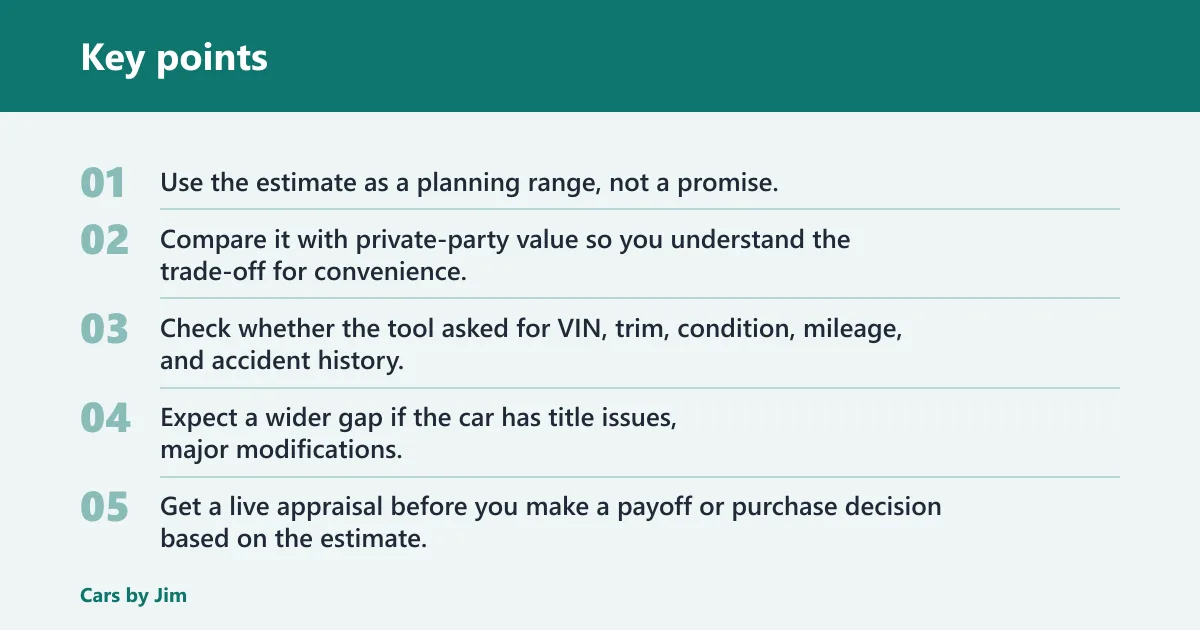
- Use the estimate as a planning range, not a promise.
- Compare it with private-party value so you understand the trade-off for convenience.
- Check whether the tool asked for VIN, trim, condition, mileage, and accident history.
- Expect a wider gap if the car has title issues, major modifications, or unusual demand in your market.
- Get a live appraisal before you make a payoff or purchase decision based on the estimate.
Say a 2021 Honda Civic is a common trim, has about 48,000 miles, and shows normal wear. A VIN-based calculator that asks for condition and trim should usually get you into a useful range. If the same car is a modified Si with aftermarket suspension and a repaint, the estimate becomes much less certain.
Trade-in accuracy checklist
This checklist shows where online estimates are usually strongest and where they break down. Use it to judge whether the number is close enough for planning or too rough to trust.
| Scenario | Likely reliability | Why it breaks |
|---|---|---|
| Exact VIN-known mainstream car | High | The tool can match the exact vehicle, trim, and equipment. |
| Base trim without options | High to moderate | Fewer options mean fewer hidden value gaps. |
| High-mileage car | Moderate to low | A simple benchmark may not capture how heavily mileage affects resale demand. |
| Accident history | Low | Basic tools may not fully account for prior damage or repair quality. |
| Lifted or modded vehicle | Low | Aftermarket changes can hurt resale appeal even if the car looks well kept. |
| Salvage or rebuilt title | Low | Many calculators do not fully price in title status. |
| EV with battery concerns | Low to moderate | Battery health and warranty status may matter more than the base model data. |
| Rare or low-volume model | Low | Thin comparable sales make the estimate less stable. |
| Regional hot seller with strong local demand | Moderate | Generic tools may miss local supply and resale appetite. |
| Older car with repeated repairs | Low | Age alone does not capture wear, downtime, or dealer risk. |
| Rank | Input | Why it improves accuracy | Typical failure if missing |
|---|---|---|---|
| 1 | VIN | Identifies the exact vehicle, trim, factory equipment, and build details. | The tool may price the wrong trim or ignore equipment that changes value. |
| 2 | Condition | Excellent, Good, Fair, and Poor ratings materially change the estimate. | Cosmetic wear, mechanical issues, or warning lights may be understated. |
| 3 | Mileage | Places the car against the expected use pattern and depreciation curve. | The estimate may assume average annual use and miss high- or low-mileage effects. |
| 4 | Trim and body type | Different versions of the same model can have different demand and resale value. | The calculator may flatten a base car, sport trim, or AWD version into one price. |
| 5 | Accident and title history | Clean-history assumptions can be very wrong if the car has prior damage or a branded title. | The estimate may overstate value and create a large gap at appraisal. |
Why is my estimate different from the dealer offer?
Dealer offers differ because dealers price in inspection findings, reconditioning, resale risk, and profit margin. They also react to local demand and inventory needs. If you want a cleaner comparison between online value and a live offer, use the estimate as a starting point and then compare it with private-party value, not just the trade-in number.
VIN, mileage, condition, and accident history
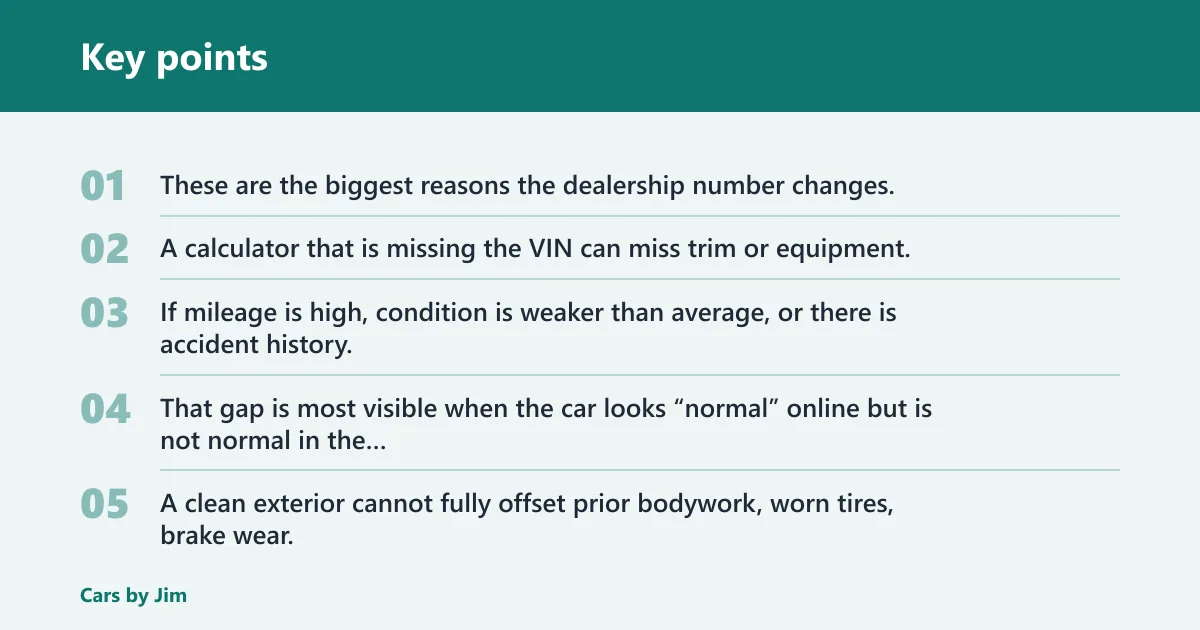
These are the biggest reasons the dealership number changes. A calculator that is missing the VIN can miss trim or equipment. If mileage is high, condition is weaker than average, or there is accident history, the dealer may reduce the offer after inspection even if the online estimate looked healthy.
That gap is most visible when the car looks “normal” online but is not normal in the used-car market. A clean exterior cannot fully offset prior bodywork, worn tires, brake wear, or mechanical concerns that affect resale confidence.
Private-party value versus trade-in value
Trade-in value is usually lower than private-party value because the dealer takes on cleanup, marketing, financing risk, and time on lot. Kelley Blue Book, Edmunds, and J.D. Power all distinguish between dealer trade-in and private-party pricing because they serve different buyers and different costs.
That is why the spread matters. If you know the private-party value, you can see whether the trade-in convenience is worth the difference. The gap also gives you a realistic target when negotiating your next purchase.
Local demand and inventory needs
Do trade-in calculators include local market demand? Usually only in a broad way. Regional supply, weather, fuel prices, and buyer preferences can all move an offer because the dealer is pricing what it can resell quickly in that market. Generic tools often miss that local demand layer.
This is one reason two dealers can quote different numbers on the same car. One may need your vehicle for its inventory mix, while another may already have similar cars sitting on the lot.
Equity and loan payoff
Equity and loan payoff can change the actual deal even if the estimate itself is solid. Positive equity can reduce what you finance on the next vehicle, while negative equity can be rolled into the new loan and make the purchase more expensive. The trade-in value and the payoff amount are related, but they are not the same thing.
If the dealership offer is lower than expected, the key question is whether the offer still covers your remaining balance. That is the number that determines your equity position, not the calculator alone.
Dealer appraisal findings
Inspection findings are often the final reason for a lower offer. Reconditioning costs, tire wear, cosmetic damage, stains, warning lights, and mechanical service needs all reduce what a dealer can safely pay. Those costs are not always visible in an online estimate, which is why the in-person appraisal can move the number materially.
That difference is not arbitrary. It reflects the cost to make the vehicle retail-ready and the risk that it may take longer to sell than expected.
Should I trust a calculator without a VIN?
You can trust a no-VIN calculator only as a rough planning tool. It is useful for a common vehicle with standard equipment, but it is too broad for trims, options, accident history, or title issues that can change value. If the car is unusual or your deal depends on accuracy, a VIN-based estimate is better.
When a generic estimate is good enough
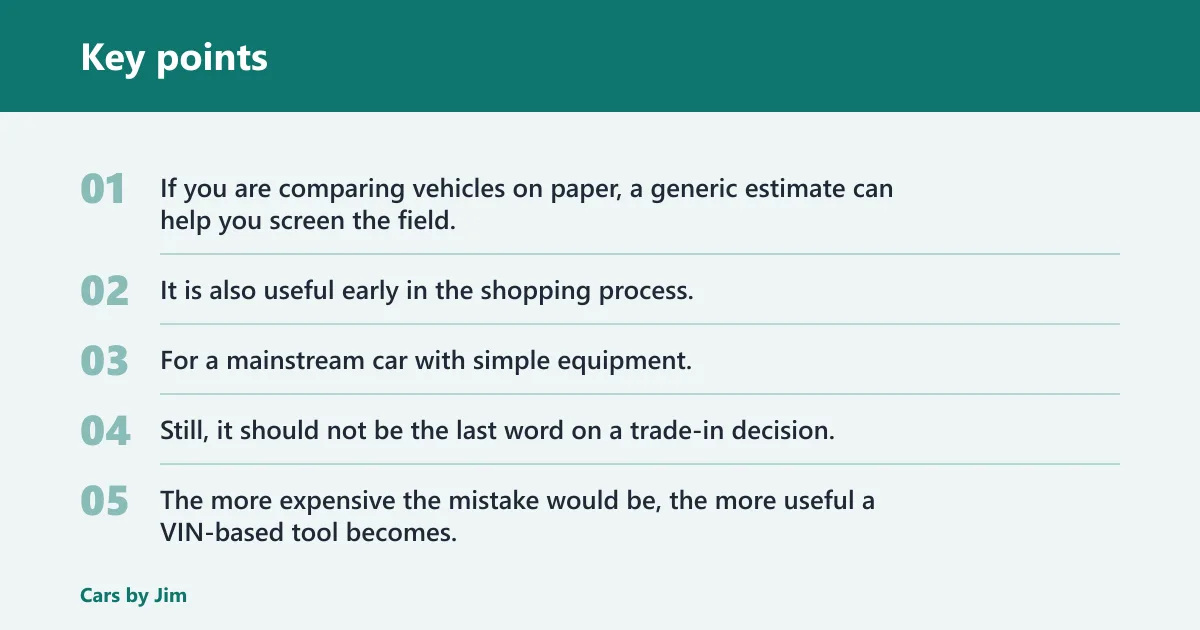
If you are comparing vehicles on paper, a generic estimate can help you screen the field. It is also useful early in the shopping process, before you have the exact VIN or a full appraisal report. For a mainstream car with simple equipment, the result may be close enough for a first pass.
Still, it should not be the last word on a trade-in decision. The more expensive the mistake would be, the more useful a VIN-based tool becomes.
Signs the tool is too coarse
If the calculator ignores trim, body type, fuel type, condition, or accident history, it is probably too broad for a serious trade-in decision. The same is true if it gives one number with no range and no explanation for title status or local demand. That kind of output is better for a quick screen than a negotiation plan.
A common mistake is using a generic estimate for a vehicle with a rare package or a branded title, then treating that number like a dealer quote. That is where the gap between planning and reality can widen fast.
Which inputs matter most?
The most accurate calculators ask for the details that separate one version of a car from another. VIN, mileage, condition, trim, accident history, and title status usually matter more than a simple year-make-model lookup. The better the input set, the closer the estimate tends to be.
VIN, trim, and body type
VIN-based, trim-specific tools are usually closer than generic calculators because they can distinguish between versions with different equipment and resale appeal. A base sedan, a sport trim, and an all-wheel-drive version of the same model can have different trade-in values for good reason.
Body type matters too. A hatchback, crew cab, or SUV may face different demand than a sedan with the same powertrain. Generic tools often flatten those differences.
Mileage and age
Vehicle age is a primary depreciation input, often calculated from model year or current age, and it is commonly used with a per-year mileage benchmark. Mileage can increase or decrease the estimate depending on whether the car is above or below the expected range.
High mileage usually lowers the trade-in estimate because it signals more wear and less remaining resale life. Age and mileage work together, though. A 10-year-old car with unusually low mileage can be more appealing than a newer car with much heavier use.
Condition and options
Condition options commonly shown are Excellent, Good, Fair, and Poor. Those labels usually cover cosmetic wear and mechanical state, and they can move the number more than many shoppers expect. A car with worn tires, a cracked windshield, or warning lights is not in the same bucket as a clean, fully sorted one.
Options can matter, but only when the calculator actually counts them. A sunroof, premium audio system, driver-assist package, or different wheel set may change the result if the tool is detailed enough to recognize them.
Accident history and title status
Accident history and title status are major value filters. Prior accidents, salvage titles, rebuilt titles, and major repairs can reduce value sharply, and basic calculators do not always include those facts.
That is one of the biggest failure cases. A clean-looking car with a branded title can seem normal online and then get a very different appraisal in person.
What makes estimates less reliable?
Some vehicle types strain online calculators more than others. High-mileage cars, lifted or modified vehicles, salvage or rebuilt titles, EVs with battery concerns, and rare or low-volume models are often harder to price accurately from a standard form.
High-mileage cars
High mileage lowers trade-in estimates because the vehicle is farther from the expected use pattern. Some tools use 12,000 miles per year as a benchmark, but a car that is far above that line may need a manual adjustment because wear, age, and resale appetite do not fall in a straight line.
Lifted or modified vehicles
Lifted trucks and modified cars are difficult because the market for the modifications may be smaller than the market for the stock vehicle. Even when the upgrades are expensive, they do not always raise trade-in value.
Salvage or rebuilt titles
Salvage and rebuilt titles are major warning flags. A calculator that does not ask about title status may overstate value by a wide margin because many buyers and dealers discount branded-title cars heavily.
EV battery concerns and rare models
EVs can be hard to estimate when battery condition, warranty status, or charging history is unclear. Rare or low-volume models are also hard because there may be too few comparable sales for a clean algorithmic answer.
Suppose a battery-electric crossover looks normal on the outside but has a reduced driving range and an expired battery warranty. A generic trade-in tool may price it like a healthy example. The live appraisal can be much lower once the dealer factors in battery risk.
How to use the estimate in negotiations
An online estimate works best as an opening figure. Use it to set expectations, compare dealer offers, and decide whether it is worth seeking another appraisal. Do not use it as a final number until the vehicle has been inspected.
Bring the calculator result with you and ask the dealer what specific items would move the offer up or down. That turns the estimate into a useful discussion tool instead of a guess you defend blindly.
- Check the estimate from a VIN-based tool if possible.
- Compare the result with private-party value.
- Review your mileage, condition, and title status before the appointment.
- Ask the dealer what reconditioning items they found.
- Compare the final trade-in offer with your loan payoff to see your equity.
A strong estimate can still be offset by timing. If the dealer already has several similar cars in stock, the offer may be softer than if the same car is in short supply locally.
Frequently asked questions
Why is my online trade-in estimate different from the dealer offer?
Dealers account for inspection findings, reconditioning costs, resale risk, and profit margin. They also know local demand and inventory needs, which a generic calculator may not capture, so the in-person number can move up or down from the online range.
Should I trust a trade-in calculator without a VIN?
Only as a rough screen. A no-VIN tool can work for a common vehicle with standard equipment, but it is too broad for trims, options, title issues, or modifications that change value in ways the calculator may not see.
What is the difference between trade-in value and private-party value?
Trade-in value is what a dealer may offer toward your next vehicle, while private-party value is what a buyer may pay you directly. Trade-in is usually lower because the dealer handles inspection, cleanup, marketing, and resale risk.
Do mileage and condition change trade-in estimates a lot?
Yes. Mileage is a core depreciation input, and condition often shifts the estimate sharply between Excellent, Good, Fair, and Poor. A well-kept car with average miles can price very differently from a worn car with the same year and model.
How often should I recheck my car’s trade-in value?
Recheck it whenever your mileage changes meaningfully, your condition changes, or the market has moved. If you are months away from trading, check again before you visit the dealer so your plan reflects current demand and your current payoff balance.