How Much Are Dealer Fees on Used Cars?
Dealer fees on used cars often run from roughly $200 to $1,000+, and the doc fee is often the largest dealer-controlled charge. Skip them, and you can overpay by hundreds or sign for more than you planned. This guide breaks down normal fees, optional add-ons, state fees, and how to calculate the true out-the-door price before you sign.
Typical cost range
For most used-car shoppers, dealer fees land in a practical range of about $200 to $1,000+, but the total can be lower or higher depending on the state, the store, and any add-ons. The key number is the out-the-door price in writing, because that is the real amount you will pay.
Why the total changes by state and dealer
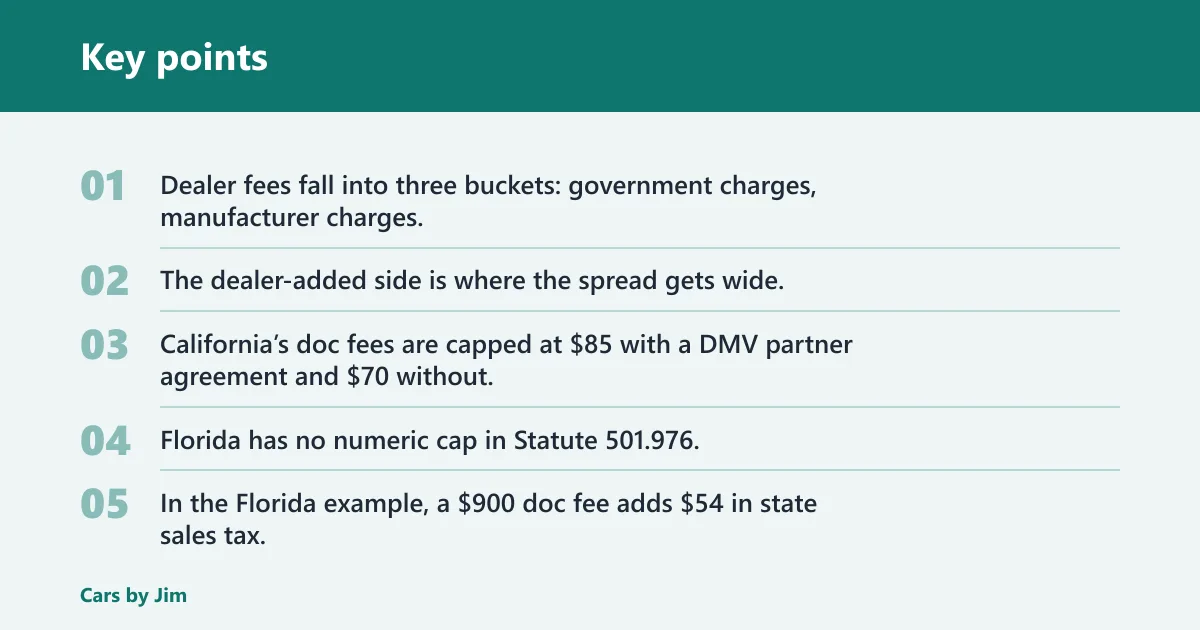
Dealer fees fall into three buckets: government charges, manufacturer charges, and dealer-added items. The dealer-added side is where the spread gets wide, especially for the dealer documentation fee, which may also be called a doc fee, processing fee, or conveyance fee.
Some states cap that fee. California’s doc fees are capped at $85 with a DMV partner agreement and $70 without, and New York’s doc fee cap is $175. Florida has no numeric cap in Statute 501.976, but dealer fees there are included in the taxable sales price.
That tax detail matters. In the Florida example, a $900 doc fee adds $54 in state sales tax. Tennessee also treats document processing and preparation fees as part of the vehicle’s sales price and subjects them to tax, with a 7% state rate plus local sales tax that varies by county or municipality.
What to expect on an out-the-door quote
Ask for the out-the-door total in writing, not just the sticker price. That written number should include the vehicle price, dealer fee, title, registration, tax, and any add-ons the dealer is trying to include. A low fee can still be offset by a higher vehicle price elsewhere.
Suppose a used SUV is advertised at $24,000 and the dealer agrees to “waive” a $499 doc fee. If the selling price quietly jumps to $24,499, the deal is no cheaper. The only number that tells the truth is the final out-the-door total.
What dealer fees do dealerships charge?
Used-car dealers commonly charge a dealer documentation fee, plus line items for prep, reconditioning, and optional add-ons. Some of those charges are fixed by policy or law, while others are negotiable or removable if you do not want them. Used cars also should not carry new-car destination fees as a normal lot charge.
Dealer documentation fee
The dealer documentation fee is the most common dealer-added fee. It covers paperwork handling, but the label matters less than who receives the money and whether the amount is capped by state law. The buyer should ask who actually receives the charge.
California law says a doc fee cannot be represented as a government fee. That distinction matters because a dealer can collect the fee, but it is still a dealer-controlled line item, not a tax or DMV charge.
Dealer prep and processing fees
Dealer prep, processing, and similar labels often overlap. Some stores use them for cleaning, fueling, inspection, or basic paperwork. Others use them in a way that duplicates work already covered by the dealer documentation fee or by manufacturer-paid predelivery work.
That is why the label alone is not enough. Ask what exact service the fee covers and whether it duplicates another charge on the buyer’s order. If the answer sounds vague, ask for it to be removed or folded into the selling price.
Optional add-ons that may appear on the quote
Optional add-ons can include GAP, service contracts, VIN etching, rustproofing, tire or wheel protection, and similar products. These items can often be declined if they are not required, though some dealers may try to finance them into the loan or present them as part of a package.
There is a difference between optional and mandatory. A dealer can offer an add-on, but that does not make it required for the purchase. Review each line before you sign, especially if the add-on is already included in the payment amount.
Which fees are government charges?
Government charges usually include sales tax, title fee, and registration fee. These are separate from dealer profit lines and usually do not work like regular negotiable charges. They still belong on the out-the-door quote, because they change the final amount you owe.
Sales tax
Sales tax is a government charge calculated from the taxable sales price, and rules vary by state and locality. In some places, dealer fees can increase the taxable amount, which means the fee itself can create extra tax on top of the fee.
That is why a $900 dealer fee is not just $900. In a state where the fee is taxable, the total cost can rise by the fee plus the tax that applies to that fee.
Title fee
The title fee is a government-related transfer charge. It is usually remitted to the state, though a dealer may collect it on your behalf as part of the paperwork. It should be listed clearly so you can tell it apart from dealer profit lines.
Registration fee
The registration fee is the government vehicle registration cost. It may include plate ordering or renewal handling, but it is not a dealer profit line when passed through correctly. If the dealer is charging more than the government amount, ask for the breakdown.
Destination fee on used cars
The destination charge is a manufacturer fee disclosed on the Monroney label. It is a new-car charge, not typically a used-car lot fee. If you see a destination fee on a used vehicle quote, ask why it is there and whether it is being mislabeled or duplicated.
Used-car fee worksheet
Use a simple worksheet to compare quotes line by line. The goal is not to memorize every fee name. The goal is to sort each charge into dealer-added, government, or optional, then compare the out-the-door total across dealers.
| Fee name | Typical purpose | What to ask the dealer |
|---|---|---|
| Dealer documentation fee | Paperwork handling; dealer-controlled line item | What is the exact amount, and is it capped by state law? |
| Dealer prep fee | Cleaning, fueling, or preparation | What work does this cover, and does it duplicate another fee? |
| Reconditioning fee | Dealer work to ready the car for sale | Is this already reflected in the vehicle price? |
| Sales tax | Government charge on taxable sales price | What amount is taxable, and what rate is being used? |
| Title fee | Title transfer charge | Is this a pass-through government fee or an added service fee? |
| Registration fee | Plate and registration cost | What part goes to the state, and is any handling fee included? |
| GAP or service contract | Optional add-on product | Can this be removed without changing the car price? |
| VIN etching or protection product | Optional add-on product | Is this required, or can I decline it? |
Out-the-door calculator fields
Use these fields to build the total before you agree to anything:
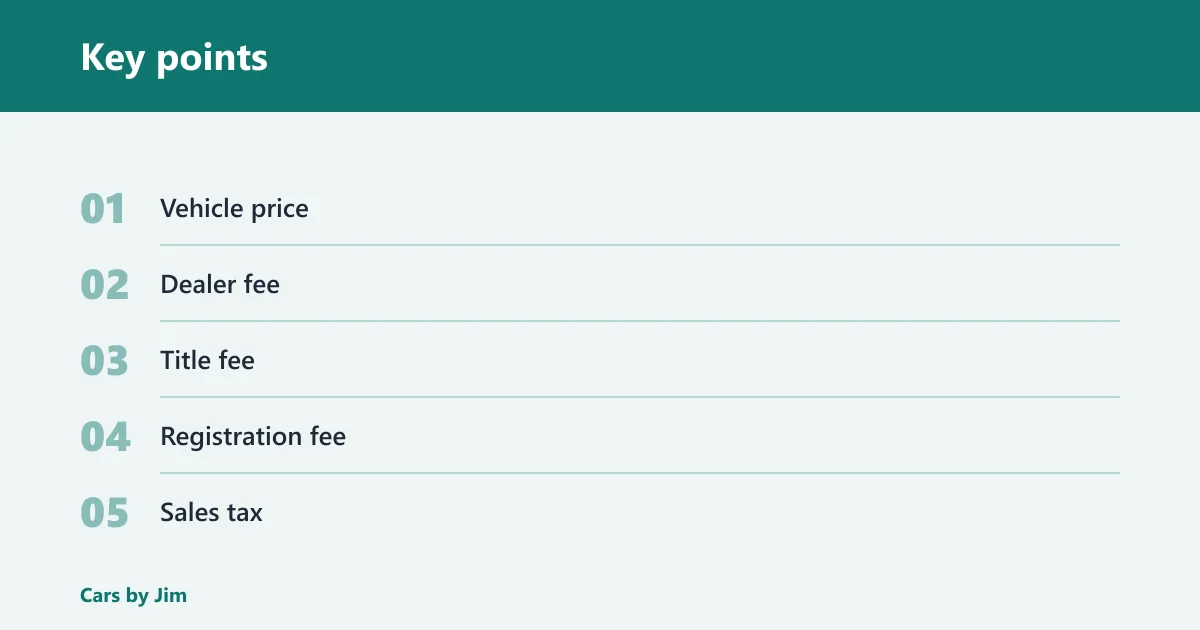
- Vehicle price
- Dealer fee
- Title fee
- Registration fee
- Sales tax
- Add-ons
Out-the-door cost = vehicle price + dealer fee + title fee + registration fee + sales tax + add-ons
How to use the worksheet to compare quotes
Ask each dealer for the same line-item format, then fill in the worksheet with the exact numbers. A quote with a lower fee but a higher vehicle price may still cost more. Compare the full total, not one line in isolation.
Picture two quotes on the same sedan. Dealer A shows a $399 doc fee and no add-ons. Dealer B shows a $199 doc fee, but adds a $299 service contract and a higher selling price. The worksheet makes the difference obvious.
Which fees can you negotiate?
Some fees are fixed by law or tax rules, but others can be reduced, removed, or offset in the deal structure. The doc fee may be capped by state law, add-ons can often be declined, and a waived fee may reappear in the vehicle price if the dealer moves the money elsewhere.
Doc fee limits and state caps
The dealer documentation fee is not always negotiable in practice, but state caps can limit the amount charged. California and New York have specific caps, while Florida does not have a numeric cap in the cited statute. Even where the fee cannot be removed, the amount still needs to be disclosed clearly.
That means “non-negotiable” does not always mean “invisible.” You may not be able to change the fee, but you can still compare dealers based on how large it is and how it affects the final tax bill.
Dealer add-ons you can decline
Optional add-ons are often the easiest place to save money. GAP, service contracts, VIN etching, rustproofing, and tire or wheel protection can usually be declined if they are not required. If the dealer says an add-on is mandatory, ask for the written reason.
When a waived fee may reappear in the price
A fee waiver does not automatically lower the deal. Dealers can raise the selling price, remove a discount, or add a different charge to offset the waiver. That is why the only fair comparison is the final out-the-door number.
One useful check is to compare the vehicle price before and after the fee discussion. If the fee drops by $300 but the price climbs by $300, the total deal has not changed.
How do you check the buyer’s order?
Review the buyer’s order line by line before signing. Look for duplicate charges, confirm which items are taxable, and make sure the out-the-door price in writing matches the number you agreed to. If a charge is unclear, ask who receives it and why it is there.
Spot duplicate charges
Watch for prep, reconditioning, dealer service fee, processing fee, and similar labels appearing together. One store may use several names for the same type of work. Ask whether each line is separate work or a duplicate charge under a different label.
Confirm taxable items
Check whether your state taxes dealer fees. Florida does, and Tennessee treats document processing and preparation fees as part of the vehicle’s sales price. If the fee is taxable, it will raise the out-the-door total beyond the fee itself.
Get the out-the-door price in writing
The out-the-door total should be written on the buyer’s order before you sign. The FTC warned 97 dealership groups about advertised prices and mandatory fees, and the guide cites a $4 million Manchester City Nissan settlement. Those examples are a reminder to get the complete number in writing.
- Ask for the full buyer’s order, not a payment-only quote.
- Check the vehicle price, dealer fee, tax, title, registration, and add-ons.
- Look for duplicate labels such as prep, reconditioning, and processing.
- Ask who receives each fee and whether it is mandatory.
- Confirm the out-the-door total before you sign anything.
Frequently asked questions
How much are typical dealer fees?
Typical dealer fees on used cars often fall between about $200 and $1,000+, but the spread can be wide because state rules and store policies differ. The doc fee is often the largest dealer-controlled line, while title, registration, and tax are separate government-related charges that also affect the total.
How much are dealer fees?
Dealer fees are not one fixed number. A buyer may see a modest doc fee, a prep or processing charge, and optional products added to the quote. The safer question is not the fee alone, but the final out-the-door price after tax, title, registration, and add-ons.
How much are average dealer fees?
Average dealer fees are hard to pin down because they vary by state, dealer type, and whether the quote includes add-ons. On a used car, the practical range often starts in the low hundreds and can climb past $1,000 when optional products or higher doc fees are included.
What fees can a car dealer charge?
A dealer can charge dealer-added fees, government pass-through fees, and optional products if they are disclosed. Common examples include the dealer documentation fee, prep or reconditioning charges, title, registration, sales tax, and optional add-ons such as GAP or a service contract. Ask for each item in writing.
Do all car dealers charge dealer fees?
No, but most will charge something, and the amounts can vary a lot. Some fees are fixed by state law, some are dealer policy, and some are optional add-ons you can decline. Even if a fee is removed, the dealer may offset it elsewhere in the deal.
How much are car dealer fees?
For used cars, dealer fees commonly land in roughly the $200 to $1,000+ range, though the total can vary with the fee mix and state tax rules. A buyer should compare the full out-the-door number, because a lower advertised fee can still lead to a higher final price.