Private Party vs Dealer Price Difference: What Is Normal?
A normal private-party discount is often about 5% to 15% below dealer retail, but the real test is whether taxes, repairs, financing, and warranty coverage erase that gap. Ignore that math and you can overpay for a “cheap” listing or miss a dealer car that is actually the better total deal. This guide shows how to compare sticker price, out-the-door cost, repair risk, financing, and warranty value.
| Decision factor | Private party | Dealer price | Winner |
|---|---|---|---|
| Sticker price | Usually lower, often sold as-is | Usually higher because it includes reconditioning, overhead, and margin | Private party |
| Immediate risk and repairs | Buyer carries the first repair bill and inspection risk | Some issues may be handled before sale, and a limited warranty may help | Dealer price |
| Financing and paperwork | More steps; often arranged through a bank or credit union | Usually easier, with dealer financing and handled paperwork | Dealer price |
| Total comparison after adjustments | Must add tax, registration, inspection, repairs, and transport, then subtract any warranty value | Must add dealer fees and compare the included reconditioning and coverage | Tie |
Typical cost range
The sticker gap is real, but it is only the starting point. Private-party sales are typically 10–15% cheaper than dealer retail for the same vehicle, and a $25,000 car can save about $2,500 to $3,750 in a private-party deal. That savings can shrink fast once you add inspection costs, repairs, taxes, and financing differences.
What the sticker price leaves out
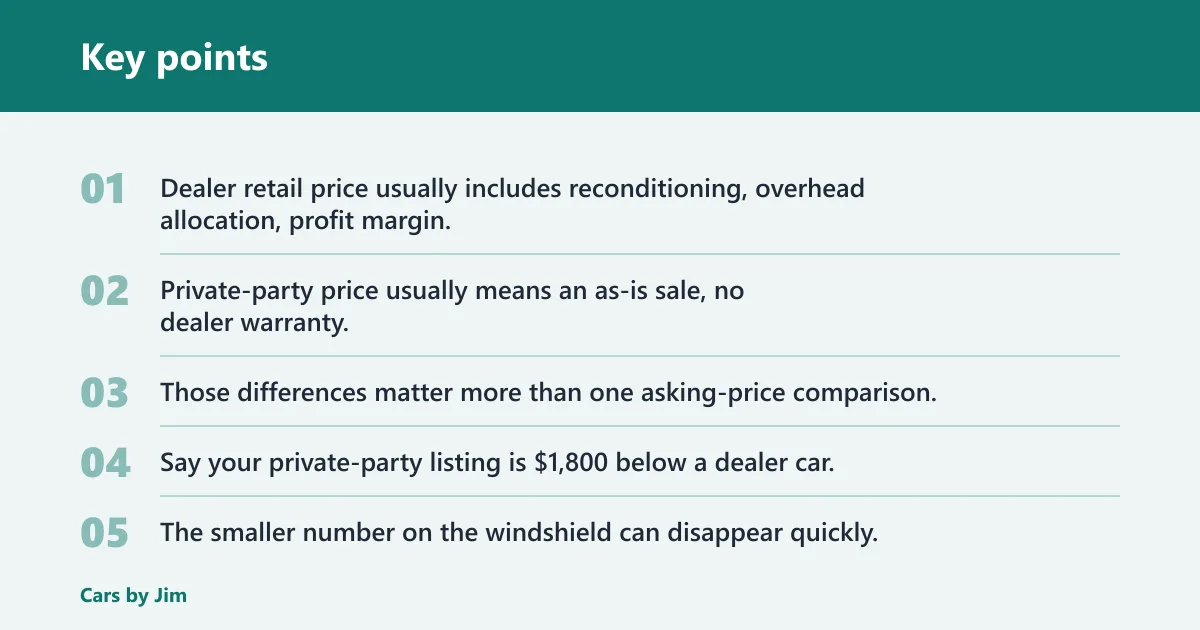
Dealer retail price usually includes reconditioning, overhead allocation, profit margin, and paperwork handling. Private-party price usually means an as-is sale, no dealer warranty, no reconditioning included, some room to negotiate, and direct owner history. Those differences matter more than one asking-price comparison.
Say your private-party listing is $1,800 below a dealer car, but the tires need replacement, the brake fluid is overdue, and the bank charges a higher rate for the private loan. The smaller number on the windshield can disappear quickly.
Why the same car can cost more at a dealer
Dealer support is not free. A dealer may spend money on tires, fluids, detailing, minor bodywork, title work, and other inspection-driven adjustments before the car is listed. The posted price often reflects that work plus the dealer’s cost of running the business.
The FTC Used Car Rule requires dealers to display a Buyers Guide that indicates whether the car is sold with warranty coverage or as-is. That disclosure does not make the price low, but it does tell you what level of protection is attached to the sale.
How to compare total cost, not just asking price
The clean way to compare is to normalize both options to total out-the-door cost. Independent-dealer and private-party prices should be normalized by OTD cost, repairs, warranty value, and financing difference. CarmaDeal says a 10%-15% private-party discount is a planning assumption, not a universal fact.
That matters because a private-party listing can look cheap and still cost more after repairs, while a dealer listing can look expensive and still win once warranty value and lower repair risk are counted.
Side-by-side price comparison
The correct comparison is asking price versus asking price only if every other cost is the same. In practice, it is total cost versus total cost, with the same taxes, registration, repairs, financing difference, and warranty value applied to each listing. That is the only way to tell whether the gap is real.
Taxes, registration, fees, and travel
Both paths can trigger sales tax and registration, but dealer deals often add more line items. Private-party purchases can also require travel, temporary transport, or a day away from the buyer’s home area. Those costs do not care how clean the listing looks.
Warranty value and financing differences
Dealer coverage can add value, especially if it includes a limited warranty or return policy. VinSpecs says dealers may offer a limited warranty or return policy, and private-party sales are almost always sold as-is with no warranty. That difference can be worth real money, but only within the stated coverage period and scope.
Dealer financing is often easier to obtain than private-party financing, but a bank or credit union may still finance a private-party car. The key is rate, fee structure, and convenience, not a blanket rule that one path always wins.
Price gap by vehicle age and mileage
The normal gap changes with age and mileage. A low-mileage car, a mid-mileage car, and a high-mileage car carry different repair risk, different warranty value, and different room for reconditioning. Treat them separately.
Low-mileage cars
On a newer, low-mileage car, dealer retail can be easier to justify because limited warranty coverage may matter more. CarmaDeal estimates CPO value at about $1,200-$2,000 as a planning assumption, and its example showed a franchise CPO at $25,000 OTD with $250 immediate reset. A low-mileage private-party discount can be too small if the buyer gives up warranty value and still pays dealer-like money after add-backs.
Mid-mileage cars
Mid-mileage cars often sit in the middle of the trade-off. A private-party car may still be cheaper, but inspection findings, tire age, and maintenance history matter more than the badge on the lot. This is where a $700 dealer immediate reset, like the CarmaDeal independent dealer example, can narrow the true gap faster than a simple sticker comparison suggests.
High-mileage cars
High-mileage cars can favor private party if the buyer is prepared for repairs and has a strong inspection result. Squeezed says private-party prices run 10–20% lower than dealer retail on average, but on older cars the savings can be consumed by first-round maintenance, transport, and a stricter financing offer. Cheap is only cheap if the repair stack stays small.
What makes dealer prices higher?
Dealer prices are higher because the dealer is selling more than metal and mileage. The price usually includes work the buyer would otherwise have to arrange, plus the business costs of stocking, storing, and selling the vehicle. That is the trade.
Reconditioning and inspection work
Reconditioning covers the visible and hidden items that make a used car sale-ready: tires, fluids, detailing, minor bodywork, and inspection-driven adjustments. If a dealer puts money into those items before listing the car, the asking price usually reflects it. That is why some dealer cars appear expensive but need less immediate cash after purchase.
Overhead allocation and profit margin
Dealer retail price also absorbs overhead allocation and profit margin. Those costs are part of the business model, and they help explain why the same vehicle can sit above a private-party price even when the underlying car is similar. The buyer is paying for the seller’s structure as well as the car.
Paperwork handling and convenience
Dealers handle a lot of the admin work. Title transfer, DMV paperwork, lender coordination, and buyer disclosures are usually simpler at the store than in a driveway sale. That convenience has value, especially when time matters or the buyer does not want to chase forms and signatures.
What should you add to a private-party price?
Add every cost needed to make the car truly comparable with a dealer listing. A private-party asking price alone is too low a number to trust because it excludes inspection, history checks, and the repair money you are likely to spend right away. Compare full totals, then decide.
Inspection and history report costs
A pre-purchase inspection from an independent mechanic typically costs about $100–$200. The same source recommends that step, and the reason is simple: it can screen for mechanical problems and title risk before money changes hands. A vehicle history report from Carfax or AutoCheck typically costs about $25–$50 and can reveal accident, title, and odometer issues.
Immediate repairs and reconditioning allowance
Build in an immediate repair allowance even if the car seems clean. CarmaDeal’s private-party example used $21,500 OTD with $1,400 immediate reset, while the same example showed an independent dealer at $23,200 OTD with $700 immediate reset. Those numbers show how quickly “cheaper” becomes less cheap once first-round work is counted.
Title checks, taxes, and transport
Verify that the seller name matches the title, confirm lien release, and look for salvage or rebuilt title risk. Then add taxes, registration, fees, and any transport or travel cost. If the car is two hours away and needs a trailer, the difference between private party and dealer can change fast.
- Get the asking price.
- Add tax and registration.
- Add inspection and history report cost.
- Add expected immediate repairs.
- Add travel or transport.
- Subtract warranty value if the dealer car includes it.
- Add the financing difference if the loan terms are not the same.
When is a private-party car overpriced compared with dealer retail?
A private-party car is overpriced when the adjusted total comes close to, or exceeds, a dealer car with clearer disclosure, reconditioning, or warranty coverage. If the discount is only a few hundred dollars after you add inspection, repairs, and financing differences, the private-party deal may not deserve the extra effort. The risk must buy you something.
When the discount is too small
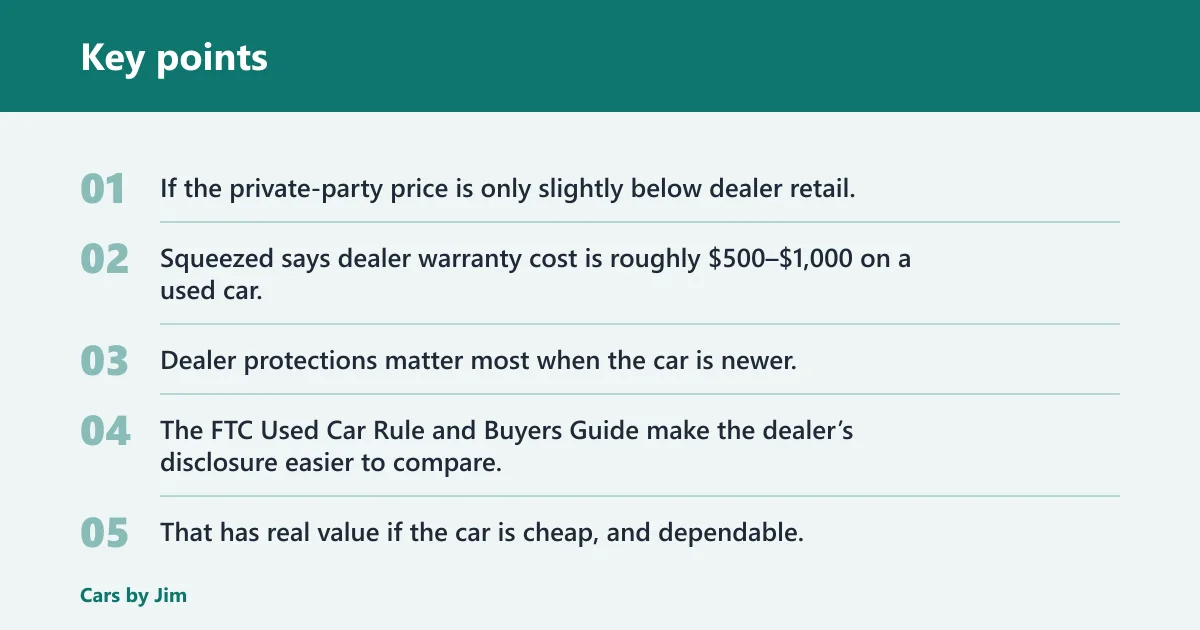
If the private-party price is only slightly below dealer retail, the gap can disappear once you add the pre-purchase inspection, history report, and first repairs. The same source says dealer warranty cost is roughly $500–$1,000 on a used car, so a weak private discount can fail to cover even one modest repair issue. Small savings are fragile.
When dealer protections justify the extra cost
Dealer protections matter most when the car is newer, the buyer wants a simpler transaction, or the warranty period is likely to matter. The FTC Used Car Rule and Buyers Guide make the dealer’s disclosure easier to compare, and the limited warranty or return policy can reduce the buyer’s exposure during the first weeks or months. That has real value if the car is cheap, and dependable.
Suppose a newer sedan is priced $1,500 below a dealer equivalent, but the private-party car lacks coverage, needs tires, and has no clean service history. In that case, the dealer car may be the lower-stress buy even at the higher sticker price.
When a private-party listing is really a dealer-level price
Some private sellers ask dealer money without offering dealer support. If the listing is near dealer retail, the title history is thin, and the seller will not move much on price, the deal can be poor. A private-party car should usually earn its premium with cleaner history, better maintenance records, or a meaningfully lower total cost.
Choose Private party if… / Choose dealer price if…
Choose private party if the price gap stays large after you add taxes, repairs, inspection, history checks, and financing differences. Choose dealer price if the extra money buys meaningful warranty coverage, lower first repair risk, or easier paperwork. The right choice is the one with the better total cost for your situation.
Choose Private party if…
- You can verify the title, lien release, and ownership history.
- You can afford a pre-purchase inspection and a repair cushion.
- You want the lowest total cost and the discount is still strong after add-backs.
- You are comfortable arranging your own financing or paying cash.
Choose dealer price if…
- You want a clearer process and less paperwork.
- You value a limited warranty, return policy, or reconditioning work.
- You need dealer financing or want easier loan handling.
- The private-party car is only a little cheaper after adjustments.
Private party price normalization table
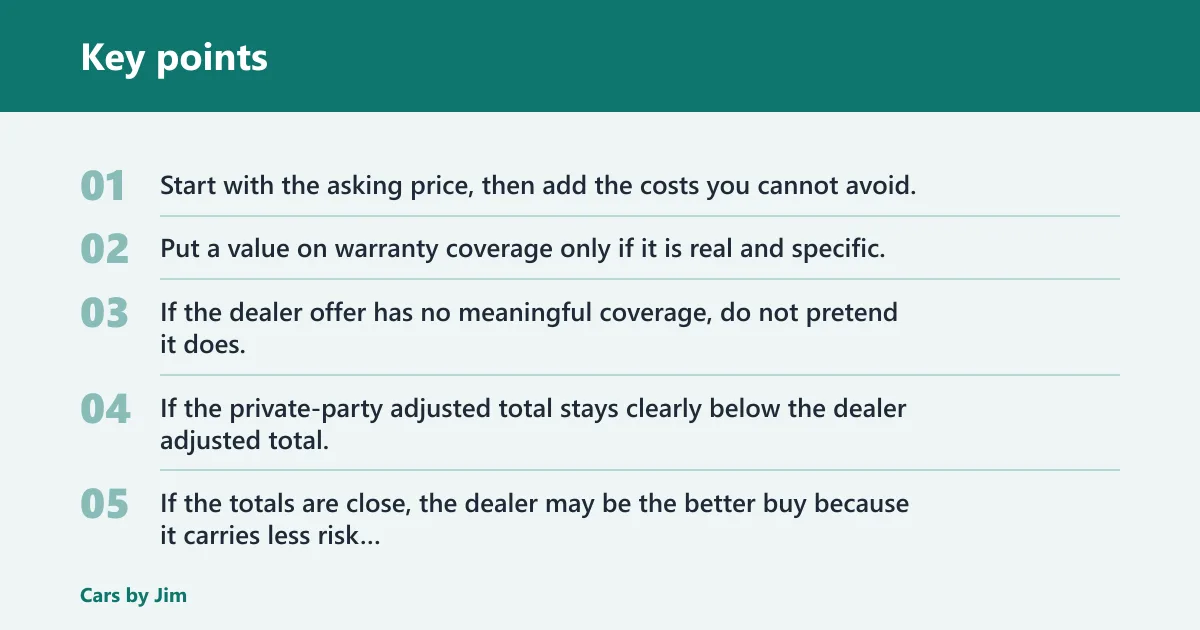
Use the same formula for both options: asking price + taxes/registration + immediate repairs + inspection cost + financing difference – warranty value. The point is not to force every buyer into the same answer. The point is to make the gap visible in dollars, not just in ads.
| Example | Private party | Dealer price | What changes the gap |
|---|---|---|---|
| Low-mileage car | $24,000 asking + $1,100 taxes/registration + $150 inspection + $400 repairs + $300 financing difference – $0 warranty value = $25,950 | $25,500 asking + $1,100 taxes/registration + $100 repairs – $1,500 warranty value = $25,200 | Dealer price wins because warranty value offsets the higher sticker |
| Mid-mileage car | $20,500 asking + $1,000 taxes/registration + $150 inspection + $1,200 repairs + $250 financing difference – $0 warranty value = $23,100 | $22,200 asking + $1,000 taxes/registration + $600 repairs – $800 warranty value = $23,000 | Nearly even; dealer price is slightly better after adjustments |
| High-mileage car | $14,500 asking + $900 taxes/registration + $200 inspection + $1,800 repairs + $350 financing difference – $0 warranty value = $17,750 | $16,000 asking + $900 taxes/registration + $1,000 repairs – $500 warranty value = $17,400 | Dealer price wins on total cost if the repair gap stays this wide |
How to use the formula
Start with the asking price, then add the costs you cannot avoid. Put a value on warranty coverage only if it is real and specific, such as limited powertrain coverage for 30 to 90 days or 3,000 to 5,000 miles. If the dealer offer has no meaningful coverage, do not pretend it does.
How to read the adjusted total
If the private-party adjusted total stays clearly below the dealer adjusted total, the discount is real. If the totals are close, the dealer may be the better buy because it carries less risk and less hassle. If the private-party total is higher, the listing is overpriced for what it offers.
Frequently asked questions
How much cheaper is private party than dealer for the same car?
That is a starting point, not a final answer. Taxes, repairs, financing, and warranty value can shrink or erase the advantage.
What price difference between private seller and dealer is normal?
A normal gap is often 10–15%, but the right comparison is adjusted total cost, not sticker price. The same source says that percentage is a planning assumption, not a universal fact. Newer cars, older cars, and CPO units can all land differently once warranty and repair risk are counted.
Is a private party discount worth the risk versus dealer protections?
It can be, if the discount still looks strong after inspection, history, taxes, and first repairs. It usually is not, if the savings are thin and the dealer car includes real coverage or lower repair exposure. The value has to exceed the risk, not just match it.
What fees make dealer and private-party prices less comparable?
Taxes, registration, dealer fees, inspection cost, vehicle history reports, immediate repairs, and travel or transport all affect the true total. Financing differences can matter too, since dealer financing is often easier while private-party loans may require a bank or credit union and different terms. Those costs belong in the same calculation.
How do warranty and reconditioning change the price gap?
Dealer reconditioning can reduce the repairs you face right away, and limited warranty coverage can reduce risk for a short time after purchase. Only count that value if the coverage is real and relevant.
Can I finance a private-party car the same way as a dealer car?
Sometimes, but not usually with the same ease. Dealer financing is often simpler because the dealer manages more of the paperwork, while a private-party loan may need a bank or credit union and more steps. The loan may still be available; the difference is convenience, speed, and rate.