How High Mileage Is Too High for a Used Car to Buy?
A used car is too high-mileage when the discount no longer covers the repairs you are likely to face. At 150,000 miles, you need full service records and a pre-purchase inspection. At 200,000 miles, buyers should generally look only at especially well-kept examples. This guide gives you a practical buy/no-buy framework, plus the checks that matter most before you pay.
When mileage matters most
Short answer: mileage matters most when it tells you how much wear the car has likely absorbed, how soon big services may be due, and how much repair budget you need to reserve. A higher odometer reading is not an automatic dealbreaker, but it should narrow your margin for error and lower the price you are willing to pay.
Odometer mileage is a wear-and-tear proxy, not a verdict. Read it with age, service history, and use pattern. A well-kept 120,000-mile highway car can beat a neglected 70,000-mile city car with no records.
Average annual mileage helps you judge whether a car has been used lightly or heavily. U.S. drivers average about 13,500 miles a year according to the Federal Highway Administration, while many shoppers still use 12,000 miles a year as a practical benchmark for normal use. In the UK, annual mileage benchmarks are often lower and can vary by driver profile, so the closer the odometer sits to the expected pattern, the more “normal” the use tends to look. FHWA Vehicle Miles Traveled Statistics
How age and mileage work together
Age matters because rubber, seals, hoses, and fluids age even when the car does not rack up miles. Mileage matters because moving parts wear with use. A 5-year-old car at 50,000 miles fits a normal pattern. A 2-year-old car at around 20,000 miles can also fit a normal pattern. An 8-year-old car at 80,000 miles may still be fine, but the service record becomes much more important.
Higher mileage usually lowers price and resale value. That is the opportunity. It is also the risk. The real question is not “How many miles are too many?” but “Does the price leave enough room for the repairs this car is likely to need before you sell it?”
What average annual mileage says about use
Yearly mileage can reveal whether a car spent most of its life on motorways or in stop-and-go traffic. Highway miles tend to be gentler on brakes, steering, and transmissions than repeated short trips, cold starts, and city congestion. Those city miles can add wear even when the odometer number looks modest.
Say your shortlist includes a 6-year-old hatchback with 72,000 miles and a 9-year-old sedan with 78,000 miles. The first averages 12,000 miles a year, which looks normal. The second averages about 8,700 miles a year, which also looks reasonable, but the longer age means more attention to age-related parts and service dates.
Is 100,000 miles too much for a used car?
Short answer: no. 100,000 miles is a checkpoint, not a cutoff. Many modern vehicles can exceed 200,000 miles when maintained on schedule, so the important question is not whether the odometer has crossed six figures, but whether the car has records, recent maintenance, and a price that still leaves room for near-term repairs. iSeeCars longest-lasting cars study Consumer Reports cars
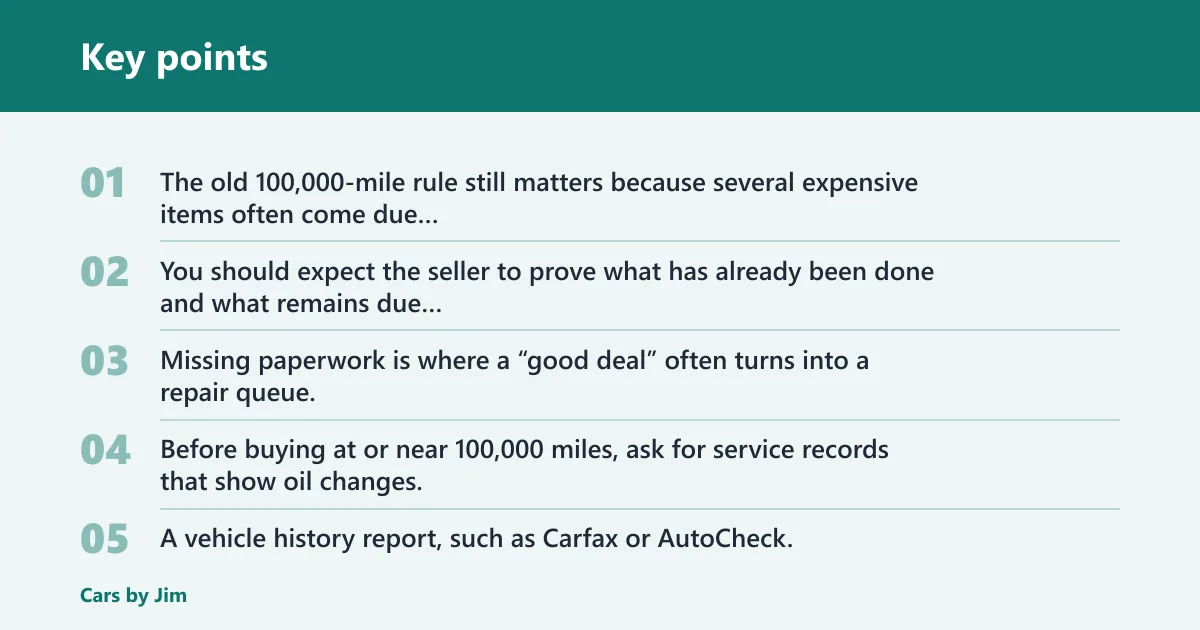
The old 100,000-mile rule still matters because several expensive items often come due around that point. You should expect the seller to prove what has already been done and what remains due soon. Missing paperwork is where a “good deal” often turns into a repair queue.
What has to be documented before you buy?
Before buying at or near 100,000 miles, ask for service records that show oil changes, cooling-system work, and the big scheduled items. A vehicle history report, such as Carfax or AutoCheck, should be checked for accident history, odometer history, and title history. A pre-purchase inspection should follow even if the report looks clean.
Look for proof of timing belt service if the engine uses one, water pump replacement when it is tied to the belt job, transmission fluid changes, and spark plug replacement if that interval is due. OEM maintenance schedules vary by model, but many manufacturers place these items in the 60,000- to 120,000-mile window. If the seller cannot document them, assume the next owner may have to pay for them soon. Toyota Owners manuals and maintenance schedules Honda maintenance schedules
Common costs that start to matter near this point
Some repairs are cheap enough to ignore. Others are not. A worn belt, overdue plugs, or fluids can be manageable. A transmission problem is not. RepairPal estimates transmission replacement typically lands in the several-thousand-dollar range, and larger transmission failures can climb beyond that depending on the vehicle and labor market, which is why transmission history matters more than the mileage sticker alone. RepairPal transmission repair cost estimator
| mileage range | what it usually means | must-have proof before buying | common failure points | when to walk away |
|---|---|---|---|---|
| under 60,000 | Low mileage; may still feel like-new if maintained well | Service stamps, clean history report, no warning lights, PPI if price is strong | Brake wear, battery age, tires, neglected fluids | Walk if records are missing and the car has visible neglect or accident history |
| 60,000–100,000 | Mid-range mileage; a normal buying zone for many shoppers | Maintenance history, recent fluid changes, history report, PPI | Suspension wear, brakes, cooling parts, spark plugs, transmission service gaps | Walk if the service record is patchy and the seller cannot explain missing intervals |
| 100,000–150,000 | Traditional danger-zone territory; no longer an automatic no-buy point | Full records, proof of major services, detailed PPI, clean title history | Timing belt systems, water pump, transmission wear, oil leaks, worn mounts | Walk if major services are overdue, the car has slip/noise symptoms, or the discount is thin |
| 150,000+ | High mileage; not necessarily a dealbreaker, but the inspection bar rises sharply | Complete records, recent major services, strong PPI results, ownership history that makes sense | Transmission wear, suspension looseness, cooling leaks, electrical faults, rust | Walk if records are missing, rust is active, or the price does not leave room for repairs |
What matters more than mileage?
Short answer: service history, use pattern, rust exposure, and the quality of the inspection matter just as much as the odometer. A well-documented car with higher miles can be a safer buy than a lower-mileage car with gaps in maintenance or evidence of hard use.
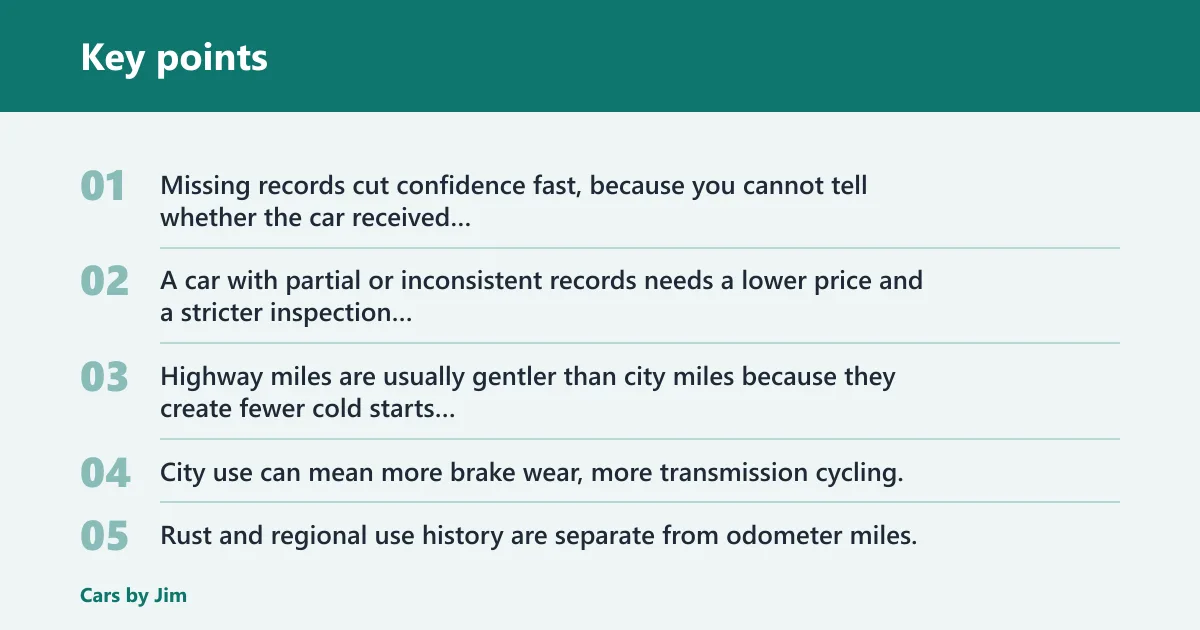
Service history matters as much as mileage. Missing records cut confidence fast, because you cannot tell whether the car received timely oil changes, coolant service, transmission maintenance, or overdue repairs. A car with partial or inconsistent records needs a lower price and a stricter inspection than one with clean documentation.
Driving conditions matter too. Highway miles are usually gentler than city miles because they create fewer cold starts and less stop-and-go wear. City use can mean more brake wear, more transmission cycling, and more strain on cooling and charging systems.
Rust and regional use history are separate from odometer miles. A clean-looking car from a salt-belt area can hide corrosion under the body, on suspension parts, and around brake lines. That can turn a “reasonable mileage” car into a difficult buy.
Service history and missing records
Missing records should be treated as a pricing problem first and a trust problem second. If the seller cannot show maintenance, assume the car may need catch-up work. If the mileage is high and the records are weak, the discount needs to be large enough to cover the uncertainty.
Suppose a 110,000-mile SUV has no proof of transmission service, no timing belt documentation, and no recent fluid records. Even if it runs well on the test drive, the lack of paper trail means you should price in the next owner’s maintenance, not the previous owner’s promises.
Highway miles versus city miles
Highway use usually leaves fewer wear clues than city use. A car that spent years on motorways may show less brake and steering wear than one that did short, stop-start trips across town. That does not make it trouble-free. It just changes where to inspect first.
For city cars, check brake condition, suspension noise, idle quality, and transmission smoothness. For highway cars, pay more attention to service intervals, oil leaks, tire age, and any history of long, overdue maintenance.
Rust, salt, and regional use history
Rust-belt use should lower your tolerance for high mileage. A 90,000-mile car from a dry climate can be a stronger candidate than a 70,000-mile car that spent winters on salted roads. Corrosion is expensive because it affects structure, fasteners, and underbody components that are hard to replace cleanly.
Check for bubbling paint, crusty brake lines, flaking subframes, and seized suspension hardware. If corrosion is active, mileage matters less than the cost of making the car safe and serviceable again.
Is 150,000 miles too high for a used car?
Short answer: not automatically. 150,000 miles is the point where the inspection bar rises sharply, because the car should already show evidence of major maintenance and enough remaining value to justify near-term repair risk. For the right buyer and the right price, a 150,000-mile car can still be a smart purchase.
150,000 miles is a strong inspection checkpoint, not an automatic reject. At this stage, the car should already have proof of major services, a clean history report, and a pre-purchase inspection that checks leaks, wear, and hidden damage. Without that evidence, the risk usually outweighs the savings.
The discount has to match the remaining life you expect to get from the car. If you plan to keep it only a year or two, and the price is low enough to absorb repairs, a well-kept 150,000-mile car can still make sense. If you need long ownership with little repair risk, the bar should be much higher.
Which older repairs should already be done?
By 150,000 miles, a strong candidate should usually have documentation for major service milestones that fall earlier in its life: timing belt, water pump, transmission fluid, and spark plugs where applicable. Cooling-system work and suspension refreshes also become important. If these items are overdue, they should be treated as real costs, not maybe-soon items.
Most manufacturers expect some wear parts to have been replaced by this point. If the seller cannot prove it, assume you are buying the job along with the car.
When the discount still makes sense
The car can still make sense if three things line up: the price is low, the records are strong, and the inspection is clean. Toyota, Honda, Lexus, and Subaru often have stronger mileage reputations than some rivals, but brand reputation does not cancel out neglect. Condition still wins.
A late-model 150,000-mile car can be a better buy than an older one with the same odometer reading if the newer car has cleaner records, fewer owners, and less corrosion. Age and mileage must be judged together.
Transmission and major service risks
Short answer: transmission condition can make or break the deal. Even a good-looking high-mileage car can become a no-buy if the gearbox slips, shudders, or delays engagement. Major scheduled services also matter because missing them can turn a bargain into a repair bill before you have owned the car long enough to enjoy it.
Transmission wear deserves its own check because it can be far more expensive than many other repairs. Automatic transmissions can slip, shudder, or hesitate. CVTs have their own warning signs and can be costly when neglected. Manual gearboxes are often simpler, but they still need clean clutch and shift behavior.
Listen for noises, feel for vibration, and check for delayed or rough engagement. A transmission that hesitates when selecting Drive or Reverse is not a small issue. It is a warning sign that should affect the price immediately, or end the deal.
Automatic transmission warning signs
Automatic transmissions should shift smoothly, without flare, harshness, or delay. If the car slips under load, shudders at steady speed, or takes too long to engage, assume there is a mechanical or hydraulic issue until proven otherwise. A PPI should include a road test that checks these behaviors under light and moderate throttle.
Transmission fluid condition matters too. Burnt smell, dark color, or evidence of neglected service can point to future expense. If the seller says the fluid “never needs changing,” be cautious. That claim often conflicts with the car’s actual maintenance needs.
CVT concerns and symptoms to watch
CVTs are not all bad, but they need closer scrutiny than a simple mileage number suggests. Watch for whining, shuddering, hesitation, or strange engine flare during acceleration. Any no-engagement symptom, where the car does not move promptly when selected into gear, is a serious red flag.
With CVTs, the maintenance record matters more than optimism. A clean test drive does not erase skipped service intervals. It only means the problem may not have shown up yet.
Timing belt, water pump, fluid, and spark plug timing
Big service items often cluster around 100,000 miles. Timing belts, water pumps, transmission fluid, and spark plugs are the common ones to check. If the timing belt is due, the water pump is often done at the same time because labor overlaps. That is not a bargain repair. It is a real cost.
These jobs should already appear in the records on a high-mileage car. If they do not, the asking price should reflect that work. If it does not, walk away.
Should you avoid a high-mileage used car?
Short answer: no, not automatically. A high-mileage car can still be a smart buy when the model has a strong durability record, the maintenance history is complete, and the price gives you room for the first year of ownership costs. The right question is not whether the car is high-mileage, but whether it is underpriced enough to offset the likely repairs.
No, not automatically. A high-mileage car can still be a smart buy if the price leaves room for repairs, the records are complete, and the inspection comes back clean. The best candidates often come from reliable-nameplate models that have a strong history of surviving mileage when maintained properly.
You should avoid a high-mileage car when the paperwork is weak, the rust is active, the transmission shows symptoms, or the price ignores the next round of maintenance. Mileage alone does not decide the deal. The full cost picture does.
Good candidates by make and model reputation
Toyota, Honda, Lexus, and Subaru often have stronger mileage reputations, especially when maintained on schedule. That does not mean every example is good. It means the odds can be better when the service records are strong and the car has not lived a hard life.
Use reputation as a filter, not a shortcut. Even a well-regarded model can become a bad purchase if the previous owner skipped fluid changes, ignored warning lights, or drove it in rust-heavy conditions.
When the price is low enough to justify repairs
The price must leave room for the next repair cycle. If the car needs tires, brakes, a service package, and a likely transmission drain-and-fill or belt job, those costs should be visible in the asking price. A cheap sticker is not cheap if the first year of ownership becomes a repair list.
Ask a simple question: if you subtract the likely near-term repairs, is the car still worth buying? If the answer is no, the mileage is too high for that particular example.
When to walk away even if the car looks clean
Walk away if the title history is unclear, the odometer history is inconsistent, the seller cannot document major service, or the PPI finds leaks, wear, or hidden damage. Clean paint does not fix bad records. It only hides them better.
Also walk if the car is high-mileage and your ownership plan is long, but your repair budget is thin. A car that needs frequent catch-up work is the wrong fit for a buyer who wants low-risk commuting and minimal surprises.
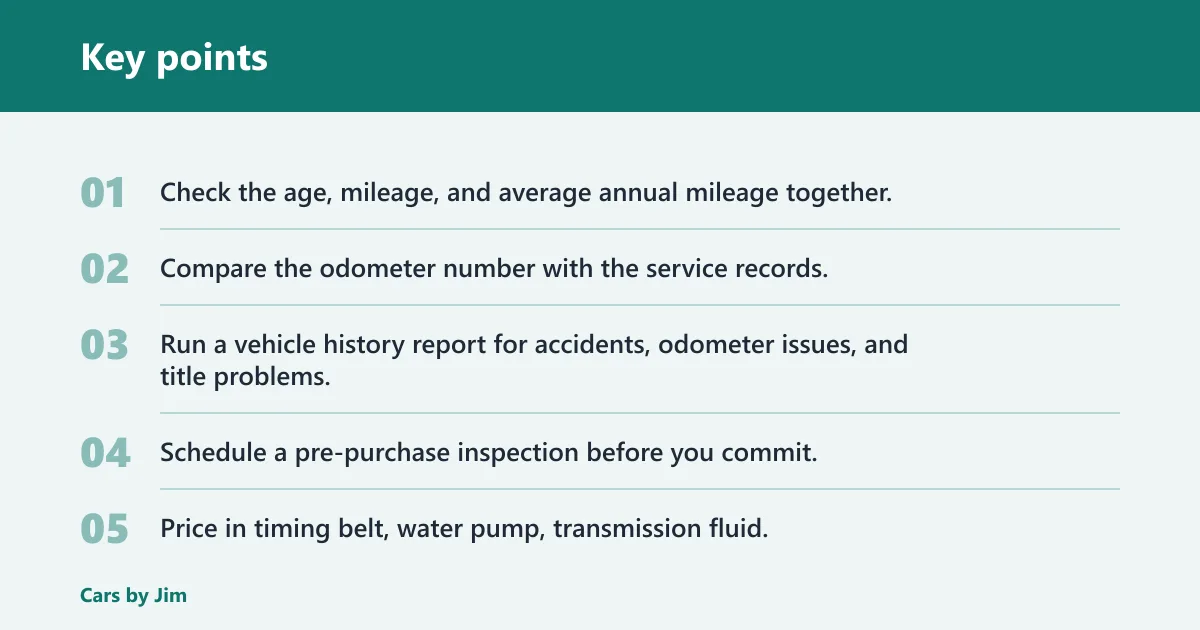
- Check the age, mileage, and average annual mileage together.
- Compare the odometer number with the service records.
- Run a vehicle history report for accidents, odometer issues, and title problems.
- Schedule a pre-purchase inspection before you commit.
- Price in timing belt, water pump, transmission fluid, and spark plug work if the records are missing.
- Walk away if the repair total cancels out the discount.
| high-risk case | why it matters | what to do | walk-away trigger |
|---|---|---|---|
| missing records | You cannot verify oil changes, major services, or skipped intervals | Demand a lower price and a stronger PPI | No proof of major service and no price cushion |
| rust-belt use | Corrosion can affect structure, brakes, and underbody parts | Inspect the underside carefully and budget for rust repairs | Active corrosion on structural or brake components |
| CVT or automatic concerns | Slipping, shuddering, noise, or delayed engagement can mean expensive failure | Insist on a road test and fluid history | Any no-engagement, slip, or vibration symptom |
| overdue major services | Timing belt, water pump, transmission fluid, and spark plugs can become immediate costs | Subtract those jobs from the offer price | Seller wants full price with overdue service still pending |
Frequently asked questions
How high mileage is too high for a used car to buy?
Short answer: it is too high when the car’s likely repairs, missing records, and remaining ownership horizon no longer fit the discount. For many buyers, that tipping point shows up somewhere above 150,000 miles, but a cleaner, better-documented car can be the safer choice even at a higher number.
It is too high when the mileage, age, and service gap together leave no room in the price for likely repairs. For many buyers, that point arrives somewhere above 150,000 miles unless the car has strong records, a clean inspection, and a price that reflects the next maintenance cycle.
What mileage is too high for a used car?
Short answer: there is no universal cutoff. Mileage becomes too high when the likely repair bill, the lack of records, or the buyer’s ownership plan no longer fit the discount. Condition and price matter more than the number alone.
There is no single cutoff. Mileage becomes too high when the likely repair bill, the lack of records, or the owner’s planned time in the car no longer fit the discount. A 120,000-mile highway car and a 90,000-mile city car can lead to very different answers.
Can a used car with over 100,000 miles still be reliable?
Short answer: yes. Modern vehicles can exceed 200,000 miles when maintained properly, and reliability at this stage depends more on service history and condition than on the odometer alone. The best examples are the ones with proof, not promises.
Yes. Today’s vehicles can last well into the 200,000-mile range if properly cared for. Reliability at this point depends more on maintenance, previous use, and inspection results than on the odometer alone. Strong records matter as much as the mileage number.
What should I check before buying a high-mileage used car?
Short answer: check the records, the title, the road-test behavior, and the underside. Then compare the likely first-year repairs with the discount. If the numbers do not work, the car does not work for your budget.
Check the service records, a vehicle history report, and the results of a pre-purchase inspection. Pay close attention to timing belt, water pump, transmission fluid, and spark plugs where applicable. Also look for rust, accident history, and transmission symptoms such as slip or delayed engagement.