Private Party Price: How to Value a Used Car Fairly
Set a fair private-party used-car price by averaging KBB or Edmunds private-party value, at least five local comparable listings, and itemized condition adjustments, then stay within about 5 to 10 percent of that result. Price it wrong and you can overpay, leave money on the table, or stall the sale. This guide lays out the pricing workflow, condition deductions, local-comp checks, and negotiation guardrails.
What does private party price actually mean?
Private party price is the market range for a direct sale between one owner and one buyer, with no dealer overhead and no trade-in haircut. It is the range for an as-is transaction in the open market, so use it as a starting point, not a final transaction number, because mileage, condition, history, title, options, and local demand still shift the real deal price.
How private-party value differs from dealer retail and trade-in
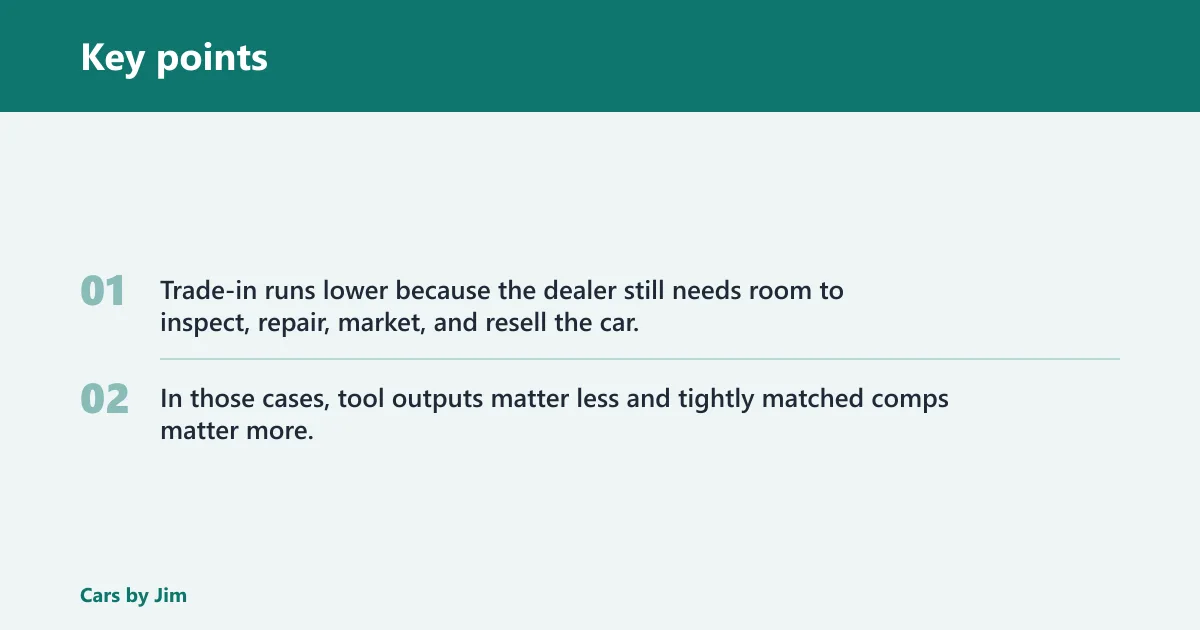
Dealer retail usually runs higher because the store has reconditioning costs, staffing, lot expense, warranty exposure, advertising, financing overhead, and profit built into the sticker. Trade-in runs lower because the dealer still needs room to inspect, repair, market, and resell the car.
That leaves private-party value in the middle. It reflects a direct buyer-to-seller deal where the car is sold as-is unless state law or a written agreement says otherwise.
Why the starting number can still be wrong
Valuation tools often assume average mileage, a clean title, and condition that sits somewhere between good and very good. A car with worn tires, a cracked windshield, spotty service records, or a recent transmission replacement can land far from that baseline.
Private-party pricing also breaks down faster on unusual vehicles: niche trims, old diesels, heavily optioned trucks, EVs with battery concerns, collector cars, and modified cars with missing stock parts. In those cases, tool outputs matter less and tightly matched comps matter more.
How do you set a fair private-party price range?
Set a fair range by starting with private-party tool values, checking at least five local comps that match trim and equipment, then adding or subtracting line-item adjustments for mileage, condition, service history, accidents, title status, options, and market demand. The result should be a range, not one rigid number.
Pricing workflow
- Pull baseline values. Run the exact year, make, model, trim, drivetrain, mileage, and ZIP code through KBB, Edmunds, and NADA or JD Power. Record only private-party outputs, not trade-in or dealer retail, because mixing value types distorts the baseline.
- Average the baselines. If the three private-party numbers are reasonably close, average them. If one sits far outside the other two, check whether the tool defaulted to the wrong trim, drivetrain, mileage band, or condition input before you keep or discard it.
- Build matched comps. Gather at least five local listings for the same year range, same trim, same drivetrain, similar mileage, and similar factory equipment. A compact SUV in front-wheel drive and the same model in AWD are often different markets.
- Adjust for condition. Separate cosmetic flaws from mechanical faults. Paint chips, seat wear, and curb-rash wheels should not be priced like warning lights, leaks, slipping transmissions, overdue timing-belt service, or nearly bald tires.
- Adjust for history. Reduce value for reported accidents by looking at severity, repair paperwork, panel fit, paint quality, and any airbag or structural damage, then make larger deductions for branded titles. Clean-title cars with minor repaired damage usually stay in the normal market; salvage, rebuilt, flood, and lemon titles do not.
- Set your range. Use the worksheet below to turn the baseline into a fair-price range, then set two decision numbers: a seller asking price above the target and a buyer walk-away ceiling below the total budget. Those two limits prevent emotional negotiation.
What a usable price range looks like
A range is more defensible than a single point because buyers and sellers rarely agree on every input. If the reconciled number is $14,200, a fair range might be about 5 to 10 percent wide depending on the car’s condition and how many close comps exist.
Say your target lands at $14,200 on a common midsize sedan with several close local comps. A workable fair range could be $13,500 to $14,800, with a seller ask a bit above that and a buyer ceiling a bit below all-in budget.
How do you confirm a private-party value before you list the car?
Use a valuation tool as a starting point, then verify the exact VIN, trim, mileage, and condition before you set the price. The supporting guide explains how to translate that estimate into a realistic asking range by comparing nearby listings and completed sales, then adjusting for options, history, accidents, title issues, and other major factors. That matters because even a small mistake can push buyers away or leave money on the table. If you want a step-by-step way to turn a generic estimate into a number you can defend, see private party value.
Which valuation tools should you trust first?
Trust private-party outputs from KBB, Edmunds, and NADA or JD Power as baselines, then verify them against matched local comps before treating any one number as real market value. When the tools disagree, the fix is usually in the inputs: trim, drivetrain, mileage, condition, ZIP code, or option assumptions.
How to use tool outputs without overrating them
KBB, Edmunds, and NADA or JD Power can anchor the process, but none sees the actual car in front of you. A tool cannot tell whether “good” condition means dealer-ready good or simply presentable with no major faults.
Use those outputs for direction, then compare them to local listings that match the car closely. If KBB says $18,400, Edmunds says $17,700, and JD Power says $18,100, the average is useful. If one tool says $15,900 while the others are above $18,000, check the setup before trusting the outlier.
How to reconcile conflicting outputs
- Verify the trim. Confirm the exact trim from the VIN sticker, build sheet, or original window sticker if available. LX, EX, XLT, Limited, Premium, and similar badges can move value more than buyers expect.
- Check drivetrain and engine. AWD, 4WD, hybrid, diesel, and higher-output engines often sit in different value bands. Some tools default to the base powertrain unless you force the exact configuration.
- Re-enter mileage carefully. One misplaced digit can swing a value by thousands. Also check whether the tool rounded the odometer into a higher or lower bracket than the actual reading.
- Normalize condition inputs. Run the same car in good condition across all tools first, then apply your own deductions after. Tool condition grades are not perfectly aligned, so this keeps the starting point cleaner.
- Test against comps. If the averaged tool value still sits above or below the matched local market, the comps should carry more weight. Live listings are imperfect, but a cluster of similar cars priced the same way is hard to ignore.
How should you build local comps that actually match?
Use local comps that match the same year, make, model, trim, drivetrain, major packages, and a close mileage band, then stay within a realistic radius for your market. A loose comp set gives false confidence, especially when one option package or one drivetrain changes demand.
What counts as a true comp
Start with the exact trim. Then match drivetrain, engine, seating layout, bed length for trucks, battery size for EVs, and major factory packages such as tow, luxury, premium audio, or driver-assist bundles.
Mileage should be close enough to reflect the same ownership stage. A practical screen is within about 10,000 to 15,000 miles for newer mainstream vehicles, with a wider band for older cars if local supply is thin.
How far out to search
For common sedans, crossovers, and half-ton trucks, a local radius of about 50 to 100 miles is often enough. Expand farther for low-volume trims, older diesel pickups, EVs, full-size vans, and enthusiast models where local supply may be too thin for five useful matches.
Use live listings carefully. They show seller expectations, not completed sale prices, so discount stale or unrealistic ads. If a car has been listed for weeks at the same high number, it is weaker evidence than a fresh listing that disappears quickly.
What local comparable listings should I use to price my car?
Use listings for the same generation, year or near-year, exact trim, drivetrain, and major factory equipment, then filter for similar mileage and condition within your local market radius. Skip broad “same model” comparisons, because AWD, tow packages, safety tech, and trim upgrades can move value materially.
Suppose two nearby listings look close: both are 2020 compact SUVs with 68,000 miles. One is base front-wheel drive, the other is AWD with a factory tow package and adaptive cruise. Those are not interchangeable comps, even if both wear the same model badge.
How do mileage, condition, and service history change value?
Mileage changes value only in context, while condition and service history often move the number more than buyers expect. Low miles can deserve a premium, high miles usually need a deduction, and missing maintenance records or overdue major work should reduce the fair range even if the car looks clean.
Mileage adjustments that make sense
Compare odometer reading to age and class. A common rule of thumb is roughly 12,000 miles per year for broad-market use, although pickups, commuter cars, and city cars can vary. Treat that figure as a reference, not a law.
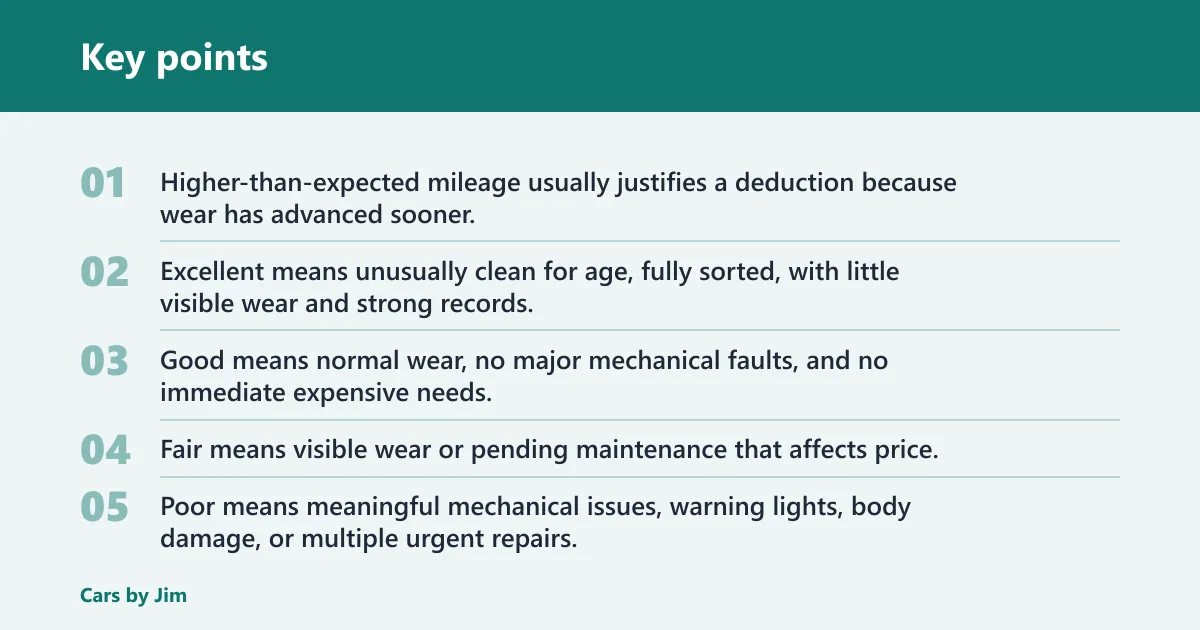
Higher-than-expected mileage usually justifies a deduction because wear has advanced sooner. Lower-than-expected mileage can support a premium, but only if the car also has current time-based service, healthy tires, and no storage-related problems such as dry rot, dead batteries, or stale fluids.
Condition grades that belong in negotiations
Excellent means unusually clean for age, fully sorted, with little visible wear and strong records. Good means normal wear, no major mechanical faults, and no immediate expensive needs. Fair means visible wear or pending maintenance that affects price. Poor means meaningful mechanical issues, warning lights, body damage, or multiple urgent repairs.
Keep cosmetic wear separate from mechanical faults. A scratched bumper is not equivalent to a leaking water pump or a check-engine light.
Service history and deferred maintenance
Records support value because they reduce uncertainty. A stack of invoices for fluid services, brakes, tires, and scheduled maintenance can justify the upper end of a fair range.
Missing records, overdue major services, weak tires, worn brakes, warning lights, and known leaks should all reduce the price. If a timing belt service is due soon, or the car needs four tires and front brakes, build those costs into the offer rather than hoping they disappear in conversation.
A common first-timer mistake is paying extra for low mileage without checking time-based maintenance. A 9-year-old car with 42,000 miles can still need tires, brake fluid, coolant, and a battery because age keeps moving even when the odometer barely does.
How much do accidents, title brands, and modifications affect price?
Accidents, title brands, and modifications can reduce value sharply, but the size of the deduction depends on severity, repair quality, financing and insurance limits, and whether the car can still compete with clean, stock examples. Minor repaired damage is one market; structural or branded-title history is another.
Accident history and diminished value
A report that shows minor damage and proper repair is very different from airbag deployment, multiple panel replacements, or structural repair. Buyers should look for paint mismatch, uneven gaps, overspray, replacement labels, and invoices that explain what was repaired.
Stronger deductions apply when airbags deployed, the frame or unibody took a hit, corrosion protection may have been disturbed, or the repair paperwork is weak. Even if the car drives well, future resale usually suffers.
Title brands and why they are not equal
Clean title is the normal market. Salvage means the insurer once treated the vehicle as a total loss. Rebuilt means it was repaired and retitled after that event, but it still carries the history. Flood branding raises electrical and corrosion concerns. Lemon branding can hurt buyer confidence and financing even if the defect was repaired.
Branded titles usually need much larger deductions than ordinary accident history. They can also restrict financing, narrow insurance options, and shrink the buyer pool, which pushes private-party prices down further.
Modified cars and aftermarket risk
Most modifications do not add dollar-for-dollar value in the private market. Lift kits, lowered suspensions, tunes, oversized wheels, non-factory lighting, and cheap aftermarket electronics often reduce the buyer pool and raise reliability questions.
Stock parts matter. If the seller kept the original intake, wheels, exhaust, or suspension, the car may be easier to price and insure. If emissions equipment is missing or poor-quality parts were installed, many buyers should walk away rather than guess at repair cost.
How should local demand and equipment adjust the number?
Local demand and equipment should move the price after the baseline, not replace it. Regional taste, seasonality, fuel prices, weather, drivetrain preference, and inventory scarcity can all push a car above or below book value, while missing factory features can limit what buyers will actually pay.
Market factors that move price
AWD crossovers and 4WD trucks often bring more in snow-belt markets. Convertibles can soften in cold months. Full-size SUVs may rise when fuel prices are stable and soften when gas spikes. Hybrids can move the other way.
Inventory matters too. If there are only two clean examples of a specific trim within 100 miles, sellers can hold closer to ask. If there are 20 similar cars nearby, buyers gain bargaining power.
Equipment and package adjustments
Trim and options should match your comp set whenever possible. If they do not, adjust for what the market actually cares about: AWD or 4WD, factory tow package, larger battery pack, leather, panoramic roof, driver-assist tech, premium infotainment, and third-row seating on family vehicles.
Missing expected equipment can drag value. A high trim without the premium audio or towing package common to local listings may need a deduction because buyers cross-shop by feature list, not badge alone.
Pricing worksheet
Text-only adjustment sheet
Use this worksheet after averaging tool values. It converts one baseline into a final fair-price range, then separates market value from listing strategy so sellers and buyers do not confuse the two.
| Line item | Example input | Adjustment | Running total |
|---|---|---|---|
| Base private-party value | KBB $18,400; Edmunds $17,700; JD Power $18,100; average used | $18,067 | $18,067 |
| Mileage adjustment | 78,000 miles on a 5-year-old car; about 18,000 over a 60,000-mile reference | – $900 | $17,167 |
| Condition adjustment | Good overall, but four tires at 4/32 and windshield chip | – $650 | $16,517 |
| Service-history adjustment | Records missing for transmission service; brake fluid overdue | – $250 | $16,267 |
| Accident-history adjustment | One reported minor rear-end repair, no airbag deployment, straight panels | – $500 | $15,767 |
| Title-status adjustment | Clean title | $0 | $15,767 |
| Equipment adjustment | Missing factory driver-assist package common on local comps | – $400 | $15,367 |
| Local-market adjustment | Demand slightly above average; only three close comps within 75 miles | + $300 | $15,667 |
| Fair-price range | About 5 to 10 percent around adjusted total, depending on comp quality | $14,900 to $16,400 | $14,900 to $16,400 |
| Seller asking-price buffer | List about 3 to 5 percent above target to leave room for negotiation | $16,200 ask on a $15,667 target | $16,200 ask |
| Buyer walk-away ceiling | Cap at target plus unavoidable fees only | $15,900 before tax and registration | $15,900 max offer |
How to use the worksheet in a real deal
For sellers, the adjusted total is the target, not the listing price. A modest buffer leaves room for inspection findings and normal negotiation without making the ad look unrealistic.
For buyers, the walk-away ceiling should be set before the meeting. If the inspection uncovers tires, brakes, warning lights, or weak records beyond what was priced in, the ceiling should move down, not up.
How much should you negotiate off the asking price?
Negotiate from evidence, not from a fixed percentage. The discount should reflect how far the asking price sits above the fair range, what the inspection finds, and how strong the documentation is. Some cars deserve a small adjustment; others need four-figure deductions supported by specific defects.
Seller strategy: asking price versus bottom line
Sellers usually need a buffer above target, but not a fantasy number. A common practical range is about 3 to 5 percent above the target price on mainstream used cars with decent demand.
Should you list your car above your bottom-line price? Yes, usually, but keep the gap controlled. Too little room invites premature discounting; too much room scares away serious buyers who are screening dozens of ads.
Buyer strategy: use findings, not haggling theater
Build the offer from the worksheet and the inspection. Deduct for worn tires, thin brakes, warning lights, cracked glass, missing records, overdue maintenance, and title or accident concerns.
Picture a seller asking $17,500 for a car your worksheet puts at $15,900 target and $16,400 upper fair range. If the pre-purchase inspection then finds two tires, front pads, and a valve-cover leak, the right move is a documented offer near or below target, not an arbitrary “take 10 percent off.”
How can you tell if a private party price is too good to be true?
A price is suspicious when it sits far below matched local comps without a clear reason, especially if the title is branded, records are missing, photos hide body angles, or the seller resists a pre-purchase inspection. Cheap usually means history, condition, paperwork, or scam risk that the listing is not spelling out.
What fees turn a fair price into the real total cost
The real cost of a private-party purchase is the sale price plus taxes and transfer fees where your state charges them, plus inspection, transport, and immediate catch-up maintenance. A fair market price can still become a bad purchase if the all-in number breaks the budget.
What to add beyond sale price
- Sales tax, if your state taxes private-party sales
- Title transfer and registration fees
- Emissions or safety inspection fees where required
- Pre-purchase inspection cost
- Transport or travel cost if the car is outside the local market
- Immediate maintenance such as tires, brakes, fluids, battery, or key replacement
Financing and insurance complications
Branded-title cars can be harder to finance and insure. Some lenders avoid them, and some insurers limit physical-damage coverage or settle claims differently because value is lower and harder to establish.
That matters even for cash buyers. If resale and claim handling will be harder later, the purchase price today should be lower to compensate.
Frequently asked questions
How do I value a used car fairly for a private party sale?
Start with private-party values from KBB, Edmunds, and NADA or JD Power, then compare them with at least five local comps that match trim, drivetrain, mileage, and equipment. After that, adjust for condition, service history, accident history, title status, and market demand to create a defendable range.
What is the difference between private party price and dealer price?
Private party price reflects a direct buyer-to-seller deal without dealer overhead, warranty cost, or lot expense. Dealer retail is usually higher for those reasons, while trade-in is usually lower because the dealer still needs room to inspect, recondition, and resell the vehicle at a profit.
How do mileage and condition affect private party value?
Mileage matters relative to the car’s age, type, and local market, while condition often changes value more than buyers expect. Low miles can support a premium, high miles usually need a deduction, and visible wear, warning lights, overdue maintenance, or poor records should push the price down.
How do accident history and title brands change a fair asking price?
Minor repaired damage with no airbag deployment usually hurts value less than structural repair, major panel replacement, or weak documentation. Branded titles such as salvage, rebuilt, flood, or lemon require larger deductions because financing, insurance, and resale become harder for the next owner too.
How much should I negotiate off a private party asking price?
There is no reliable fixed discount. The right amount depends on how the asking price compares with your fair-value range and what the inspection uncovers. If the price already fits the market, the discount may be small; if tires, brakes, records, or history are weak, the deduction should be itemized.
What fees and taxes affect the total private party purchase price?
Total cost can include sales tax, title transfer, registration, emissions or safety inspection, a pre-purchase inspection, travel or shipping, and immediate maintenance after purchase. Buyers should also check insurance cost and financing limits early, especially if the car has a branded title or heavy modifications.