Maintenance Records: What to Check Before You Buy
Check the VIN, line up the mileage and dates, compare the file against the factory service schedule, and grade the paperwork before you buy. Strong records support condition and price. Weak, vague, or contradictory records raise the risk of overdue recalls, hidden odometer problems, and missed maintenance that can change the deal from buy to inspect, renegotiate, or walk away.
- Match the VIN across the car, title, report, and invoices.
- Build one timeline from service, inspection, registration, title, and recall records.
- Check mileage progression for steady increases and believable gaps.
- Compare the file with the factory maintenance schedule for likely missed work.
- Grade the records as complete, partial, suspicious, or useless.
- Use the score to buy, inspect, renegotiate, or walk away.
What counts as a useful maintenance record?
A useful maintenance record links one service visit to one vehicle and one point in time. It should identify the car clearly, show when the work happened, record the mileage, and describe the work in enough detail to confirm what was actually done. Without those basics, the paper may exist but add little buying value.
The five details every record should show
A service record should show the date, shop, and odometer reading. It should also state the work performed and identify the vehicle clearly enough that you can match it to the title and seller paperwork.
High-value entries usually list specific jobs: oil and filter changes, tyre rotations, brake pad or rotor replacement, state inspections, and brake-fluid, coolant, or transmission-fluid service. Low-value entries tend to say only inspection or multi-point check with no mileage, no invoice number, and no itemized work.
High-value records versus low-value records
- High-value: dated invoice from a dealer or chain, mileage listed, labor line items, parts listed, and a VIN or plate reference.
- Medium-value: receipt from a small shop with date and work detail, but no VIN; still useful if mileage and seller timeline match.
- Low-value: reminder stickers, handwritten notes, oil-change windshield labels, or screenshots with no shop identity.
- Near-useless: a stack of receipts for parts only, unless the seller can tie them to mileage and explain who did the work.
Which maintenance items matter most before purchase?
Before purchase, look for routine items first because they establish the service rhythm. Reported work can include dated oil and filter changes, tyre rotations, brake inspections, pad or rotor replacement, coolant flushes, and transmission-fluid service. Battery or charging work can matter too, especially on older cars or hybrids. On models with known major intervals, timing-belt, transmission, and cooling-system services carry extra weight because missed work can turn into a big bill fast.
Start with the VIN and build the service file
Match the VIN everywhere
- Match the VIN. Enter the 17-character VIN to search service history. Then compare that VIN to the dashboard tag, door sticker, title, registration, seller ad, and every service document. One digit off can mean the paperwork belongs to another car.
- Pull the history report. Start with the free preview, then buy the full records if the car stays in contention. A detailed vehicle history report can include reported accidents, title brands such as salvage or rebuilt, theft records, auction listings or sales, open or completed recalls, and maintenance entries, and those maintenance entries sit alongside odometer readings, ownership, and title records in the report.
- Add direct records. Ask for dealer printouts, invoices, inspection slips, emissions paperwork, registration renewals, and receipts. Dealer service records often verify faster than handwritten receipts because dealer networks and national chains report more consistently than many independents.
- Build one timeline. Put every dated event in order by date and mileage: service visits, registration mileage, inspection mileage, title events, and recall work. What matters is regularity across sensible intervals, not one visit alone.
What belongs in the file
The file should include service visits with date, shop name, odometer reading, and work performed. Add any invoice support, recall campaign paperwork, and dealer confirmation if available. Some manufacturer portals show dealer service history for current owners, and depending on the brand, that history may transfer through a dealer printout or owner account.
Do not treat recall completion as maintenance. The record can show recall work completed at a dealer, but that is a separate safety check, not proof that the owner kept up with oil, brakes, or fluids.
How do you tell if the records are complete or weak?
Grade the file by how well it proves the seller’s story and supports the mileage timeline. Complete records are specific and consistent. Partial records leave some gaps but still support the car’s history. Suspicious records contain contradictions or vague entries. Useless records cannot reliably tie service to this vehicle.
Complete
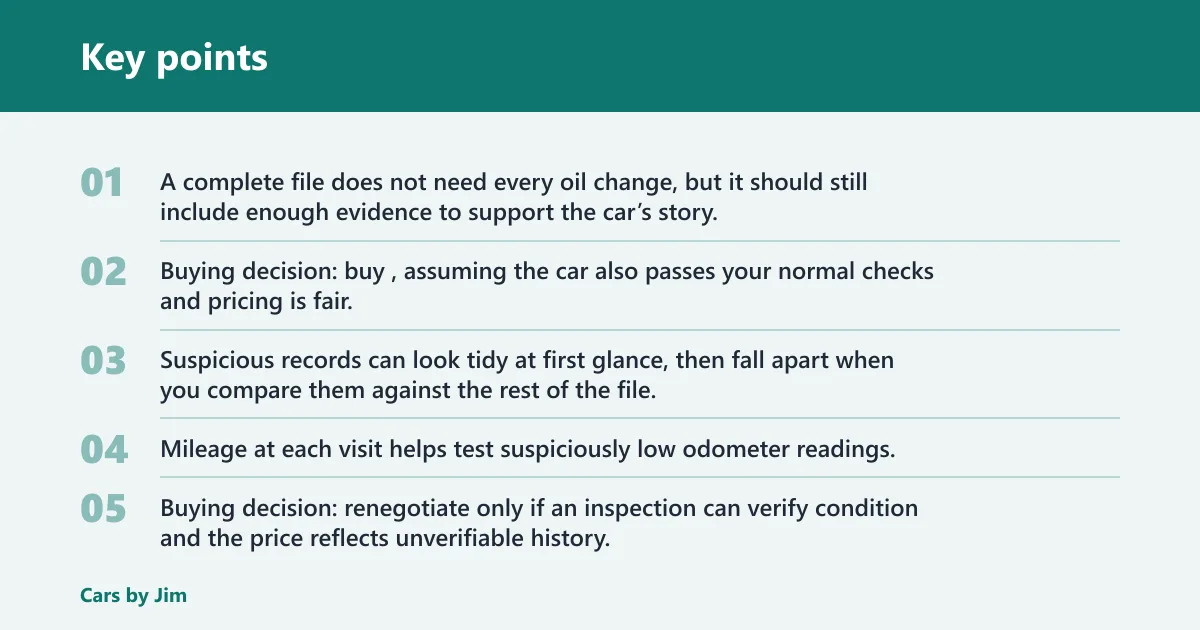
A complete file does not need every oil change, but it should still include enough evidence to support the car’s story. Expect a sensible progression of dates and mileage, repeated shop names or a plausible change of shops, and specific work listed at normal ownership intervals.
Buying decision: buy, assuming the car also passes your normal checks and pricing is fair.
Partial
Partial records still have real value. You may see strong early history, then silence after the owner moved or switched to a small local shop that never reported. That is not ideal, but it is not automatic neglect if mileage entries, registration records, and the seller’s explanation still line up.
Buying decision: inspect. A pre-purchase inspection should verify the undocumented period by checking wear items, fluid condition, leaks, tire age, brake life, and any overdue scheduled service before you commit.
Suspicious
Suspicious records can look tidy at first glance, then fall apart when you compare them against the rest of the file. Warning signs include duplicate mileage, mileage that drops, repeated vague entries, missing shop names, or receipts that do not match the VIN and odometer timeline. Mileage at each visit helps test suspiciously low odometer readings.
Buying decision: renegotiate only if an inspection can verify condition and the price reflects unverifiable history. Otherwise, be ready to leave.
Useless
Useless records cannot verify service on this car. Think unlabeled invoices, photos cropped so the shop name is missing, generic maintenance-app screenshots, or seller claims with no supporting document trail. A thick folder can still be useless if none of it ties the work to the vehicle, mileage, and date sequence.
Buying decision: walk away unless the vehicle is priced as undocumented and a thorough inspection changes the risk picture.
Picture a seller with twelve receipts that all say vehicle service and show only a total dollar amount. The stack looks reassuring until you notice no VIN, no mileage, and no line items. That is not a complete history. It is paper volume without proof.
What mileage patterns should the timeline show?
The timeline should show mileage rising in a steady, believable sequence across service visits, inspections, registrations, and title events. Small data-entry mistakes happen, but the overall pattern should move forward with time. If mileage stalls, jumps oddly, duplicates too often, or drops between events, treat the history as weaker until the seller can explain it with matching paperwork.
Normal mileage progression
Normal records show mileage increasing from one event to the next. The exact interval varies by driver and use, so look for consistency rather than a fixed number of miles per month. Service visits should fit the ownership pattern: commuter miles rise steadily, low-use second cars rise slowly, fleet vehicles often climb faster.
Patterns that suggest missing service or bad data
- Long date gaps followed by a normal next mileage entry.
- Two entries on different dates showing the same mileage.
- A burst of services clustered just before sale after years of silence.
- Repeated inspection entries with no service details.
- Entries where the date sequence and mileage sequence both move forward, but the jumps are too large for the seller’s story.
Patterns that can point to rollback
A rollback can appear when mileage drops between reported events. That is the clearest alarm. Less obvious cases include mileage that freezes for multiple transactions, then resumes climbing later, or service entries that reappear out of sequence across sources.
Suppose the history report shows 82,400 miles at a brake job, then 76,100 miles at a state inspection months later, then 84,000 miles at resale. That middle dip matters even if the seller says it was a clerical error. The burden shifts to the seller to prove it with original invoices and inspection records.
How much does a gap in service history matter?
A gap matters based on length, timing, and what should have happened during that period. A short silence inside an otherwise coherent file is often manageable. A multi-year gap around major mileage milestones, ownership changes, or overdue scheduled work matters far more because it weakens both the maintenance story and the odometer story at the same time.
When a gap is acceptable
A gap can be workable if the rest of the file is strong and the missing period has a believable explanation. A silence after a move or shop change carries more weight when registration mileage, inspection slips, and later service entries still form a coherent timeline.
When a gap changes the decision
A gap becomes serious when it hides the period where major scheduled work likely came due, or when the odometer pattern around the gap looks odd. Silence during a later ownership period can also matter more than silence early in the car’s life, because recent neglect affects condition now.
Buying rule:
- Short gap, strong timeline: inspect, then proceed if condition supports the story.
- Long gap, but consistent mileage and receipts outside the report: renegotiate for documentation risk.
- Long gap plus contradictory mileage or seller claims: walk away.
Can you trust dealer records, chain shops, or Carfax alone?
Dealer and national-chain records usually verify faster and more consistently than small independent-shop entries, but none of them is complete proof on its own. A vehicle history report can be very useful, yet it can miss maintenance, delay updates, or reduce detailed invoices to one-line summaries. Judge the combined file, not any single source.
Dealer service records and manufacturer portals
Dealer records count even if you buy from a private seller. They are often easier to confirm because dealer networks and national chains report more consistently than many independents. Some manufacturer portals show dealer service history for current owners, though access and transfer rules vary by brand.
Dealer history still has limits. It may show only work done within that brand’s network. If the owner used independent shops for years, a clean dealer printout may simply be incomplete.
Chain and independent shop records
National chains are usually the next best source because entries tend to include date, location, mileage, and service type. Small independents can be excellent mechanically but weak as record keepers. A stamped booklet or handwritten invoice is better than nothing, yet it needs mileage, dates, and identifiable shop details to carry weight.
What a vehicle history report confirms and what it cannot
The report preview is free, but the full records are paid. Use the preview to screen cars, then pull the full report for any serious candidate. It may include maintenance records, title data, theft, auction activity, odometer entries, and recalls, but it cannot prove that every service happened or that every listed service was done correctly.
Should Carfax maintenance records alone settle the issue? No. They are one input. A clean report with sparse maintenance is still sparse maintenance.
Record quality scorecard
Maintenance quality scorecard
| Checkpoint | 0 points | 1 point | 2 points |
|---|---|---|---|
| Mileage continuity | Backward or repeated mileage with no proof | Mostly rising mileage with one unexplained issue | Clean rising mileage across sources |
| Date spacing | Long unexplained silence or pre-sale cluster only | Some gaps, but pattern still usable | Regular visits across ownership |
| Service type specificity | Vague checks only | Mixed vague and specific entries | Specific line-item work listed |
| Shop identity | No shop name or unverifiable source | Shop named but weak contact detail | Dealer, chain, or clearly identifiable shop |
| Invoice support | No invoices or receipts | Some receipts, incomplete details | Invoices support most key services |
| Brand/dealer confirmation | None available for claimed dealer service | Partial dealer printout or portal view | Dealer history confirms key visits |
| Recall completion | Open recalls with no plan | Recall status unclear | Campaign completion confirmed |
| Odometer consistency | Conflicts with title or inspection records | Minor discrepancy, plausible clerical error | Matches service, title, and inspection timeline |
| Gap explanation | No explanation for missing years | Explanation given but weak proof | Explanation supported by paperwork |
| Seller consistency | Claims exceed documents | Small mismatch in wording or dates | Seller story matches the file |
How to total the score
- Score each checkpoint. Give every row 0, 1, or 2 points based on the evidence available. Do not reward a seller for verbal claims that the file cannot support.
- Total the points. Add the ten rows for up to about 20 points. Then compare the score to the car’s price, seller type, and the cost of any overdue service you cannot verify.
- Match the decision. Use the total as a buying rule, not a decoration. A strong score can support paying market price; a weak score should change the offer or end the deal.
- 17-20: Buy, assuming condition and price also check out.
- 13-16: Inspect before buying.
- 9-12: Renegotiate around documentation risk and inspect.
- 0-8: Walk away.
Worked example: scoring a partial file
Suppose a seller provides dealer oil-service invoices, one brake invoice, registration paperwork, and a history report. Mileage rises cleanly, but there is a long silent period and no proof of a major scheduled fluid service. That file might score strong on mileage continuity, shop identity, and seller consistency, but only middling on date spacing, invoice support, and gap explanation. A total in the inspect or renegotiate range means the next step is not blind trust. It means verify the undocumented period with a pre-purchase inspection, estimate any overdue service, and use that risk to decide whether to buy at the asking price, renegotiate, or leave.
How should your decision change by seller type?
Seller type changes how much documentation should be available, but it does not change the grading standard. Private sellers may have a mixed paper trail. Dealers should have easier access to reports and disclosures. Fleet and rental cars often show frequent basic service with thin detail. Certified pre-owned status can add warranty value, but not a complete maintenance past.
Private seller
Expect a mixed file: some dealer visits, some chain-shop invoices, maybe some owner-performed maintenance. The key is whether the story stays consistent. If the seller says the car was always serviced on time, the paperwork should show enough dated, mileage-based support to back that up.
Independent or franchised dealer
Ask for the full vehicle history report, reconditioning invoice, and any prior-owner records they received. A dealer that cannot produce basic VIN-matched paperwork on a higher-priced used car is shifting verification work onto you. Use that in negotiation or move on.
Fleet, rental, and company vehicles
These vehicles often have frequent oil changes and inspections, which helps. The weak point is specificity. You may see many entries from internal fleet systems with little item detail. That can still be workable if the mileage progression is solid and a pre-purchase inspection finds no deferred wear.
Certified pre-owned vehicles
CPO status does not erase record gaps. It may give you a warranty and a dealer inspection process, but it does not automatically prove the whole maintenance past. Grade the file anyway, especially if the price premium depends on history as much as warranty coverage.
What should you ask when the records stop or do not match?
Ask focused questions that can be checked against paperwork, not open-ended questions that invite a sales pitch. You want to know where the car was serviced, why the record trail stopped, who performed any do-it-yourself work, and whether supporting receipts exist. Specific, verifiable answers can strengthen a partial file. Vague answers usually weaken it.
Questions for missing years or missing mileage
- Ask where it was serviced. Get the shop name, city, and approximate dates for the missing period. If the seller changed shops after moving, the timeline should show that shift rather than a mystery gap.
- Ask for support. Request invoices, card statements, parts receipts, inspection slips, or registration paperwork from the same period. Even if a small shop never reported, those documents can still support the mileage timeline.
- Ask about owner work. If the seller says maintenance was done at home, ask which services, at what mileage, and whether parts receipts exist. DIY claims without dates and mileage add little value.
Questions for vague or repeated service entries
Ask what inspection or service actually included. Ask whether brake fluid, transmission fluid, coolant, spark plugs, or battery testing were done, and whether the seller has the invoice pages that show it. Vague records become more useful only when they turn into specific records.
Questions when seller claims exceed the paperwork
Say your seller claims the car had all scheduled service, but the file stops before the mileage where a major transmission or timing service would typically come due. Ask directly whether that service was done, where, and on what date. If the answer is still vague after one follow-up, price the car as undocumented.
When weak records mean you need a pre-purchase inspection
When an inspection is optional
If the records grade as complete and the mileage timeline is coherent, a pre-purchase inspection is still smart but less likely to uncover hidden history problems. In that case, the inspection mainly checks present condition against the documented past.
When an inspection is mandatory
An inspection becomes mandatory when records are partial, suspicious, or missing, when mileage conflicts appear, when the seller’s claims exceed the paperwork, or when a major maintenance interval cannot be verified. The mechanic should look for signs of deferred service, fluid condition, brake wear, leaks, charging issues, tire age and wear pattern, and any evidence that supports or contradicts the timeline.
How weak records should affect your offer
Documentation risk has value. If maintenance is unverifiable, the offer should reflect that with either a lower price, an inspection contingency, or both. Strong records can support the asking price. Weak records should not.
Frequently asked questions
What maintenance records should I look for before buying a used car?
Look for records that show the date, shop name, odometer reading, work performed, and invoice support tied to the correct VIN. Prioritize oil and filter changes, tyre rotations, brake work, fluid services, inspections, battery or charging work, and any major timing or transmission service that should have happened by that mileage.
How do I know if a maintenance record is complete or fake?
A complete record fits the VIN, date sequence, mileage timeline, and seller story. A fake or weak one often has missing shop details, vague service descriptions, no invoice number, no mileage, or entries that conflict with title and inspection records. The strongest test is whether multiple sources tell the same timeline.
Should I trust Carfax maintenance records alone?
No. A vehicle history report is useful, but maintenance can be incomplete, delayed, or absent even when service happened. Use the report as a screening tool, then compare it with dealer printouts, invoices, registration mileage, inspection slips, and the seller’s own paperwork before deciding what the history is worth.
Can maintenance records reveal odometer rollback?
Yes. Mileage at each visit helps test suspiciously low odometer readings, and a rollback can appear when mileage drops between reported events. Watch for backward mileage, frozen mileage across multiple events, duplicate readings with no explanation, or entries that reappear out of order across service and title records.
What should I ask the seller if the records stop a few years ago?
Ask where the car was serviced during the missing period, whether the owner changed shops or moved, whether any maintenance was done at home, and whether receipts or parts invoices still exist. Then compare that answer to the odometer timeline. A specific explanation with paperwork can support a partial file; a vague explanation cannot.