Are High Mileage Cars Reliable? What to Check
This guide uses OEM maintenance schedules, Consumer Reports and J.D. Power reliability trends, NHTSA recall and complaint data, and repair-cost benchmarks from reputable shop-estimate sources to judge whether a high-mileage car is a smart buy. The inspection method is simple: verify records, scan for codes, inspect the underbody, road test the drivetrain, and compare expected repairs to the car’s value.
High-mileage cars are not automatically bad; many remain reliable if maintenance is documented and the next 24 months of repairs fit your budget. Skip that check and you can buy a cheap car that needs expensive work soon after purchase. This guide shows how to judge high-mileage reliability by service history, model risk, and likely near-term costs.
Are high mileage cars still reliable?
Yes, many are. High mileage commonly starts around 100,000 miles, but some shoppers use 80,000 to 90,000 miles as the line and very high mileage can begin at 150,000 to 200,000 miles and beyond. Consumer Reports and J.D. Power reliability data both show that maintenance history and model reputation matter more than the odometer alone.
What high mileage really signals
High mileage means the car has already spent a lot of time accumulating wear, not that it is finished. A 12-year-old Toyota with around 180,000 miles can sometimes be a better buy than a 7-year-old luxury SUV with around 95,000 miles if the Toyota has a clean record and the SUV has neglected service.
The useful question is not “Is it high mileage?” It is “What broke, what was fixed, and what is likely to break next?” Reliable economy cars may still make sense well past 150,000 miles, especially when the powertrain has been serviced on time and rust is light. OEM durability assumptions are based on scheduled maintenance, not mileage alone.
Why mileage alone is a weak predictor
A car with 100,000 highway miles in a mild climate can be in better condition than a 100,000-mile city car. Highway driving is generally easier on brakes and transmissions than stop-and-go driving, because the car spends more time at steady operating conditions and less time cycling hard through heat and low-speed wear.
City use usually shortens the life of brakes, suspension parts, and transmission fluids faster than highway use. That does not make city-driven cars bad. It just raises the odds that the next 24 months will include more catch-up repairs.
How to interpret the mileage threshold
Most buyers should treat 100,000 miles as a practical screening point, not a hard fail. At that stage, a car is often entering the period when age-related maintenance begins to matter more, especially for belts, hoses, coolant parts, suspension wear, and rust. NHTSA complaint trends and OEM schedules both matter because the risk comes from deferred maintenance, not from the odometer reading by itself.
What matters more than the odometer?

Service records, use history, and current condition tell you more than mileage alone. The strongest high-mileage buys usually have proof of oil changes, transmission service, timing belt or chain service where applicable, and documented major repairs. A clean pre-purchase inspection is another key positive sign.
Service records that separate good buys from bad ones
Look for receipts, not vague claims. You want evidence of regular oil changes, transmission service at the right interval, cooling-system work, and any major repair that would otherwise be overdue. If the seller cannot show what was done, assume the car may need it soon. See our maintenance records guide for what to verify and what to ignore.
Pay extra attention to timing components. On engines with a timing belt, missing service can turn a bargain into an expensive repair. On timing-chain engines, you still want proof of oil changes, because neglected oil can create chain and tensioner wear over time. For interval logic, compare the owner’s manual to our timing belt vs chain guide.
Why highway miles usually age a car more slowly than city miles
Highway miles often mean fewer brake applications, fewer heat cycles in traffic, and less drivetrain stress from repeated stop-start use. That matters because wear is not only about distance. It is also about how the miles were accumulated.
Suppose a midsize sedan has 165,000 miles from long interstate commuting and a folder of service records. Compare that with a similar sedan at 115,000 miles from short urban trips, repeated idling, and no proof of transmission service. The higher-mileage car may be the safer buy.
For a deeper breakdown of wear patterns, see our pre-purchase inspection checklist and transmission warning signs guide.
How rust, warning lights, and leaks change the risk
Rust is a hard stop when it affects structure, suspension mounting points, or brake and fuel lines. Warning lights are also serious, especially if the seller says they are “just a sensor.” Leaks matter because they can point to timing cover seepage, valve cover issues, coolant loss, or transmission trouble.
Any one of those can raise the cost of ownership fast. A car may still be mechanically sound and still be a poor buy if corrosion or multiple leaks mean the first year will be full of repairs. For what to check underneath, use our rust inspection guide.
Timing-belt intervals and why they matter
OEM schedules are the authority here. Many timing-belt engines call for replacement around 60,000 to 105,000 miles or by time limit, depending on the model. If the service interval is unknown, the correct assumption is that the belt is an imminent expense, not a bonus feature. This is one of the biggest hidden costs in high-mileage shopping.
High-mileage reliability scorecard
Use this scorecard to decide whether the car is still reliable, reliable but worn, or too risky. The weighting is intentional: paperwork, rust, and drivetrain health matter more than cosmetic condition because they drive repair risk. A “yes” earns the full weight; a “no” earns zero. Then total the points and compare them to the recommendation bands below.
| Check | Yes points | No points | What to look for |
|---|---|---|---|
| Oil changes documented | 12 | 0 | Receipts or service entries at regular intervals |
| Transmission service documented | 12 | 0 | Fluid service or other proof of maintenance |
| Timing belt or chain service handled | 10 | 0 | Proof it was done on schedule, if applicable |
| Major repairs documented | 8 | 0 | Cooling, suspension, steering, or engine repairs with receipts |
| Mostly highway use | 8 | 0 | Commuting, road miles, or steady long-trip use |
| Rust is light or absent | 12 | 0 | No structural rust, brake-line rust, or heavy underbody corrosion |
| Cooling system appears current | 10 | 0 | No overheating history, weak hoses, or neglected coolant parts |
| Transmission behaves normally on test drive | 10 | 0 | Clean shifts, no flare, slip, shudder, or delay |
| No active warning lights or stored codes | 10 | 0 | Dashboard clear and scan tool shows no current issues |
| First-year catch-up maintenance is affordable | 8 | 0 | Brakes, tires, shocks, water pump, or timing items fit the budget |
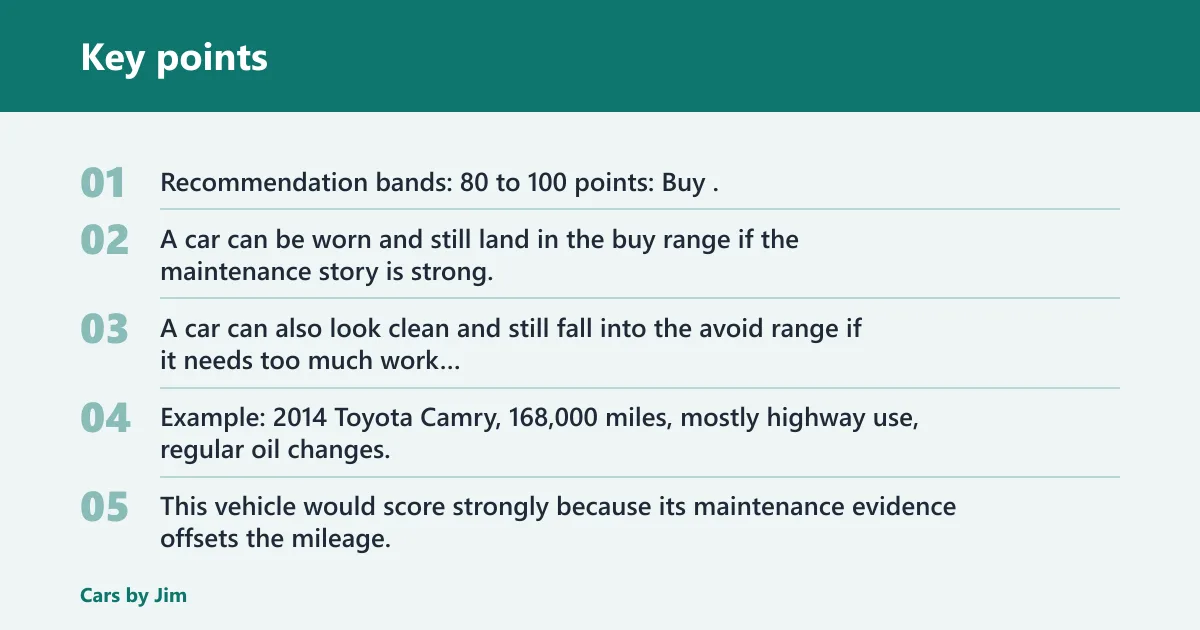
Recommendation bands: 80 to 100 points: Buy. 60 to 79 points: Buy with reserve budget. Under 60 points: Avoid.
That scorecard keeps the decision simple. A car can be worn and still land in the buy range if the maintenance story is strong. A car can also look clean and still fall into the avoid range if it needs too much work right away.
Sample scored vehicle
Example: 2014 Toyota Camry, 168,000 miles, mostly highway use, regular oil changes, transmission service documented, timing chain engine, no warning lights, light surface rust only, and a clean inspection. This vehicle would score strongly because its maintenance evidence offsets the mileage. If the same car needed struts, tires, and a cooling-system refresh, the score would still be decent, but the reserve budget would need to rise.
High mileage cars bad scorecard
Documentation gets the most weight because it predicts future cost. Rust gets nearly equal weight because structural corrosion can make a mechanically good car unsafe or uneconomical. Transmission behavior and warning lights also score heavily because they are expensive to ignore. Cosmetic condition gets no separate score because it rarely changes the true ownership risk.
Estimated first-year catch-up maintenance
Do not shop only on sale price. Estimate what the first year may cost in catch-up work, including brakes, tires, shocks, a water pump if due, and timing components if the service history is missing. Add that amount to the purchase price before you decide.
| First-year reserve item | Typical budget range | Why it matters |
|---|---|---|
| Oil/fluid catch-up service | $150-$400 | Baseline maintenance and overdue fluids |
| Brakes and rotors | $300-$900 | Common on high-mileage city-used cars |
| Tires | $500-$1,200 | Age and tread often catch up at once |
| Suspension wear parts | $400-$1,500 | Struts, shocks, bushings, links, and alignment |
| Timing belt service, if due | $700-$1,800 | Major scheduled maintenance on belt engines |
| Cooling-system repairs | $250-$1,200 | Hoses, thermostat, water pump, radiator issues |
A practical reserve budget should cover the repairs you can reasonably expect soon after purchase. If the car looks solid but still needs tires, a brake job, and one overdue fluid service, it is not a bad car. It is a car that needs a larger cash cushion.
Simple reserve-budget calculator
Reserve budget = expected maintenance + likely repairs + 20% buffer.
Example: $900 in tires + $600 in brakes + $300 in fluids = $1,800. Add a 20% buffer ($360). Recommended reserve budget: $2,160.
When is a high-mileage car too risky?
A high-mileage car becomes too risky when the repair bill starts chasing the vehicle value. A common decision point is 50% of vehicle value: if immediate or near-term repairs are likely to reach that level, the deal deserves a hard pause. That rule is especially useful when the car also has rust, warning lights, or a shaky transmission.
Use repair cost versus vehicle value
Look at the car’s market value, then estimate the repairs likely needed within the next 24 months. If the likely repair total is near half the car’s value, the car may still run, but it is no longer a smart risk for most buyers. This 50% benchmark is widely used by repair advisors because it helps separate a manageable used car from one that is likely to become uneconomical.
That benchmark is about exposure, not perfection. A car that needs one major service can still make sense. A car that needs several major repairs, with more hidden issues possible, is often better left alone.
How to decide with a 50% rule
If a car is worth $8,000 and your likely repair total is $3,500 or more, the deal is getting close to the danger zone. That does not automatically mean “no,” but it does mean you should compare the car with better options under budget, including vehicles listed in our best used cars under budget guide.
Red flags that should end the deal
Walk away if the car has structural rust, persistent overheating, transmission slip or delay, multiple warning lights, or no proof of basic maintenance. Walk away if the seller dismisses leaks without explanation. Walk away if the shop inspection turns up major codes plus obvious mechanical wear.
A common first-timer mistake is buying the cheapest high-mileage car on the lot and assuming the low price creates safety margin. It does not. Cheap purchase price plus overdue repairs can become a very expensive ownership cycle.
Which high-mileage cars are worth buying?
The best high-mileage buys are usually simple, well-maintained vehicles with known long-life powertrains. Toyota and Honda often fit that pattern when records are strong. Ford trucks can also be strong bets when maintenance is documented. Some Hyundai models and other brands can be solid too, but only if upkeep is clear and the specific powertrain has a good track record.
Best bets by vehicle type
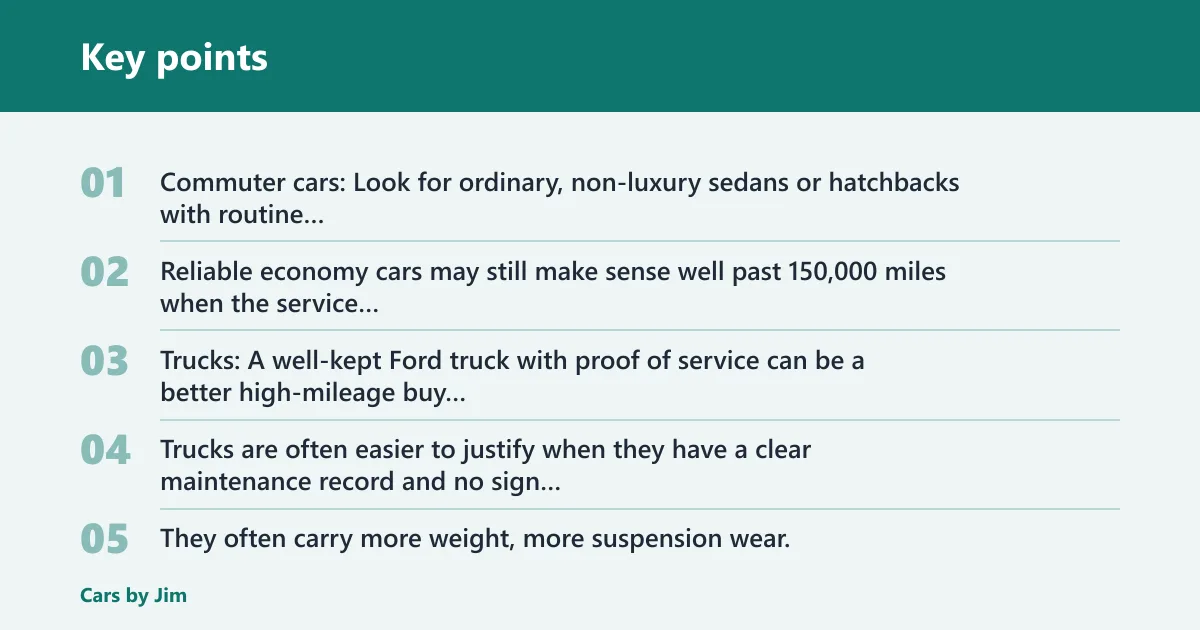
Commuter cars: Look for ordinary, non-luxury sedans or hatchbacks with routine maintenance and no warning lights. Reliable economy cars may still make sense well past 150,000 miles when the service story is complete.
Trucks: A well-kept Ford truck with proof of service can be a better high-mileage buy than a lower-mileage vehicle with a neglected history. Trucks are often easier to justify when they have a clear maintenance record and no sign of heavy towing abuse.
SUVs: Choose carefully. They often carry more weight, more suspension wear, and more complex repairs than small cars. A maintained SUV can still be a smart buy, but the risk rises fast when records are thin.
Luxury cars: These are usually riskier at high mileage because parts, labor, and system complexity are higher. A 95,000-mile luxury SUV can cost more to keep than a 180,000-mile mainstream car if the luxury vehicle has deferred maintenance.
Hybrids and EVs: They can be good high-mileage choices if the battery system, cooling system, and electronics are healthy. The upside is lower wear in some mechanical areas. The downside is that battery or electronic problems can be expensive and harder to predict.
How to separate reliable but worn from reliable but expensive to keep
A car is reliable but worn when it still starts, drives, and stops well, but it needs common age-related items soon. A car is reliable but expensive to keep when it still functions well yet its next repairs are likely to be costly because of complexity, age, or poor parts availability.
That difference matters. The first car may be a fair deal if the reserve budget is ready. The second car may eat into savings even if it never fully breaks down.
What should you inspect before buying?
An independent mechanic inspection is essential. Ask for checks of leaks, codes, transmission behavior, rust, and the parts most likely to cost money soon. A clean pre-purchase inspection is one of the strongest positive signs you can get before signing anything. A good inspection should also cross-check NHTSA recall status and visible signs of deferred maintenance.
- Start with the service file and verify oil changes, transmission service, timing service, and major repairs.
- Scan for warning lights and stored codes, even if the dashboard looks normal.
- Inspect underneath for rust, fluid leaks, and damage around the frame, subframe, and brake lines.
- Check transmission behavior on a cold start and during a full drive cycle.
- Review wear items such as brakes, tires, shocks, water pump, and timing components.
- Add the likely first-year catch-up maintenance to the purchase price before you decide.
Picture a compact SUV with 142,000 miles, no rust, a clean scan, and proof of regular fluid service. If the only near-term needs are tires and front brakes, it may still be a sensible buy. Now picture the same SUV with delayed shifting, a coolant smell, and no record of timing work. That changes the answer fast.
The strongest rule is simple: buy if the maintenance story is strong and the next 24 months fit your budget. Walk if the car needs too much work, has weak records, or carries repair exposure that approaches half its value.
Frequently asked questions
How many miles is too many on a used car?
There is no single cutoff. The better question is whether maintenance, rust, and repair risk are acceptable.
Is a 150,000-mile car a bad buy?
Not automatically. A reliable 150,000-mile vehicle can still deliver value for years if maintained correctly. It becomes a bad buy when service records are weak, rust is present, or the next repairs are likely to approach 50% of the car’s value. High mileage plus neglect is the real problem.
What matters more than mileage on a used car?
Service records and use history matter more than the odometer alone. Oil changes, transmission service, timing belt or chain service, and documented major repairs tell you far more than the number on the dash. Highway use also matters because it usually creates less wear than stop-and-go driving.
When does a high-mileage car become too expensive to keep?
When the likely repair bill starts to approach half the vehicle’s value, the car is getting too expensive to keep for most buyers. That is especially true if the car also needs tires, brakes, suspension parts, or timing work. A low purchase price does not help if repair costs climb fast.