How Can I Check the Value of a Used Car Without a VIN?
You can estimate a used car’s value without a VIN by identifying the exact trim from the license plate or listing, matching mileage and condition to comparable sales, and using a pricing tool or local comps to set a fair range. Miss the trim or condition, and you can overpay by thousands. This guide shows a VIN-free workflow using plate data, listing clues, mileage, photos, options, and comps.
What you can value without a VIN
You can often get a workable value range without a VIN if you can identify the year, make, model, trim, mileage, ZIP code, and condition. That is enough to build a rough estimate from comparable market data. It is not enough to confirm every option, accident record, or title issue.
What the VIN would add
A VIN is a 17-character code used to identify a vehicle. When available, it can help identify the year, make, model, series, and trim, and it may reveal history items that change value. A VIN alone cannot prove the final price, but it usually makes the estimate tighter.
Without it, you can still estimate value from the information you can verify. The gap is precision, not usefulness. The closer you get to the exact trim and equipment, the more useful the estimate becomes.
What you cannot verify well without a VIN
You usually cannot confirm accident history, title brands, theft records, odometer events, or ownership records without a VIN-based history check. You also may miss factory equipment that changes price, such as a towing package, upgraded audio, or a specific wheel set.
That is why a no-VIN estimate is best treated as a range. It is a starting point, not a guaranteed sale price.
Can you use a license plate instead?
Yes, sometimes. A license plate lookup can be an alternative when a VIN is hidden or unavailable, but it depends on the tool, the state, and the access level. A plate search requires the issuing state for the lookup, and it may still stop short of a full valuation report.
When a plate lookup works
A plate lookup can help when you need the car’s basic identity and you have the state of issue. It may surface registration-linked details, or at least help you confirm the year, make, model, or trim shown in the listing. That can get you close enough to start pricing.
What you need besides the plate number
Have the state, the seller’s listing, and clear photos ready. If the plate search returns only partial data, use the photos to confirm trim cues such as badging, wheel style, headlights, and interior features. Mileage and ZIP code still need to be added separately.
When a plate lookup still leaves gaps
Even a good plate lookup may not reveal the exact trim, packages, or history records that affect price. It can also fail on out-of-state cars, temporary tags, or listings where the plate is blocked. When that happens, fall back to listing clues and manual comparable searches.
VIN-free valuation worksheet
This worksheet gives you a text-only path to a reasonable estimate. Use it to collect the facts you can verify, then build a low, likely, and high range from local comps and condition.
| Input | Where to find it without a VIN | What it changes in price | Red flags that force a VIN-based check |
|---|---|---|---|
| Year, make, model | Listing title, seller message, registration, insurance card, badges, photos | Sets the base market bucket | Badges do not match the photos or title language |
| Trim / series | Photo details, window sticker, dealer listing, option list, exterior cues | Can move the car into a higher or lower price tier | Multiple trims share the same body style and equipment is unclear |
| Mileage | Odometer photo, seller disclosure, service records | Raises or lowers the estimate against the market average | Odometer photo is missing, blurry, or inconsistent |
| ZIP code | Seller location or your local market area | Shifts the estimate to local supply and demand | The car is being sold far from where it will be bought |
| Condition | Photos, inspection, seller notes, walkaround video | Condition changes the value most after trim and mileage | Body damage, warning lights, smoke, or rust are visible |
| Options and equipment | Photos, seller list, door stickers, roof rails, seats, wheels | Can raise or lower value depending on market demand | Options are claimed but not visible or documented |
| History | VIN-based report, title paperwork, service records | Accidents, title brands, theft, and odometer issues can cut value | No title paperwork, salvage hints, or unexplained gaps in records |
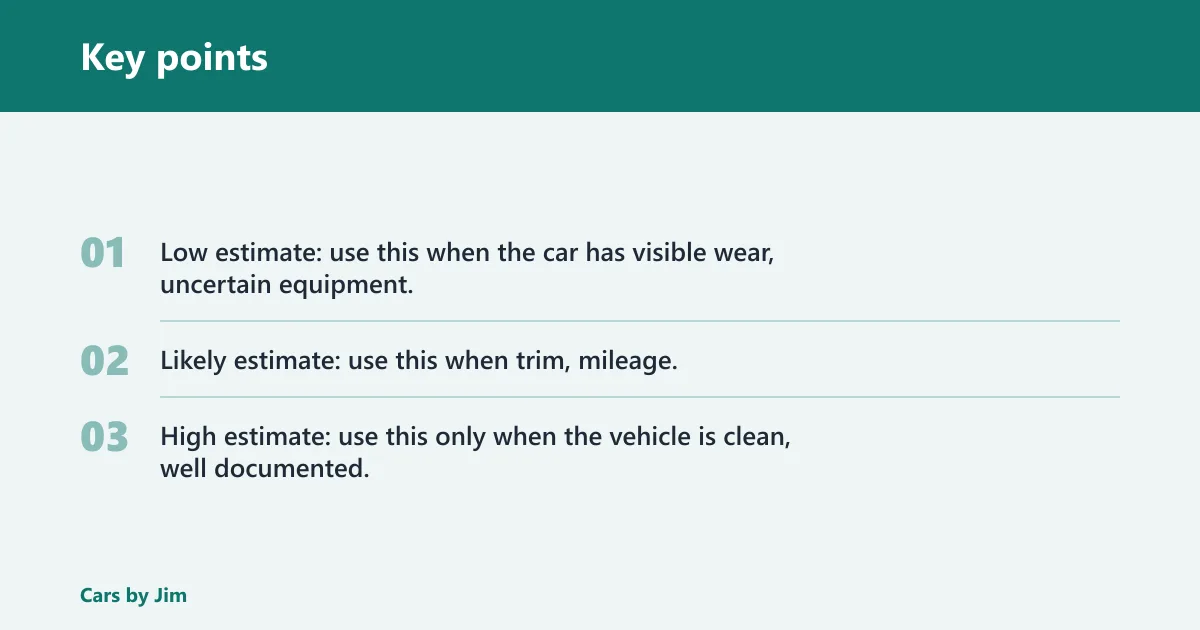
Low estimate: use this when the car has visible wear, uncertain equipment, average or high mileage, or thin listing detail. It should sit near the weaker local comp. Likely estimate: use this when trim, mileage, and condition are clear and the local comps agree. High estimate: use this only when the vehicle is clean, well documented, and priced against the strongest nearby comps.
How to estimate value step by step
Start with the exact vehicle, then narrow the range with mileage, condition, and local comps. The goal is not a perfect number. The point is to avoid a guess that ignores trim or market reality.
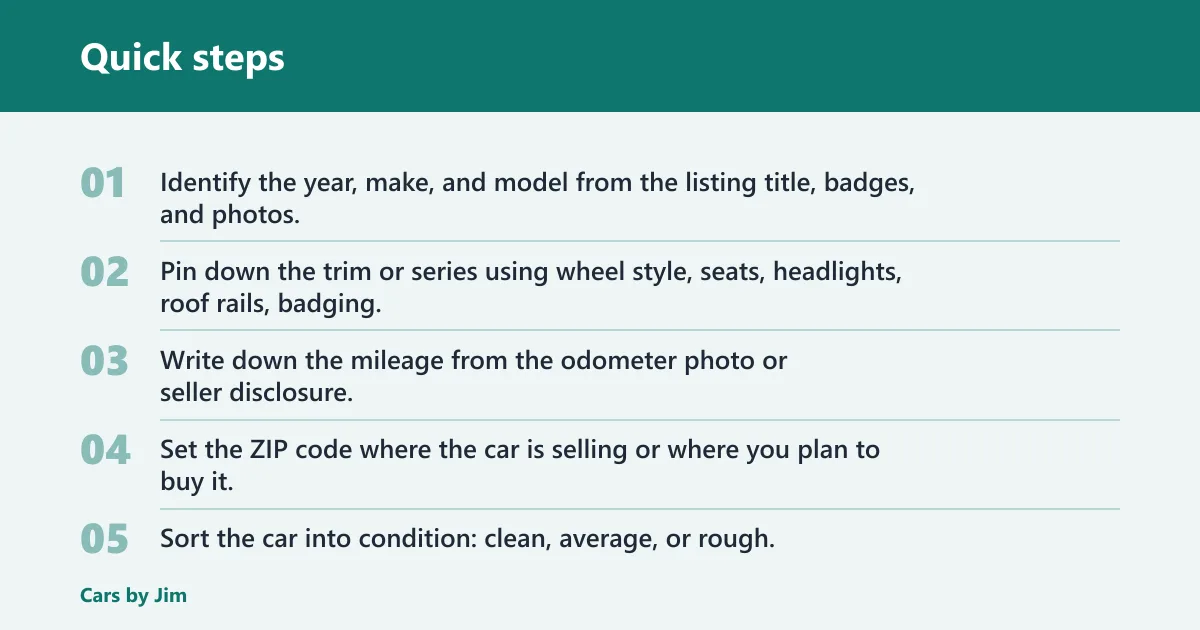
- Identify the year, make, and model from the listing title, badges, and photos.
- Pin down the trim or series using wheel style, seats, headlights, roof rails, badging, and option clues.
- Write down the mileage from the odometer photo or seller disclosure.
- Set the ZIP code where the car is selling or where you plan to buy it.
- Sort the car into condition: clean, average, or rough.
- Search comparable listings and recent sales for the same year, make, model, trim, and mileage band.
- Compare trade-in, private-party, dealer retail, and wholesale ranges before deciding what the car is worth to you.
Start with trim, not just body style
A sedan badge is not enough. Two cars can share the same shape and still sit in very different price bands because one has base cloth seats and the other has leather, larger wheels, or a better drivetrain. The trim often changes price more than a casual buyer expects.
Say your listing shows a 2019 Honda Accord, but the seller left out the trim. A photo of the dashboard, wheel design, and seat material may help separate an LX from an EX-L. That difference can change the estimate enough to matter on a private sale.
Adjust for mileage and condition
Mileage must be added to the valuation, and condition has to be judged across mechanical, exterior, interior, tires, glass, keys, maintenance, and repair status. A clean car with high mileage can still be worth more than a rough car with lower mileage. The market rewards the better mix.
Picture two same-year compact SUVs in the same ZIP code. One has 62,000 miles, fresh tires, and clean paint. The other has 110,000 miles, curb rash, and a check-engine light. Even without a VIN, those details point to different value bands.
Check local comps by ZIP code
ZIP code matters because local supply and demand change prices. A vehicle that sits high in one region may be ordinary in another. Use local comparables first, then widen the search only if the local sample is too thin.
Look for the exact trim where possible. If you cannot find it, use the closest trim and adjust mentally for the missing equipment. Keep the comparison honest. A base model should not be priced like a higher trim with a sunroof and safety package.
Compare the four common value types
| Value type | What it means | Best use |
|---|---|---|
| Trade-in value | What a dealer may credit before reconditioning | Trading the car to a dealer |
| Private-party value | Value for a direct sale between individuals | Buying from or selling to an owner |
| Dealer retail value | Prepared dealer asking range, often with reconditioning and overhead factored in | Pricing a lot-listed vehicle |
| Wholesale value | Business-to-business benchmark influenced by fees and transport | Understanding the dealer’s floor |
The same vehicle can have several legitimate values. That is normal. A free VIN value lookup is only a starting point, not a guaranteed sale price, and a no-VIN estimate is even more dependent on the quality of the inputs.
When condition changes the number most
Condition often affects the estimate more than a small mileage difference. Mechanical problems, body damage, worn tires, cracked glass, missing keys, and poor maintenance records can all cut value fast. A clean car with a few extra miles may still beat a rough one with fewer miles.
Mechanical condition
Warning lights, rough idle, transmission slip, brake noise, coolant loss, or visible leaks should push the estimate down. If the seller cannot explain a repair, count that as risk. Repair uncertainty matters because the next owner may inherit the bill.
Exterior, interior, glass, tires, keys, and repairs
Check panels, paint, bumpers, upholstery, headliner, windshield, tires, and the number of working keys. Missing keys are not a small issue. They can mean additional cost at handoff, and the market often discounts that cost right away.
Damage that can move the value a lot
Accident damage, rust, flood signs, airbag deployment, frame concerns, and title branding can lower value significantly. Those are not cosmetic notes. They can shift the vehicle into a different market tier or make the car hard to finance and resell.
Do you need a vehicle history report?
Yes, if you can get the VIN. A vehicle history report can reveal accidents, title brands, theft records, odometer readings, ownership records, and recalls that affect value. Without it, you may miss a problem that changes the car’s worth more than the mileage does.
Which history items usually lower value?
Accidents, salvage or rebuilt titles, theft recovery, odometer issues, flood damage, and repeated ownership changes often cut value. The exact drop depends on the car and the market, but these items are rarely neutral. They usually push the number down.
What to do if the VIN is missing or unreadable
If the VIN plate is missing, damaged, blocked, or unreadable, use the title, registration, insurance card, seller photos, and a plate search if the state and tool allow it. If the seller refuses to provide a verifiable vehicle identity, stop and verify before you buy.
When a VIN check is still worth getting
Get the VIN before you trust the estimate if the listing is thin, the trim is unclear, the odometer reading looks inconsistent, or the car shows damage. A no-VIN estimate is useful for screening, but it is not the final word when the details matter most.
Red flags that make a no-VIN estimate risky
Watch for a missing plate, no dash photo, no odometer shot, inconsistent mileage, generic listing text, or photos that hide the badges and interior. Those are signs that the car may be harder to identify or that the seller is not giving enough information for a fair price check.
A common first-timer mistake is assuming a polished online ad includes enough details to estimate the car’s value. Suppose the ad says “2018 crossover, 74,000 miles,” but omits trim and location. That is not enough to trust a tight number, because the same body style can span several value bands.
Cases where the listing data is too thin
If you only have year and model, the estimate will be broad. If you do not even have the model, skip the guesswork and ask for a photo of the registration, title, or dashboard tag. The more vague the listing, the wider the error band.
When to pause and verify before you buy
Pause before payment when the seller will not confirm the state of registration, the exact trim, or the vehicle history. Also pause if the price looks too good for the mileage and condition. That is where a VIN-based check earns its keep.
Frequently asked questions
How can I check the value of a used car without a VIN?
Start with the listing or plate data, then confirm the year, make, model, trim, mileage, ZIP code, and condition. Use comparable local vehicles in the same trim and mileage band, then compare trade-in, private-party, dealer retail, and wholesale ranges to build a fair estimate.
Can I look up a car value by license plate instead of VIN?
Sometimes. A plate search can help, but it depends on the issuing state and the tool you use. It may confirm a vehicle’s identity or help you narrow the trim, yet it often leaves gaps that still require photos, mileage, condition checks, and local comps.
What information do I need to estimate a used car’s value?
You need at least year, make, model, trim, mileage, ZIP code, and condition. Options and visible damage help refine the number. If you can later get the VIN, add history items such as accidents, title brands, theft, odometer issues, and recall records.
Is a VIN lookup the only way to get an accurate car value?
No, but it is the best way to tighten the estimate. A no-VIN workflow can get you close when the trim and condition are clear, but it cannot verify every history item or option. The final price is still not guaranteed by any estimator.
How accurate is a car value estimate without a VIN?
It can be useful, but it is usually less precise than a VIN-based lookup. Accuracy depends on how well you identify the trim, mileage, condition, and local market. If any of those are vague, the range gets wider and the risk of error rises.
What can I use if the VIN is missing or unreadable?
Use the title, registration, insurance card, seller photos, and a state-based plate lookup if available. If those still do not identify the car well enough, ask for a dashboard photo, door-jamb label, or paperwork that lists the vehicle details before you rely on the price.