Do Sellers Have to Disclose Accident History on a Used Car?
Yes, sometimes. It depends on the seller, the state, and the damage. Some accidents must be disclosed, while others may not need reporting. Skip that step, and you can end up with hidden repairs, lower resale value, and a car that costs more than it should. This guide explains when disclosure is required, why accident history may not appear on reports, and what proof to demand before you buy.
Proof to demand before you buy: title status, written disclosure from the seller, the VIN or chassis number, repair invoices or photos if damage is claimed, a current vehicle history report, and an independent inspection before you pay.
Jurisdiction caveat: disclosure duties vary by state and by sale type. Title branding, material-damage disclosure, and fraud rules are not the same thing. Before relying on any general rule, verify the state law that applies to the sale and compare it with the seller’s paperwork and the vehicle’s condition.
Disclosure duty
There is no single rule for every used-car sale. Disclosure duties vary by jurisdiction, and the legal answer depends on who is selling, what they knew, what records exist, and whether the car has a branded title or only repaired damage.
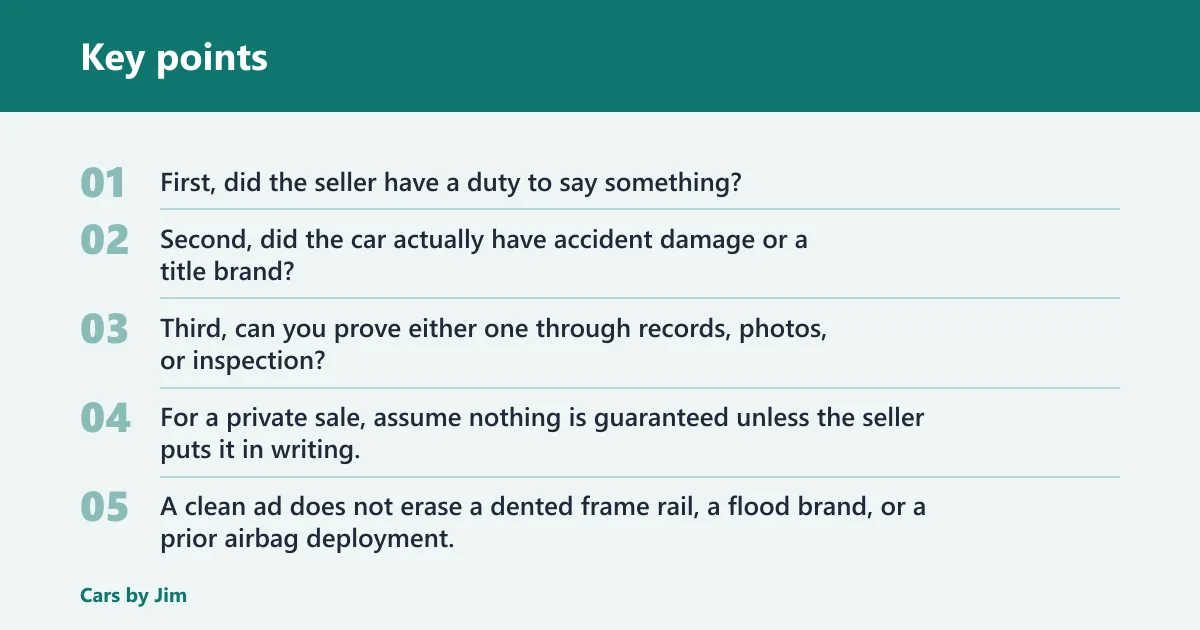
That means you should separate three questions. First, did the seller have a duty to say something? Second, did the car actually have accident damage or a title brand? Third, can you prove either one through records, photos, or inspection?
Private-party sales
Private sellers often have a narrower duty than licensed dealers, but they still may not be able to hide known material facts. If a seller knows the car was in a crash, had major body repair, or carries a branded title, silence can create a legal problem depending on local law.
For a private sale, assume nothing is guaranteed unless the seller puts it in writing. A clean ad does not erase a dented frame rail, a flood brand, or a prior airbag deployment. Verify the state rule first, then compare it with the seller’s statements and the records.
Dealer sales
Dealers usually face stricter disclosure rules and broader consumer-protection obligations than private sellers. They are also more likely to have dealer-provided vehicle history reports, auction records, and inspection paperwork that can support the sale.
That said, a dealer-provided report is not a substitute for direct questions. A dealer can sell a car with prior damage if the law allows it and the condition is disclosed accurately. If the paperwork is vague, push for specifics before you sign.
When local law controls the answer
The legal duty changes by jurisdiction, so a car that must be disclosed in one place may not trigger the same rule elsewhere. Title branding, consumer-fraud rules, and disclosure forms are often state-specific, and cross-border sales can follow different rules again.
Because of that variation, use a simple standard: verify the title status, ask for written disclosure, compare the seller’s story with records, and check the state rule before you rely on any general statement. If those three do not match, treat the sale as higher risk.
What counts as accident history?
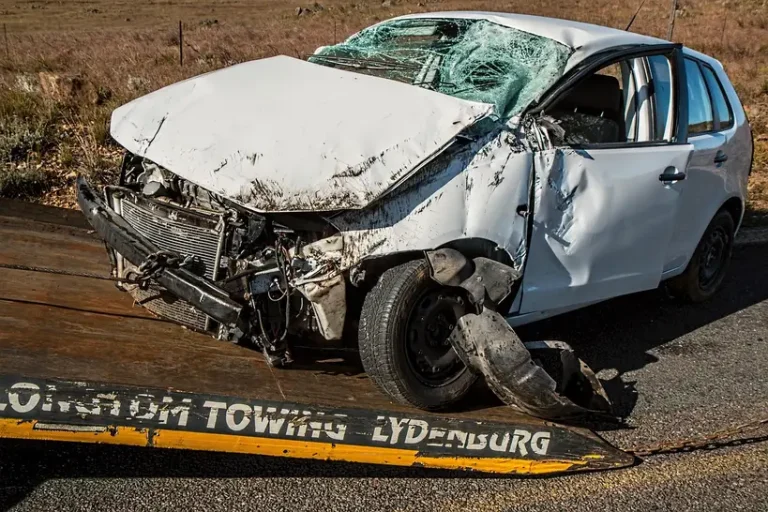
Accident history usually means a record of collision damage, insurance claims, police reports, inspection findings, or other documented damage events. It is broader than a scrape or repaint, and narrower than a branded title. A clean title does not rule out prior accident history.
Reported collisions and insurance claims
Vehicle history reports can show accident history, title records, odometer readings, ownership records, theft records, recall information, and service history. Some reports also show severity indicators or damage type, which helps you judge whether the event was minor cosmetic damage or something more serious.
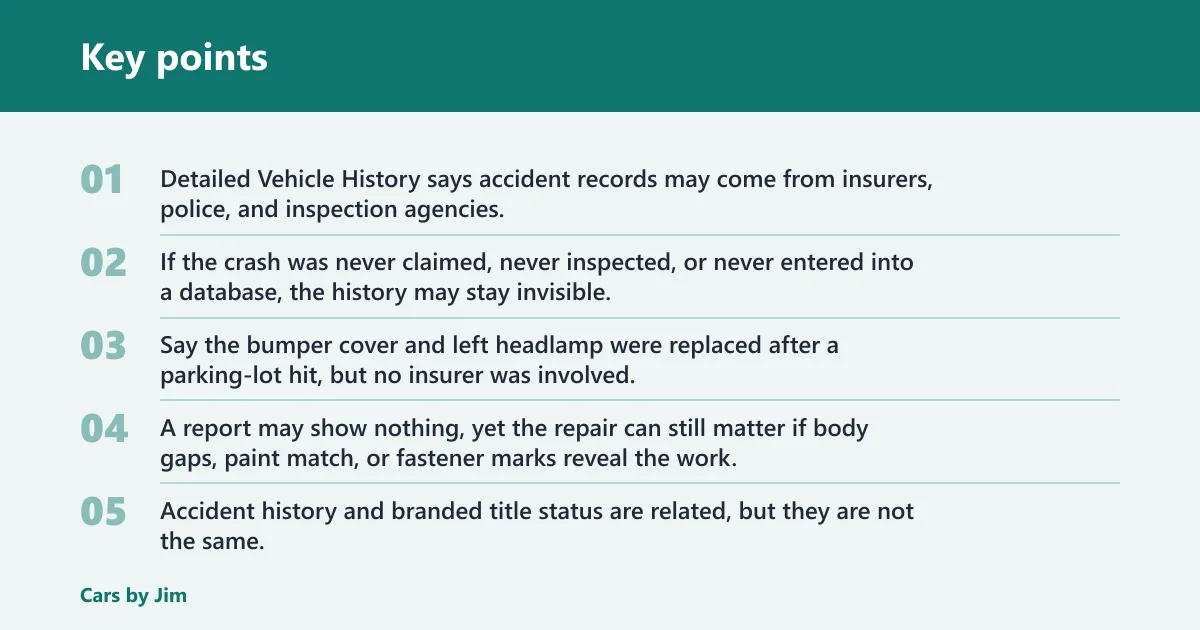
Detailed Vehicle History says accident records may come from insurers, police, and inspection agencies. That matters because the report is only as complete as the records that reached those systems.
Repairs that never hit a report
Not every repaired car appears in a report. If the crash was never claimed, never inspected, or never entered into a database, the history may stay invisible. That is why a clean report does not prove the car was never damaged.
Say the bumper cover and left headlamp were replaced after a parking-lot hit, but no insurer was involved. A report may show nothing, yet the repair can still matter if body gaps, paint match, or fastener marks reveal the work.
Accident history versus branded title
Accident history and branded title status are related, but they are not the same. A branded title is a legal title mark such as salvage, rebuilt, junk, lemon, flood, or fire. The same source lists those brands separately from accident records.
That distinction matters for buyers. A car with accident history may still have a clean title. A car with a branded title carries a very different risk profile, because the title itself signals a major event in the vehicle’s past. Fraud, title-brand disclosure, and material-damage disclosure are related but distinct issues.
How to check accident history by VIN or chassis number
You check records by entering the vehicle identifier into a history service or asking the seller for a report tied to that number. For most vehicles, that means the VIN. For many Japanese imports, it means a chassis number instead, because OTOFACTS says Japanese cars use a chassis number rather than a VIN.
Using the 17-character VIN
OTOFACTS says VINs are 17 characters long. How-To Geek recommends asking the seller for the VIN number before checking history. That number is the key you use to search accident history, title records, theft records, ownership records, mileage entries, and recall information.
Get the full VIN. Ask for all 17 characters, not a partial listing. One wrong character can pull the wrong vehicle or no record at all.
Match the VIN in three places. Check the dashboard plate at the base of the windshield, the driver-side door frame label, and the title or registration documents. The number should match everywhere.
Run the history lookup. Use the VIN to search for accident history, title records, theft records, ownership records, mileage entries, and recall information. If the report is thin, that is a warning sign, not a clean bill of health.
Using a chassis number on imports
The same source says a chassis number is used for Japanese imports and is nine to twelve alphanumeric characters paired with a model code. That is why some import records are tracked differently from standard VIN-based reports.
Check the registration paperwork or body markings for the chassis number, then compare it with the model code if one is listed. If the seller cannot show it or the numbers do not line up, stop and verify before money changes hands.
What a vehicle history report can and cannot prove
A vehicle history report is a reference tool, not a perfect record. It can help you spot accidents, title brands, mileage jumps, theft history, recalls, and service entries. It cannot prove that every past repair, repaint, or collision was recorded.
What the report can include
Carfax is a VIN-based report used as a used-car buying reference, and it can display accident history, service history, and recall data. That kind of report helps you compare the seller’s claim with a database trail.
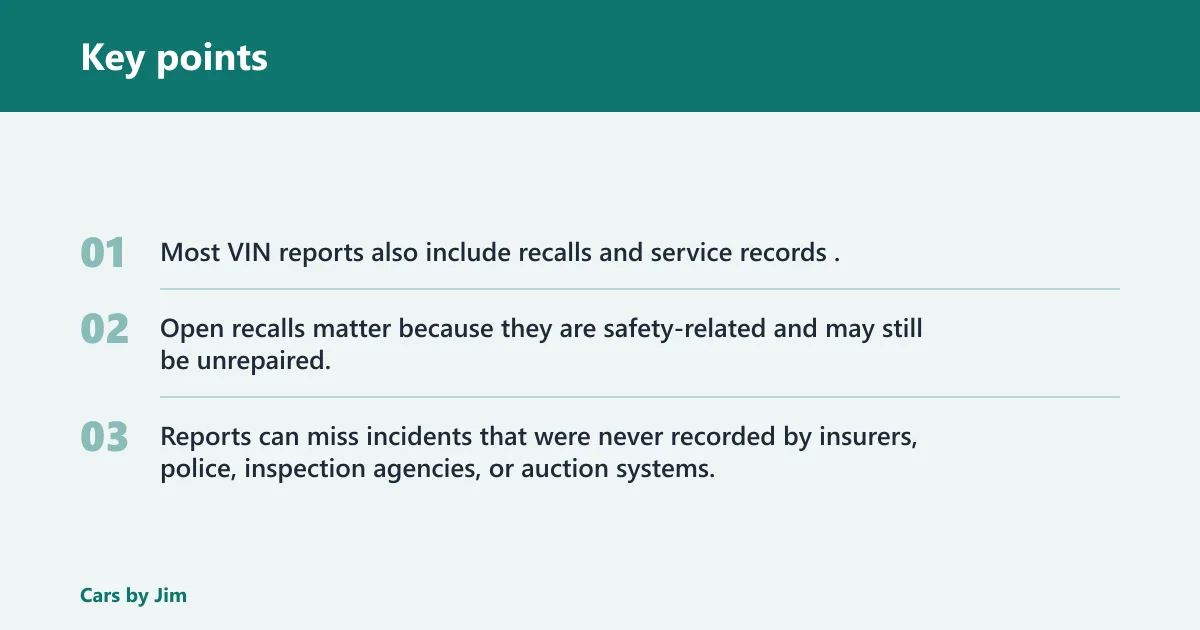
Most VIN reports also include recalls and service records. Open recalls matter because they are safety-related and may still be unrepaired. A report can show whether the recall exists, but you still need to confirm repair status with the seller or the manufacturer.
What the report may miss
Reports can miss incidents that were never recorded by insurers, police, inspection agencies, or auction systems. They can also miss repairs done outside a formal claim, especially if the seller fixed the car privately or before the damage was documented.
A common first-timer mistake is treating “no accident listed” as the same thing as “no accident occurred.” Those are not the same. The first means the database has no entry; the second means you have evidence that nothing happened, which is much harder to prove.
Disclosure decision checklist
| Seller type | Accident severity | Title status | Report shows it | Seller said it | Buyer action |
|---|---|---|---|---|---|
| Private sale | Minor repair, no structural damage known | Clean title | No | No | Verify with inspection; negotiate only if wear or paintwork is visible |
| Private sale | Known crash repair, airbags deployed | Clean title | Yes | Yes | Verify invoices and photos; negotiate on value or walk away if the repair is major |
| Dealer sale | Documented collision with panel and suspension repair | Clean title | Yes | Yes | Verify the repair history and compare pricing to similar cars; negotiate |
| Dealer sale | Major loss event | Salvage or rebuilt title | Yes | Yes | Verify title brand paperwork and inspection results; walk away unless the discount and documentation are compelling |
| Online listing | Unknown | Clean title claimed | No | Yes, seller disclosed damage | Verify with documents and pre-purchase inspection; negotiate if the damage history is real but not severe |
| Private or dealer sale | Repaired damage not on report | Clean title | No | No | Walk away unless independent inspection confirms no structural, flood, or safety damage |
What should you ask before you buy?
Ask direct questions and ask them in writing. You want to know whether the car has ever been in a crash, had airbag deployment, needed frame or structural repair, carried a branded title, or had flood, fire, theft, or auction issues. If the seller hesitates, treat that as useful information.
Ask for full disclosure. Ask whether the car has any accident history, repaired damage, or title brands. Request a plain yes or no answer first, then details.
Request proof documents. Ask for repair invoices, photos of the damage, inspection reports, title brand paperwork, and any prior vehicle history report. These documents help separate actual repairs from vague claims.
Order an inspection. Arrange an independent pre-purchase inspection before you commit. A body shop or mechanic can look for overspray, bent mounts, mismatch in panel gaps, and signs of frame repair.
Suppose a 2018 sedan shows a clean title, but the seller says the front bumper and radiator support were replaced after a deer strike. That does not automatically make the car a bad buy. It does mean you should verify the repair with invoices and an inspection before deciding whether the price makes sense.
What if the seller did not disclose an accident?
If the seller omitted or denied accident history, start by verifying the facts before accusing anyone. Compare the VIN or chassis number against a report, the title, repair invoices, auction records, and the physical condition of the car. If the evidence lines up against the seller’s statement, the car becomes a much bigger risk.
Collect the proof. Save the listing, the seller’s messages, the report, and any inspection notes. Written proof matters more than a verbal dispute.
Compare the condition. Look for mismatched paint, overspray, replaced glass, uneven panel gaps, missing factory fasteners, or fresh underbody coating. Those clues can support the documents, even when the report is incomplete.
Choose your exit. Renegotiate if the issue is minor and disclosed late. Walk away if the damage is major, the story keeps changing, or the title brand was hidden. If local law may have been broken, verify the applicable state rule or get local legal advice, because remedies depend on jurisdiction.
Jalopnik reported a dealer sold a Toyota Supra that had no catalytic converter and an accident history. That kind of case shows why the paper trail matters. A car can look complete from ten feet away and still carry hidden problems that affect value and safety.
Frequently asked questions
Do sellers have to disclose accident history on a used car?
Sometimes, but not always in the same way everywhere. The duty depends on local law, the seller type, what was known, and whether the damage was material or tied to a branded title. A dealer often faces stricter disclosure rules than a private seller.
What counts as accident history on a used car?
Accident history usually includes documented collisions, insurance claims, police reports, inspection findings, and severity indicators tied to damage. It does not mean every scratch or repaint. A car can have repaired damage without ever showing a branded title or a report entry.
Can a seller hide prior accident damage?
A seller may try, but that does not make the omission safe or legal. If the seller knew about major damage, title brands, or safety-related repairs and failed to disclose them, the buyer may have grounds to complain or seek remedies under local law.
Is accident history the same as a salvage or rebuilt title?
No. Accident history is a record of damage or a claim, while salvage and rebuilt are title brands. The same source lists salvage, rebuilt, junk, lemon, flood, and fire as branded-title examples. A car can have one without the other.
What if the accident was never reported to Carfax?
Then the report may not show it, even if the damage happened. Carfax uses VIN-based records, but reports depend on what insurers, police, auctions, or service networks submitted. Ask for repair invoices, photos, and an inspection before you rely on the report.
Can I trust a vehicle history report completely?
No. Use it as a screening tool, not a final verdict. A report can show accidents, title records, odometer readings, ownership records, theft records, recall information, and service history, but it can miss unreported damage or repairs done outside recorded systems.