Used Car Values by VIN: How Accurate Are They?
A VIN-based used-car value gives you a solid starting estimate, but it is only dependable after you verify trim, mileage, options, and history; without those checks, the number can miss by a wide margin. An estimate that is too high or too low can cost you money in a purchase, trade-in, or negotiation. This guide explains when VIN values hold up, when they slip, and which checks tighten the estimate.
What a VIN value can tell you
A VIN-based estimate is more specific than a generic make-and-model number because the VIN can identify year, make, model, trim, engine, and build details. It also ties the car to history records such as accidents, title status, and ownership changes. That makes the starting value better targeted, but still not final.
What the VIN identifies
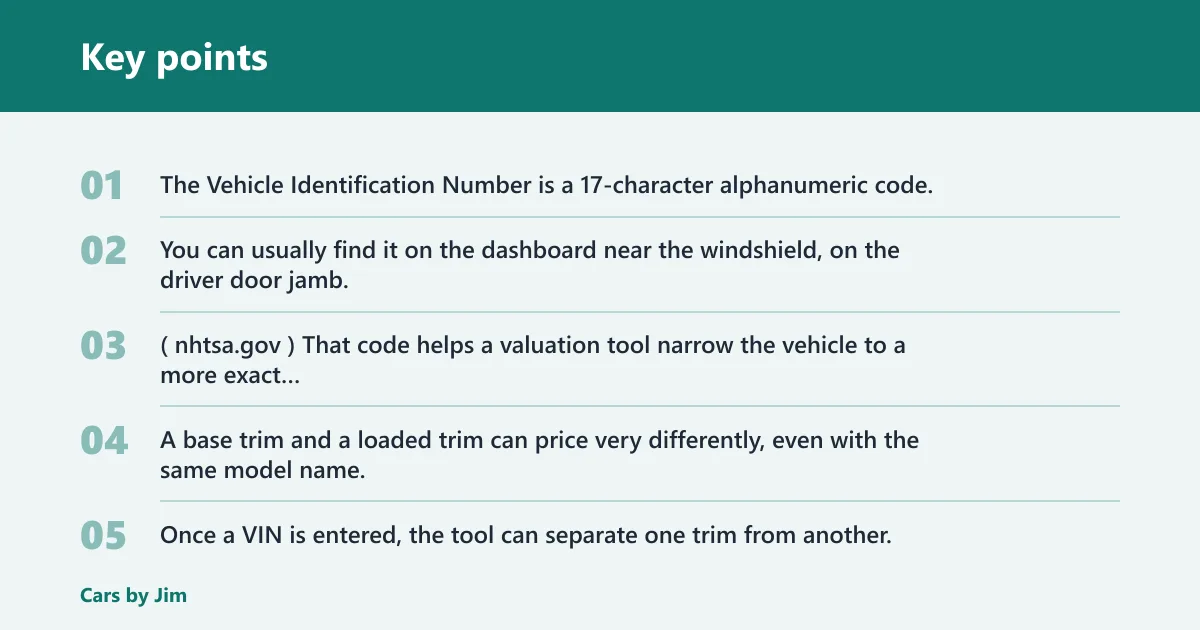
The Vehicle Identification Number is a 17-character alphanumeric code. You can usually find it on the dashboard near the windshield, on the driver door jamb, or on paperwork such as the title, registration, and insurance documents. (Nhtsa)
That code helps a valuation tool narrow the vehicle to a more exact configuration. A base trim and a loaded trim can price very differently, even with the same model name.
Why the estimate changes after a VIN is entered
Once a VIN is entered, the tool can separate one trim from another, identify engine and drivetrain details, and often attach known history data. That is why the number often changes after a VIN lookup. The car is no longer treated as a generic version of the model.
But decoding the car correctly is not the same as pricing it correctly. A tool can identify the right vehicle and still be off if it lacks the right mileage, condition, option, or regional data.
What a VIN lookup cannot know by itself
A VIN lookup cannot inspect paint, interior wear, mechanical soundness, or recent damage on its own. It also cannot see every option, aftermarket change, or local demand shift unless that data is entered or inferred from listings. That is where most pricing error starts.
Suppose two SUVs share the same VIN-decoded trim, but one has 52,000 miles and clean history while the other has 132,000 miles and a repaired front-end hit. The lookup may identify both correctly, yet their market values will not be close.
Which VIN value tools are worth comparing?
Many valuation tools use VIN-specific data and weigh inputs differently. Kelley Blue Book, CARFAX Value, Edmunds True Market Value, and J.D. Power or NADA Guides can be useful benchmarks, especially when comparing more than one source instead of relying on a single number.
Kelley Blue Book
Kelley Blue Book is widely used for trade-in and private-party estimates. It uses VIN-specific inputs such as mileage and condition, so it is often a practical baseline when you want a fast market check.
CARFAX Value
CARFAX Value leans on history-based pricing. That means service records, accident history, and ownership count can affect the result more visibly than in a basic make-model lookup.
Edmunds True market Value
Edmunds True Market Value is a market-based valuation that uses local market pricing data and VIN details. That makes it useful when local supply and demand are changing quickly.
J.D. power and NADA guides
J.D. Power and NADA Guides are commonly used for dealer and consumer pricing. Their VIN-specific trim, engine, and option data can help when you want a dealer-facing reference point, not just a consumer-sale estimate.
How to compare them
Do not ask which one is “right.” Ask which one fits your transaction. A trade-in deal, a private sale, and a dealer retail listing are different price points, so a single number should not be expected to match all three.
| Tool | Main strength | Best use |
|---|---|---|
| Kelley Blue Book | Trade-in and private-party benchmarks | Quick starting point for buyers and sellers |
| CARFAX Value | History-based pricing | Vehicles with service records, accidents, or title changes |
| Edmunds True Market Value | Local market pricing data | Checking current retail pressure in your area |
| J.D. Power / NADA Guides | VIN-specific trim and option data | Dealer-facing comparisons and financing discussions |
How accurate are VIN-based values?

VIN-based values are usually close enough to guide a negotiation, but they are not exact market prices. Accuracy is best when the car is common, clean-title, stock, and well described. Accuracy drops when condition, options, or local supply are missing from the data.
When the estimate is usually close
A VIN estimate is often dependable for common trims with clean title history, average mileage, and no major modifications. In those cases, the VIN narrows the car enough that the remaining spread is usually driven by condition and local listings rather than by identification errors.
VinAudit says its calculator is free and checks VIN-based values instantly. It also says the calculator is limited to 5 market value lookups per day, and it shows average price, price range, listings considered, and the data collection period. Those details help you judge how current the number is.
VinAudit also says its estimates are based on millions of dealer listings, with many updates occurring in real-time. That kind of updating can improve freshness, but it still depends on how well the tool matches your exact vehicle and market.
When the estimate can miss by a lot
The number can miss by a wide margin when the car is unusual, the history is messy, or the local market has thin comparables. Rare trims, rebuilt-title vehicles, heavily modified cars, and classics are the biggest trouble spots because the tool has fewer clean market examples to compare against.
Picture a 20-year-old truck with a lift kit, larger wheels, and a nonfactory exhaust. The VIN may still identify the base truck correctly, but the market price now depends on buyer taste, parts quality, and whether the modifications help or hurt resale in your area.
What drives the biggest price swings
Mileage, condition, history, and location do most of the work. A clean-title car can still vary by several thousand dollars if the mileage is far above average or the condition grade drops from Excellent to Fair. Title branding can move the price even more.
Mileage, condition, and title history
These three inputs matter because they change what buyers are willing to pay. The VIN may identify the vehicle, but mileage and condition decide how worn it is, and title history decides how much trust the market gives it.
Mileage and the 12,000 to 15,000 mile benchmark
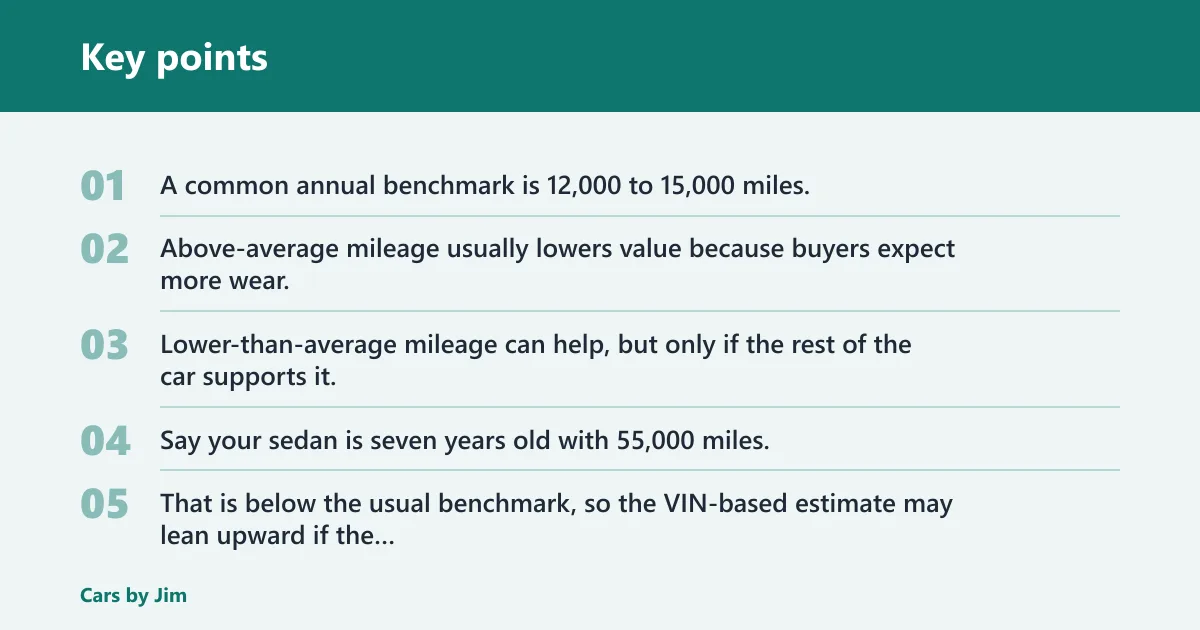
A common annual benchmark is 12,000 to 15,000 miles. Above-average mileage usually lowers value because buyers expect more wear, more maintenance, and less remaining life on common wear items. Lower-than-average mileage can help, but only if the rest of the car supports it.
Say your sedan is seven years old with 55,000 miles. That is below the usual benchmark, so the VIN-based estimate may lean upward if the condition is clean. If the same car has 115,000 miles, the estimate should be checked against local listings because the wear profile is very different.
Condition grades from Excellent to Poor
Condition grades usually run from Excellent to Poor. That grading matters because condition can move value by several thousand dollars, especially when paint, interior wear, and mechanical soundness differ from the assumed grade in the lookup.
A car listed as Excellent but showing seat wear, worn tires, and warning lights is unlikely to deserve the top number. If the tool assumes clean condition and the car is closer to Fair, the estimate will be too high.
Accidents, salvage titles, and rebuilt titles
Accident history and title status can cut value sharply. Salvage or branded title vehicles usually sell for less than clean-title vehicles because financing, insurance, and resale are more difficult. Rebuilt titles sit in between, but they still need careful verification.
CARFAX Value can reflect service and accident history, which may help when records exist. Even so, a repaired car may still be priced too optimistically if the damage was major or if the repair quality is hard to prove.
VIN values for trade-in, private sale, and retail
These are not the same benchmark. Trade-in is the lowest, private-party sits in the middle, and dealer retail is the highest. If you use the wrong benchmark, the number may look wrong even when the lookup is behaving correctly.
Trade-in value
Trade-in value is what a dealer will offer. It is usually the lowest benchmark because the dealer must cover reconditioning, overhead, and profit room. A trade-in number is useful for budgeting your next purchase, not for judging what a retail shopper will pay.
Private-party value
Private-party value is the midpoint benchmark and is usually the target for a direct sale. It is typically 10–20% higher than trade-in value, because the seller is not paying the dealer’s reconditioning and markup costs.
Dealer retail value
Dealer retail is the highest benchmark and includes markup. CarCheckerVIN describes it as the top benchmark, while trade-in is the dealer offer. If you are buying from a dealer, this is the number most likely to matter for the asking price.
When VIN values need a second check
Some vehicles need more than a lookup. If the car has rare equipment, heavy modifications, a thin local market, or a branded title, the estimate should be treated as a draft. Those cases need comps, records, or an inspection before money changes hands.
Rare trims and option packages
Rare trims and option packages can be missed or overstated if the tool does not capture every package correctly. A loaded trim can command much more than the base version, and a missing option can pull the price down. When the VIN-based trim looks unusual, verify it against the sticker, build sheet, or seller paperwork.
Modified vehicles and classics
Modified vehicles and classics are weak fits for automated pricing. Aftermarket changes can help or hurt value depending on the buyer, and classic pricing often depends on originality, rust, restoration quality, and collector demand rather than standard VIN lookup logic.
Low-comps markets and regional swings
Low-comps markets are another blind spot. If few similar vehicles are listed near you, the estimate may lean on distant or stale data. Regional market variation matters too; ZIP code or region can change prices, and truck and SUV demand often differs by climate and geography.
- Compare the estimate with local listings for the same trim, mileage, and title status.
- Check the VIN-decoded trim against the window sticker, build sheet, or seller listing.
- Review the mileage against the 12,000 to 15,000 mile annual benchmark.
- Look for accident records, branded title history, and ownership changes.
- If the car is rare, modified, or has thin comps, get an inspection before relying on the number.
VIN value reliability checklist
This checklist shows when the estimate is dependable, when to compare against comps, and when to get an inspection. Use it before you negotiate, make an offer, or accept a trade-in figure.
| Scenario | Expected accuracy risk | What to verify next |
|---|---|---|
| Clean-title common trims | Low risk; VIN estimate is usually usable as a starting point | Compare with local listings and confirm mileage and condition |
| High-mileage examples | Moderate to high risk; value can slip well below a standard estimate | Compare against comps with similar mileage and ask for service records |
| Accident or rebuilt titles | High risk; history can lower value sharply | Get an inspection and verify title branding, repairs, and disclosure documents |
| Rare trims or options | Moderate to high risk; VIN decoding may miss a value-moving package | Match the build sheet, window sticker, and trim-specific comps |
| Modified vehicles | High risk; market value depends on the quality and taste of the changes | Compare against similar modified listings and get a mechanical inspection |
| Low-comps markets | High risk; thin local data can distort the estimate | Expand the search radius and compare against regional listings |
Frequently asked questions
How accurate are used car values by VIN?
They are accurate enough to start a conversation, not to settle the deal by themselves. A VIN improves the match by identifying trim, engine, and build details, but the estimate still depends on mileage, condition, title history, options, and local supply.
Does a VIN lookup show the true value of my car?
No. A VIN lookup shows an estimate based on known data, not a guaranteed market price. It can be very close on common, clean-title vehicles, but it can be wrong when condition, options, history, or regional demand are missing or unusual.
Why does the value change when I enter the VIN?
Because the tool can narrow the vehicle from a broad model to a specific trim, engine, and build. That changes the pricing logic. A base model and a higher trim can differ a lot, so the VIN often moves the estimate up or down.
What information does a VIN-based car value include?
Most VIN-based values use year, make, model, trim, engine, mileage, condition, and history data when available. Some tools also include service records, accident history, ownership count, and local market pricing. The more complete the data, the tighter the estimate usually is.
Can mileage, accidents, or trim make VIN values wrong?
Yes. Mileage above the 12,000 to 15,000 mile annual benchmark can lower value, accidents can reduce value significantly, and an incorrect trim assignment can move the number in the wrong direction. These are some of the biggest reasons a VIN lookup needs verification.
What should I check before trusting a VIN car value estimate?
Check the trim, mileage, title status, and condition first. Then compare the result with local listings for the same configuration. If the car is rare, modified, rebuilt, or unusually high-mileage, get an inspection before you treat the number as a negotiating anchor.