What Paperwork Do I Need to Sell My Car Privately?
For a private sale, the must-have items are the V5C logbook, a signed sales receipt or bill of sale, and the DVLA keeper-change process. If the car has finance, you also need settlement proof before you can treat the sale as complete. The V5C shows the registered keeper, but it does not by itself prove ownership; buyers may also want service records, MOT evidence, keys, accessories, and proof that any personal data has been removed.
Quick answer: what you must have vs what builds trust
Must-have for a safe transfer: V5C, receipt/bill of sale, keeper transfer via DVLA, finance settlement proof if the car is financed, and a seller/buyer ID and address match where needed to resolve any mismatch or estate/company-sale issue.
Trust-builders that help the sale: MOT status/history, service history, receipts for repairs, all keys and accessories, and a reset of personal data from the car’s systems.
Private-sale paperwork checklist
Use this as a decision list, not a shopping list. Some items are needed for a safe transfer, while others mainly help the buyer feel confident and help you justify the asking price. The V5C is the core document, but it is not the only one that matters. DVLA explains that the V5C records the registered keeper, while the right to sell may also depend on the seller’s authority, the finance position, or other supporting proof in non-standard sales.
| Required for a safe transfer | Helpful but optional | If missing, do this next |
|---|---|---|
| V5C logbook with keeper details ready to transfer | Service book and full service history | Apply for a replacement from DVLA if it is lost or damaged, or complete the keeper-change process using the existing V5C if available; expect a slower sale if it is missing |
| Signed sales receipt or bill of sale with buyer and seller details | MOT certificate and MOT history printout | Use the MOT history service to print the current test record and keep a dated receipt showing the sale terms and parties |
| Proof of ownership or authority to sell, especially if the car is financed, part of an estate, or a company car | Invoices and receipts for work carried out | Gather lender settlement proof, probate/estate authority, company permission, or other documents that show the right to sell before agreeing a handover |
| All keys, including any spare key handed over at collection | Locking wheel nut tool and other accessories | Find every key and accessory first; replace missing items where possible before listing |
| Personal-data reset before handover | Bluetooth contacts, sat nav data, paired phones | Factory reset the infotainment system, delete stored data, and remove connected accounts before the buyer arrives |
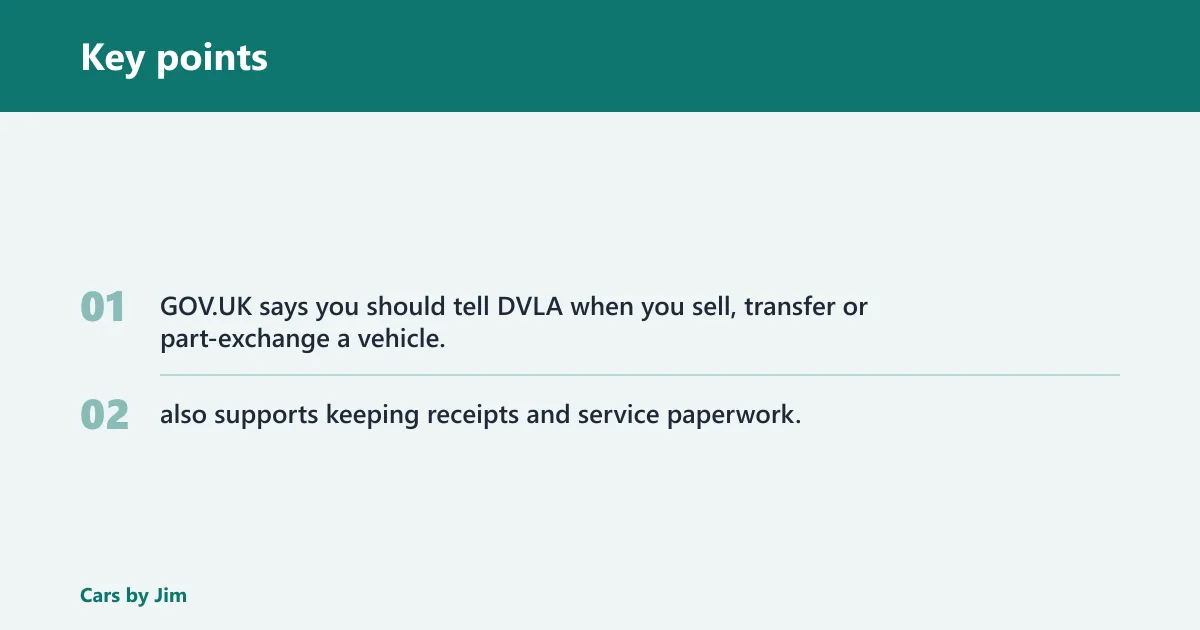
GOV.UK says you should tell DVLA when you sell, transfer or part-exchange a vehicle, and the MOT history service lets a buyer check the car’s test record online. Consumer guidance from Which? also supports keeping receipts and service paperwork, especially when you need to explain maintenance or confirm finance settlement.
What paperwork do you need before listing the car?
Before you advertise, check the V5C details, gather MOT records, and assemble service paperwork. Add invoices, receipts, keys, and accessories to the pile. That gives you a complete handover pack and avoids delays when a buyer is ready to collect.
Check the V5C details first
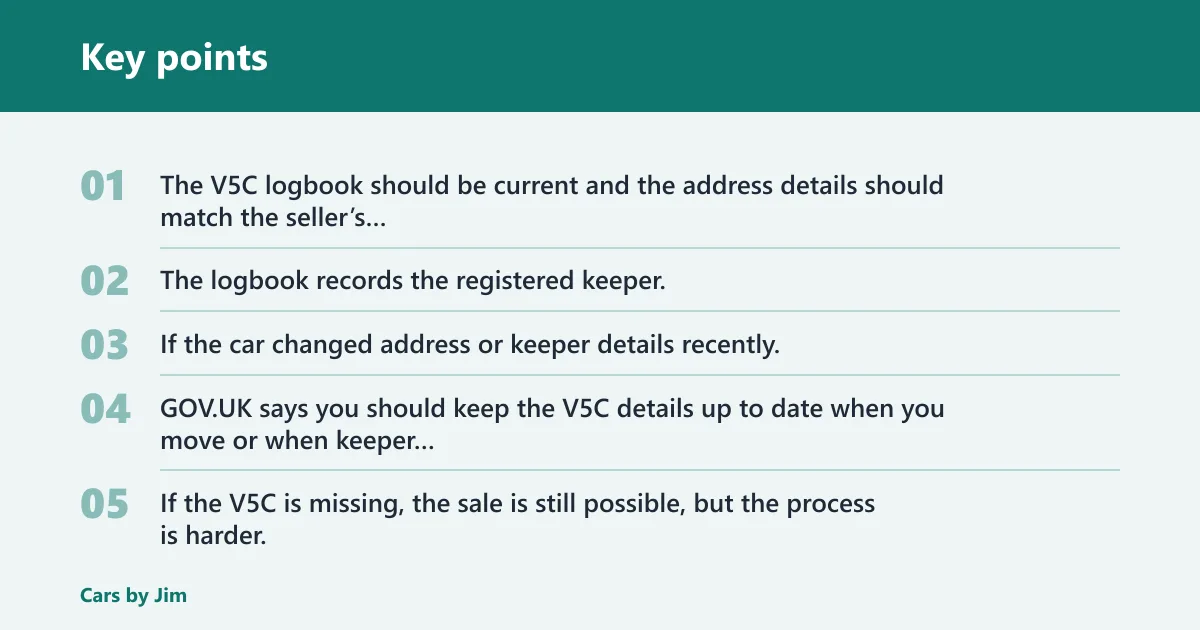
The V5C logbook should be current and the address details should match the seller’s details. The logbook records the registered keeper, so a mismatch can slow the sale or create confusion at handover. If the car changed address or keeper details recently, sort that out before the listing goes live. GOV.UK says you should keep the V5C details up to date when you move or when keeper details change, and use the correct process to notify DVLA when the vehicle is sold.
If the V5C is missing, the sale is still possible, but the process is harder. DVLA provides a replacement logbook service for lost, stolen, damaged or destroyed V5C documents. Buyers often treat a missing logbook as a warning sign, so be ready to explain what happened and what step you have taken to replace it.
Gather MOT records and service paperwork
MOT certificates belong in the file, and the MOT history helps build trust. A recent MOT can make the car easier to sell because it gives the buyer more confidence in roadworthiness and reduces immediate uncertainty. The certificate is useful, but the history matters too. You can check the current status and past results through the official MOT history service, which is especially helpful if the paper certificate is missing.
Service history is also recommended for private sales. Full or partial service history can increase value, and receipts for work carried out help document maintenance. If the service book is incomplete, a stack of dated invoices still helps more than silence. Consumer advice from Which? also points to service records as useful evidence when you want to show how the car has been maintained.
Find invoices, receipts, keys, and accessories
Keep invoices and receipts for major work or parts. They help prove maintenance and can back up claims about recent repairs, tyres, brakes, cambelt work, or other major items. Even a partial paper trail is better than an empty folder. A proper sales receipt or bill of sale should also show the date, price, vehicle details, and the names and addresses of the parties, because that paper trail can matter if there is a later dispute about what was sold and when.
Gather all keys, including spares. Which? says to include the locking wheel nut tool if you have it. Re-fit removed accessories where possible before the buyer arrives, such as a parcel shelf, tow bar cover, or a boot mat that was taken out.
Say your hatchback has one key fob, a spare blade key, and a locking wheel nut tool in the boot. That small bundle can turn a nervous buyer into a ready buyer, because the handover looks complete rather than improvised.
Which documents should you hand over at collection?
At collection, hand over the documents that are needed for the transfer, but keep control of anything that proves payment or keeps the car in your name until funds clear. A common safe sequence is to confirm payment first, complete the keeper transfer, then release the keys and full paperwork set. GOV.UK’s guidance on selling or transferring a vehicle makes the keeper-change step central to the process.
What to give before payment clears
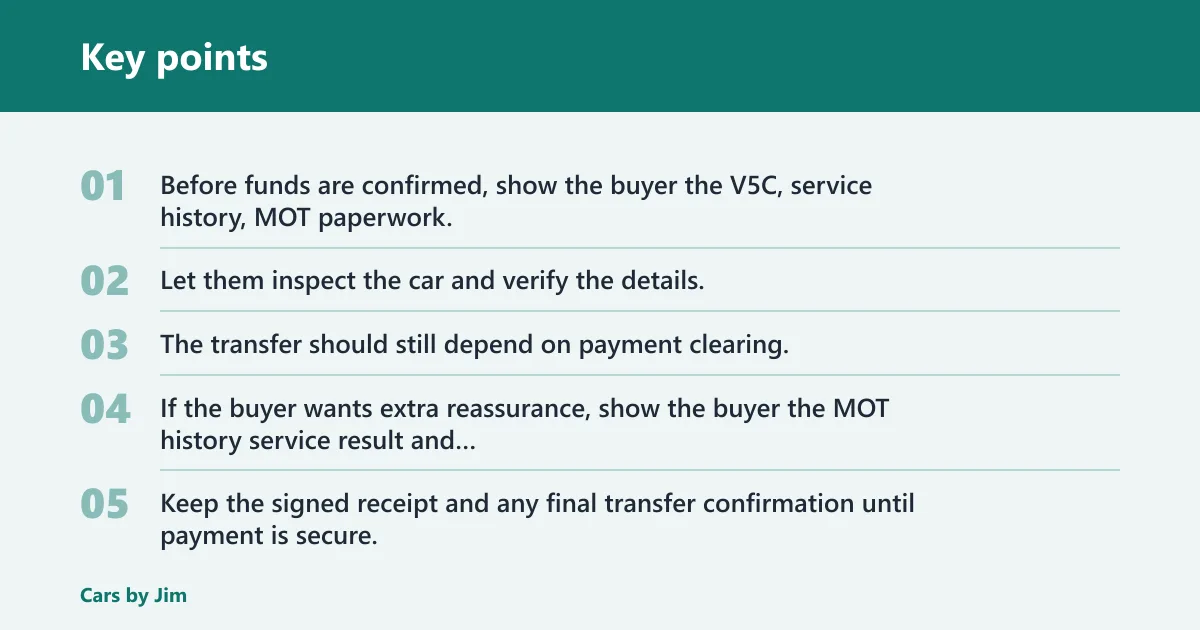
Before funds are confirmed, show the buyer the V5C, service history, MOT paperwork, and any invoices you want them to review. Let them inspect the car and verify the details, but do not hand over everything just because they have arrived. The transfer should still depend on payment clearing. If the buyer wants extra reassurance, show the buyer the MOT history service result and the sale receipt template or completed receipt, rather than rushing the final handover.
What to keep until funds are confirmed
Keep the signed receipt and any final transfer confirmation until payment is secure. If you release the keys too early, you lose control if the transfer stalls. Hold back the last step until the money is in your account or the agreed payment method has cleared. For private sales, consumer advice commonly recommends treating proof of cleared payment as a precondition for release of the car and final documents.
How to complete the V5C transfer
Complete the change-of-keeper section on the V5C and follow the DVLA process to notify the keeper change. Keep your copy of the receipt and any proof that the car was handed over. That record matters if parking charges, tolls, or fines turn up after the sale. GOV.UK says the seller should notify DVLA when the vehicle changes keeper, and the V5C is the document used for that notification.
Picture a sedan collected at 7 p.m. with the buyer saying the bank transfer is “on the way.” The safe move is to wait for cleared funds, then sign the receipt, hand over the keys, and complete the keeper change. A rushed handover can become a payment dispute.
Can you sell a car without the V5C logbook?
You can sell a car without a V5C, but the process is harder and the buyer will usually want extra reassurance. The logbook is the core transfer document, so missing it means more explanation, more caution from the buyer, and a slower handover. It does not automatically stop the sale. DVLA provides a replacement process if the logbook is lost or damaged, and that is usually the cleanest route if you have time.
What a missing V5C changes
Without the V5C, you lose the cleanest way to transfer keeper details. That means the buyer may worry about ownership, tax transfer, or whether the car’s details are accurate. Expect more questions and a lower level of trust unless you can support the sale with other proof. The key point is that the V5C shows the registered keeper, not ownership in a strict legal sense, so a missing logbook creates uncertainty even when the seller is genuine.
How to apply for a replacement
If the logbook is lost or damaged, apply for a replacement before advertising if time allows. A replacement makes the sale easier because it restores the normal transfer path. If you must sell before it arrives, explain the situation plainly and show the buyer any paperwork that supports the car’s identity. GOV.UK’s replacement V5C service is the official route for a lost, stolen, damaged or destroyed logbook.
What buyers will need to know
Tell the buyer why the V5C is missing, what you have done to replace it, and what evidence you can show instead. Keep the story short and factual. If the address details on an existing V5C are wrong, correct the issue rather than hoping the buyer will ignore it.
Do you need the MOT certificate to sell privately?
You do not need to treat the MOT certificate as the only route to a private sale, but it belongs in the paperwork pack. The certificate and MOT history help buyers judge roadworthiness confidence. A recent MOT helps the sale because it reduces doubt, especially on cars that are due soon. The official MOT history service is particularly useful because it shows current status and past test results, even if the paper certificate is missing.
MOT certificate versus MOT history
The certificate shows the most recent result. The history shows the pattern. A complete MOT history builds buyer trust because it reveals passes, advisories, and past failures over time. If the paper certificate is missing, the history can still help, especially if the buyer can see the current status through the official service.
Why a recent MOT helps confidence
A recent MOT gives the buyer a clear starting point. It suggests fewer immediate surprises and makes the car easier to compare against others. It is especially useful on older cars, where buyers often look for evidence that the vehicle has been checked recently. Because the official record is searchable, it also helps a buyer verify the car without relying only on what the seller says.
What to do if the car has no current MOT
If the car has no current MOT, be direct about it. Provide the last MOT history, service records, and invoices so the buyer can judge the condition themselves. Do not imply the car is road legal simply because it has paperwork. The documents support confidence; they do not create it. A no-current-MOT car may still be sold privately, but the buyer needs to understand the status clearly before agreeing a collection.
What if the car still has finance?
If the car still has finance, you need proof that the lender’s interest has been settled before ownership transfers cleanly. Which? says sellers should prove outstanding loans have been paid off, and lenders or finance companies usually provide settlement figures and confirmation when the balance is cleared. That step protects the buyer and stops you from promising a car you do not fully control yet.
How to confirm settlement
Ask the lender for settlement figures and written confirmation once the account is cleared. Keep the payoff proof with the sale file. If the finance is not settled, do not hand over the car as though it is ready for transfer. The buyer needs certainty, not promises. If the car is on hire purchase, PCP, or similar finance, the lender may still have rights over the vehicle until the balance is paid and settlement is confirmed.
What proof to show the buyer
Show the buyer the settlement proof, not just a verbal assurance. If there was an outstanding loan, the buyer may ask for lender documentation or a clear statement that the debt has been cleared. That proof matters because it ties directly to ownership and transfer. A seller who can show finance settlement paperwork is in a much stronger position than one who can only say the account is “nearly done.”
When you can transfer ownership
Transfer ownership only after the finance is settled and you can show evidence of that settlement. If the lender still has a claim on the vehicle, the handover can become complicated fast. Do the finance work first, then complete the paperwork with the buyer. For practical guidance, sellers often use a finance-settlement letter or confirmation statement as part of the handover pack.
How do you prove the car is yours to sell?
Proof of ownership means evidence that you have the right to sell the car. That can include the V5C in your name, finance settlement proof, purchase records, or other documents that match the car and the seller. It becomes especially important if the car is not straight-forwardly registered to you. In the UK, the V5C helps show who is responsible for the vehicle, but it is not a stand-alone ownership deed.
Single owner versus multiple owners
If the car is in one name and the V5C matches, proof is usually straightforward. Multiple owners make the paperwork more sensitive, because everyone with a legal interest may need to agree. Check the registration and the sale authority before you promise a collection time. Where the seller is a company or a trader acting for a business, the authority to sell should be clear before you accept payment.
Selling for a family member or estate
If you are selling on behalf of a family member or an estate, bring the authority to act, not just the keys. A buyer may reasonably ask who can sign, who owns the vehicle, and who is allowed to receive the money. Keep the authority documents with the sale pack. If probate is involved, the person handling the sale should be able to show the right to deal with the vehicle as part of the estate.
What to do if ownership documents do not match
If the ownership documents do not match the seller’s name, pause the sale and sort the mismatch first. That might mean getting written permission, correcting the keeper record, or confirming the estate paperwork. A buyer should not be asked to guess who legally controls the car. In third-party sales, the safest route is to line up the seller’s authority, the ID/address details, and the paperwork before the car is advertised.
What should you delete before the buyer arrives?
Delete stored personal data before handover. Factory reset the infotainment system if needed, remove Bluetooth contacts and sat nav data, and revoke app access. Which? recommends deleting stored personal data, and says a factory reset may be needed for infotainment data. That protects privacy and avoids the next owner seeing your details. It also reduces the chance that the buyer can access your phone contacts, navigation history, or connected-car account.
Factory reset the infotainment system
Reset the system to remove saved accounts, paired phones, addresses, and media preferences. Some cars store far more than call logs. If the system keeps showing old profiles after a simple delete, use the full factory reset option. A proper reset should be paired with a check that the system is no longer linked to your accounts.
Remove contacts, locations, and saved accounts
Check Bluetooth contacts, navigation favourites, home address entries, and streaming or app logins. Remove anything tied to your phone. A buyer should receive a car, not a list of your saved locations and numbers. If the vehicle stores multiple user profiles, clear each one rather than deleting just the primary profile.
Revoke app access and paired devices
Sign out of connected manufacturer apps and remove the car from any account that can unlock, locate, or monitor it. Unpair all devices before collection. That stops the new owner from fighting your old phone connection on day one. It also protects any account that could still show mileage, location, or vehicle status after the sale.
A common first-timer mistake is deleting one phone contact list and leaving the sat nav home address behind. The car may look clean, but the data trail still points to your house. Reset both systems, then check the menus once more before the buyer turns up.
Frequently asked questions
What paperwork do I need to sell my car privately?
You need the V5C logbook, a signed sales receipt, and the DVLA change-of-keeper notice. Add MOT paperwork, service history, and receipts if you have them. If the car still has finance, settle it first and keep proof that the loan has been cleared. The V5C helps transfer the registered keeper, while the receipt and finance proof help show the sale was properly completed.
Do I need the MOT certificate to sell my car privately?
The MOT certificate is recommended, but it is not the only thing that matters. MOT history also helps build trust, and a recent MOT can make the sale easier. If the car has no current MOT, be clear about that and show the buyer the full history. Buyers can verify the test record through the official MOT history service.
Do I need service history when selling a car privately?
You do not need a perfect file to sell, but service history is recommended. Full or partial records can increase value and confidence, especially when backed by invoices and receipts. If the book is incomplete, keep the paperwork you do have and present it clearly.
What documents should I hand over to a private buyer?
Hand over the V5C transfer section, the signed receipt, and any documents the buyer needs to prove the car’s history and condition. That usually includes MOT paperwork, service records, and receipts. Keep payment-related records until the money has cleared and the transfer is complete.
What if I still owe money on the car loan?
If the car still has finance, you need proof that the loan has been paid off before the sale is complete. Ask for settlement confirmation from the lender and keep it with the handover file. Do not transfer ownership until the finance is settled and documented. If you are not sure whether the settlement is complete, ask the finance provider for written confirmation rather than relying on a verbal update.
What should I delete from the car before selling it?
Delete Bluetooth contacts, sat nav data, saved addresses, app logins, and any stored personal profiles. Use a factory reset if the system keeps old data. Then unpair devices and revoke connected app access so the next owner starts with a clean system.
Do I need to prove the car is mine to sell it?
Yes. The buyer should be satisfied that you have the right to sell the car, especially if the V5C is missing, the car has finance, or you are selling on behalf of someone else. Match the documents to the vehicle and keep any settlement or authority proof ready.
Sources
GOV.UK: Tell DVLA when you sell, transfer or part-exchange a vehicle
GOV.UK: Vehicle log book (V5C)
GOV.UK: Replace a lost, stolen, damaged or destroyed V5C
GOV.UK: Check the MOT history of a vehicle
Which?: Used cars advice
Which?: Selling a car