Can I Run a VIN Check for Free, and What Will I Miss?
Yes, run a free VIN check first. Then pay for a full report before buying if the car is newer than 10 years, has any auction, theft, flood, or title-brand hint, or lacks a clean paper trail. Missing records can hide odometer fraud, structural damage, or title problems that cost far more than a report. This guide maps each free-report gap to the risk it conceals and tells you when free is enough.
What a free VIN check shows
A VIN is commonly a 17-character code assigned by the manufacturer. It identifies the vehicle’s year, make, model, engine size, manufacturer, and manufacturing location. A free VIN check usually starts with those basics, then may add open recall status from the NHTSA recall database.
That is useful, but it is not a full vehicle history report. A result can look complete because it names the trim, engine, and recall count while still leaving out accident, title, lien, theft, and ownership data. Those missing pieces are where the buying risk usually sits.
Typical free results
Many free tools show factory specs, equipment details, and recall status. Some also show basic market-related context or a simple accident count preview, depending on the platform. Bumper says its free VIN check includes vehicle specs, factory equipment, and NHTSA recall status, while a full report adds accident and damage history, theft status, salvage and title branding, lien data, and ownership records.
That split matters. A clean free screen does not mean the car has a clean history. It may only mean the free tier stopped where the more sensitive records begin.
What makes a result feel complete, but not be complete
The biggest trap is assuming that a page with specs and recalls has already answered the important questions. It has not. A report can confirm the car’s identity and still miss the records that determine whether the vehicle is hard to insure, hard to title, or worth less than the asking price.
Say your search shows a 2019 sedan with the right engine, matching trim, and one open recall. That does not tell you whether the car was flood-damaged, rebuilt, or carrying an unpaid lien. Those are separate checks.
Can I run a VIN check for free?
Yes. Many sites let you enter a 17-character VIN and get a free basic report. Free tools often show the vehicle’s core specs and open recall status, and some add a small slice of history data before asking you to pay for the rest. Some platforms also offer license plate lookup if the VIN is unavailable, though a VIN is the better starting point when you have it.
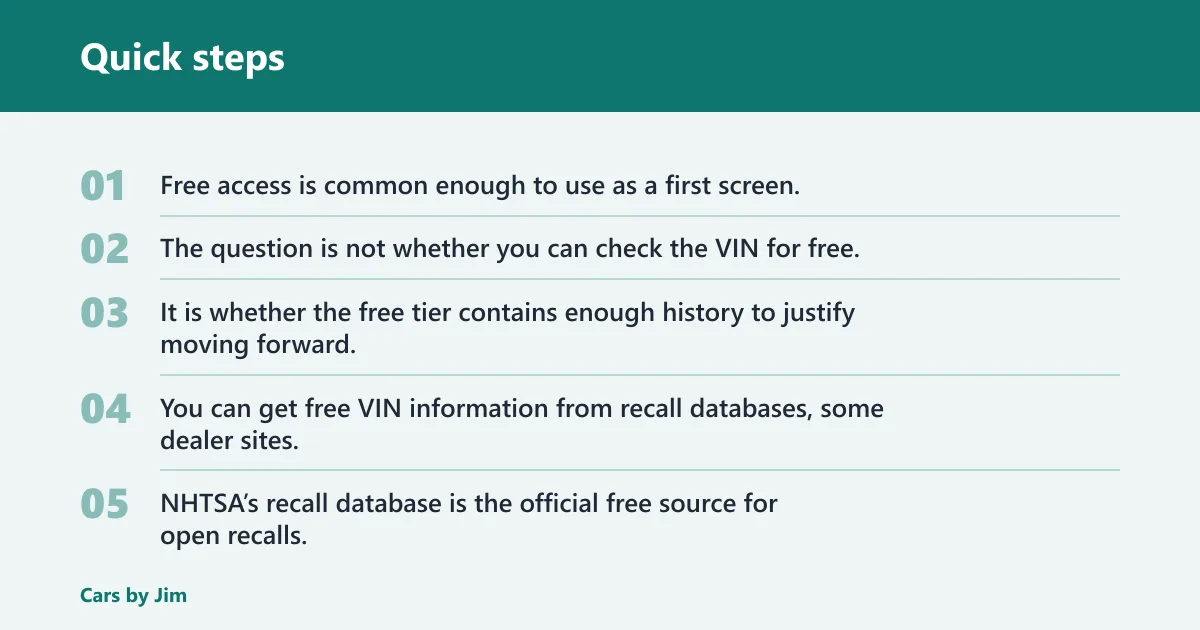
Free access is common enough to use as a first screen. The question is not whether you can check the VIN for free. It is whether the free tier contains enough history to justify moving forward.
Where free checks are available
You can get free VIN information from recall databases, some dealer sites, and some consumer vehicle-history tools. NHTSA’s recall database is the official free source for open recalls. Third-party sites may bundle recall data with factory specs and a partial history preview.
VinAudit says it is an approved NMVTIS data provider, and iSeeCars notes that its iVIN reports are available only for US passenger vehicles model years 1981 and newer. That model-year floor matters because some older vehicles may not have the same depth of searchable history across every platform.
What you can usually get without paying
Without paying, expect the basics: year, make, model, trim or equipment details, and open recall status on some tools. VinSpectorAI says its free check includes recall count, accident count, MSRP, and core specs, which shows how different free tiers can be.
The exact mix varies by site. A free result that includes recall count is not the same as a full history report that includes title brands, odometer readings, theft status, lien checks, and ownership history.
What usually sits behind the paywall
The records most likely hidden behind a paywall are the ones buyers care about most: accidents, salvage and title brands, theft status, lien records, ownership history, and detailed odometer readings. The same source says its free check excludes salvage and title branding, and that lien and ownership records require the full report.
The same source says its reports cover title issues, odometer readings, accident history, structural damage, liens, theft records, and recalls. That is the scope you want when the car is expensive, newer, or has any odd paperwork.
What free VIN checks miss
Free VIN checks often miss records that can affect the buying decision. The main gaps are accidents and damage, title brands, theft status, liens, ownership count, odometer history, and market value. Those omissions matter because each one changes either the car’s safety risk, its transfer risk, or its fair price.
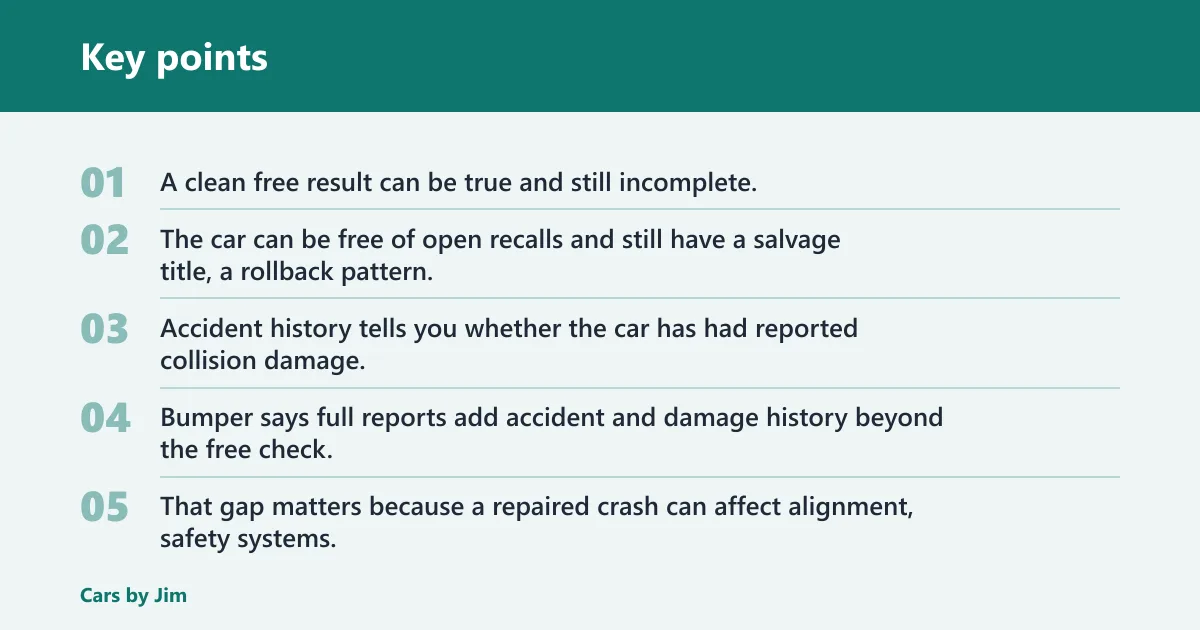
A clean free result can be true and still incomplete. The car can be free of open recalls and still have a salvage title, a rollback pattern, or a lien that blocks transfer.
Accidents and damage records
Accident history tells you whether the car has had reported collision damage, airbag deployment, or structural repair. The same source says full reports add accident and damage history beyond the free check. That gap matters because a repaired crash can affect alignment, safety systems, and resale value even if the car drives normally.
Damage records matter even more on newer vehicles with expensive sensors, radar units, and driver-assist parts. A minor-looking bumper hit can hide costly work.
Title brands, salvage, and flood history
Title brands are the labels that follow a vehicle through state records, including salvage, rebuilt, junk, flood, lemon, and some odometer-related brands. The same source says salvage and title branding are excluded from the free check. NMVTIS and state title records are the main follow-up sources when you need to know whether the title has been branded.
That gap changes value fast. A salvage or flood brand can reduce marketability, complicate insurance, and signal deeper repair risk than a basic free report will show.
Theft status, liens, ownership count, odometer history, and market value
Theft status matters because a stolen or recovered vehicle can still have paperwork problems and transfer issues. The same source says theft status is not included in its free check, and VinAudit says a VIN check can show active theft and theft records. Liens matter for the same reason: an unpaid finance claim can block a clean transfer.
Odometer history shows mileage readings over time. When the readings do not move forward in a believable way, that can point to rollback or inconsistent reporting. Ownership count and sale history help you judge how often the car changed hands and whether it moved through auctions, fleets, or rental use. Market value adds a price check so you can compare the asking price with local market context.
What free VIN checks miss decision table
| Missing data type | Buying risk it hides | Best follow-up source | Usually missing because of |
|---|---|---|---|
| Accidents | Hidden crash damage, unsafe repairs, lower resale value | Full vehicle history report; repair invoices if available | Free-tier limit |
| Salvage, rebuilt, junk, flood, lemon, and other title brands | Major loss history, insurance trouble, title transfer problems | NMVTIS and state title records | Free-tier limit and reporting gaps |
| Theft status | Stolen/recovered complications, possible transfer block | Full report plus theft databases | Free-tier limit |
| Liens | Unresolved loan or finance claim that can block ownership transfer | Full report and seller lien release documents | Free-tier limit and reporting gaps |
| Ownership count | Frequent turnover, fleet use, rental use, auction churn | Full report | Free-tier limit |
| Odometer history | Rollback patterns, skipped readings, inconsistent mileage | Full report and service records | Reporting gaps and free-tier limit |
| Market value | Overpaying for a car with hidden history or weak equipment | Full report and local market pricing tools | Free-tier limit |
Why a clean free result can mislead you
A clean free result can mislead you in two different ways. First, the tool may hide the data behind a paywall. Second, the event may never have been reported into the systems the tool uses. Those are different problems, and you should treat them differently.
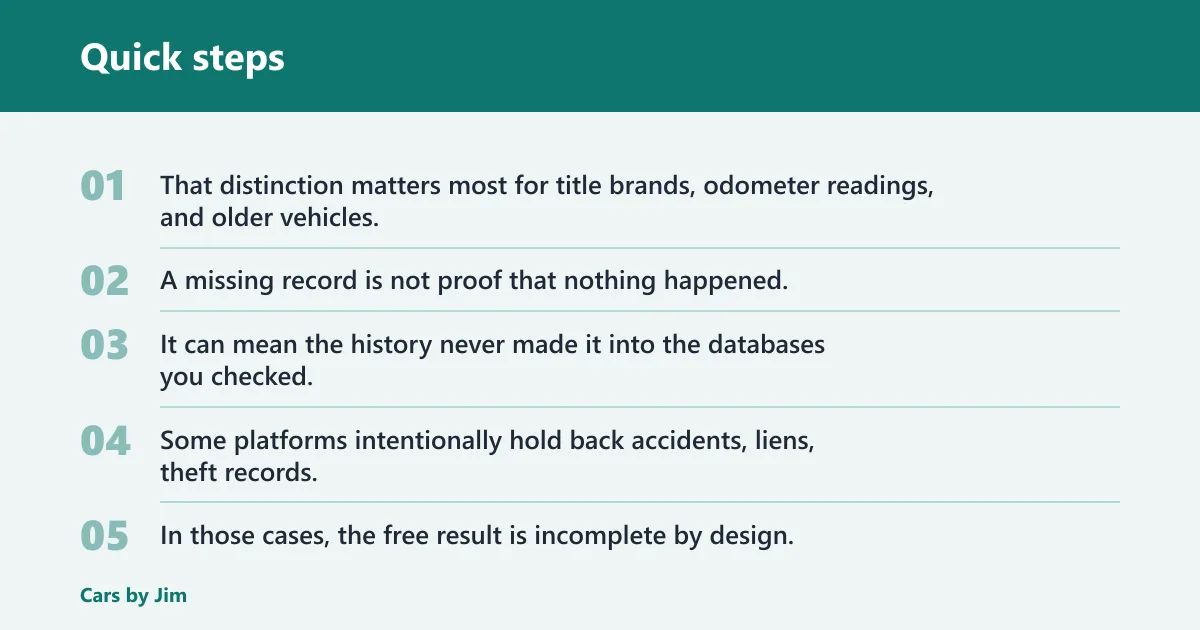
That distinction matters most for title brands, odometer readings, and older vehicles. A missing record is not proof that nothing happened. It can mean the history never made it into the databases you checked.
Missing because the tool limits the free tier
Some platforms intentionally hold back accidents, liens, theft records, and title brands until you buy the report. Bumper is explicit about this split. In those cases, the free result is incomplete by design, not because the vehicle has no history.
When the free tier stops at specs and recalls, do not mistake that for a full screen. Paywall limits are common and predictable.
Missing because the event was never reported
Some history never makes it into the databases. A private repair may not be reported. A move across states can split title records. A fleet or rental vehicle may have a paper trail that is thinner than expected in one system and stronger in another.
Suppose a truck spent time in two states and then sold through an auction. A free search may show a clean recall line but miss the title brand that appears only after a state-level record is checked. Interstate title washing is one reason a single free report is not enough.
Older cars, interstate moves, and fleet histories
Older vehicles can have thinner electronic records. Interstate transfers can scatter title events across jurisdictions. Fleet and rental histories can leave ownership patterns that matter for wear, but not every free tool exposes those patterns. The same source notes that no report reveals previous owners’ names because of privacy laws, so ownership data is always limited to record history, not personal identity.
That is another reason to cross-check seller documents. A title, registration, service invoices, and recall printout can fill in some of the gaps a free search leaves open.
Is a free VIN check enough before buying a used car?
A free VIN check is enough only as an initial screen. It can confirm the car’s identity, basic equipment, and open recalls, but it cannot reliably rule out crash damage, salvage branding, liens, theft records, or odometer problems. For a cheap older car with strong documents, it may be a good first pass. For anything else, it is not enough by itself.
The higher the price and the thinner the paper trail, the more you should move past the free check. Newer vehicles, auction cars, flood-area cars, and vehicles with any title oddity need a fuller report.
When free is usually enough
Free is usually enough when the car is older, low-value, and supported by clear paperwork such as a current title, consistent registration, and service records, with no signs of flood, auction, theft, or title-brand history. It is also enough when you only need the recall status before scheduling an inspection or dealer appointment.
Even then, a free result should be treated as a screen, not a verdict. You still need to inspect the car and review the seller’s documents.
When to pay for a fuller report
Pay for a fuller report when the car is relatively new, priced near the top of its market range, or missing a clean paper trail. Pay if the listing mentions rebuilt, salvage, flood, auction, fleet, rental, or out-of-state history. Pay if the mileage seems odd or the asking price is high for the trim and condition.
A full report is also worth it when the car is a long-distance purchase. Interstate title issues and incomplete local records are harder to spot from photos alone.
When to stop and verify with documents and inspection
- Compare the VIN on the car with the title, registration, and listing.
- Check the recall status and confirm whether the recall was repaired, not only whether it is open.
- Ask for service records, lien release papers, and any salvage or rebuilt paperwork.
- Inspect the car for paint mismatch, uneven panel gaps, water lines, or airbag warning lights.
- If anything conflicts, walk away or order a fuller report before you proceed.
Can a free VIN check show accidents, theft, or liens?
Sometimes a free VIN check will mention one of those items, but many free tools keep them behind the paid report. A cautious assumption is that a free result may show open recalls and basic specs, while accidents, theft status, and lien records often require a full report or a second source.
That is why a clean free result should never be treated as proof of a clean vehicle. If the free report does not name those risks, the tool may simply be hiding them.
Open recalls and the NHTSA database
Open recalls are one of the few items that are commonly available for free. The NHTSA recall database is the official source for open recalls. A free VIN check on some platforms may pull that status directly or display it alongside factory details.
But open does not mean repaired. You still need to ask whether the recall work was completed and get proof if the seller says it was fixed.
Accidents and damage records: accident data is often
Accident data is often behind the paywall. The same source says full reports add accident and damage history beyond the free check. The same source says its reports include accident history and structural damage. If the free result does not mention a crash, that may reflect a free-tier limit, not a clean history.
That matters most on cars with replacement panels, repainting, or mismatched sensors. A partial report can make those clues look less serious than they are.
Liens and transfer risk
Liens are a transfer problem, not a cosmetic one. If the lender still has a claim on the vehicle, you can run into title delays or a blocked sale. The same source says lien and ownership records require the full report, and VinAudit says a VIN check can show open lien checks.
If the seller cannot show a clean title or a lien release, stop there. A free report cannot cure a bad title trail.
What should you do after the free VIN check?
After the free VIN check, decide whether the missing data matters for this car. If the vehicle is cheap, older, and well documented, the free check may be enough to keep shopping. If the car is newer, expensive, imported through auctions, or missing paperwork, get a full report before you put money down.
Then inspect the car, verify the recall repair status, and review the seller’s documents. That sequence is the safest way to catch what the free report leaves out.
Practical next steps
- Run the VIN through an official recall source.
- Compare the free report with the listing and title.
- Look for title brands, mileage mismatches, and ownership clues.
- Ask for proof of recall repair, not just recall status.
- Buy the full report if any key history is missing.
Frequently asked questions
What information does a free VIN check show?
Most free checks show the vehicle’s core specs, such as year, make, model, and sometimes factory equipment. Some also show open recall status, and a few include a small amount of history data. They usually do not show the full accident, title, lien, or theft record set.
What will a free VIN check miss?
A free VIN check often misses accidents, salvage and other title brands, theft status, lien records, ownership count, odometer history, and market value. Those omissions are the ones that can change the price, the insurance setup, or whether the car can be transferred cleanly.
Can I check recalls on a VIN for free?
Yes. Open recalls can be checked for free, and the NHTSA recall database is the official source. Keep in mind that an open recall is not the same as a repaired recall. If the seller says the issue was fixed, ask for proof of the repair.
How do I know if a VIN check result is incomplete?
If the report shows only specs and recalls, it is incomplete for buying purposes. If it does not address accidents, title brands, theft, liens, or odometer history, the tool either hid those records or could not find them. Either way, do not treat it as a clean bill of health.