What Does Dmv Title Problems Reported Mean on a History Report?
“DMV title problems reported” means the vehicle had a title issue in the state record, such as a branding conflict, duplicate title, lien mismatch, or ownership error, and you should verify the title chain before buying. Ignore it and you can end up with a car that is hard to register, finance, or resell. This guide explains what the flag means, which records to check, and how to sort it into low, medium, or high risk in minutes.
What the title warning usually means
A DMV title record is the state-issued ownership record for a vehicle. It can show title events, branding, or administrative issues, but it may not show the full multi-state history. A vehicle history report pulls from multiple sources and is not proof of current legal ownership.
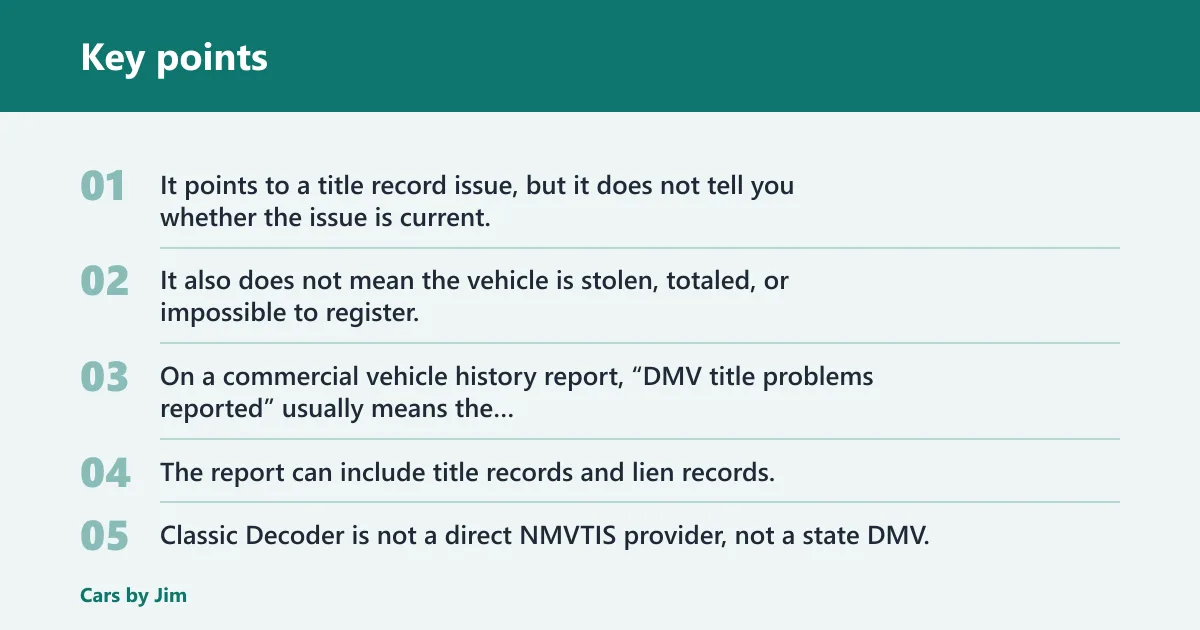
That is why the flag matters. It points to a title record issue, but it does not tell you whether the issue is current, historical, or already fixed. It also does not mean the vehicle is stolen, totaled, or impossible to register.
What the flag usually signals
On a commercial vehicle history report, “DMV title problems reported” usually means the report found one or more title-related records that do not line up cleanly. The report can include title records and lien records, and NMVTIS-related information may appear through partners. Classic Decoder is not a direct NMVTIS provider, not a state DMV, and not a government registry.
Classic Decoder’s history report costs $29.99, includes eight record categories, and supports 5- to 17-digit VINs. It is built for classic and pre-1981 vehicles, and it is designed for research, not proof of ownership.
Why it is a warning, not a verdict
The same flag can point to a simple clerical mismatch or a serious legal defect. A typo in a VIN, a duplicate title filing, or a title transfer that has not been finalized can trigger the alert. So can a branded title history. The flag alone does not separate those cases.
Missing records do not prove there was no issue. Coverage varies by vehicle, jurisdiction, era, and surviving records, so one report can be clean while another vehicle with a similar past shows a warning.
How title records differ from ownership proof
Title records are historical ownership and title events. They can vary by jurisdiction and may be incomplete or fragmented. A report can help you spot a problem, but it is not the legal title document itself. For that, you need the current title, a DMV record, or other official paperwork.
State DMV records are the official government source for title and registration records. A commercial report may aggregate pieces of that history, but it is still a summary. It can point you toward the right questions. It cannot settle ownership by itself.
What the flag may mean and what to ask next
The next step is to classify the flag. Some causes are paperwork issues. Others are legal or financial problems that can affect registration and resale. Use the table below to decide what to ask for before you move forward.
| Possible meaning | Urgency | Likely document to request | Walk away? |
|---|---|---|---|
| Open lien | High until confirmed | Lien release letter, payoff confirmation, current title copy | Yes, until the lien is cleared |
| Salvage or rebuilt history | High | Title copy showing brand, repair paperwork, inspection documents | Maybe, depending on your risk tolerance and inspection results |
| Title branding mismatch | Medium to high | Current title and the DMV record showing the exact brand | Pause until the mismatch is explained |
| Duplicate or duplicate-issue title | Medium | Title copy, DMV transaction record, seller identity documents | Not always, but do not proceed without proof the duplicate was resolved |
| Out-of-state transfer delay | Medium | Application receipt, transfer paperwork, prior state title | Usually no, if the delay is documented and temporary |
Open lien
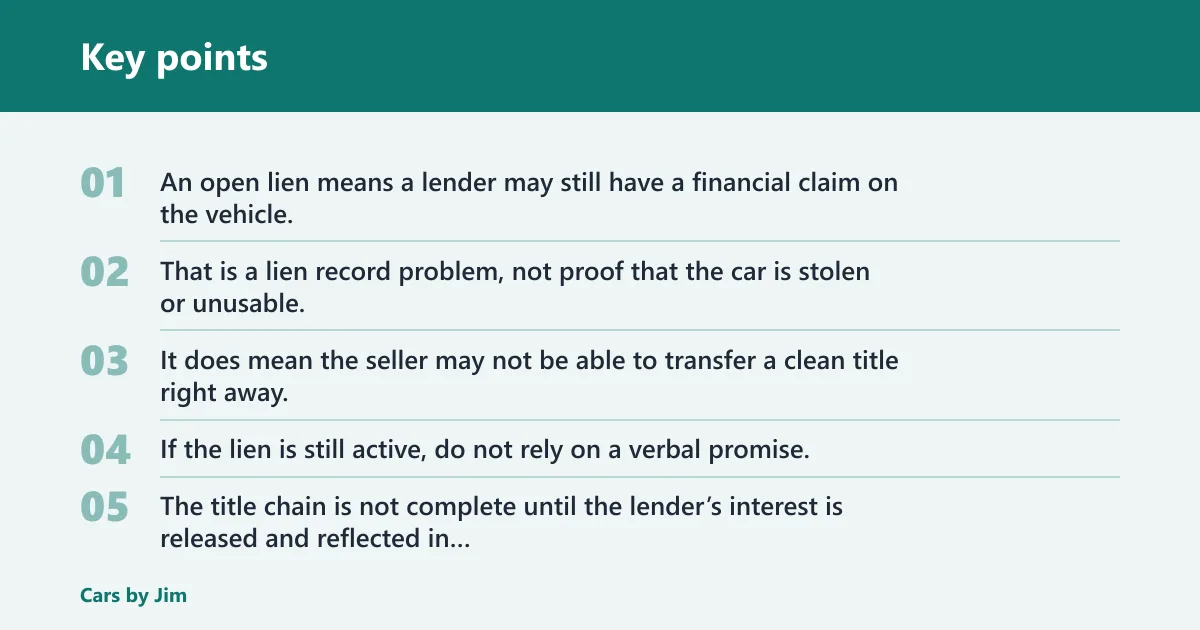
An open lien means a lender may still have a financial claim on the vehicle. That is a lien record problem, not proof that the car is stolen or unusable. It does mean the seller may not be able to transfer a clean title right away.
Ask for the lien release or payoff letter. If the lien is still active, do not rely on a verbal promise. The title chain is not complete until the lender’s interest is released and reflected in the paperwork.
Salvage or rebuilt history
A salvage title is a branded title tied to a prior total-loss event. A rebuilt title usually follows salvage status after repairs and inspection. Those are serious title events, and they affect value and insurability.
They are different from a generic title-problems flag because they identify a known brand, not just an inconsistency. If the report shows salvage or rebuilt history, ask for the title copy, repair records, and any state inspection paperwork that allowed the car back on the road.
Branding mismatch
A branding mismatch happens when the report and the seller’s paperwork do not agree. One record may show salvage, rebuilt, flood, or another brand while another source does not. That can happen when the title moved across states or when records were entered differently.
This is a verification problem. Do not treat the absence of a brand on one document as proof that the issue never existed. Compare the VIN, title brand, issue date, and state of issue line by line.
Duplicate or duplicate-issue title
A duplicate title often means a replacement title was issued after the original was lost, damaged, or not available. In some cases, a duplicate-issue title can also point to a record mix-up, a prior owner error, or a title that was replaced while a transfer was in progress.
The question is whether the duplicate was properly processed. Ask for the DMV transaction record or the paperwork that ties the replacement title to the current seller. If the story is vague, stop and verify it at the DMV.
Out-of-state transfer delay
An out-of-state transfer delay can create a temporary title problem when one state has not finished posting the record or when the prior state’s title data has not matched the new filing yet. This is common enough to be worth checking, and it may be resolved with paperwork already in the seller’s file.
Ask for the prior state title, transfer receipt, and any application confirmation. If the seller recently moved the car across state lines, the report may be seeing an in-progress record rather than a true defect.
Is a title problem the same as a salvage title?
No. A title problem is a broad warning that something in the title record needs verification. A salvage title is a specific branded title status tied to a prior total-loss event. Many title problems are clerical or administrative, and some never involve salvage branding at all.
That difference matters. A report can flag a title issue because the state record is incomplete, duplicated, mismatched, or still open because of a lien. Salvage is one possible cause, but it is not the only one.
Title problems without salvage branding
Some title problems come from paperwork rather than damage history. A title may have been typed with the wrong VIN digit, reissued after a lost document, or held up because a lien release was not posted. None of those automatically means salvage.
Suppose a 17-digit VIN is entered correctly on the vehicle but the DMV file shows a single transposed digit. The report may still flag a title problem even though the issue is clerical. The fix is to match the title copy against the vehicle and the DMV record.
When a branded title is the real issue
If the title copy shows a salvage, flood, junk, or rebuilt brand, the issue is no longer just a reporting flag. That brand is part of the legal title status, and it can affect financing, resale value, and insurance options.
In that case, the report is warning you about a real title history, not a minor data error. You still need to confirm whether the brand was issued by the correct state and whether the rebuilt process, if any, was completed properly.
Why rebuilt titles still need a close check
A rebuilt title does not erase the underlying salvage history. It only means the vehicle went through a repair and inspection process that allowed it back into service. The report may still show title problems because the chain of title was not clean, or because a state updated the brand in a later filing.
Ask for inspection records, repair invoices, and the current title. If those do not line up, treat the vehicle as higher risk even if it is currently road-legal.
Can a car still be bought?
Yes, a car with a title-problems flag can still be bought, but the risk level depends on why the flag appeared. If it is a clerical or temporary transfer issue, the car may be fine after verification. If the issue is current and legal, you may have trouble registering, financing, or reselling it.
The smart move is to separate a fixable paperwork problem from a title defect that is still active. Do not buy on a seller’s promise alone.
When the issue is clerical
If the title problem comes from a typo, duplicate filing, or delayed transfer, the vehicle may be a normal purchase once the record is corrected. Ask for the title copy, DMV receipt, and any correction paperwork. Those documents should explain the issue in plain terms.
A common first-timer mistake is treating every flag as a deal-breaker. A duplicate title that was already reissued and recorded is not the same risk as an active lien or salvage brand.
When the issue is current and serious
If the lien is still open, the brand is unclear, or the seller cannot produce current title paperwork, pause the deal. A current title defect can block registration or leave you with a vehicle you cannot legally transfer in your name.
That is the point where the flag becomes more than a research note. You need official documents, not a verbal explanation.
When to pause or walk away
Walk away if the seller cannot show the current title, cannot explain the issue, or gives inconsistent answers about the state of issue, brand, or lien status. The report is telling you the chain of title deserves scrutiny.
It is also reasonable to walk away if the paperwork is too messy for the price. A bargain disappears fast when you cannot register the car.
How to verify the record
Use the report as a lead, then verify the title trail. The goal is to learn whether the issue is current, historical, or already resolved. You can usually sort that out with a few documents and one DMV check.
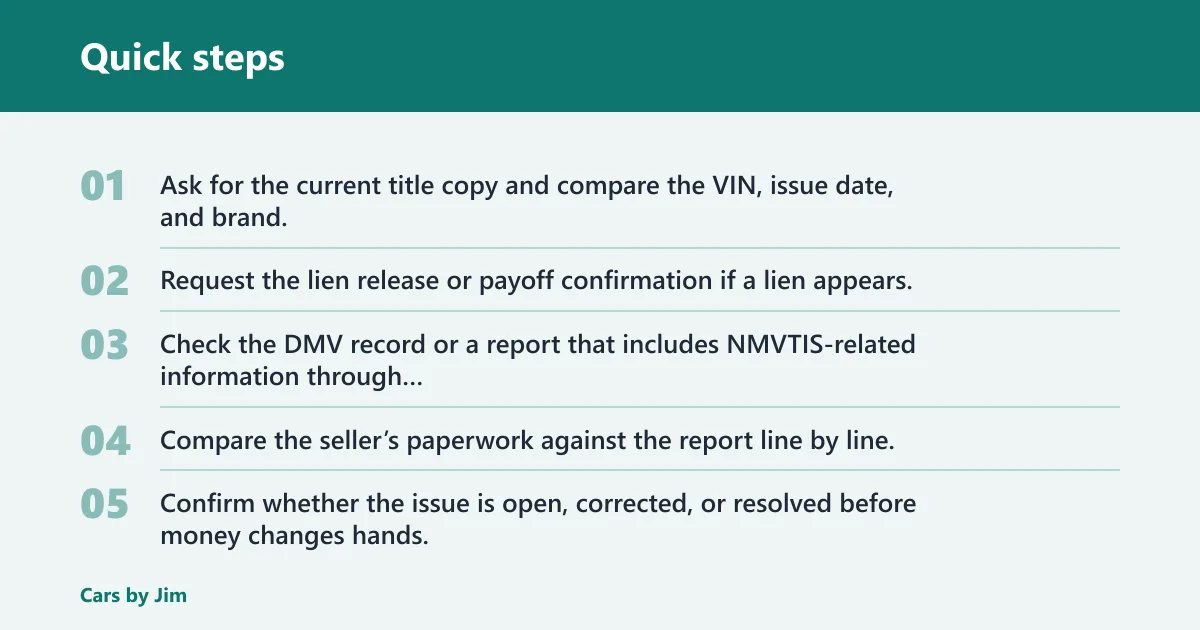
- Ask for the current title copy and compare the VIN, issue date, and brand.
- Request the lien release or payoff confirmation if a lien appears.
- Check the DMV record or a report that includes NMVTIS-related information through partners.
- Compare the seller’s paperwork against the report line by line.
- Confirm whether the issue is open, corrected, or resolved before money changes hands.
Ask for the current title copy
The current title copy is the fastest way to see whether the flag matches the official record. Look for the title brand, the issuing state, the issue date, and any notation that explains a replacement or duplicate title.
If the seller only shows a registration card or a bill of sale, that is not enough. Those are useful documents, but they do not replace the title.
Request the lien release if one exists
If a lien appears, ask for a lien release letter from the lender. A paid-off loan does not always mean the DMV record has been updated yet. The release document bridges that gap.
If the seller says the lien is “already handled,” ask for the proof. A missing release can keep the title from being transferred cleanly.
Check the DMV record or NMVTIS-linked report
The state DMV is the official source for title and registration records. If your report includes NMVTIS-related information through partners, that can help cross-check the history, but it is still not the same as a direct state record.
Use the DMV to confirm whether the title event is active, corrected, or superseded by a later filing. That is the cleanest way to sort a flag into current or historical status.
Compare VIN, brand, and issue date
The VIN should match across the vehicle, the title, and the report. If the brand or issue date does not line up, that is a clue that the problem may be a transfer or data-entry issue rather than a true ownership defect.
Picture a vehicle with a clean-looking title copy from one state but a history report that shows a prior duplicate issue in another. The mismatch does not vanish on its own. You need the earlier paperwork to see whether the duplicate was resolved or never properly closed.
Why some reports show it and others do not
Different reports can show different title histories because the source records are not identical. One report may catch a title event through a partner database while another misses it because the state has not posted it yet or because the vehicle’s older history was never digitized.
That is why you should never treat missing records as proof of a clean past.
State-by-state record differences
Title records can vary by jurisdiction, and states do not all report the same way or on the same schedule. A DMV title record is a state-issued ownership record, but a commercial report may only see part of that state’s file.
This is especially important when a vehicle has moved across state lines. One state may show the brand; another may not carry it forward in the same way.
Missing or delayed updates
Some records lag behind real-world events. A lien can be paid off before the DMV database updates. A replacement title can be issued before a partner database reflects the change. That delay can create a temporary warning.
Use the date on the document, not just the flag itself. Recent paperwork is often the clue that the issue is already resolved.
Older and fragmented title histories
Older vehicles and non-standard VINs are harder to research because surviving records may be incomplete. Classic Decoder supports 5- to 17-digit VINs, which helps with classic and pre-1981 vehicles, but coverage still varies by vehicle, jurisdiction, era, and surviving records.
That means an older car can have a real title issue even when the report shows limited detail. The absence of records is not the same thing as a clean chain of title.
What to ask the seller before you buy
Ask direct questions and ask for documents, not explanations alone. The goal is to confirm whether the flag reflects an active problem or a resolved one. A seller who can answer clearly should be able to support the answer with paperwork.
Questions to ask
- What exactly caused the title problem on the report?
- Is the issue current, or has it already been resolved?
- Do you have the current title in hand?
- Is there a lien, and if so, where is the release?
- Has the vehicle ever carried a salvage or rebuilt brand?
- Was the car transferred from another state recently?
- Can you show the DMV receipt, correction notice, or replacement title paperwork?
What to inspect in person
Look at the title copy, the seller’s ID, the VIN plate on the vehicle, and any DMV paperwork together. If the VIN is inconsistent, stop. If the issue date is recent and the seller claims it is resolved, ask for the exact document that proves it.
What you want is a clean explanation that matches the paper trail. If the story changes from one document to the next, the risk is still open.
Frequently asked questions
What does DMV title problems reported mean on a vehicle history report?
It means the report found a title-related issue in the vehicle’s state record. The issue could be a branding conflict, duplicate title, lien mismatch, or ownership error. It is a warning to verify the chain of title, not proof that the car is unbuyable.
Does title problems reported mean the car has a salvage title?
No. Salvage is only one possible cause. The flag can also come from an open lien, a duplicate title, a data mismatch, or a delayed transfer. You need the current title and supporting paperwork to know whether salvage branding is actually involved.
Is a title problem the same as a lien or ownership issue?
Not exactly. A lien is a financial-interest record, while an ownership issue is a problem with who can legally transfer the vehicle. A title problem can involve either one, but it can also be a clerical or administrative issue that is already resolved.
Can a car still be bought if title problems were reported?
Yes, but only after you confirm the problem is current, historical, or already fixed. A clerical issue may be manageable. An open lien, missing release, or unresolved brand is much riskier because it can block registration, financing, or resale.
How serious is a title problem compared with a branded title?
A branded title is usually more serious because it is an identified legal status, such as salvage or rebuilt. A title problem flag may be broader and less severe, but it still needs proof. Some title problems are minor; others point to major legal or financial issues.
What records can confirm whether the title issue was resolved?
Ask for the current title copy, any lien release, DMV transaction paperwork, and seller documents that match the VIN and issue date. A state DMV record is the most authoritative check. A commercial history report can help, but it is not proof of current legal ownership.
Why would a history report show title problems on some cars and not others?
Because record coverage varies by vehicle, jurisdiction, era, and surviving records. One car may have complete state records while another has fragmented history or delayed updates. Older and out-of-state vehicles are especially likely to show gaps or mismatched title data.
What should I ask the seller or DMV before buying a car with title problems?
Ask what caused the flag, whether the issue is resolved, whether a lien exists, and whether the vehicle ever carried salvage or rebuilt branding. Then ask the DMV to confirm the current status. Do not buy until the paperwork matches the story.