How to Check a Used Car Reliability Rating Before You Buy
Check a used car’s reliability by comparing at least two rating sources, then verify the car’s history and maintenance records. If two of the three checks are weak, walk away. Miss this step, and you can end up with repeat repairs, hidden safety problems, and a car that costs more than it should. This guide shows the three-layer method for judging whether a reliability score is solid enough to buy.
What you’ll need
- The exact VIN
- A Consumer Reports reliability score for the exact model year
- A vehicle history report
- A free NHTSA recall lookup
- Service records and repair receipts
- Access to an independent mechanic for a pre-purchase inspection
How do I check a used car reliability rating before I buy it?
Start with the exact model year, then compare the reliability score against the car’s history and likely maintenance needs. Use average or better overall reliability scores as your first filter, but stop there only if the other checks back it up. A strong score means lower risk, but it does not cancel out accidents, open recalls, or overdue repairs.
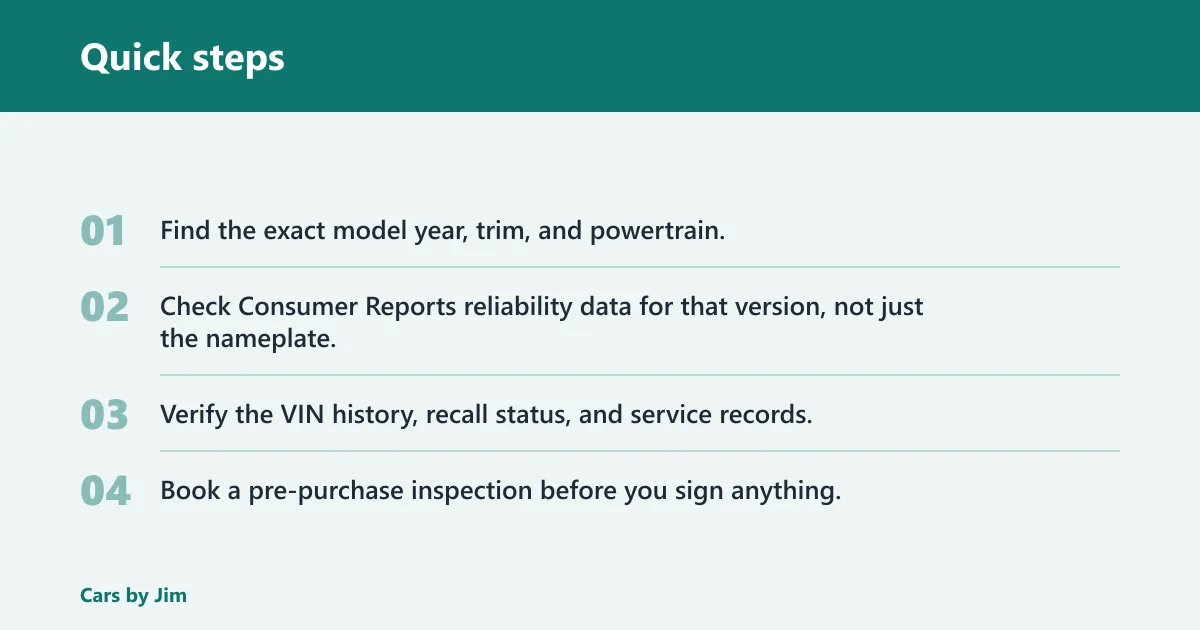
- Find the exact model year, trim, and powertrain.
- Check Consumer Reports reliability data for that version, not just the nameplate.
- Verify the VIN history, recall status, and service records.
- Book a pre-purchase inspection before you sign anything.
Check the model-year score first
Consumer Reports uses member surveys to report reliability on various models, and it says reliability can change year by year within the same vehicle family. That means a model from around 2018 can sometimes be a better choice than nearby model years of the same model. (Consumerreports)
Look for year-to-year pattern changes
Pay close attention to redesign years and known issue years. A model can look good overall and still have one weak year because of a new transmission, revised electronics, or another change that affects ownership risk.
Flag trims with different engines or transmissions
Trim matters because equipment changes can change repair risk. A base four-cylinder, a turbocharged version, and a hybrid often do not share the same long-term pattern. Compare the exact trim and drivetrain before you trust a score.
Where can I find reliable used car ratings by model year?
Consumer Reports is the main place to start for model-year reliability scores, because it compares make, model, and model year using member survey data. Use it as a filter, not a final verdict. A good score helps narrow the field; it does not replace a history report or inspection.
Use the score as a buying filter
CR says average or better overall reliability scores are a key used-car filter. That is a practical cutoff when you are comparing several cars in the same price range. If a candidate falls below that level, it needs stronger history evidence to stay in the running.
Compare the same model across different years
Do not assume one model year tells you everything about the whole nameplate. Year-to-year redesigns can change the engine, transmission, infotainment system, or suspension parts. If one year has a weak score and another has a better one, favor the stronger year unless the history report raises new concerns.
Should I trust Consumer Reports reliability scores on used cars?
Trust them as one layer, not the final answer. Consumer Reports reliability scores are useful because they come from member surveys and are tied to specific model years, but they cannot show whether a particular car was crashed, poorly maintained, or repaired badly. The score works best when the car’s history is clean too.
Use the score to screen, not to approve
A strong reliability score means the model-year pattern looks better than average. It does not prove the exact car in front of you has been cared for. If the score is good but the history shows major damage or skipped maintenance, the score should not outweigh that evidence.
Watch for trim-level differences
Two trims can share a body shell and still carry different risk. One may use a more complex transmission, a turbo engine, or more electronic equipment. Those differences can change repair cost and failure patterns, so compare the exact configuration before you decide.
How do I verify the car’s history?
Run the VIN through a vehicle history report, then check recall status with the same VIN. The FTC says history reports can include ownership history, accidents, repair records, and salvage status, while NHTSA provides free open-recall listings by VIN. A clean report helps, but it is not the same as a clean mechanical inspection.
Check for accident, salvage, and title-loss records
Look for signs of flood damage, salvage branding, title loss, and repeated ownership changes. Those items do not always kill the deal, but they raise the bar for proof. If the seller cannot explain a title issue clearly, that is enough reason to pause.
Confirm whether recalls are still open
The same source recommends checking manufacturer websites or NHTSA for recall status using the VIN. Open recalls matter because they are still unresolved. Do not assume the seller already fixed them unless the repair can be verified in writing.
Use service records to support the history report
The same source says service receipts can help verify odometer readings. Look for oil changes, brake work, tire rotations, and invoices that show mileage at the time of service. Gaps in paperwork are common, but a stack of dated receipts is much better than a seller’s memory.
How do I judge maintenance risk?
Maintenance risk is the part of ownership that a rating alone cannot show. A car can score well and still need brakes, tires, fluid service, or timing-related work soon. The key question is whether the next 12 months look normal or expensive compared with the asking price.
Read service records for regular intervals
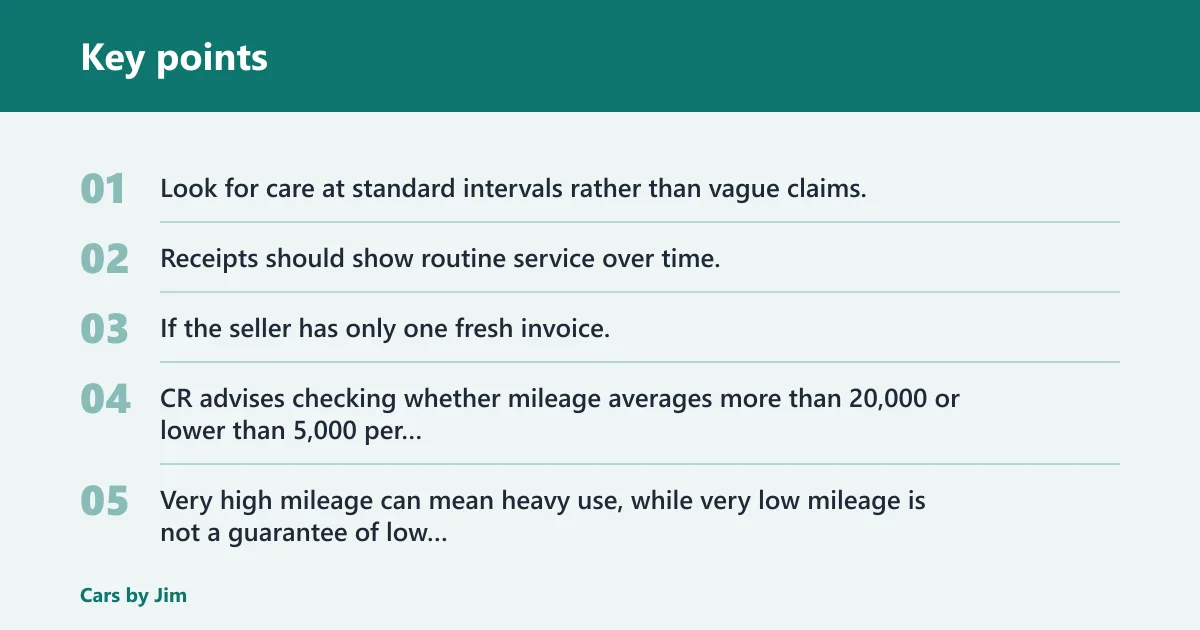
Look for care at standard intervals rather than vague claims. Receipts should show routine service over time, not just a recent oil change right before sale. If the seller has only one fresh invoice, treat that as weaker evidence than a steady record.
Match mileage to age and use pattern
CR advises checking whether mileage averages more than 20,000 or lower than 5,000 per year. Very high mileage can mean heavy use, while very low mileage is not a guarantee of low risk. Highway use often wears a car differently from short trips, so context matters. (Consumerreports)
Get a pre-purchase inspection before you decide
F1 says Consumer Reports recommends a mechanic inspection before finalizing the deal, and F9 says an independent inspection is not a substitute for a history report. Use both. The report shows past events; the inspection looks for hidden damage and mechanical risk that paperwork cannot reveal.
Say your 2016 sedan shows average reliability, but the history report lists one minor accident and the service file has regular oil changes. If the inspection also finds dry suspension bushings and brake pads near the limit, the score is no longer enough by itself. That is a negotiation case, not an automatic buy.
Common mistakes
These are the errors that cause buyers to overpay or buy the wrong car. They are common because each check looks reassuring on its own, but the full picture can still be weak. Use the three layers together.
- Trusting a clean report too quickly: A clean history report does not prove the car is mechanically sound.
- Confusing safety with reliability: Crash test ratings and reliability scores answer different questions. NHTSA and IIHS ratings speak to protection in a crash, not ownership costs.
- Missing trim-level differences: The same model year can have different engines, transmissions, or option packages with different risk.
- Overvaluing low mileage: Low mileage does not erase age-related wear, dried seals, stale fluids, or deferred maintenance.
Suppose a compact SUV has about 42,000 miles, a clean history report, and no open recalls. That still does not answer whether the tires are worn, the brakes are near replacement, or a specific trim has a known transmission issue. The score, history, and inspection must agree before the car looks truly safe to buy.
Reliability cross-check worksheet
| Rating source | Evidence to verify | Decision |
|---|---|---|
| Consumer Reports model-year score | Exact make, model, year, and overall reliability rating; use average or better as the first filter | Buy if strong and other checks are clean; negotiate if mixed; walk away if weak |
| Trim and powertrain comparison | Same body style, but different engine, transmission, hybrid system, or option package | Buy only if the exact trim has similar or better reliability; otherwise negotiate or walk away |
| VIN history report | Ownership history, accidents, salvage or title-loss information, repair records when available | Buy if clean; negotiate if minor issues are explained; walk away if major damage or title problems appear |
| NHTSA recall lookup | Open recalls only, using the VIN; confirm manufacturer repair status | Buy only after open recalls are fixed or clearly scheduled |
| Service records | Maintenance intervals, repair receipts, odometer readings on invoices, evidence of regular care | Buy if records are consistent; negotiate if gaps exist; walk away if neglect is obvious |
| Independent inspection | Hidden damage, fluid leaks, worn brakes, tire wear, suspension play, warning lights, and repair estimates | Buy if clean; negotiate for needed repairs; walk away if major mechanical risk shows up |
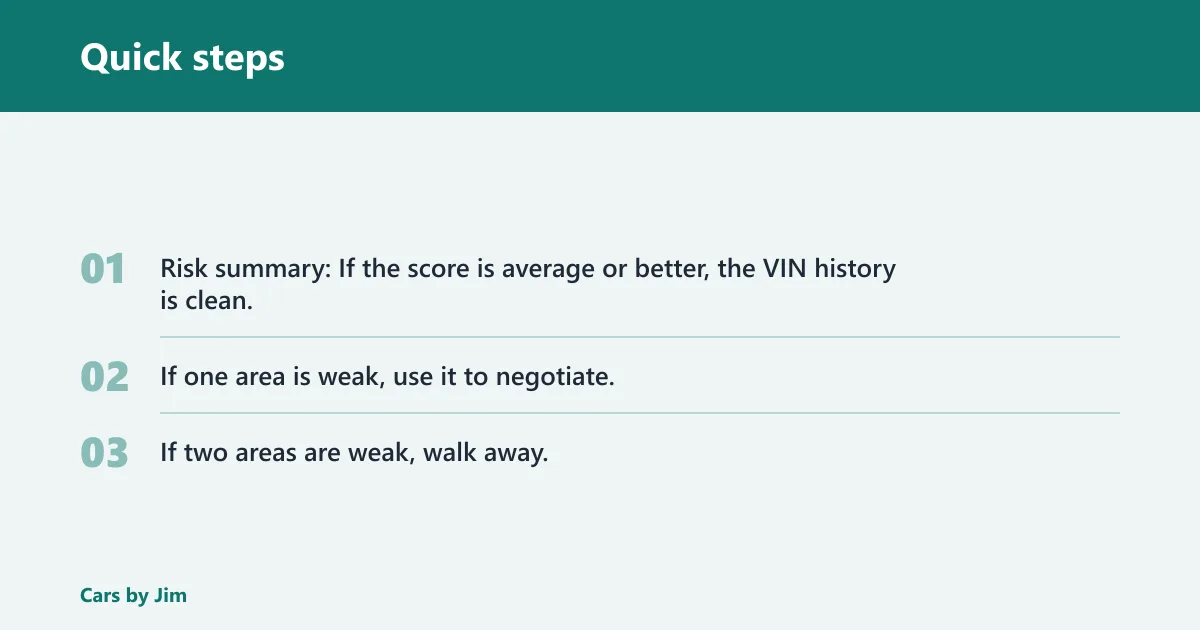
Risk summary: If the score is average or better, the VIN history is clean, recalls are closed, and the inspection finds only normal wear, the car is a reasonable buy. If one area is weak, use it to negotiate. If two areas are weak, walk away.
Frequently asked questions
What is the best site to check a used car’s reliability history?
Consumer Reports is the strongest place to start for model-year reliability, while a vehicle history report and NHTSA recall lookup fill in the car-specific record. Use CR for the score, the history report for ownership and damage, and the VIN recall check for open safety work.
Do vehicle history reports show reliability problems?
They show ownership, accidents, repair records, and salvage status, but they do not measure reliability in the survey sense. A report can reveal signs of neglect or major damage, yet a car may still have a strong or weak reliability pattern across its model years.
What if a used car has low mileage but no reliability history?
Treat it cautiously. Low mileage below 5,000 per year does not guarantee low risk, and lack of history records means less proof of care. Ask for receipts, get the VIN report, check recalls, and use a mechanic inspection before making an offer.
What should I do if reliability ratings conflict with the seller’s claims?
Trust the evidence you can verify. If the seller says the car is “problem-free” but the model year scores poorly, the VIN report shows prior damage, or the inspection finds wear, use that conflict to lower the offer or walk away.
Can a used car be reliable but still need expensive repairs soon?
Yes. A reliable model can still need tires, brakes, fluids, suspension parts, or a scheduled service item in the near term. That is why the inspection matters: it shows what is likely coming next, even when the model itself has a solid score.
Which reliability checks matter most before buying a used car?
The most useful order is model-year reliability, VIN history, recall status, service records, and then an independent inspection. If the first two checks look good and the last three confirm normal care, the car is easier to trust. If they conflict, treat that as a warning.