Used Car Value: How to Price Any Car Fairly
Price a used car fairly by starting with the private-party market median for the same year, trim, mileage, and title status, then making mileage and condition adjustments, with a common rule of thumb being about $0.10 to $0.25 per mile from average and about 5% to 15% for condition. Miss this, and you can leave thousands on the table, overpay, or accept a weak trade-in. This guide gives you a repeatable pricing method for private sales, dealer offers, and trade-ins.
This method does two things many pricing pages skip. First, it builds a live market range from comparable listings and dealer-style valuation data. Then it converts mileage, condition, damage history, equipment, local demand, and seller type into adjustments that produce three usable numbers: a list price, an expected sale price, and a walk-away price.
What is a fair used-car price?
A fair used-car price is a range built from the current market for closely matched vehicles, then tightened to a target based on mileage, condition, history, equipment, and seller type. In practice, you usually need three numbers, not one: a list price, an expected sale price, and a walk-away floor or ceiling.
Why fair value is a range, not a single number
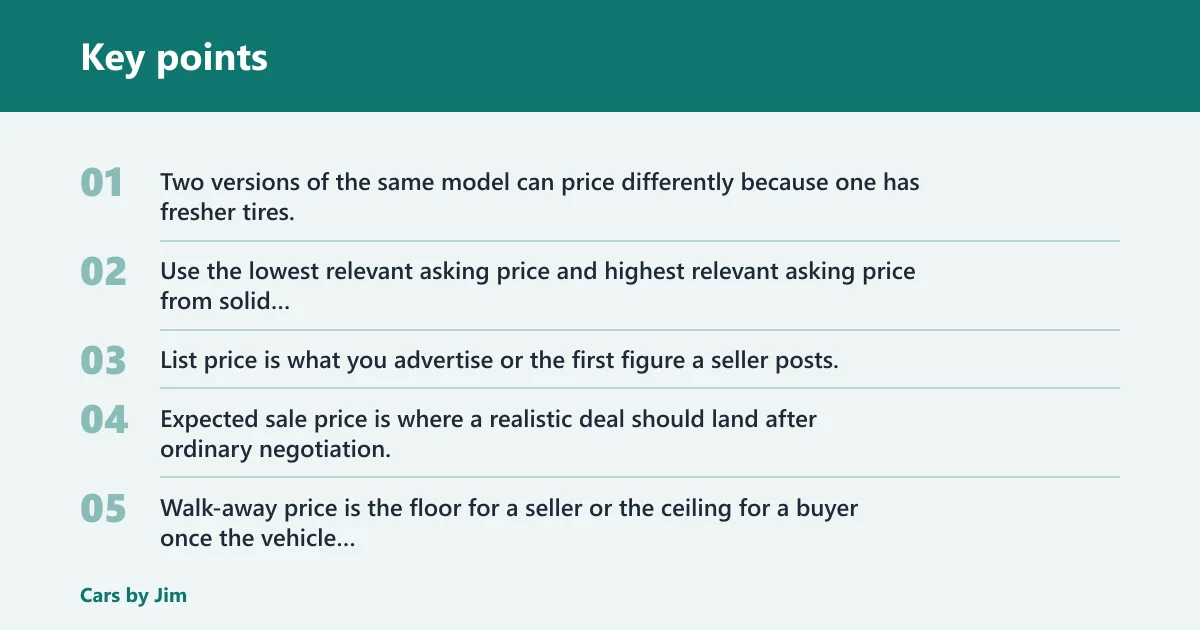
Used cars do not sell at one exact figure. Two versions of the same model can price differently because one has fresher tires, cleaner paint, full service records, and no prior damage, while the other has curb rash, overdue brakes, and a thin history file.
Start with a market range. Use the lowest relevant asking price and highest relevant asking price from solid comparables, remove obvious outliers, then work from the midpoint. That midpoint is only the starting figure.
The three numbers that matter
List price is what you advertise or the first figure a seller posts.
Expected sale price is where a realistic deal should land after ordinary negotiation.
Walk-away price is the floor for a seller or the ceiling for a buyer once the vehicle has been adjusted for mileage, condition, history, and local market pressure.
Why seller type changes the definition of fair
A private seller, a franchised dealer, a used-car lot, a trade-in desk, and a car-buying service do not value the same car the same way. Car and Driver says its calculator uses Black Book data dealers use to appraise vehicles, and it provides both private-sale and trade-in values. MotorTrend also says its estimator uses Black Book data dealers rely on and gives two estimates: private-party sale and dealership trade-in. (Caranddriver)
That split matters. Dealer numbers reflect auction and wholesale reality more than front-line retail asking prices, while private-party numbers sit closer to consumer listing markets.
How do you set a starting market range?
Set the starting market range by collecting comparable listings for the same generation, body style, engine, drivetrain, trim, title status, and roughly similar mileage band, then removing bad comps and stale ads. The goal is not the average of every listing. It is the price band where real, sale-ready vehicles actually compete.
Choose the right comparables
Match these items first:
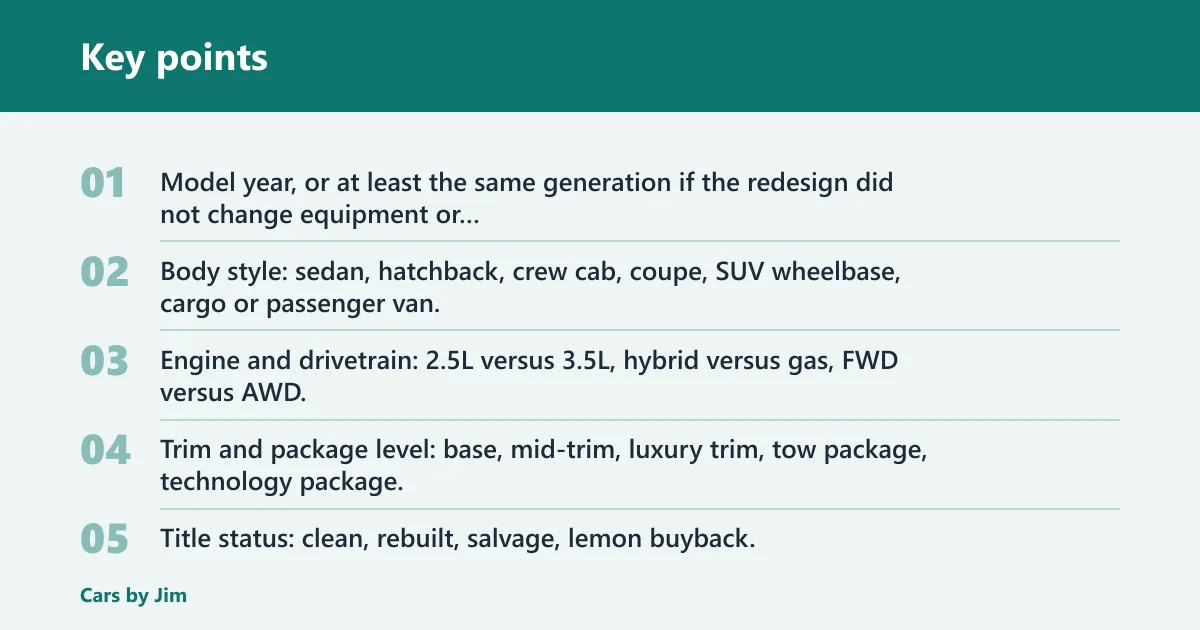
- Model year, or at least the same generation if the redesign did not change equipment or engines.
- Body style: sedan, hatchback, crew cab, coupe, SUV wheelbase, cargo or passenger van.
- Engine and drivetrain: 2.5L versus 3.5L, hybrid versus gas, FWD versus AWD, 4×2 versus 4×4.
- Trim and package level: base, mid-trim, luxury trim, tow package, technology package.
- Title status: clean, rebuilt, salvage, lemon buyback.
- Mileage band: close enough that mileage adjustment stays manageable.
If a comp misses one of those points, it needs a visible adjustment or it should be discarded.
Remove bad comps before you do math
Bad comps distort pricing fast. Drop rebuilt-title cars when valuing a clean-title car. Drop obvious trim mistakes, such as a base model listed like a premium trim because it has aftermarket wheels. Drop stale listings that have sat for weeks at an unrealistic ask. They tell you more about seller optimism than market value.
Also drop extreme-mile examples unless you are valuing an extreme-mile car. A 38,000-mile car and a 168,000-mile car can belong to different markets even if they share a badge.
Read the market range correctly
Use three reference points: the lowest relevant ask, the highest relevant ask, and the midpoint after outlier removal. The low side often reflects cosmetic flaws, weak records, or urgency. The high side often includes dealer markup, recent recon, stronger photos, warranty coverage, or an ambitious seller.
The midpoint is the starting figure, not the finished one.
Picture three comparable compact SUVs priced at $17,400, $18,200, and $18,900 after bad comps are removed. The midpoint of that band is $18,150. If the vehicle being valued has 20,000 more miles and one moderate prior repair, the fair target should land below that midpoint.
Where Black Book data fits
Use listing data to read the retail-facing market, and use Black Book-based tools to check wholesale pull. Car and Driver says values are based on age, mileage, condition, options, and accident history. MotorTrend says its value data is updated daily. That daily dealer-oriented view helps when retail listings look overheated or when a trade-in offer feels light.
Black Book is most useful as a dealer appraisal reference, not as a retail asking-price sheet. If listings suggest $24,000 private party and a Black Book-based trade-in estimate sits far lower, the spread may reflect reconditioning, auction risk, local inventory, and dealer margin.
How do you price a car fairly without a VIN?
You can price a car fairly without a VIN if you correctly match trim, engine, drivetrain, body style, and major options from photos and equipment details, then keep the result as a range. A no-VIN estimate is often good enough for early pricing, but not for final money on rare trims or mixed equipment cars.
Build a no-VIN spec match
The same source says a VIN is not necessary to get an estimate. That is true for many mainstream vehicles, provided you can identify the right configuration.
Use badges, wheel design, seat material, screen size, headlight style, sunroof, towing hardware, and drivetrain labels to separate trims. On pickups, count cab style and bed length. On SUVs, note bench versus captain’s chairs and whether driver-assist features appear in the mirror cluster or bumper sensors.
Use photos and equipment clues carefully
Window stickers, glovebox option labels, build sheets, and clear interior photos can settle trim differences. So can feature bundles. A heated steering wheel, larger infotainment screen, adaptive cruise, and factory tow controller together may place the vehicle in a higher package even if the seller omitted the trim name.
Do not pay premium-trim money for aftermarket additions. Leather seat covers, blacked-out badges, or oversized wheels do not turn a lower trim into a higher one.
Know when no-VIN pricing is enough
A no-VIN estimate is usually enough for common sedans, crossovers, and half-ton pickups with easy-to-read trims. It is weaker on luxury cars, special editions, diesels, performance models, and vehicles with major factory options that carry real used-market value.
If two trims differ by drivetrain, safety tech, or towing package, wait for the VIN or original equipment list before setting a final walk-away number.
When you need to value a car without a VIN
If you only have a listing, license plate, or a few photos, you can still get a useful price estimate by narrowing down the exact trim, matching mileage and condition, and comparing similar local sales. The supporting guide to used-car value without VIN explains how to do that without guessing, so you can avoid overpaying or pricing too low.
That matters most when the VIN is missing from an ad, the seller won’t share it yet, or you’re comparing cars online before you contact anyone. The article shows which clues identify the right model and how to turn those details into a fair value range.
How much should mileage change the price?
Mileage should change the price by comparing the vehicle’s odometer reading with the market norm for that age and model, then applying a range-based adjustment rather than one fixed per-mile rule. For many mainstream cars, a common starting rule of thumb is about $0.10 to $0.25 per mile from average.
Mileage bands matter more than tiny differences
Do not overreact to a 3,000-mile gap on a ten-year-old commuter. Do pay attention when a vehicle crosses a meaningful band such as average miles, unusually low miles, or clearly high miles for its age.
Start by estimating average miles for that age from the comp set itself. If similar eight-year-old vehicles cluster around 88,000 to 102,000 miles, a 96,000-mile example is ordinary. A 56,000-mile example deserves a premium, but only if condition and service support the odometer story.
Compare low-mile and high-mile examples fairly
Lower miles usually support a stronger number, but the premium shrinks when age-related wear still applies. Rubber, fluids, tires, and batteries age even when driven less. Higher miles lower value because they push the car closer to major wear points and narrow the future buyer pool.
Suppose two midsize sedans have the same trim and clean titles. One has 72,000 miles and the other 102,000. Using a $0.15-per-mile starting adjustment for that 30,000-mile difference points to about a $4,500 spread, and condition can move it further.
When mileage matters less than maintenance
A fully documented high-mile car with strong service history can beat a lower-mile car with thin records, old tires, brake vibration, and delayed fluid changes. Mileage affects depreciation. Maintenance affects risk.
That is why the mileage adjustment belongs before condition and history adjustments, not instead of them.
Rollback risk and odometer warning signs
CarVertical says cars with mileage fraud may be overpriced by as much as 25%. Warning signs include seat, pedal, and steering-wheel wear that do not fit the odometer, gaps in inspection records, title history jumps, or digital service logs that move backward in time.
If rollback is possible, stop pricing from the claimed miles and value the car as a history problem until records support the reading.
What makes condition and damage change value?

Condition and damage change value because buyers pay for remaining life, cosmetic appeal, and confidence that the car is safe and properly repaired. Fair pricing separates appearance from mechanical condition, then applies dollar or percentage deductions for wear, deferred maintenance, poor repairs, and accident severity.
Translate cosmetic wear into price deductions
Use visible wear categories instead of vague labels. Light stone chips and one small door ding may call for little or no deduction if comps show similar wear. Multiple panels with scratches, curb-rash on all wheels, stained seats, torn bolsters, cracked trim, or smoke odor deserve larger cuts.
A practical method is to stack line-item deductions for issues a buyer notices in the first five minutes: paint defects, wheel damage, windshield chips, interior tears, and odor.
Separate mechanical condition from appearance
Mechanical issues belong in their own bucket. Tires near replacement, thin brake pads, suspension noise, fluid leaks, warning lights, weak A/C, overdue timing-belt service, or rough shifts can change value more than faded paint.
If repair cost is known, use it. If not, price the uncertainty. Buyers usually discount unknowns more than documented repairs.
A common first-timer mistake is to call a car “excellent” because it washes well, even though it needs four tires and front brakes. On a modest used car, that can erase much of the cosmetic premium right away.
Accident history, repair quality, and hidden safety concerns
Prior damage lowers value because it raises questions about repair quality and future safety. The same source says a history report can show estimated repair costs from past damage. That does not answer every question, but it helps separate a bumper-cover repair from a larger hit.
Severity matters. Minor cosmetic repairs with clear invoices and paint-match quality may justify a small discount. Structural damage, poor panel gaps, overspray, airbag concerns, frame pulls, or unexplained alignment issues deserve a much larger one.
If airbags deployed or structural rails were repaired, treat the value hit as history plus risk. A clean visual finish does not remove hidden safety concerns.
How records and deferred maintenance move the number
Records support the top of the range. Missing records push the number down unless recent inspection and current condition are unusually strong. Old repairs matter less when documentation is complete and the work has aged without symptoms.
Mixed-use vehicles also deserve care. The same source says former taxis and rentals are worth less. Fleet and rental history can mean heavier wear, even if the odometer looks normal for age.
Rebuilt titles, very low miles with long storage, and unusually high miles need larger discounts or a much wider range. Those are edge cases, not standard comps.
Which specs and local factors change the price?
Trim, options, climate, season, and local buyer demand can all shift a fair price once the base market range is set. The biggest gains usually come from the right trim and drivetrain, while many owner-added extras add little. Local effects matter most when supply is tight or regional preferences are strong.
Trim differences and options that still hold value
Trim-level gaps matter when they change core use or buyer demand: AWD instead of FWD, larger engine, hybrid system, premium audio, factory towing package, advanced driver-assist suite, or upgraded infotainment. Wheel and tire packages can help or hurt depending on replacement cost and ride quality.
Specification match is the key. A seller may advertise “loaded,” but if the comp set includes adaptive cruise and ventilated seats while the subject car does not, the premium disappears.
Do not overpay for sunk-cost upgrades. New floor mats, window tint, or aftermarket wheels rarely return their original spend.
Regional demand, climate, and season
Car and Driver notes location can affect value because different regions favor different vehicles. Four-wheel-drive trucks and winter-capable SUVs often carry stronger demand in snow states. Convertibles often do better in warmer markets. Rust-belt vehicles can suffer from corrosion history that sun-belt comps do not show.
Urban markets may prize fuel economy and compact size. Rural markets may reward towing, ground clearance, and bed length. Season matters too. A convertible in late fall and a 4×4 SUV before winter do not meet the same market.
State tax effects on trade-ins
Trade-in math is not only about the raw offer. In some states, the trade-in reduces the taxable amount of the next purchase, which can narrow the gap between a private sale and a dealer trade. That tax effect does not change private-party value, but it does change your net proceeds comparison.
How do private sale, trade-in, and instant offers differ?
Private sale, trade-in, and instant-buy offers differ because each buyer assumes a different level of risk, prep cost, and resale effort. Private-party prices are usually highest, trade-ins lower, and car-buying services often sit between wholesale and trade-in. The fair number changes with convenience, tax treatment, and time-to-sale.
Private-party value versus dealer retail asking price
Private-party value is not dealer retail. Dealer retail can include inspection, detail work, recon, overhead, financing profit, and room for negotiation. If you compare your private-sale car with dealer lot pricing, subtract for that spread before claiming the same number is fair.
Trade-in value and the real spread
Trade-in value reflects what the dealer can safely allow while covering transport, reconditioning, auction risk, and margin. Car and Driver and MotorTrend both separate private-party and trade-in values, which helps frame the gap correctly.
To compare net outcomes, subtract your expected private-sale prep costs, ad time, title-transfer hassle, safety inspection needs, and any missed tax credit from the higher private-sale number.
Car-buying services and where they usually land
Car-buying services pay for speed and certainty. Expect the offer to land below a strong private sale, sometimes near trade-in, sometimes a bit better if the vehicle fits current demand. Age and mileage caps matter too. Andy-Auta says it only buys cars up to 13 years old and up to 250,000 km.
Car value worksheet
Use this worksheet by starting with a clean comp-based market range, then adding or subtracting only the differences you can explain. The final output should give you three numbers you can act on right away: list price, expected sale price, and walk-away price.
Text-only pricing worksheet
| Line item | Method | Example value |
|---|---|---|
| Starting market range | Relevant comparable asks after outlier removal | $17,400 to $18,900 |
| Starting midpoint | Midpoint of cleaned range | $18,150 |
| Mileage adjustment | Subject has 20,000 more miles than comp-set norm at $0.15 per mile | – $3,000 |
| Condition adjustment | Front tires near replacement, two wheel rash spots, clean interior | – $700 |
| Accident-history adjustment | Prior rear-bumper repair with invoice, no structural note | – $600 |
| Equipment adjustment | Missing factory driver-assist package found on many comps | – $500 |
| Local-demand adjustment | Strong local demand for this AWD model before winter | + $400 |
| Seller-type adjustment | Private sale target versus trade-in target | $0 private sale / – $1,800 trade-in |
| Adjusted fair private-sale figure | $18,150 minus $3,000 minus $700 minus $600 minus $500 plus $400 | $13,750 |
| Recommended list price | Leave modest negotiation room above expected sale | $14,400 |
| Expected sale price | Realistic private-party transaction band center | $13,750 |
| Walk-away price | Lowest acceptable private-party number after review | $13,200 |
| Indicative trade-in target | Adjusted fair private-sale figure minus seller-type adjustment | $11,950 |
How to use the worksheet in practice
- Build a comp set of at least five solid listings if the model is common.
- Write down the cleaned low price, high price, and midpoint.
- Adjust mileage from the comp-set norm, not from a national average alone.
- Deduct for cosmetic and mechanical issues separately.
- Deduct again for accident history if the comp set is cleaner.
- Add or subtract for meaningful equipment differences.
- Adjust for local demand and seller type.
- Set list price above expected sale price, and set walk-away price before negotiations start.
Say your clean-title crossover matches the example above and a dealer asks $16,900 for a similar one with lower miles and fresh tires. That does not make your private-sale car worth $16,900. Dealer recon, warranty exposure, and lot overhead still sit between those numbers.
How do you tell if a used car is overpriced?
A used car is overpriced when the seller uses weak comparables, ignores title or accident differences, overstates option value, or anchors to dealer retail without accounting for recon and markup. The clearest test is simple: run the market range, apply the worksheet, then compare the ask with your expected sale band.
Red flags in listings and add-ons
Watch for mismatched trim names, missing VIN photos, selective angle shots, no service records, or pricing that leans on rare-option claims without proof. Dealer add-ons such as nitrogen tires, paint sealant, wheel locks, or etch packages can inflate the out-the-door number without adding real used-car value.
When a premium is justified
A premium can be fair when the car has unusually low miles backed by records, top-trim equipment buyers actually want, fresh tires and brakes, clean history, and strong cosmetic condition. It is not justified by old aftermarket upgrades, vague claims of “mint,” or one overpriced dealer comp.
When to negotiate, counter, or walk away
Make an offer when the ask is within reach of your calculated expected-sale band. Counter when a seller is anchored to an inflated list price but the vehicle itself checks out. Walk away when title problems, missing records, rollback signs, structural repairs, or large undisclosed needs break the pricing logic.
Buyers should keep the ceiling number private until inspection and history review are complete. Sellers should decide the floor before the first showing. That step prevents emotional pricing.
Frequently asked questions
How do I value a car for sale?
Value a car for sale by building a private-party comp set for the same year, trim, drivetrain, mileage band, and title status, then adjust from the cleaned midpoint for condition, prior damage, equipment, and location. Finish with three numbers: list price, expected sale price, and the lowest number you will accept.
How do I value a used car before I buy it?
Start with comparable asks, remove rebuilt-title and stale listings, then compare the target car against that range using mileage, tire and brake condition, records, accident history, and option match. The result should be a maximum offer, not one exact value, because inspection results can still change the number.
What makes a used car worth more or less?
Trim, drivetrain, mileage, clean title status, service records, cosmetic condition, mechanical condition, accident severity, repair quality, and local demand move the price most. Seller type matters too. A private seller, dealer, trade-in desk, and car-buying service are pricing different risks and different resale paths.
What’s the difference between private sale and trade-in value?
Private sale value is higher because the next owner pays closer to market retail, while trade-in value is lower because the dealer still has to recondition, market, finance, and possibly wholesale the car. In some states, a trade-in tax credit narrows the real net gap, so compare after-tax proceeds, not raw offers alone.