What Does Out-the-Door Price Mean on a Used Car?
Out-the-door price is the full amount you pay to take a used car home: vehicle price plus taxes, title, registration, and dealer fees, with no extra add-ons unless they’re listed. Skip it, and a low ad price can turn into a bigger bill at signing. Use it to check the buyer’s order and final paperwork before you sign.
Out-the-door price vs selling price
Out-the-door price is the final amount required to buy the used car and leave with it. That number matters most, not the sticker price, advertised discount, or monthly payment. For comparison shopping, it is the clearest way to line up one dealer’s total against another dealer’s total.
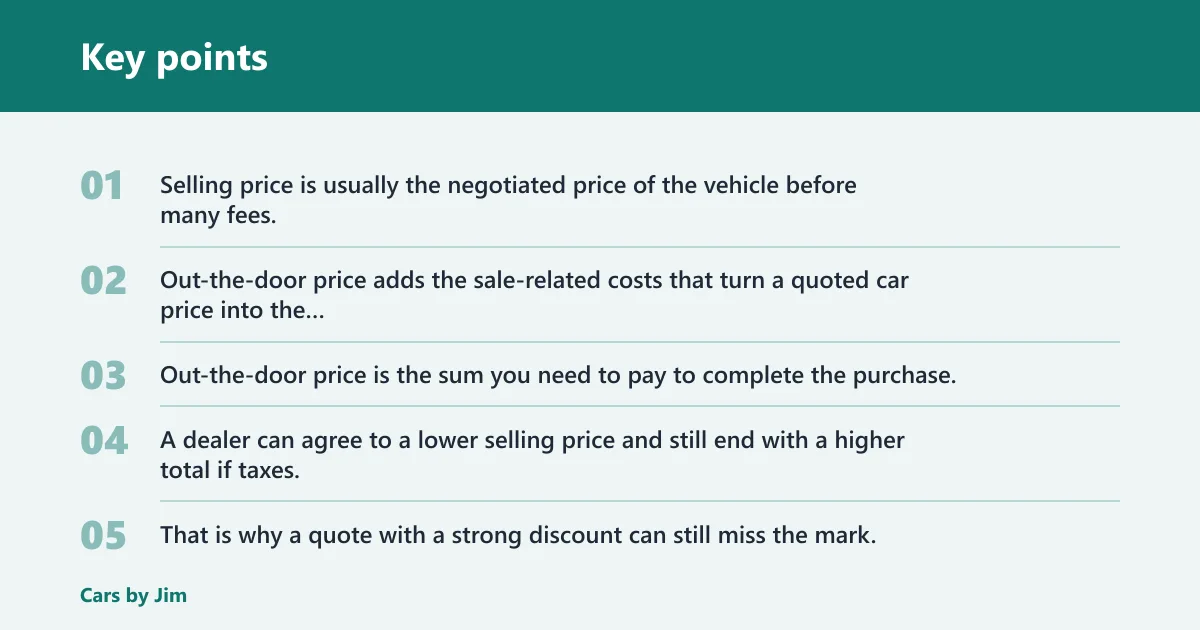
The distinction is simple. Selling price is usually the negotiated price of the vehicle before many fees. Out-the-door price adds the sale-related costs that turn a quoted car price into the amount due at signing or delivery.
How it differs from selling price
Selling price is the starting point. Out-the-door price is the sum you need to pay to complete the purchase. A dealer can agree to a lower selling price and still end with a higher total if taxes, documentation fees, or add-ons are larger than expected.
That is why a quote with a strong discount can still miss the mark. A $1,500 discount can be offset by a $1,995 protection package, leaving the final total much closer to the original number than it first appears.
What is included in a used-car out-the-door price?
Most used-car out-the-door quotes include the selling price, mandatory taxes, title fees, registration, dealer documentation fees, and any destination charges or add-ons the dealer includes in the deal. The exact mix of out-the-door charges can vary by state, dealer, and how the paperwork is written. Ask for each line item, not just the final total.
Taxes, title, and registration
Sales tax is a government cost and is usually mandatory. Title fee covers the transfer paperwork, and registration fee covers the vehicle’s legal registration. Sales tax, title, and registration vary by location, so two similar cars can still have different totals even if the selling price is the same.
Do not treat those charges as dealer-created extras. They are often unavoidable purchase costs, although the amount depends on your state or jurisdiction. That is why the same used car can have a different out-the-door price in two places.
Dealer documentation fees
Dealer documentation fees are common and can be capped by law in some places. They cover paperwork handling, but the amount can vary widely by dealer and state. A quote that looks competitive at the vehicle-price line can still rise sharply if the doc fee is high.
Ask the dealer to separate the documentation fee from taxes and government charges. If the fee is rolled into a vague “processing” line, request the exact amount before you agree to anything.
Add-ons and protection packages
Optional dealer add-ons can quietly raise the final total. Optional dealer add-ons may include paint protection, wheel and tire coverage, VIN etching, alarm systems, or bundled protection packages. If you did not request them, they should not be treated like mandatory purchase costs.
Suppose a used SUV is quoted at one total online, then a finance manager adds a protection package during the final paperwork review. If that package was not part of the written quote, the out-the-door number changed. Treat that as a change to the deal, not a routine update.
Out-the-door price vs. monthly payment
Out-the-door price is about the purchase total. Monthly payment is about how that total is financed. A lower payment can come from a longer term, a larger down payment, or a higher purchase total spread over more months. Do not confuse payment comfort with a better car price.
Where interest belongs
Interest is generally not part of the out-the-door price as a purchase cost. It belongs in the cost of financing over time. If you finance the car, the loan contract can raise the amount you pay in total even when the purchase price itself does not change.
That separation matters. A cash buyer focuses on the total amount due to buy the car. A financed buyer should still check the out-the-door price first, then review the loan terms separately for rate, term, and total finance charge.
Should you get the out-the-door price in writing?
Yes. Ask for the out-the-door price in writing before you visit the lot or before you agree to anything. The FTC recommends getting out-the-door prices in writing before visiting, because a written quote makes it easier to compare dealers and spot last-minute changes.
A written quote also forces the dealer to name the fees. If the numbers are spread across verbal promises, you have little to audit when the buyer’s order appears. Written totals create a paper trail you can check line by line.
How to compare dealers on the same total
Compare used-car quotes using the same total: out-the-door price. Do not compare one dealer’s vehicle price to another dealer’s total due. A lower selling price can be canceled by a higher doc fee, extra add-ons, or a larger tax line depending on location.
Use the quote to compare like for like. If two dealers list the same car, ask each for the total amount required to buy and leave with it, plus a breakdown of what is mandatory and what is optional.
Used-car OTD audit sheet

Use this table to check the quote against the buyer’s order before you sign. If a line item appears in the quote but not the contract, or in the contract but not the quote, ask for an explanation before continuing.
| Quoted line item | Mandatory or optional | What to verify on the buyer’s order |
|---|---|---|
| Selling price | Negotiable | Matches the agreed vehicle price before taxes and many fees |
| Sales tax | Mandatory | Correct tax rate and taxable amount for your location |
| Title fee | Mandatory | Listed as a government-related transfer charge, not a dealer add-on |
| Registration fee | Mandatory | Matches the vehicle registration cost required by your state or jurisdiction |
| Dealer documentation fee | Usually mandatory at that dealer, amount varies | Exact dollar amount, and whether it was disclosed in the quote |
| Dealer add-on or protection package | Optional unless you agreed to it | Separate line item, with your approval in writing |
| Destination charge | Can be included in the quote | Shown clearly and not hidden inside another fee |
| Extended warranty or service contract | Optional | Present only if you chose it, with the stated price and term |
- Start with the selling price and match it to the written offer.
- Check the tax line against your state or local rate.
- Verify title and registration charges are listed separately.
- Look for the documentation fee and confirm the exact amount.
- Scan for add-ons, protection plans, or accessories you did not request.
- Compare the final due amount on the buyer’s order with the quoted out-the-door total.
What to do if the price changes at signing
If the out-the-door price changes at signing, stop and compare every line item against the written quote. A change can happen because a fee was omitted, an add-on was slipped in, or the paperwork uses a different tax or registration figure. Do not sign until the difference is explained in writing.
Common failure cases
One common failure case is a quote that leaves out dealer documentation fees until the final worksheet appears. Another is a protection package added after the test drive, with the dealer treating it as part of the deal even though you never approved it. A third is a payment quote that hides the real purchase total until the finance office.
A used sedan might be quoted at about $18,900, then a buyer’s order can arrive with a higher doc fee and an added theft package. If the total due no longer matches the written out-the-door price, the paper trail has failed. That is the moment to pause.
Walk away
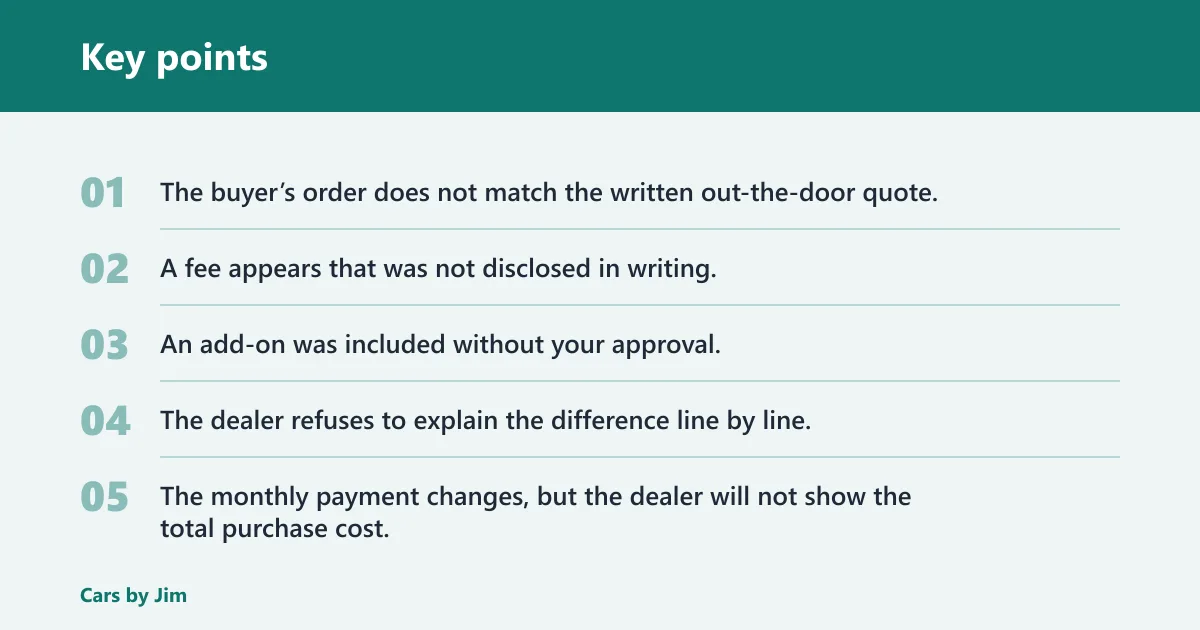
- The buyer’s order does not match the written out-the-door quote.
- A fee appears that was not disclosed in writing.
- An add-on was included without your approval.
- The dealer refuses to explain the difference line by line.
- The monthly payment changes, but the dealer will not show the total purchase cost.
Frequently asked questions
What does out the door price mean when buying a car?
It means the total amount you must pay to buy the car and leave with it. On a used car, that usually includes the selling price, taxes, title, registration, dealer documentation fees, and any add-ons or other sale-related costs listed in the deal.
What does out the door car price mean?
It is the same idea: the final total due to complete the purchase. Use it to compare dealers on the same basis, because it is more reliable than a sticker price, website number, or advertised discount that does not include every fee.
What does out the door mean when buying a car?
It means the amount due after all required purchase costs are added. For a used car, that usually includes taxes, title, registration, and dealer charges. It should be the number you verify before signing the buyer’s order or finance contract.
Does out-the-door price include taxes and fees?
Yes. Taxes and fees are part of the out-the-door number, which is why it is the best comparison figure. The exact tax, title, registration, and documentation amounts can change based on location and dealer policy, so verify each line item.
Does out-the-door price include interest or only purchase costs?
It should include only the purchase costs needed to buy the car, not loan interest. If you finance, interest appears in the loan terms and raises the amount you pay over time, but it is separate from the out-the-door purchase total.