Sell Your Car: Private Sale, Trade-In, or Online?
Private sale usually pays the most, trade-in is fastest, and online offers split the difference. If the expected private-sale premium is under about 10% after fees, time, and repairs, trade-in or online bid may be the better choice. Choose the wrong path and you can lose thousands, wait weeks, or expose yourself to title, payoff, and payment scams. This guide ranks each method by net payout, speed, effort, paperwork, and risk for loans, older cars, newer cars, and urgent timelines.
The trade-off in one line
The higher the potential price, the more time, seller work, and transaction risk you usually take on.
That trade-off matters more than the headline offer. A private buyer may pay more, but the seller also has to handle cleaning, photos, listing, messages, test drives, payment verification, title transfer, and failed appointments. A dealer trade-in cuts most of those steps. An online instant offer lands in the middle: quick quote, short acceptance window, then inspection and payment.
📊 Car and Driver compared several online-buying services using a 2019 Subaru Impreza hatchback and reported that the offers it reviewed were typically locked for seven days. Source: Caranddriver.
Selling methods decision table
The table below scores each path on a 1-to-5 scale, where 5 is best for the seller on that factor. It is a decision tool, not a market-price promise. Use it to compare net dollars, time cost, and risk in the real world, where repairs, missed work, and deal fallout can change the math.
| Factor | Private party sale | Trade-in | Online instant offer |
|---|---|---|---|
| Likely sale price | 5 | 2 | 3 |
| Time to sell | 1 | 5 | 4 |
| Effort | 1 | 5 | 4 |
| Scam risk | 2 | 5 | 4 |
| Paperwork burden | 2 | 5 | 4 |
| Payment speed | 2 | 5 | 4 |
| Negotiation stress | 1 | 4 | 5 |
| Loan payoff complexity | 1 | 5 | 3 |
| Condition sensitivity | 3 | 3 | 2 |
| Best-fit vehicle type | Clean, in-demand car with records | Replacement purchase, normal used car | Late-model mainstream vehicle, urgent sale |
| Best scenario | Maximize net payout and accept slower close | Need one-stop sale and next-car transaction | Need fast pricing with less hassle than private sale |
What the scores mean
Private sale wins only if the premium survives hidden costs. Those costs can include detailing, paintless dent repair, a check-engine-light diagnosis, listing fees on some platforms, fresh photos, transport to a buyer meetup, unpaid time, and the risk of restarting after a flaky buyer disappears.
Trade-in gives up price for certainty. That can be the right move when a lender payoff is involved, the title is delayed, or the seller is replacing the car at the same time. In many states, trading a vehicle toward another purchase can also change the taxable amount on the replacement vehicle, which can narrow the raw-price gap, but the exact tax effect is state-specific and should be confirmed before relying on it.
Online offers can be strong on newer, mainstream vehicles, but the quote is only as good as the condition report. Dents, rust, windshield cracks, tire wear, interior odor, warning lights, paintwork, accident history, and after-factory modifications can all affect the final number at inspection.
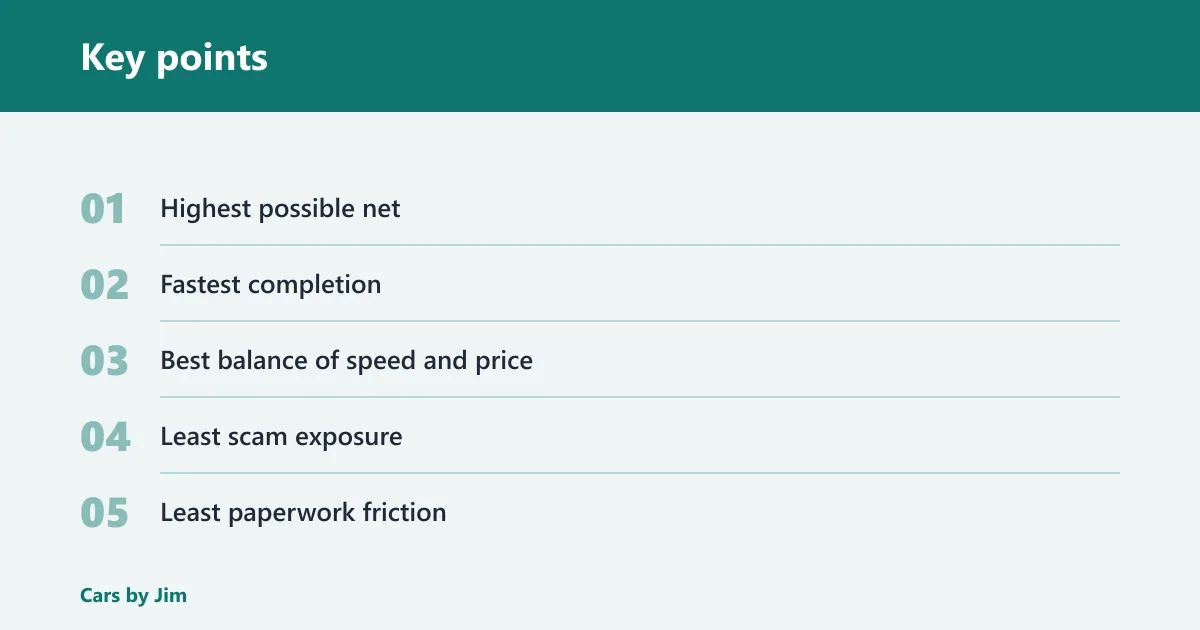
Scenario winners by priority
- Highest possible net: Private party sale, if the car is clean, titled, and in local demand.
- Fastest completion: Trade-in, especially when buying another vehicle.
- Best balance of speed and price: Online instant offer for a late-model mainstream vehicle.
- Least scam exposure: Trade-in, then online instant offer.
- Least paperwork friction: Trade-in.
- Easiest with a loan: Trade-in first, online buyer second, private sale last.
Net-proceeds formula
A simpler way to decide is to compare net proceeds instead of headline offers:
Net proceeds = sale price or offer – prep and repair costs – listing or transport costs – payoff shortfall – time cost – tax difference + convenience value.
For example, if a private buyer offers $22,000, but detailing, a windshield repair, two missed half-days of work, and the risk of a failed deal effectively cost $1,600, the practical net is closer to $20,400. If a trade-in is $20,000 and also reduces taxes on the replacement vehicle in your state, the lower headline number may still be the better financial outcome.
Scenario matrix by car age, title status, urgency, and condition
| Situation | Private party sale | Trade-in | Online instant offer |
|---|---|---|---|
| Late-model, clean title, low urgency, clean condition | Usually best for max net | Best only if replacement purchase or tax treatment closes the gap | Strong compromise if the quote is competitive |
| Late-model, clean title, high urgency, clean condition | Possible, but speed risk is higher | Fastest same-day path | Often the best speed/price balance |
| Older car, clean title, average condition | Works if local demand is solid and the premium is real | Often reasonable if offers are close | Varies widely by company and vehicle eligibility |
| High-mileage or rough condition | Expect heavier negotiation and more fallout | Often simpler than repeated private renegotiation | Can work, but inspection deductions matter |
| Loan payoff or lien still in place | Hardest path because title timing must be explained to the buyer | Usually easiest because the dealer can handle payoff directly | Often workable if the buyer pays the lender and then the seller |
| Branded, salvage, rebuilt, or missing-title issues | Retail buyer pool narrows sharply | Often more realistic than a standard private listing | Eligibility may be limited; verify before relying on the quote |
Is it better to sell privately, trade it in, or use an online buyer?

Private sale is usually best for maximum upside, trade-in is best for minimum friction, and an online buyer is best when speed matters but a dealer offer feels too low. The right choice depends on whether your car is clean and desirable, whether you still owe money, and how much time and payment risk you can absorb.
Private party sale: maximum upside, maximum seller work
Private sale usually has the highest ceiling because a retail buyer may pay more than a wholesaling dealer or algorithmic buyer. That is most true for clean, stock vehicles with solid maintenance records, a clear title, and broad demand in the local market.
The seller handles the ad, photos, messages, scheduling, test drives, payment verification, bill of sale, and title transfer. TrueCar says private party sales can take more time and seller effort than selling to a dealer, and state DMV rules still control the actual transfer documents. For step-by-step paperwork help, see this title transfer guide and this bill of sale guide.
Maintenance records matter most here because a retail buyer has to believe your description. Records back up condition claims, reduce buyer suspicion, and support the asking price on higher-value vehicles, newer vehicles, and cars with recent tires, brakes, or major scheduled service.
Trade-in: lowest friction when replacing the car
Trade-in is usually the easiest choice when another vehicle purchase is part of the same transaction. The same source says a dealer sale is fast and easy and that the dealer handles paperwork. That removes much of the title, payoff, and release-of-liability burden from the seller, although exact state filing rules can still differ.
The trade-off is a lower raw offer in many cases. A dealer has to price in reconditioning, transport, auction risk, and profit margin. Still, a trade-in can win on net when the private-sale premium is modest and the seller would otherwise spend time fixing cosmetic flaws or fielding low offers.
Online instant offer: fast quote, inspection-dependent final number
Online buyers usually start with a VIN or license plate lookup, then ask about mileage, trim, condition, options, and history. Car and Driver reported that the online-service quote process it reviewed required VIN or license plate entry, and that photos were optional but recommended for online offers.
Offer timing is a major detail. The same source says it can give a TRUECash Offer in minutes, says getting an offer takes about two minutes, and says gathering details about mileage, color, options, history, and condition takes about five minutes. It also describes a three-step process: enter vehicle, get instant offer, then drop off and get paid.
But the quote is time-limited. The same source says its offer is good for three days. Car and Driver, which compared offers from Carvana, Vroom, CarMax, KBB, and a local dealership using a 2019 Subaru Impreza hatchback, reported that the online offers it reviewed were locked in for seven days. Published windows vary by company, so the seller has to read the terms before assuming the quote will still be valid next week. (Caranddriver)
Which option puts the most money in your pocket?
The answer is whichever method leaves the highest net after prep costs, time, tax effects, and deal risk. Private sale often starts with the highest asking price, but a smaller premium can vanish once cleaning, minor repairs, listing effort, missed work, and failed-buyer risk are counted.
Headline price versus net proceeds
Start with three numbers: a likely private-sale price, a dealer trade-in offer, and an online offer. Then subtract the costs tied to each path. Private sale often carries the longest list: detailing, touch-up work, state inspection or emissions fixes where needed, ad fees on some platforms, and the value of time spent answering messages.
If the private-sale advantage is under about 10% after those deductions, it usually stops being compelling. That is especially true for ordinary commuter cars, older high-mileage sedans, and vehicles with visible flaws that invite repeated renegotiation at the meetup. To estimate a fair starting number before comparing offers, use a car appraisal guide.
How much more money can you get by vehicle type?
A private sale may net meaningfully more on a clean late-model SUV, truck, or family crossover because those vehicles attract many retail buyers. The gap is often smaller on an old commuter car, where buyers are price-sensitive and one repair estimate can erase the spread.
- Older commuter car: Often a modest private-sale edge, but one tire set or brake job can wipe it out.
- Late-model SUV or truck: Often the best private-sale candidate if clean and stock.
- Luxury vehicle: Private sale can bring more, but buyer pool is smaller and condition scrutiny is tougher.
- High-mileage vehicle: Expect more discounting and more deal fallout in private sale.
- Modified vehicle: Private buyers may value mods, while dealers and online buyers often discount them.
- Damaged car: Trade-in or online buyer can be more realistic than repeated private renegotiation.
- Non-running vehicle: Private sale gets harder fast, specialized buyers or dealer disposal channels may fit better.
When trade-in tax treatment changes the math
In many states, a trade-in can reduce the taxable amount of the replacement vehicle. That does not make every trade-in the winner, but it can narrow the gap enough that the shorter timeline and dealer-handled paperwork become worth more than chasing a slightly higher private-sale figure. Because sales-tax treatment is state-dependent, the exact savings should be checked under the buyer’s state rules before using it in the comparison.
Say your late-model crossover draws a private buyer at a stronger price, but the gap shrinks after paint correction, a windshield chip repair, and a day away from work for test drives. If the trade also lowers tax on the replacement purchase, the simpler route may come out ahead.
What is the fastest way to sell without getting lowballed?
The fastest path is usually a trade-in, followed by an online instant offer with accurate condition details. To avoid getting lowballed, compare at least one dealer bid with one online offer, move within the locked offer window, and do not let hidden defects surprise the inspection stage.
Typical timelines by method
Trade-ins can often be completed the same day because the appraisal, payoff handling, and purchase paperwork happen in one place. Online buyers can return a quote in minutes or seconds, but closing still depends on scheduling inspection, pickup, or drop-off, then final payment.
Private sales vary widely. An in-demand, clean vehicle can move quickly, while an overpriced, rough, or niche car can sit for weeks. The seller also has to absorb no-shows, financing failures from buyers, and repeated requests for lower pricing after inspection.
How locked-in offer windows work
Online offers are rarely open-ended. The same source says its offer is good for three days. Car and Driver reported that the online offers it reviewed were locked in for seven days. That means a seller should not get a quote first and plan the sale later; the clock usually starts immediately, subject to each company’s terms. (Caranddriver)
Condition accuracy matters most when time matters most. If the seller leaves out curb-rashed wheels, paintwork, warning lights, or accident history, the quote may drop after inspection, and the backup options may no longer be ready inside the same week.
How to keep speed from turning into a weak sale
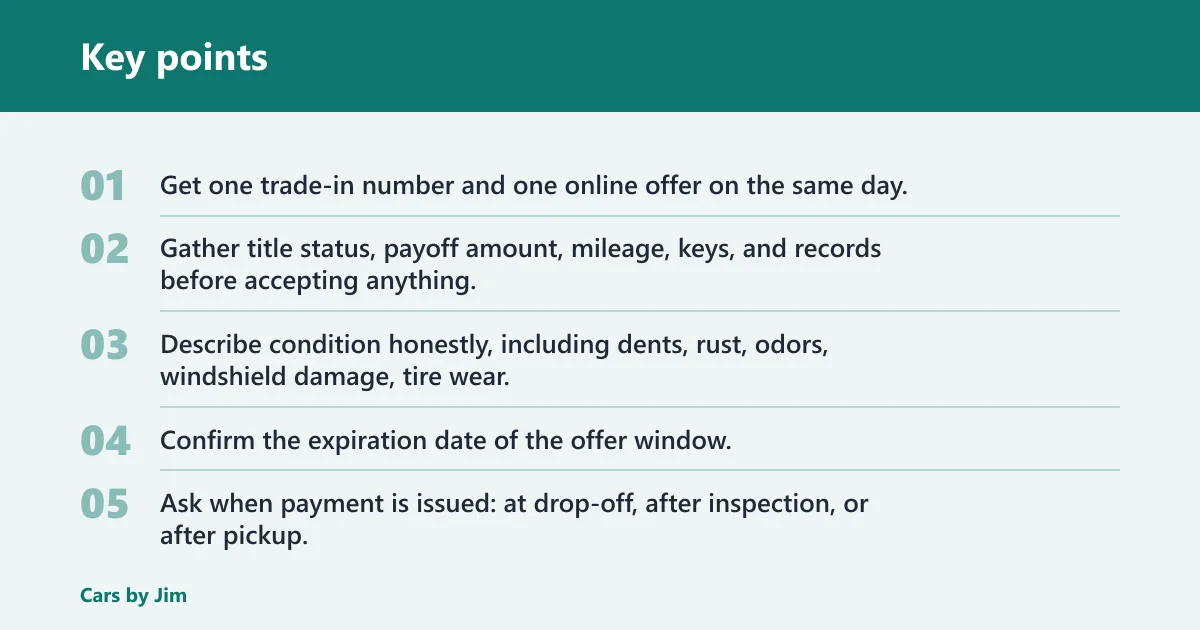
- Get one trade-in number and one online offer on the same day.
- Gather title status, payoff amount, mileage, keys, and records before accepting anything.
- Describe condition honestly, including dents, rust, odors, windshield damage, tire wear, and warning lights.
- Confirm the expiration date of the offer window.
- Ask when payment is issued: at drop-off, after inspection, or after pickup.
How do effort, paperwork, and payment risk compare?
Trade-ins usually require the least effort and carry the lowest payment risk, online buyers sit in the middle, and private sales demand the most paperwork discipline. The main failure points are missing title documents, unresolved liens, fake payment, signing the title too early, and releasing the car before funds are fully verified.
Title, bill of sale, odometer disclosure, and keys
The vehicle title proves ownership, and loan payoff status affects whether it can be transferred immediately. If a lender still holds the title, the seller needs payoff instructions and a clear plan for lien release timing.
A bill of sale is required in some states and commonly recommended even where not strictly required; title and transfer rules vary by state DMV. Many states also require an odometer disclosure for certain model years or transaction types, plus a release of liability or notice of transfer filed promptly after the sale. For the exact forms and timing, use your state’s DMV instructions together with a bill of sale guide and a title transfer guide.
Have every key and remote ready. Missing keys reduce trust in a private sale and can cut appraised value with dealers and online buyers because replacement cost is real and immediate.
Payment timing and verification by method
Trade-ins are often paid through same-day transaction credit toward the next vehicle or same-day sale paperwork if there is no replacement purchase. Online buyers commonly pay after inspection or pickup, depending on the company process and whether any lender payoff must clear first. Private-sale payment timing depends on verified funds and any lien-release delay.
Safe payment is specific, not vague. The seller should verify cashier’s checks with the issuing bank using a trusted number, confirm wire instructions directly with the receiving bank, and avoid releasing keys, title, or possession before funds are confirmed as final under the bank’s rules. That last step matters because some payment types can appear available before they are fully collected.
Common scam and deal-failure points
- Fake cashier’s checks: Printed to look real, then rejected later.
- Reversed transfers: Payment apps or bank transfers that appear pending, then disappear.
- Title signed too early: Gives up control before verified payment.
- Unverified wire instructions: Fraudsters alter account details.
- Meetup theft risk: Keys or car taken during an unsafe handoff.
- Shipping-agent and overpayment scams: Buyer claims a transporter will handle everything and asks for a refund of the extra amount.
Picture a private buyer who agrees to full price for a high-mileage sedan, then asks to send more than the amount due because a shipper needs paying. That is a classic failure mode. The sale should stop there.
How does your car type change the best selling method?
The best method changes with demand, condition, and buyer pool. Clean late-model mainstream vehicles usually have the strongest private-sale or online-offer potential, while rough, niche, heavily modified, salvage-title, or non-running vehicles often fit better with trade-ins or buyers that price them for wholesale disposal.
Old commuter cars and high-mileage vehicles
Older daily drivers attract budget buyers who negotiate hard and notice every upcoming maintenance item. Tires near replacement, soft brakes, windshield cracks, rust bubbles, odors, warning lights, or peeling clearcoat can turn a decent asking price into a string of low offers.
That does not mean private sale is wrong. It means the seller should be realistic about the extra effort needed to protect even a small premium.
Late-model SUVs, trucks, and mainstream family cars
These usually give the seller the most flexibility because demand is broad. A clean title, stock configuration, and complete maintenance records help both private and online paths. If urgency is low, private sale may bring the best net. If urgency is high, an online instant offer is often the cleanest compromise.
Luxury, modified, salvage-title, and non-running vehicles
Luxury cars can reward a private sale, but the buyer pool is thinner and records matter more. Modified cars are unpredictable: the right private buyer may pay for the parts, while many dealers and online buyers discount after-factory changes. Salvage or rebuilt titles sharply narrow retail demand. Missing-title cars, emissions failures, and non-runners create even more friction.
Suppose a turbo sedan has aftermarket suspension, a branded title, and one warning light. Private sale is still possible, but each issue reduces lender eligibility for the buyer and increases the chance of a collapsed deal. That is where wholesale-style channels start to make more sense.
What if you still owe money on the car?
A loan makes every selling method more complex, but private sale is the hardest because the buyer wants title certainty while the lender controls the lien release. Trade-ins are usually simplest, online buyers are next, and private sale works best only when payoff timing and title handling are clear before meeting any buyer.
Private sale with a lien
Call the lender first. Get the exact payoff amount, the valid-through date, and the release process. Ask whether the lender can handle the transaction in person, accept buyer funds directly, or send the title after payoff. Without that roadmap, the buyer has too much reason to walk away.
If the loan balance exceeds the car’s value, the seller is upside down. That means cash has to be added to close the gap. Private buyers rarely want to wait around for that to be sorted out.
Trade-in payoff and negative equity
Trade-ins handle this best because the dealer can pay the lender directly and roll any remaining negative equity into the next transaction if the replacement purchase supports it. That does not make negative equity painless, but it does remove most of the private-sale title-transfer friction. Timing and payoff crediting still vary by lender and dealer process.
Online buyer payoff process and lease buyout limits
Online buyers often pay lenders directly, then pay any remaining equity to the seller after inspection and transfer. The seller still needs payoff information ready, and some companies limit or refuse certain lease buyouts, branded titles, or non-running vehicles. Those restrictions should be checked before relying on the quote because company rules and lessor policies can change.
Use equity and repair costs to decide whether to keep the car
This guide shows how to make the keep-or-sell call with numbers instead of guesswork. It walks through the three factors that matter most: your car’s equity, how much the next 12 months of repairs are likely to cost, and what it would take to replace the vehicle if you sold it now. That matters because a car with strong equity can be worth selling, while a car that still has affordable ownership costs may make more sense to keep.
If you are stuck between fixing another problem and moving on, sell or keep guide helps you compare the options in a practical way.
Choose private sale if… / Choose trade-in if… / Choose online offer if…
Choose private sale if…
- The car is clean, stock, and easy to describe accurately.
- The title is in hand or the lien-release plan is simple and documented.
- You have maintenance records, both keys, and time to manage buyers.
- The expected net premium still looks worthwhile after prep costs and missed time.
Choose trade-in if…
- You are buying another vehicle now and want one transaction.
- You still owe money and want the lender payoff handled for you.
- You want the lowest scam exposure and the least paperwork burden.
- The private-sale premium is small once tax treatment, repairs, and time are counted.
Choose online offer if…
- You want a fast quote without managing a private listing.
- The car is late-model, mainstream, and easy to assess by VIN and condition report.
- You can act within a short locked-in offer window.
- You want better speed than private sale and possibly better pricing than a trade-in.
Frequently asked questions
How much more money can I get from a private sale?
It depends on the vehicle segment and condition. Clean late-model SUVs and trucks often show the biggest private-sale upside, while older commuter cars and high-mileage vehicles may show only a small net gain after detailing, repairs, listing effort, and failed-buyer risk are deducted.
What paperwork do I need to sell my car to a private buyer?
You usually need the vehicle title, a state-compliant bill of sale where required or recommended, odometer disclosure where required, lien payoff documents if money is still owed, and a release of liability or notice of transfer if your state requires one. Title and bill-of-sale rules vary by state DMV.
How do online car-buying offers work?
Most start with VIN or license plate entry, then ask for mileage, options, history, and condition. Car and Driver reported that photos were optional but recommended in the quote flows it reviewed. The company issues a quote, sets a short acceptance window, verifies condition at inspection, then pays after transfer or pickup, subject to any lien payoff steps.
Which selling method is safest if I want to avoid scams?
Trade-in is usually safest because the dealer handles the transaction, title transfer, and payoff process in one place. Online buyers are next, provided the company is established and payment terms are confirmed. Private sales carry the most exposure to fake checks, reversed transfers, and title-release mistakes.
How long does it take to get paid when selling a car online?
The quote can come fast, but payment usually comes after inspection or pickup, not at the first screen. The same source says it can give a TRUECash Offer in minutes, but the seller still needs to complete drop-off and transfer steps before funds are released, and lender payoff timing can extend the process if a lien is involved.