Common Seller Paperwork Mistakes That Delay a Car Sale
Common seller paperwork mistakes include missing signatures, title mismatches, odometer errors, unpaid lien releases, and skipped release-of-liability forms. Any one can delay transfer or trigger DMV rejection. Bad paperwork can leave registration stuck, fees unpaid, and the seller still exposed after the car is gone. This guide shows the pre-sale audit that catches those errors before you hand over the keys, using DMV transfer rules, NHTSA odometer disclosure rules, and FTC Used Car guidance where they apply.
What to check before the buyer leaves
Start with every form on the table. The point is to catch the errors that stop title transfer, slow registration, or keep your name attached to the car after the sale. Check the title first, then the odometer disclosure, bill of sale, lien release, and release of liability before the keys change hands. For title assignment, lien release, plate handling, notarization, emissions timing, and release-of-liability deadlines, follow the DMV rules in your state; those requirements vary and can affect whether the buyer can register the car.
Say your title has the buyer’s name filled in, but the seller signed on the wrong line. A DMV may reject the transfer even if the sale price and date are correct, because the assignment may not match the state’s transfer block. That usually means the buyer cannot register yet, and the seller may still receive notices tied to the vehicle.
What you’ll need
- Vehicle title
- Buyer’s full legal name and address
- Your government-issued ID
- Odometer disclosure form if the title does not handle it
- Bill of sale
- Lien release or lender payoff letter, if the car was financed
- Release-of-liability filing information for your state
- Registration card and plates, if your state requires them to be removed
- Smog or emissions certificate, where required
- Pen with blue or black ink
- Copies or photos of every completed form
Can you sell a car if the title is signed wrong?

Sometimes, but the buyer may not be able to register it until the title is corrected or a replacement is issued. A wrong signature, the wrong line, or a crossed-out assignment can make the title look incomplete or altered, which may lead to DMV rejection.
Name and signature match
The name on the title should match the seller exactly as the DMV expects it, and the signature should match the transfer rules on that title. If the title shows two owners, check whether it uses and or or; that changes who must sign. If the title name differs from your ID, the buyer may need extra proof or a corrected title before registration.
Assignment to the buyer
Fill in the buyer’s full legal name, date of sale, and any odometer block on the title if your state uses one. Leave no blank spaces that could invite later changes. If you make a mistake, many DMVs will want a corrected title or a state-approved correction process, not a handwritten fix.
Lien and odometer fields
If a lender once held the title, confirm the lien is released before handoff. If the odometer disclosure belongs on the title or a separate form, complete that section in the format your state requires. NHTSA odometer disclosure rules, and state DMV rules that mirror them, are strict about accuracy and completeness; a missing lien release can block a clean transfer, and an incomplete odometer section can delay the buyer’s registration.
Paperwork audit checklist
Use this table before the handoff. It shows the error, the problem that usually follows, the fix to make before the buyer drives away, and the way a DMV commonly flags the issue.
| Document | Most common error | Likely problem | Fix before handoff | How the DMV flags it |
|---|---|---|---|---|
| Vehicle title | Seller name does not match the title, signature is on the wrong line, or an assignment block is left blank | DMV rejects the transfer; buyer cannot register; seller may still be linked to the car | Use the exact signature and transfer block the title requires, and correct mismatch issues before sale | Clerk sees an incomplete assignment, signature mismatch, or an altered title record |
| Bill of sale | Missing sale price, date, VIN, buyer or seller name, or signatures | Buyer may lack proof of purchase; DMV may question the sale date or value | List all required fields and have both parties sign a clean copy | Clerk cannot match the sale to the title because the transaction details are incomplete |
| Odometer disclosure | Odometer reading is omitted, altered, estimated, or does not match the title or disclosure form | Transfer can be delayed or flagged; federal disclosure problems may apply to many vehicles | Enter the exact reading required by the form and use the correct title or federal disclosure document | Mismatch with the title, an unreadable correction, or a blank mileage block triggers review |
| Lien release | No payoff confirmation or release from the lender | DMV may not process a clean title transfer; buyer may not get clear ownership | Get the paper or electronic release after payoff and confirm it is available before the sale | Title record still shows a lienholder, so the clerk cannot clear ownership |
| Release of liability | Not filed, filed late, or filed without the buyer’s information and sale date | Seller can still get tickets, tolls, or tax notices after the car leaves | File it as soon as the sale is complete and keep proof of submission | State record still ties the vehicle to the seller after the sale date |
| Registration card and plates | Seller assumes the plates transfer automatically when the state removes them instead | Buyer may be stopped without valid temporary proof; seller may keep the wrong plates | Check state rules before the handoff and remove or leave plates as required | Plate status does not match the transfer record or the state’s plate-removal rule |
| DMV transfer forms | Missing notarization, missing form, or missed submission deadline | Buyer’s registration stalls; title transfer can be rejected | Complete the state form exactly and keep a copy for your records | Form arrives unsigned, unsigned where notarization is required, or after the deadline |
| Smog or emissions certificate | Test is expired, not required form was used, or the car failed and the seller ignored it | DMV can block transfer until the required certificate is on file | Confirm whether your state requires a pass result within the current test window before listing the car | Certificate is outside the state window, missing, or tied to a failed emissions status |
- Match the title first. Confirm the owner name, co-owner wording, and assignment block before anything else. If the title was signed in the wrong place, stop and correct it before the buyer leaves.
- Complete the sale details. Fill in the buyer name, sale date, and sale price exactly as the form asks. Add the VIN where required, because that ties the paperwork to one vehicle and one transaction.
- Enter the odometer reading. Write the exact mileage shown on the cluster, unless your state or federal disclosure form requires a different format for exempt vehicles. Do not round, guess, or substitute a note.
- Attach the lien release. If the car was financed, make sure the lender’s release is in hand or accessible electronically. A paid loan without a release can still stall transfer in many states.
- Prepare the bill of sale. Include buyer and seller names, VIN, sale price, date, and signatures. Even where it is not mandatory, it gives both sides a clear record of what changed hands.
- File the release of liability. Submit it to the DMV or online system your state uses, and save the confirmation. This is the form that helps separate you from post-sale notices, tolls, and tickets.
- Handle plates and registration. Remove or leave plates based on state rules, and do not assume the registration card proves ownership. The buyer may need it as temporary proof, but it is not the title.
- Keep every copy. Save a full set of signed documents, plus proof of submission for any DMV filing. If a problem surfaces later, those copies are the cleanest defense.
What happens if you forget the release of liability?
If the release of liability is skipped, the DMV may still connect the vehicle to the seller after the sale. That can mean toll bills, parking tickets, tax notices, or record mismatches that are hard to unwind later. File it as soon as the handoff is complete, and keep the submission proof.
Why the DMV still contacts the seller
Many state systems do not treat the sale as fully closed until the DMV gets notice from the seller. If the buyer delays registration, the old record can remain active. That is why a missing release of liability is more than a paperwork miss, it can become a billing problem.
What proof to keep
Keep the filing confirmation number, timestamp, printed receipt, or emailed confirmation. Save a copy of the completed title, bill of sale, odometer disclosure, and lien release with it. If a notice arrives later, those records help show when the sale ended.
When to file it
File it the same day the car changes hands if your state allows online submission. If your state uses a mailed form, send it immediately and keep tracking or a dated copy. Delay is what creates the liability gap.
Which mistakes trigger DMV rejection?
The biggest DMV rejections usually come from documents that do not agree with each other. A correct title can still fail if the bill of sale says one date and the odometer disclosure says another, or if the lien release is missing. The buyer then loses time, and the seller can still be attached to the vehicle record.
Bill of sale errors
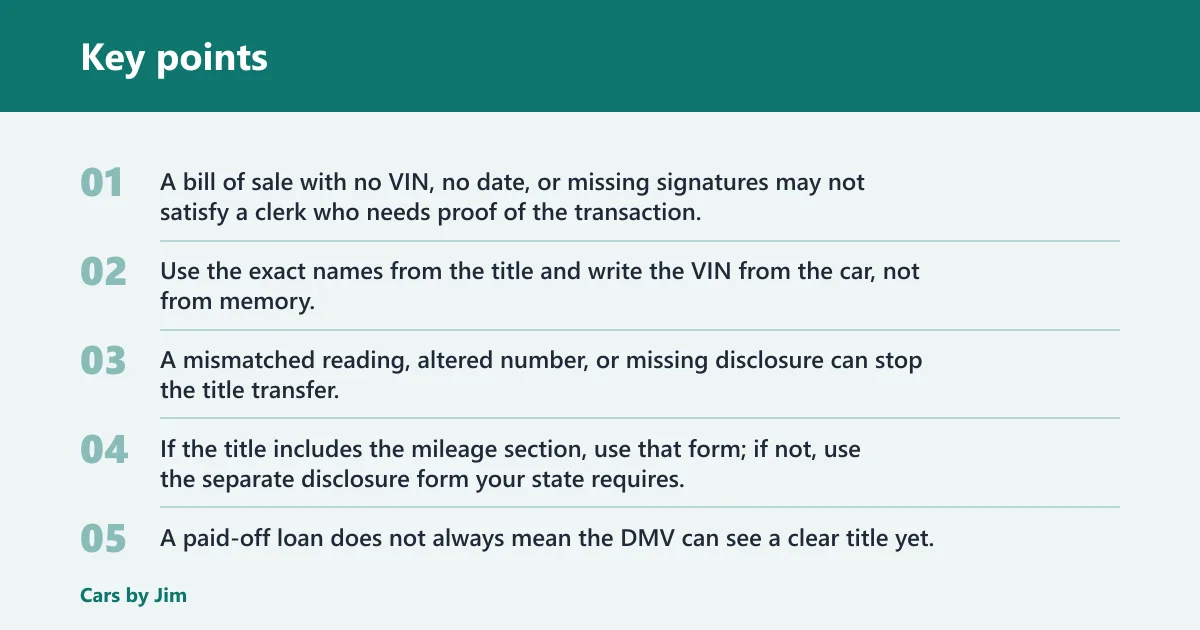
A bill of sale with no VIN, no date, or missing signatures may not satisfy a clerk who needs proof of the transaction. It can also create a problem if the buyer later disputes the sale price or date. Use the exact names from the title and write the VIN from the car, not from memory.
Odometer disclosure errors
For many vehicles, NHTSA odometer disclosure rules require a truthful statement, and the FTC Used Car guidance emphasizes that mileage and condition disclosures should not mislead the buyer. A mismatched reading, altered number, or missing disclosure can stop the title transfer. If the title includes the mileage section, use that form; if not, use the separate disclosure form your state requires.
Lien release problems
A paid-off loan does not always mean the DMV can see a clear title yet. Some lenders issue a paper release, others send an electronic release. If the lender is late, the buyer may not get a transferable title until the release posts.
Plate and registration confusion
Registration is not ownership. Some states keep plates with the seller, some require removal, and some allow transfer only in narrow cases. Do not leave this to guesswork, because the wrong plate handling can cause the buyer or seller to miss a state-specific requirement. State DMV rules also differ on whether plates stay with the vehicle or with the seller, so the plate step should be confirmed before the handoff.
Smog certificate gaps
Where emissions testing is required, an expired or missing certificate can block transfer even when the title is otherwise complete. The test also has a recency window, so an old pass result may not count. If the car failed, fix the emissions issue before the sale or expect a delay. DMV emissions windows vary by state, so a certificate that is valid in one place may not satisfy another state’s transfer rule.
A common first-timer mistake is crossing out a name and writing over it in the title area. That often looks like an altered document, which can send the buyer back to the DMV for a replacement title instead of a fast transfer.
Suppose the title shows a married couple as owners, but only one spouse signs because the car is titled as “and” instead of “or.” The buyer may not be able to register until the missing owner signs or the title is reissued in the correct form. DMV transfer blocks often treat that wording as decisive, so co-owner signature rules should be checked before the sale.
Common mistakes to avoid
Most problems come from skipping a field, assuming one document replaces another, or using the wrong state rule for plates and notarization. Catch the issue before handoff, not after the buyer is gone. That is the easiest way to avoid DMV rejection and post-sale liability.
- Do not leave the odometer field blank when it is required.
- Do not use initials where the title calls for a legal signature.
- Do not assume a bill of sale replaces the title.
- Do not assume the registration card transfers ownership.
- Do not forget to file the release of liability.
- Do not hand over a car with an unreleased lien.
- Do not rely on an old smog certificate if the state requires a recent one.
- Do not throw away copies of signed documents after the sale.
Keep a one-page checklist with the title, odometer, lien, bill of sale, release of liability, plates, and emissions certificate. Check each item before the keys leave your hand. For state-specific steps on title transfer, lien release, bill of sale, odometer disclosure, smog checks, duplicate title requests, and selling to an out-of-state buyer, use the exact DMV process that applies where the car is titled and where the buyer will register it.
Frequently asked questions
What paperwork mistakes delay a car sale?
Missing signatures, title mismatches, missing odometer disclosures, and unpaid lien releases are the usual delays. A missing smog certificate can also stop transfer where emissions testing is required. The fastest fix is to compare every form before handoff and make sure the buyer receives a complete set.
Do I need to fill out the odometer reading exactly on the title?
Yes, when your title or federal disclosure form requires it. Enter the exact mileage shown on the odometer, with no rounding or guessing. If the vehicle is exempt under the form’s rules, use the correct exemption language instead of leaving the field unfinished.
What happens if I forget the release of liability after selling my car?
The DMV may still connect the car to you, which can lead to tolls, tickets, or other notices after the sale. File the release as soon as the handoff is complete and save the confirmation. That record is your best proof that the sale date has passed.
Can a mistake on the bill of sale cause DMV problems?
Yes. Missing VIN, sale date, names, or signatures can cause the DMV to question the sale or reject the buyer’s paperwork. A bill of sale is useful even when not mandatory, but it only helps if the details match the title and the rest of the transfer packet.
What if the name on the title is different from my ID?
That can create a transfer problem unless you can show why the names differ and the state accepts the proof. Common reasons include a name change or an old title record. Before selling, contact the DMV about a corrected title or the proof it will accept with the transfer.
How do I avoid title transfer problems with an out-of-state buyer?
Use the title, bill of sale, odometer disclosure, and release forms exactly as your state requires, and tell the buyer to check the destination state’s registration rules before leaving. Out-of-state buyers often need extra proof, and plates, notarization, emissions certificates, and release deadlines can differ by state. If the buyer’s state has a stricter rule, the transfer can stall even when your state paperwork is complete.