What Is a VIN Check, and What Does It Show?
A VIN check is a two-part lookup that confirms a car’s identity and screens its history for title brands, theft, odometer issues, recalls, and damage records. Skip it, and you can pay too much for a bad car or buy one with a defect that turns costly or unsafe. This guide explains what a VIN check shows, which results matter, and which details are only decoded specs.
What is a VIN?
A VIN is a vehicle identification number: a unique 17-character code assigned to every vehicle manufactured since 1981. It identifies one specific vehicle and also carries manufacturer and model-year information, which is why the number on the car must match the number on the paperwork.
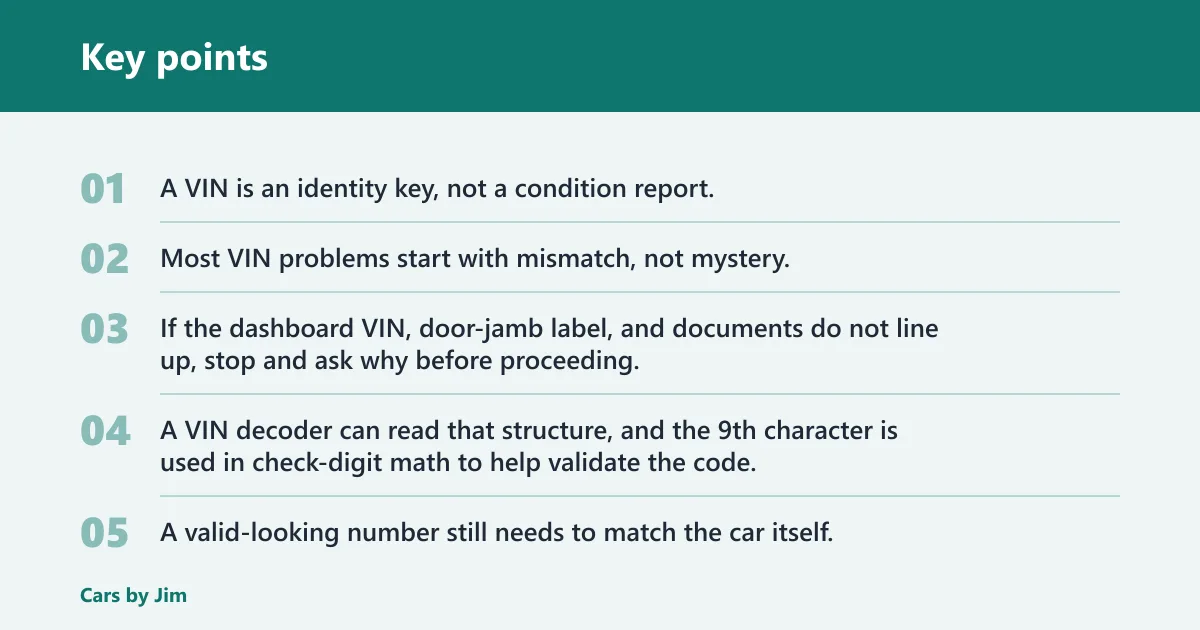
The key point is simple. A VIN is an identity key, not a condition report. It can help verify that the car in front of you is the same car described on the title, registration, and sales paperwork.
Most VIN problems start with mismatch, not mystery. If the dashboard VIN, door-jamb label, and documents do not line up, stop and ask why before proceeding.
Why the 17 characters matter
The 17-character format is not random. It gives a decoder enough information to identify the manufacturer, model year, assembly details, and other factory data tied to that exact vehicle. A VIN decoder can read that structure, and the 9th character is used in check-digit math to help validate the code.
That validation matters because a swapped, altered, or mistyped VIN can point you to the wrong vehicle history. A valid-looking number still needs to match the car itself.
Where do you find the VIN?
You usually find the VIN on the lower driver-side windshield area, on the door jamb label, and on paperwork such as the title, registration, insurance card, or sales documents. The number should match in all of those places.
Do not rely on one source alone. A visible dashboard VIN can be copied; the paperwork can also be wrong. Match both the physical markings and the documents.
Dashboard and windshield plate
Look through the windshield at the driver side lower corner. Many vehicles display the VIN on a plate there so it can be read from outside the car. This is one of the fastest ways to compare the vehicle to the documents.
Door jamb label and paperwork
Open the driver door and check the door jamb label. Then compare that number with the title and registration. If the car has paperwork from a dealer, lender, or auction, compare those records too.
Is a VIN check the same as a vehicle history report?
No. A VIN check can mean two different jobs: decoding the car’s factory specs and screening its event history. A decoder gives you identity details. A vehicle history report adds records such as title brands, accidents, odometer readings, lien records, sale or auction history, and theft status when those data are available.
That difference matters for buyers. A free decoder may tell you what the car left the factory with, but it does not prove that the car has a clean title, honest mileage, or no prior damage.
What a decoder shows
A VIN decoder can show make, model, trim, engine, transmission, body style, and model year. It can also confirm whether the VIN structure is valid, including the 9th-position check digit math used in many decoder tools.
Driving-Tests.org says its free decoder shows build data and open recalls, but that still does not turn a decoder into a full history report.
What a history report adds
A full vehicle history report combines decoding, status checks, and a chronological history. Driving-Tests.org says full history records can include title, accident, odometer, and lien data. VINinspect says a vehicle history report can provide ownership records and accident details.
Those records are the part that buyers use to spot risk. They are the part that can save you from buying a car with a branded title, mileage inconsistency, or a hidden claim on the vehicle.
What can a VIN check show?
A VIN check can show factory specifications and, depending on the source, safety recalls, title brands, theft records, odometer history, lien status, and sale or auction history. The exact result set depends on the database, country, and reporting source.
That is why one result can be useful and another can be incomplete. A clean decode only tells you the vehicle identity was readable. It does not prove the car is clean.
Factory specs and model data
VIN decoders are built to read the vehicle’s factory specifications, not its history. They can identify the vehicle’s configuration from the code itself, including body style and engine details.
Driving-Tests.org says the decoder also confirms the 9th-position check digit math. That is a validation step, not a condition check.
Safety recalls and status records
Open recalls are safety-related defects issued by the manufacturer. They can often be checked from the VIN through NHTSA or manufacturer sources. Driving-Tests.org says its free decoder shows open recalls.
Recall status matters because an open recall can mean a fix is available at no charge, but the car may still need the repair completed. A recall is not the same as an accident history entry.
Title, theft, lien, and mileage results
Vehicle history reports may show title brands such as salvage, rebuilt, flood, lemon, junk, or write-off categories, depending on the country. They can also show reported theft, recovered theft status, lien records, and an odometer timeline that may include service, inspection, and auction readings.
For example, a car may show 82,400 miles on the dash while a prior auction entry lists 91,200 miles from eight months earlier. That is a mileage inconsistency, and it should trigger a hard stop until the seller explains the gap with records.
How do you do a VIN check?
To do a VIN check, first verify the VIN on the car and documents, then run it through a decoder or history service, and then read the results for red flags instead of stopping at the factory specs. A clean decode is only the starting point.
If the result looks incomplete, check another source. Missing data does not mean the car is clean; it can mean the record was never reported, is country-limited, or has not been loaded yet.
Find the VIN. Read the 17-character code from the dashboard plate, door jamb label, and paperwork. Make sure every copy matches exactly before you type anything into a lookup tool.
Check the VIN format. Look for obvious problems such as too few characters, a missing 9th position, or characters that do not fit the format. A bad check digit or invalid character pattern can point to a mistyped, swapped, or cloned VIN.
Run a decoder first. Use a VIN decoder or a free NHTSA vPIC-based tool to confirm make, model, trim, engine, transmission, body style, and model year. This tells you whether the number describes the car you are looking at.
Check recall status. Look for open recalls from NHTSA or the manufacturer. If a recall is open, ask whether the repair has been completed and whether a dealer can confirm the fix.
Review history results. If you need risk screening, use a full vehicle history report. Read the title brands, theft status, odometer timeline, lien record, and any accident or auction entries together rather than one at a time.
Compare findings to the car. Match the report to the vehicle’s condition, paperwork, and seller explanation. If the report says salvage, stolen, or odometer inconsistency, treat that as a follow-up issue before any deposit or purchase.
| Result | What it means | What a buyer should do next |
|---|---|---|
| Clean decode only | The VIN decoded to factory specs, but no history risk data appeared. | Use it only as an identity check; then request a fuller history report. |
| Open recall | The vehicle has a manufacturer-issued safety repair that has not been completed. | Ask for proof of repair or budget time for the fix before buying. |
| Odometer inconsistency | Reported mileage does not follow a normal timeline. | Ask for service records, inspection records, and auction history; treat as a major red flag. |
| Salvage brand | A title authority or insurer marked the vehicle as a total loss or similar branded category. | Expect lower resale value and higher risk; verify the exact brand and repair paperwork. |
| Theft record | The vehicle was reported stolen, or recovered theft status appears in the record. | Do not buy until ownership, recovery, and title status are confirmed in writing. |
| Lien record | A bank or lender may still have a claim on the vehicle. | Confirm the lien is released before paying; unresolved liens can create repossession risk. |
| Missing data | The source has no record for one or more history categories. | Check another provider and do not treat absence of data as proof of a clean history. |
| Invalid check digit | The VIN does not validate correctly, which can signal an error or a swapped VIN. | Recheck the VIN at every location and stop until the seller explains the mismatch. |
| No record found | The lookup did not return a usable history entry. | Try a second source and verify the VIN; some vehicles have limited reporting. |
| Title brand only | The report shows a branded title but no other details may be present. | Ask which event caused the brand and whether repair records support the current condition. |
| Sale or auction history | The vehicle appears in prior sales, dealer, or auction records. | Use those entries to compare mileage, damage notes, and timeline gaps. |
| No recall listed | The source did not show an open recall for that VIN. | Cross-check with another recall source if the vehicle is from a market with mixed coverage. |
What can a VIN check miss?
A VIN check can miss records that were never reported, were reported late, or are limited by country and source coverage. It can also miss damage or title events that never reached the database you searched.
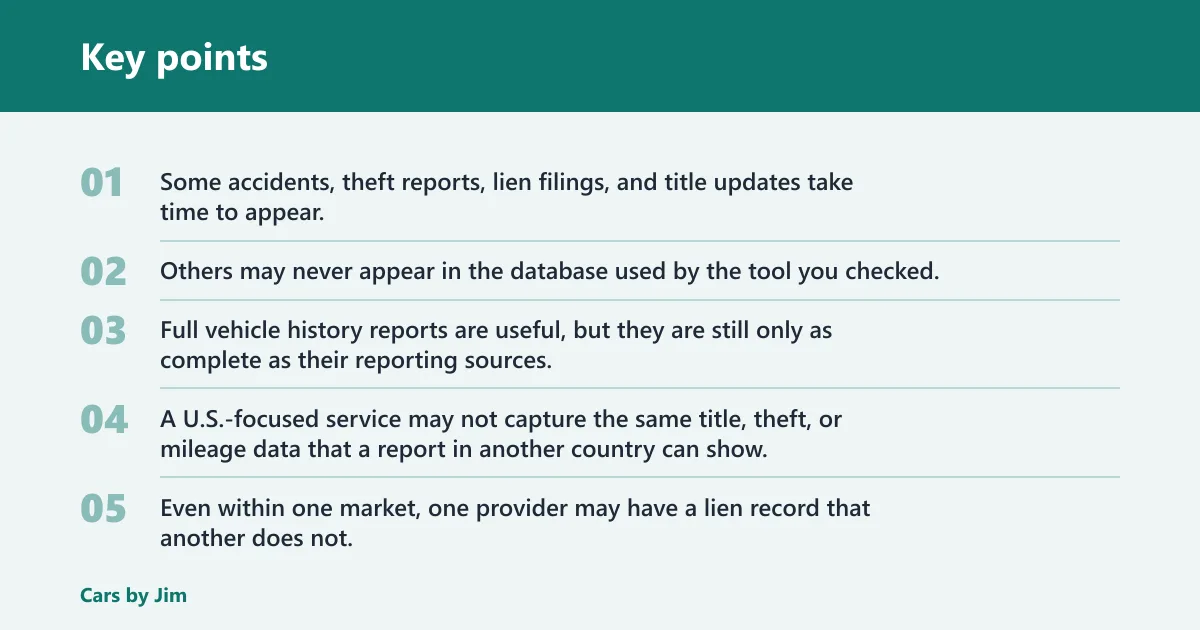
That is why a missing result is not a clean bill of health. It may mean the car has a quiet history, or it may mean the database has a gap.
Missing or delayed records
Some accidents, theft reports, lien filings, and title updates take time to appear. Others may never appear in the database used by the tool you checked. Full vehicle history reports are useful, but they are still only as complete as their reporting sources.
Country limits and source limits
Coverage differs by market. A U.S.-focused service may not capture the same title, theft, or mileage data that a report in another country can show. Even within one market, one provider may have a lien record that another does not.
VinCheck.info says NMVTIS helps with title status and branding like salvage, junk, or flood damage, and that its NMVTIS Title Report uses government-backed vehicle history data. That is useful, but it still points to source coverage, not universal coverage.
VIN problems that need follow-up
Invalid characters, a bad check digit, missing data, and mismatched paperwork all need more checking. A cloned VIN or swapped VIN can make a clean-looking record attach to the wrong vehicle, which is exactly the kind of fraud risk buyers are trying to avoid.
Picture a sedan with a clean-sounding title report, but the door-jamb label shows a different VIN from the windshield plate. That mismatch is not a small clerical issue. It is a reason to stop and verify the car before any money changes hands.
Frequently asked questions
What is a VIN check digit?
The check digit is the 9th character in a VIN. It is used in validation math to help confirm the VIN is structured correctly. A failed check digit does not prove fraud by itself, but it does mean the number needs a second look.
What does a VIN check show on a used car?
On a used car, a VIN check can show factory specs and, with a history report, title brands, accident history, odometer readings, theft status, lien records, and sale or auction history. The exact results depend on the source and the market.
What can a free VIN check tell me?
A free VIN check can often tell you the car’s make, model, trim, engine, transmission, body style, model year, and sometimes open recalls. It usually does not prove the car has a clean title, honest mileage, or no prior damage.
Where do I find the VIN to run a check?
Check the lower driver-side windshield area, the driver door jamb label, and the vehicle paperwork. The VIN should match in every place. If it does not, stop and verify the car before you continue.