Which Matters More for Reliability: Age, Mileage, or Owners?
Age often matters most for reliability, followed by mileage and then number of owners, although very low miles and missing maintenance records can change that order. Get the order wrong and you can overpay for a tired car or pass on a sound one. This guide ranks the three signals and shows which one should dominate in common buy-or-skip scenarios.
Which matters most for reliability?
| Decision factor | Which matters more for reliability: age, mileage | owners | Winner |
|---|---|---|---|
| What it tells you | Age tracks time-based wear in seals, rubber, fluids, electronics, and storage-related damage. | Owner count can hint at care patterns, but it says little without records and title history. | Which matters more for reliability: age, mileage |
| Wear signal strength | Strong, especially when a car is old enough that age-related deterioration becomes likely. | Weak by itself. Three careful owners can be better than one neglectful owner. | Which matters more for reliability: age, mileage |
| How easy it is to verify | Easy to confirm from the model year and visible aging clues. | Only useful with service records, title history, and evidence of how the car was used and stored. | Which matters more for reliability: age, mileage |
| Best use case | Older cars that may have sat, or cars with unknown maintenance history. | Cars with documented maintenance, clean title history, and consistent care. | Which matters more for reliability: age, mileage |
What age tells you
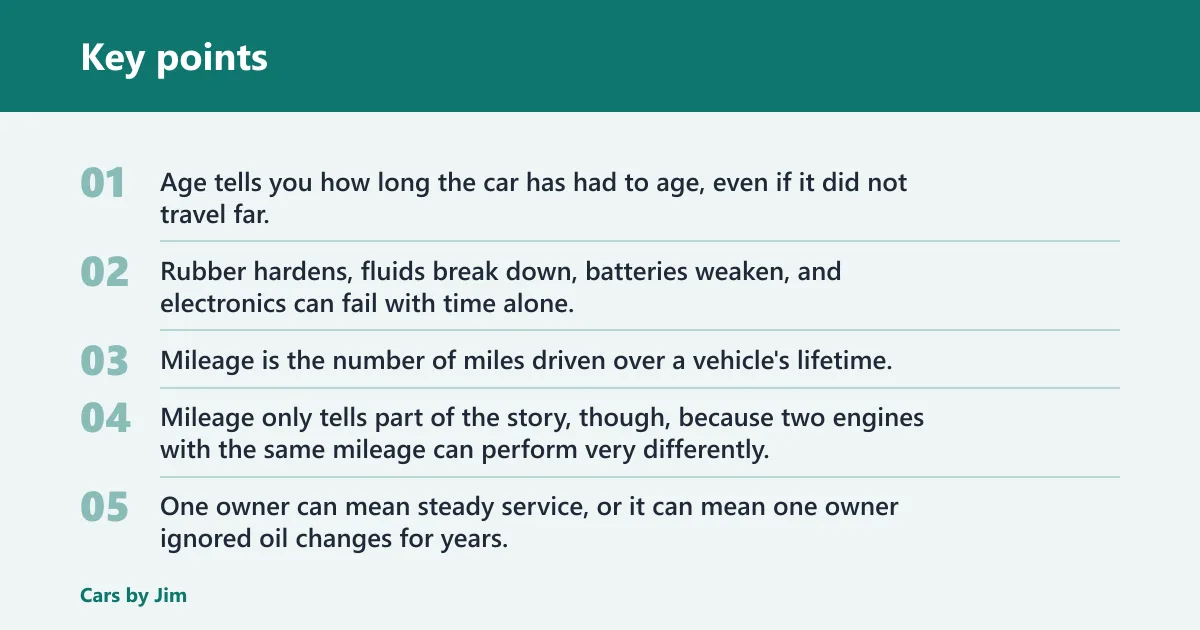
Age tells you how long the car has had to age, even if it did not travel far. Rubber hardens, fluids break down, batteries weaken, and electronics can fail with time alone. That is why an older low-mileage car can be more concerning than a newer high-mileage one when records are thin.
What mileage tells you
Mileage is the number of miles driven over a vehicle’s lifetime. It matters because moving parts, bearings, chains, belts, brakes, and suspension pieces wear with use. Mileage only tells part of the story, though, because two engines with the same mileage can perform very differently.
What owner count tells you
Owner count is a useful clue, not a score. One owner can mean steady service, or it can mean one owner ignored oil changes for years. Multiple owners can be fine if the records are complete, the title is clean, and each owner used the car in a predictable way.
When age matters more than miles
Age matters more when a car sat too long, when records are missing, or when storage conditions were poor. A low-mileage vehicle can still have dried seals, stale fluids, cracked hoses, and aging electronics. If age and storage look bad, mileage does not rescue the deal.
Cars that sat too long
Long storage is a reliability risk because fluids settle, seals dry out, and batteries discharge. Tires can flat-spot, brake components can rust, and fuel can age. A roughly 10-year-old car with about 22,000 miles and limited service history can be riskier than a roughly 6-year-old car with about 70,000 miles and regular maintenance.
Parts that age even when parked
Seals, belts, coolant, brake fluid, tires, and many plastic parts all age with time. Electronics and sensors do too. If a buyer sees a car that looks lightly used but has old date codes on tires, brittle hoses, or cloudy fluid, the age signal should move to the front.
Does mileage matter more than age?
Yes, mileage matters more than age when a car has been driven regularly, serviced on schedule, and shows no storage damage. Total miles still predict wear on engines, transmissions, brakes, and suspension. But age can outrank mileage when the car is old enough to have time-based deterioration.
Why total miles still count
Mileage is the best rough measure of how much mechanical work the car has done. More miles usually mean more wear on internal components, suspension joints, wheel bearings, and brake hardware. High mileage does not automatically mean a bad vehicle, but it does raise the odds of repair work.
Why same-mileage cars can wear differently
Same-mileage vehicles can hide very different wear levels because driving conditions matter. Highway driving keeps engines at steady speeds and temperatures, which reduces internal wear. City traffic creates more strain than highway use because of stop-and-go driving, cold starts, idling, and sudden acceleration.
Say your choice is between two 60,000-mile sedans. One has a thick stack of oil-change receipts and commuter-highway use. The other has the same mileage but spent years in short city trips with missed service. The first is the better reliability bet, even though the odometer is identical.
How many owners is too many?
There is no magic owner-count cutoff. Two or three owners are not a problem if the records are good and the title history is clean. What matters is whether the car changed hands because of normal life cycles or because each owner was trying to offload a problem.
Owner count with records
With maintenance records, owner count becomes a context signal. You can see oil change intervals, filter replacements, coolant service, and inspection history. A well-documented three-owner car can be a better buy than a one-owner car with no records and signs of neglect.
Owner count without records
Without records, more owners increase uncertainty. You do not know how the vehicle was used, stored, or maintained. That does not make the car bad by default, but it should lower your confidence until the title status, underhood condition, tire wear, and fluid condition all check out.
Maintenance history and driving conditions
Service history can matter more than mileage when oil changes, filter replacements, coolant flushes, and inspections were done on time. Driving conditions also change wear. Highway miles are usually easier on parts than stop-and-go city use, but engine type and service quality still change the answer.
Service records to verify
Look for dates and mileage on oil changes, air and cabin filter replacements, coolant service, brake fluid service, transmission service, and routine inspections. Regular oil changes help extend engine life. Poor maintenance can cause sludge buildup and overheating, which can turn a decent engine into a repair risk.
Check the record gaps. Ask for receipts, not just a verbal history. A long gap between services is more useful than a single missing receipt, because it can point to skipped maintenance or irregular ownership habits.
Match services to mileage. Compare the service intervals against the odometer. If oil changes were stretched far beyond normal intervals, or coolant service is absent on an older car, reliability risk rises fast.
Inspect title history. Look for salvage, flood, or rebuilt branding before you treat owner count as a positive sign. A clean title with strong records is often more useful than a low owner count on its own.
Highway miles versus city miles
Highway driving reduces internal wear because the engine stays at steady speeds and temperatures. City traffic creates more strain than highway use because of repeated stopping, idling, and cold starts. That said, a car that has mostly highway miles but weak oil-change history can still be a bad buy.
Engine type changes the answer
Engine type changes mileage expectations. Diesel engines can remain reliable beyond 200,000 miles when maintained well, while gasoline engines often show different wear patterns at the same odometer reading. The point is not that one type is always better; it is that the same mileage means something different depending on the engine and its service history.
Age, mileage matrix
This matrix scores age, mileage, owner count, maintenance history, and driving profile together. Use it as a buy-or-skip filter, not as a substitute for inspection. The same odometer number can be a green light or a warning sign depending on records, storage, and use.
| Scenario | Age score | Mileage score | Owner count score | Maintenance and driving profile | Recommendation |
|---|---|---|---|---|---|
| 8-year / 60k / 1-owner | Moderate | Moderate | Low concern | Strong records and mostly highway use push risk down. | Buy if inspection and title are clean. |
| 12-year / 45k / 3-owner | High concern | Low concern | Moderate concern | Low miles do not erase age-related wear; records decide the call. | Skip unless records, storage, and fluids are excellent. |
| 5-year / 110k / 1-owner | Low concern | High concern | Low concern | Long highway use and complete service history can keep this acceptable. | Buy if inspection confirms normal wear, otherwise pass. |
In the 8-year, 60k, 1-owner case, the balance is healthy because none of the signals is extreme. In the 12-year, 45k, 3-owner case, age is the red flag, not mileage. In the 5-year, 110k, 1-owner case, the odometer is the main concern, but a clean service record can still justify the car.
What to check before you buy
Before you buy, check records, title history, wear items, fluid condition, and storage clues. Mileage and owner count matter less if the car shows clear evidence of neglect, flood exposure, or hard use. This is where reliability decisions become concrete.
Verify service records. Look for oil changes, filter replacements, coolant service, and routine inspections at sensible intervals. Missing records do not prove neglect, but they do raise the inspection bar.
Confirm title status. Check for salvage, rebuilt, flood, or lemon branding. Title problems can explain why a car has had several owners and why the apparent deal is not as safe as it looks.
Inspect tires and brakes. Uneven tire wear, thin brake pads, or rusty rotors can point to poor alignment, ignored maintenance, or lots of stop-and-go driving. These clues help you judge how the car was used.
Check fluids and leaks. Look at engine oil, coolant, brake fluid, and transmission fluid condition. Sludge, dark fluid, low fluid, or wet underhood spots suggest maintenance gaps or active wear.
Look for storage clues. Dry belts, cracked hoses, faded seals, and dead batteries often point to long periods of sitting. That is where age can matter more than mileage.
Match use to vehicle type. Commuter cars need steady service history, trucks should show evidence of load-aware maintenance, and hybrids deserve careful battery and cooling-system checks. The right mileage cutoff depends on the platform and how it was used.
Picture a compact hybrid with 52,000 miles, but no coolant records and tires from six years ago. The low odometer looks good until you notice age-related wear and a weak maintenance trail. In that case, the mileage signal is not strong enough to override the missing history.
Choose Which matters more for reliability: age, mileage if…
Choose Which matters more for reliability: age, mileage if the car is older, has questionable storage history, or comes with thin records. Age should also lead your decision when you see aged rubber, stale fluids, cracked hoses, or other signs of time-based wear. In those cases, the odometer should take second place.
Choose owners if…
Choose owners when the car has a clean title, detailed service records, and clear evidence of consistent care from each owner. Owner count matters most when it helps explain how the vehicle was used, stored, and maintained. Without that context, it should never outrank age or mileage by itself.
Frequently asked questions
Does mileage matter more than age when buying a used car?
Not always. Mileage matters when you want to estimate mechanical wear, but age can matter more on cars that sat a long time or were poorly stored. If records are weak, age-related issues like dried seals, old fluids, and aging electronics can outweigh the odometer.
How much does the number of previous owners affect reliability?
Owner count is a clue, not a verdict. A one-owner car can be neglected, and a three-owner car can be excellent if the service records are complete. Use owner count to ask better questions about maintenance, title history, storage, and how the car was driven.
Is an older low-mileage car better than a newer higher-mileage car?
Only if the older car has strong maintenance records and no signs of age-related wear. Low mileage does not automatically mean a better vehicle, and higher mileage does not automatically mean a bad one. Age, storage, and service history decide the outcome.
What mileage is considered high for a used car?
There is no universal cutoff. What counts as high depends on vehicle type, engine type, maintenance, and use. A diesel with strong service history can remain reliable beyond 200,000 miles, while a poorly maintained gasoline car can become risky far earlier.
How do highway miles compare with city miles for wear?
Highway miles are usually easier on components because the engine stays at steady speeds and temperatures. City miles create more strain from stop-and-go traffic, cold starts, idling, and sudden acceleration. Even so, maintenance still matters more than the road type alone.
What should I check besides mileage before buying a used car?
Check service records, title status, tire and brake wear, fluid condition, leaks, and signs of poor storage. Also look at how the car was used. A good maintenance trail can matter more than mileage, while sludge, overheating history, and neglected fluids should push you away from the deal.