Trade-In Value: How to Price Your Car Fairly
A fair trade-in target is often the average local retail asking price for comparable cars minus about $1,500 to $3,500 for reconditioning, auction risk, and dealer margin, then adjusted for mileage, title status, and needed tires or brakes. Miss that range and you can leave thousands on the table, or reject an offer that is reasonable once tax savings are counted. This guide shows you how to build a dealer-ready range from retail comps, condition deductions, tax effects, and negotiation room.
What trade-in value actually means
Trade-in value versus fair market value
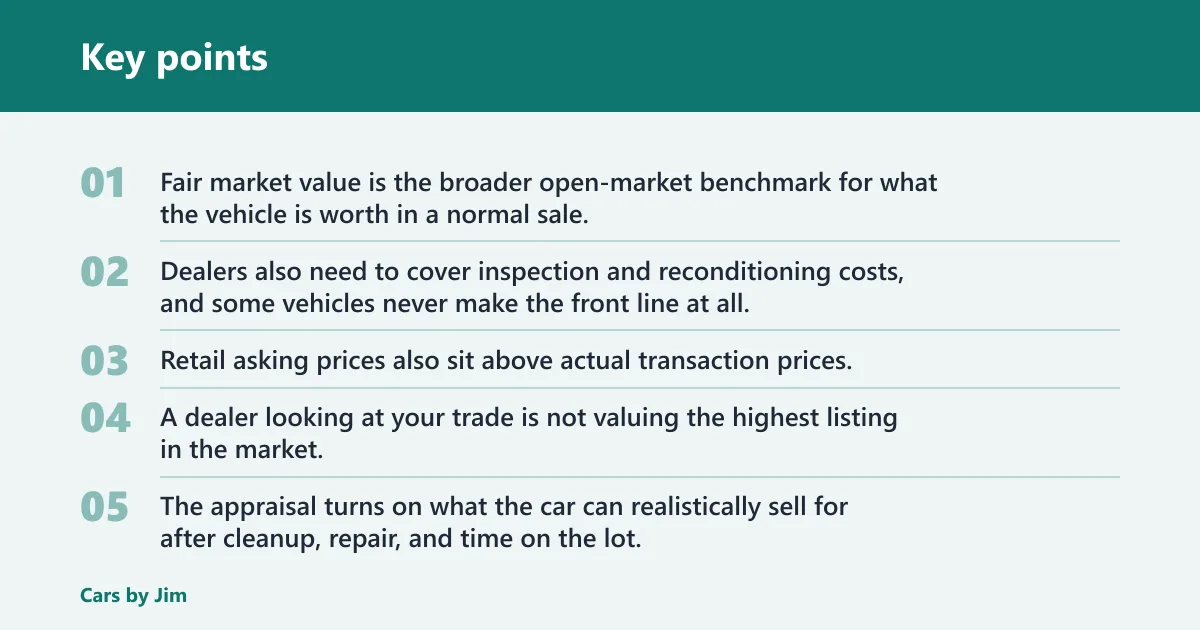
Trade-in value is the amount a dealer is likely to offer for your vehicle based on what that store expects it can resell or wholesale the car for after costs. Fair market value is the broader open-market benchmark for what the vehicle is worth in a normal sale. The two figures are connected, but they measure different things, and trade-in value is often lower than fair market value.
That gap exists because a dealer is buying your car for resale or wholesale, not for immediate use. The store has to inspect it, transport it if needed, advertise it, carry it in inventory, and stand behind it if it is retailed. Dealers also need to cover inspection and reconditioning costs, and some vehicles never make the front line at all.
Retail asking prices also sit above actual transaction prices. A dealer looking at your trade is not valuing the highest listing in the market. The appraisal turns on what the car can realistically sell for after cleanup, repair, and time on the lot.
Retail, wholesale, or auction value
A clean, desirable trade with average mileage may be valued as a retail unit. A rougher car, a very old luxury model, a branded-title vehicle, or a car with warning lights may be valued closer to wholesale or auction. That distinction can move the offer more than a small scratch ever will.
Suppose a three-row SUV has solid service records, good tires, and no history issues. A dealer may see a retail candidate. Take the same SUV with a hard-shifting transmission and an unresolved title issue, and the car can slide into wholesale logic fast, which changes the offer before anyone talks numbers.
How do you know if a trade-in offer is fair?
A trade-in offer is fair when it lines up with local retail comps after subtracting realistic reconditioning costs, a dealer margin buffer, and the risk that the car sits or goes to auction. If the offer falls inside that adjusted range, it is usually defensible. If it misses badly, ask for the deductions in writing.
The fair-offer test
Start with matching local retail asking prices, not one online estimate. Online classifieds are suggested for comparing estimated value, and the best matches share the same year, make and model, trim, mileage band, drivetrain, and major factory options.
Then back out the dealer’s costs and risk:
- Reconditioning: tires, brakes, paintless dent repair, wheel rash, windshield chips, detailing, odor treatment, fluid service, warning-light diagnosis
- Selling costs: photos, lot prep, possible certification screening, carrying costs
- Resale risk: price drops on aging inventory, finance approval issues on older units, auction exposure if the car is not retail-ready
If that math lands near the offer, the number may be fair even if it looks low next to a retail listing.
When a low offer is still reasonable
A low offer is often reasonable when one major issue changes the car’s likely exit path. Bald tires, a cracked windshield, smoke odor, two missing service records on a fragile luxury model, or a recent accident can move a unit from front-line retail to discounted retail or auction.
Say your sedan looks clean in photos and books well online, but the appraiser finds two mismatched tires, a windshield chip in the driver’s view, and a stored check-engine code. The dealer is now pricing the risk of failed recon, comeback liability, and a smaller buyer pool, not only the shiny exterior.
When to push back or walk away
Push back when the store ignores documented options, misstates trim, grades the car below its actual condition, or uses stale comps from a different market. Walk away when the dealer refuses to explain major deductions, bundles trade math into monthly payment talk, or will not put the appraisal in writing.
What should you research before visiting a dealer?
Before visiting a dealer, confirm the exact details that move used-car value, then compare several pricing tools with truly comparable local listings. The goal is not a single magic number. It is a defendable range built from your exact trim, drivetrain, mileage, condition, options, title status, and local demand.
Vehicle facts to verify first
Value research should consider make and model, location, condition, optional equipment, and mileage. It should also account for trim, drivetrain, title status, accident history, open recalls, number of keys, and whether you have payoff information if there is a loan.
- Verify the VIN. Match the VIN to the title, registration, insurance card, and any history report. A wrong digit can pull the wrong engine, trim, or restraint package and skew every estimate that follows.
- Confirm the exact trim. Check badges, window sticker if available, and original equipment lists. Similar trims can differ by all-wheel drive, battery size, towing package, or driver-assistance package, and those differences can materially change comps.
- List factory options. Note premium audio, larger wheels, tow package, panoramic roof, adaptive cruise, heated rear seats, and other factory equipment. Optional equipment should be included in research inputs, while many aftermarket parts add little or can even narrow the buyer pool.
- Record the condition honestly. Mark scratches, dings, wheel rash, odors, windshield chips, interior stains, warning lights, tire wear, and brake condition. Condition grading drives dealer appraisal adjustments more than a fresh wash alone.
- Check payoff and title status. If there is a lien, ask the lender for a current payoff good-through date. If the title is missing, branded, or awaiting release, the trade structure gets more complicated fast.
Using valuation tools together
Kelley Blue Book is one resource suggested for value research. Consumer Reports is one resource suggested for value research. Edmunds is one resource suggested for value research. NADA Guides is one resource suggested for value research.
Use all four because each tool relies on different inputs and assumptions. One may lean on dealer listings, another on market transactions, another on regional or condition filters. If three cluster tightly and one sits far outside the pack, find out why before treating the outlier as truth.
How to find local comps that actually match
Search within a distance that reflects where buyers really shop in your market. For common sedans and crossovers, local means local. For niche trims, performance cars, trucks with towing gear, or long-range EVs, the comparison radius often needs to expand.
Screen out bad comps. A base trim is not a match for a loaded trim. Front-wheel drive is not all-wheel drive in snow-belt markets. An EV with the smaller battery pack is not a true comp for the longer-range version. A listed price on a car with accident history should not anchor the value of a clean-history example.
Which inputs move a dealer appraisal the most?

The biggest appraisal drivers are mileage, trim, optional equipment, condition, history, title status, and local demand. Dealers also weigh region and seasonality because the same vehicle can sell quickly in one market and stall in another. Small option errors matter less than hidden condition or title problems.
Mileage, trim, and optional equipment
Mileage is a major pricing input. Lower mileage can support a higher offer, but only in context. High mileage hurts more on nearly new vehicles than on older mainstream cars that already trade on budget transportation logic.
Trim matters because it changes what buyers expect. On trucks, the towing package, bed length, axle ratio, and four-wheel drive matter. On SUVs, captain’s chairs versus bench seating can matter. On EVs, battery size and charging capability can matter more than wheel design.
Condition, history reports, and title status
Condition grades such as excellent, good, fair, and poor can move an offer meaningfully because they point to real recon work. Light scratches, small dings, and a dirty cabin are one level of cost. Worn tires, warning lights, smoke odor, windshield cracks, and interior damage are another.
| Appraisal factor | Common working effect on offer | Why it moves the number |
|---|---|---|
| Excellent to good | Small discount from best-case range | Mostly cleanup and minor touch-up |
| Good to fair | Noticeable discount | Often includes tires, brakes, glass, wheel repair, stain or odor work |
| Fair to poor | Large discount | Mechanical faults, warning lights, body damage, title or history concerns |
| Mileage well below local norm | Supports upper end of range | Broadens buyer pool and finance appeal |
| Mileage well above local norm | Pushes toward lower end | Raises future repair and resale risk |
A history report can change the outcome even when repairs were done well. Dealers know many retail buyers filter out accident-history cars entirely. Title brands, flood history, structural damage, or mileage inconsistencies usually hit harder than ordinary cosmetic wear.
Region, seasonality, and inventory demand
Region matters. Value research should consider location because all-wheel drive, towing hardware, convertibles, full-size trucks, and EVs do not carry the same demand in every market. Seasonality matters too. A rear-drive sports coupe in winter or a high-mile hybrid during a fuel-price dip may draw weaker trade bids.
How dealers turn your car into a number
Inspection and market lookup
A dealer appraisal usually includes a visual inspection, VIN and history checks, odometer review, a scan for warning lights or stored faults, a quick drive if policy allows, and a market lookup against current inventory and recent sale trends. The final figure is the appraisal’s business case, not a guess.
Written appraisals are stronger than casual verbal offers because they anchor the discussion. If one store says the tires are near replacement and another says they are fine, a written sheet exposes the gap.
Reconditioning cost line items
Dealers often subtract line items that a private buyer might ignore until after purchase. Common examples include tire replacement, brake service, windshield repair, wheel refinishing, paintless dent repair, interior stain cleanup, odor treatment, key replacement, fluid service, battery testing, and warning-light diagnosis.
A common first-timer mistake is assuming every cosmetic flaw should be repaired before trading. A dealer may discount a small scratch lightly because the car will be priced competitively anyway, while a cracked windshield or bald tires can trigger a much larger deduction because they are safety or inspection issues.
Dealer margin buffer and resale risk
After recon, the dealer still needs room for markdowns, financing fallout, auction exposure, and simple aging. An older German luxury SUV with perfect paint can still draw a cautious bid because expensive failures scare retail buyers and lenders. By contrast, a plain, late-model compact with average miles can need less risk padding because it sells broadly and finances cleanly.
Trade-in pricing worksheet
Build your range
Use this text-only worksheet as a calculation model, not a universal pricing sheet. The values below show the logic on a hypothetical vehicle so you can plug in your own comps and deductions.
| Worksheet item | Sample amount | How to use it |
|---|---|---|
| Average local retail asking price for matching comps | $24,400 | Use at least 4 closely matched listings with the same trim, drivetrain, and major options |
| Adjustment for your car having 12,000 more miles than comp average | -$700 | Move toward the lower half of local retail if mileage is meaningfully higher |
| Adjusted retail benchmark | $23,700 | This is the starting point before dealer costs |
| Front tires at 4/32 | -$450 | Use a realistic local tire replacement estimate |
| Brake pads near minimum | -$350 | Count obvious service items that affect retail readiness |
| Windshield chip in driver view | -$180 | Glass issues often matter more than small paint marks |
| Interior odor treatment and detail | -$220 | Use this line only if odor or staining is real |
| Wheel rash on two wheels | -$200 | Cosmetic, but often priced into recon |
| Total likely reconditioning | -$1,400 | Add only the work the next seller is likely to do |
| Dealer margin and resale-risk buffer | -$1,600 to -$2,100 | Use the lower end for easy retail units, higher end for niche or slower units |
| Fair trade-in offer range | $20,200 to $20,700 | Adjusted retail benchmark minus recon and margin buffer |
| Dealer offer below walk-away line | Under $19,500 | Ask for itemized deductions or get another appraisal the same day |
Walk-away flags
| Red flag | Why it matters |
|---|---|
| Dealer will not separate trade value from purchase price | It becomes hard to tell whether the offer is fair or cross-subsidized elsewhere |
| No written appraisal or itemized deductions | You cannot check whether the store is discounting real issues or padding the spread |
| Obvious trim or option errors | Missing all-wheel drive, tow package, safety package, or battery size can distort the offer |
| Pressure to negotiate by monthly payment only | Negative equity and trade allowance can be hidden inside the financing structure |
| Unexplained title, key, or history penalties | Some deductions are valid, but you need the reason stated clearly |
Do small repairs before trading in pay off?
Small repairs pay off when they remove safety, inspection, or broad-buyer-pool problems such as bad tires, windshield damage, or a dead battery. They usually do not pay off when they chase every cosmetic flaw. The best test is simple: fix what clearly changes retail readiness, not what merely makes the car prettier.
Repairs that often help more than they cost
Good candidates include replacing a cracked windshield, installing safe matching tires if yours are worn out, fixing obvious bulb failures, and resolving basic maintenance neglect that triggers warning messages. Missing keys can also hurt more than many owners expect because replacement and programming are expensive on many late-model vehicles.
Repairs that rarely return full value
Full paint correction, non-factory wheel upgrades, expensive audio work, and deep cosmetic restoration usually do not return dollar for dollar on a trade. Dealers often prefer to handle appearance work at wholesale rates, and aftermarket modifications can reduce demand instead of lifting value.
Picture a pickup with a lift kit, oversized tires, and deleted factory bumpers. Those parts may have been expensive, but they narrow the audience and can make financing or certification harder. A stock truck often appraises more easily than a heavily modified one.
Presentation versus actual condition
Cleaning the car helps the appraisal process because dirt can hide condition, but presentation is not a substitute for fixing major issues. A vacuumed interior and washed exterior can support a fair grade. They do not erase brake vibration, smoke odor, warning lights, or overdue tires.
How should you price special-case trade-ins?
Special-case trade-ins need a different risk adjustment. High-mileage mainstream cars may still trade predictably, while accident-history vehicles, aging luxury models, and EVs often get steeper deductions because buyer demand, finance approval, battery concerns, or repair uncertainty narrow the resale path.
High-mileage and older mainstream cars
On older mainstream cars, high mileage matters, but condition and usability can matter more. A ten-year-old compact with clean records, cold air, and decent tires may bring a better offer than a lower-mile example with warning lights and deferred maintenance.
For these cars, the question is often retail versus auction. If the car can be put on the lot cheaply, the offer may surprise on the upside. If it needs several line items at once, the dealer may bid it like wholesale transportation.
Accident-history and branded-title vehicles
Accident history does not affect every car the same way. A minor repaired incident on a common late-model sedan may simply push the offer toward the lower half of the fair range. Structural damage, airbag deployment history, salvage or rebuilt title, or uneven repairs can change the car’s entire market tier.
Aging luxury models, trucks, and EVs
Aging luxury cars often suffer from repair-cost fear. Even if the cabin looks excellent, the dealer knows the next buyer may price in air suspension, turbo, electronics, or cooling-system risk. That often means a larger dealer buffer.
Trucks need closer option matching than many passenger cars. Cab style, bed length, four-wheel drive, tow package, diesel or gas engine, and axle ratio can swing the bid. EVs need battery size, charging speed, software support, and local EV demand checked carefully. In some markets, an EV with lower range or weak charging support draws a narrower trade audience than online averages suggest.
How to negotiate the trade without losing the full deal picture
Separate the trade number from the purchase price
Negotiate the trade allowance and the replacement vehicle as separate lines first, then compare the combined out-the-door numbers. This keeps a dealer from boosting one side while trimming the other.
- Ask for line-item figures. Request the sale price of the replacement vehicle, the trade allowance, fees, taxes, payoff amount, and any add-ons on one worksheet. You need the full structure before deciding whether the trade number is carrying the deal or hiding losses elsewhere.
- Present your comps. Bring printouts or screenshots of matched local listings and your option list. A dealer offer may be increased if you show evidence the car is worth more.
- Request deduction reasons. If the offer is low, ask which items caused the drop and what market they are targeting. Tires, brakes, title issues, accident history, and wholesale-only status are valid reasons if documented.
- Compare same-day appraisals. Get written quotes from more than one dealer, ideally on the same day. Same-day comparisons reduce the noise from fast-moving used-car pricing and make it easier to see whether one store simply wants the car more.
Use tax credit and negative equity correctly
In many states, trading in a vehicle reduces the taxable purchase price of the next vehicle. That means the effective value of the trade can be higher than the allowance alone. If a state tax rate is 6% and the trade credit is $18,000, the tax savings is $1,080, which changes the comparison with a private sale.
Negative equity is different. If the loan payoff is $22,000 and the trade allowance is $18,000, the vehicle’s trade-in value is still $18,000. The extra $4,000 is debt that must be paid in cash or rolled into the next deal. Do not let that debt blur the actual appraisal number.
Missing title paperwork, open recalls, lien-release delays, undisclosed damage, and even a missing second key can slow or reduce an offer. Those are failure cases worth fixing before you debate a few hundred dollars on pure negotiation.
Frequently asked questions
How do I know if my car’s trade-in value is fair?
A fair offer usually fits within a range built from local retail comps minus realistic recon costs and a dealer risk buffer. If the offer is close to that adjusted range, it is often fair. If it is well below, ask for written deductions and compare another same-day appraisal.
What should I research before going to a dealer?
Verify trim, drivetrain, mileage, title status, accident history, service records, keys, and factory options first. Then compare Kelley Blue Book, Edmunds, NADA Guides, Consumer Reports, and matching local listings. The target is a defendable range, not one online estimate.
Does my car’s condition change trade-in value a lot?
Yes, especially when condition affects retail readiness. Light scratches and minor dings matter less than worn tires, brake needs, warning lights, smoke odor, windshield damage, or stains. Condition grades can shift a car from easy retail to wholesale logic, which changes the offer meaningfully.
Should I get trade-in quotes from more than one dealer?
Yes. Written appraisals from multiple dealers show whether one store is low, whether another values your trim or options more, and whether a specific dealer wants your car for inventory. Same-day quotes are best because used-car values and dealer demand can change quickly.
Are small repairs worth doing before trading in a car?
Some are. Safety, glass, tire, battery, and key issues often pay back better because they affect inspection, financing, and retail appeal. Cosmetic perfection rarely returns full value on a trade. Fix what changes saleability first, then clean the car so the true condition is easy to see.
How can I negotiate a better trade-in price?
Negotiate from evidence, not from a monthly payment. Bring matched local comps, an accurate option list, and written appraisals from other dealers. Ask the store to separate the trade number from the purchase price and explain each deduction. If the logic is weak, counter or walk.