Why Is My Trade-In Value So Low?
Your trade-in is low because dealers discount your car for condition, reconditioning costs, and current demand. If repairs cost less than half the gap, fixing them can pay off. Ignore that math and you can leave money on the table or waste cash on repairs the dealer will still discount. This guide breaks down the three forces behind a low offer and gives you a simple fix, negotiate, or walk-away rule.
How dealers set trade-in offers
A dealer’s trade-in offer is a wholesale number, not a retail price. It has to leave room for profit, inspection, cleaning, repairs, transport, and days on the lot while the dealer waits for the next buyer. That is why the offer can look far below what a price guide or private-party listing suggests.
Dealer offer vs. private-party price
Private-party prices usually sit above trade-in values because a private buyer pays closer to retail and does not take on the dealer’s overhead. Trade-in value also shifts with local demand, so the same car can bring different offers in different cities or even different weeks.
How reconditioning costs get built
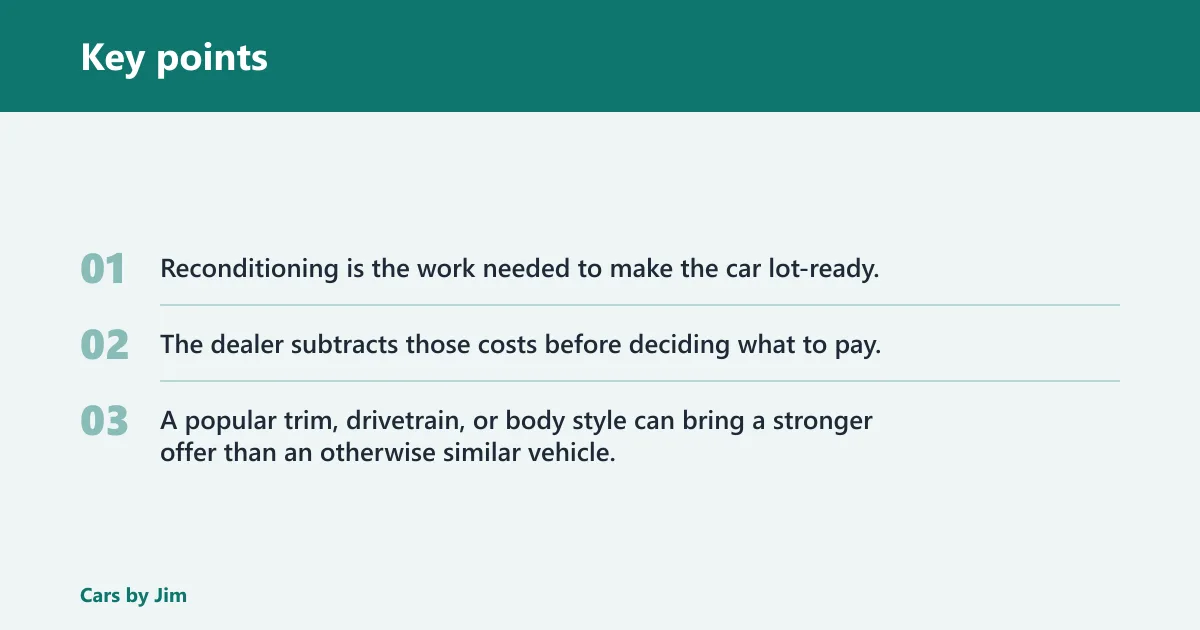
Reconditioning is the work needed to make the car lot-ready. That can include detailing, tire replacement, brake work, bulb replacement, scan-tool diagnosis, a safety inspection, small body repairs, and title or disclosure cleanup. The dealer subtracts those costs before deciding what to pay.
Why local demand can move the number
A popular trim, drivetrain, or body style can bring a stronger offer than an otherwise similar vehicle. Season matters too. A four-wheel-drive SUV may draw more interest before winter, while a fuel-efficient sedan may hold up better when gas prices are high and local lots are thin on inventory.
What lowers trade-in value most?
The biggest hits usually come from mileage, mechanical problems, accident history, and visible wear that signals extra reconditioning cost. A clean car with high mileage can still be worth more than a lower-mileage car that needs tires, brakes, and warning-light diagnosis.
Mileage and age
Higher-than-average mileage lowers value because it raises the odds of wear and future repairs. As a rough benchmark, many drivers average about 12,000 to 15,000 miles a year in the U.S.; a car far above that for its age usually gets a smaller offer. The odometer reading must also be accurate and disclosed.
Mechanical problems and warning lights
A warning light can reduce the offer more than the cost of the part itself, because the dealer has to diagnose the cause and confirm the fix. A check engine light, ABS light, airbag light, or transmission fault can turn a simple issue into a larger reconditioning bill.
Cosmetic wear and accident history
Scrapes, dents, torn seats, cracked glass, burned-out lights, and heavy curb rash chip away at value because buyers notice them fast. Accident history can reduce value even after repair, especially if records show frame damage, structural damage, airbag deployment, or unclear repair paperwork.
Say your compact SUV has 98,000 miles and a worn set of tires with 3/32 inch of tread left. If the dealer also finds a windshield chip and a dashboard warning light, the offer usually falls because three separate items now add labor, parts, and risk.
How dealers calculate trade-in value

Dealers do not use one magic number. They inspect the vehicle, check history reports and title records, compare it with book values, and adjust for local demand and estimated reconditioning. That process explains why book value is a range, not a fixed offer.
Condition inspection and test drive
The walk-around and test drive show whether the car pulls, shakes, idles roughly, leaks fluid, or has brake noise, tire wear, or body damage. A dealer is looking for the cost to make it safe, presentable, and saleable, not just whether the car starts.
History reports and title records
Accident records, odometer issues, title brands, and service history can all change the offer. A strong maintenance file can help, but it does not erase a frame repair, airbag deployment, or a branded title.
Book values and market data
Kelley Blue Book, Black Book, and J.D. Power or NADA-style references are commonly used to give estimate ranges. They are starting points, not promises. Actual Cash Value, or ACV, is a market reference used by insurers and dealers; it is closer to a ceiling reference for trade discussions than a retail sticker replacement.
| Issue | Likely impact on offer | Worth fixing before appraisal? | Accept / fix / sell privately |
|---|---|---|---|
| Tires at 3/32 to 4/32 inch tread | Lower offer because replacement cost is visible and immediate | Often yes, if a used set or a modest tire purchase closes most of the gap | A common rule of thumb is to fix the repair only if it costs less than about half the offer gap; otherwise accept the offer or compare a private-party sale. |
| Brake pads near wear limit | Lower offer for safety and lot-ready work | Yes, if pads and rotors are inexpensive relative to the discount | Fix if braking noise or thin pads are the main issue; sell privately if the car has several costly faults |
| Windshield chips or cracks | Moderate to strong reduction, especially if the crack is in the driver’s line of sight | Usually yes for a simple chip repair; no for a major crack if the quote is high | Fix if the repair is cheap; accept if the dealer’s discount is close to the repair cost |
| Warning lights | Often a strong reduction because diagnosis is uncertain | Sometimes, if the cause is known and the repair is modest | Fix if a scan shows a small sensor issue; otherwise accept or get multiple quotes |
| Accident record with structural repairs | Can reduce value materially and permanently | Usually no, because past damage remains on the record | Accept or sell privately only if the market for that model stays strong |
| Mileage far above average for age | Consistent downward pressure on value | No, mileage cannot be repaired | Accept if the car is otherwise clean; private sale may help only if the model is in demand |
| Cosmetic wear such as dents, stains, and curb rash | Usually a moderate reduction | Sometimes, if cheap cleaning or touch-up makes a visible difference | Fix small items, accept larger wear, and compare against private-party pricing |
Should you fix it before trading it in?
Fixing the right item can raise the offer, but only when the repair costs less than the discount the dealer is likely to apply. Small, visible issues are often worth addressing. Large mechanical repairs, accident history, or worn-out major components usually are not.
Worth fixing before appraisal
Minor repairs that are cheap and obvious often make sense: a windshield chip, a dead bulb, a loose trim piece, or a basic detail. If a $75 repair closes a $300 gap, the math is favorable. If the repair is $900 and the offer moves only a little, skip it.
Usually not worth fixing
Engine work, transmission repairs, airbag faults, and frame-related issues rarely pay back dollar for dollar in a trade. Dealers price in risk. They will still discount for age, mileage, and demand even after an expensive repair.
When private-party sale may pay more
A well-kept older car, a popular truck, or a vehicle with no major mechanical problems may bring more from a private buyer. That route takes more time and effort, and it is not always worth it. It makes the most sense when the dealer gap is large and the car is easy to present cleanly.
Suppose a sedan needs about $420 in tires, but the dealer’s offer is about $1,100 below similar local listings. Fixing the tires may still leave the car worth more in a private sale than in a trade, but only if the rest of the car is solid and the buyer market is active.
Should you get more than one quote?
Yes. Multiple dealer quotes are one of the simplest ways to find out whether the first offer is low because of your car, that dealer’s inventory, or both. Ask each dealer to value the trade separately from the new-car purchase price so you can compare the offer on its own.
Separate the trade from the purchase price
When the trade and the new-car discount are bundled together, it is hard to tell what the dealer is really paying for your vehicle. Get a written trade figure and a separate purchase quote. That lets you compare apples to apples.
Compare written offers
A written offer gives you something concrete to take to another store. If one dealer is higher, another may match it or explain why it cannot. The best comparison is the same car, same condition disclosure, same accessories, and the same payoff information.
Use competing quotes to negotiate
Bring the higher written offer to the next dealer and ask whether it can do better. Keep the discussion focused on the trade, not the monthly payment. A lower monthly payment can hide a weaker trade number.
-
Gather the car’s facts.
Write down mileage, trim, drivetrain, options, accident history, title status, and any warning lights or repairs needed. Dealers price with these details in mind, so accurate disclosure prevents a false comparison.
-
Request separate quotes.
Ask for the trade-in number in writing and keep the purchase price separate. This makes it easier to compare offers from different dealers without mixing the new-car deal into the trade figure.
-
Compare the net result.
Check the trade offer, the payoff balance, and any sales tax savings side by side. A lower offer can still be acceptable if the full deal is better, but the gross trade number should still be clear.
-
Use the best offer.
Share the strongest written quote with the next dealer and ask for a direct response. If the gap stays large after two or three quotes, the issue is probably the car’s condition or market demand, not just one store’s policy.
Negative equity and sales tax
Negative equity changes what you owe after the trade, but it does not change the gross trade-in offer itself. If the loan balance is higher than the vehicle’s value, the shortfall can be paid off, rolled into the next loan, or handled with cash. Sales tax savings can offset part of a lower offer, but they do not guarantee a better deal.
How loan payoff changes your net result
If you owe more than the dealer offers, the difference is negative equity. That gap can shrink your down payment or raise the next loan amount. The key is to separate the trade value from the payoff math so you know which number is actually low.
When tax savings offset a low offer
Many states tax only the price difference after the trade, so the tax savings can partly offset a weak offer. The effect depends on local rules and the deal structure. Do the math on the full transaction, not just the headline trade number, before deciding.
Frequently asked questions
Why is my trade in value so low?
Your offer is low because the dealer is pricing in condition, reconditioning cost, and current demand, not retail asking price. Mileage, age, accident history, and visible wear all push the number down. If repairs are cheap relative to the gap, fixing them can improve the result.
Why is the trade in value so low?
Trade-in value is usually lower than private-party value because the dealer must resell the car, inspect it, repair it, and make a profit. Book values are only ranges, so the actual offer can vary by market, trim, drivetrain, and local inventory.
Why is my car trade in value so low?
Your car may be discounted for high mileage, warning lights, body damage, tire wear, brake wear, or accident records. A dealer also prices in the time and money needed to make the vehicle lot-ready. That is why two similar cars can bring very different offers.
Should I fix my car before trading it in?
Fix cheap, visible problems if the repair cost is much smaller than the likely discount. Skip expensive mechanical work, frame issues, or long repair lists that the dealer will still price cautiously. A repair is worth it only when it closes most of the gap.
Should I get trade-in quotes from more than one dealer?
Yes. One quote can be low because of that dealer’s stock needs or inspection assumptions. Two or three written offers give you a cleaner read on the market and give you room to push for a better trade when it is negotiated separately from the purchase price.
Do sales tax savings make a trade-in worth more?
Sales tax savings can improve the net deal, but they do not automatically erase a low trade offer. The benefit depends on state rules and the deal structure. Compare the trade value, payoff balance, and tax savings together before deciding.