Is It Safe to Buy or Drive a Flood Damaged Car?
No—treat a flood-damaged car as unsafe to buy, and drive it only after a documented inspection shows water never reached electronics, airbags, bearings, or corrosion-prone connectors. A car can start, roll, and still carry failures that show up later. This guide separates short-term drivability from long-term risk so you can decide when to walk away.
When a flood-damaged car is too risky
Usually no, unless the seller fully discloses the damage and a specialist inspection confirms the car is repairable and roadworthy. A flood-damaged car can look fine, carry a clean title, and still hide water damage in wiring, modules, airbags, and metal parts that corrode after the sale.
What “safe” means for buying versus owning
Buying safety means you are not taking on a vehicle with hidden damage that can fail after the deal closes. Owning safety means the car will remain reliable, legal, and safe to operate over time. Flood damage can break that second condition even when the first one looks acceptable on a quick test drive.
Consumer Reports says water can ruin circuit boards, switch contacts, greases, and mechanical parts. It also warns that problems may take months or years to appear, which makes flood damage different from body damage you can see right away. (Consumerreports)
When caution turns into no
If the car has any sign of water reaching the cabin, underhood fuse boxes, control modules, or wheel bearings, the safer answer is no. That is true even if the engine starts and the transmission moves cleanly. A low purchase price does not cancel hidden electrical and corrosion risk.
Can you safely drive a flood-damaged car?
Sometimes only for short emergency use, and only if the car has already been inspected and the flood exposure appears limited. A vehicle can drive today and still be unsafe because water-damaged sensors, wiring, or brake components may fail without warning later.
What a car can do today and still fail later
Immediate drivability is a narrow question. Can it move under its own power? Maybe. Is it trustworthy for daily use, highway trips, or family transport? That is a different question, and flood damage often makes the answer no.
Modern cars rely on modules, sensors, and wiring harnesses spread through the cabin and under the floor. Moisture can corrode connectors, weaken terminals, and create intermittent faults that show up only after heat cycles, vibration, and time.
When emergency-only driving may be the limit
If the car must be moved, keep it to the shortest practical trip to a repair facility or storage location. Avoid deep rain, standing water, and long highway use. Any airbag warning light, brake warning light, or intermittent electrical issue should end the drive.
Say your sedan starts after sitting overnight and rolls normally around a parking lot, but the infotainment screen reboots every few minutes and the carpet feels damp under the rear seat. That car is not a good daily driver. It is a warning sign with wheels.
How flood damage turns into hidden failure
Flood damage is dangerous because the visible mess is often the smallest problem. Water can leave behind corrosion, contamination, and electrical weakness in places you cannot inspect without removing trim, panels, or parts of the interior.
Electrical modules, sensors, and wiring
Floodwater can reach control units, seat electronics, door modules, ABS components, and wiring connectors. Even after drying, corrosion can spread inside terminals and cause random faults later. Those faults may be hard to trace and expensive to fix.
Airbags, seat belts, and safety systems
Airbag systems depend on sensors, control modules, and pyrotechnic components that are not meant to sit in contaminated water. Seat-belt pretensioners can also be affected. A flood-damaged safety system may not fail every time, which is exactly what makes it risky.
Corrosion, fluids, and mechanical wear
Water can mix with fluids, contaminate bearings, and corrode brake parts, suspension hardware, and electrical grounds. The same source notes that totaled flood cars are supposed to get a salvage title, but the title does not remove the mechanical uncertainty built into the car.
Flood car decision matrix
This matrix gives the buyer decision rule. Use the strongest signal you find, not the weakest. If more than one row applies, choose the more cautious action.
| Signal | Immediate drivability | Likely hidden risk | Recommended decision |
|---|---|---|---|
| Light evidence of past water exposure, no cabin smell, no electrical faults, full disclosure, and a clean specialist inspection | May drive normally today | Moderate risk of delayed corrosion or sensor issues | Buy only with full disclosure and specialist inspection |
| Flood branding on the title, but the car has been repaired and reinspected | May be road-legal and drivable | Residual risk remains in wiring, modules, and corrosion points | Buy only with full disclosure and specialist inspection |
| Car starts, moves, and looks normal, but history is unclear or incomplete | Often drivable for short trips | Hidden flood risk may be missed by a quick look-over | Buy only with full disclosure and specialist inspection |
| Strong musty odor, damp carpet, or mold plus any electrical oddity | May still move | High risk of module, wiring, and safety-system failure | Walk away |
| Mud or sand under seats or dashboard, rust around doors, or mismatched carpet | Drivability may be normal for now | Very high likelihood of interior water intrusion | Walk away |
| Unreported flood story, out-of-state sale, or title-washing clues with no repair proof | Unknown | High risk that damage history has been hidden | Walk away |
| Need to move the car briefly before a proper inspection | Possible short-term only | Risk still unknown | Drive only short-term for emergency use |
Do titles tell the whole story?
No. Title branding helps, but it does not tell you everything about flood exposure. A flood-damaged car may carry a salvage title, a rebuilt title, or even a clean title after title washing or incomplete reporting. The paperwork is useful. It is not enough on its own.
Salvage title vs. rebuilt title
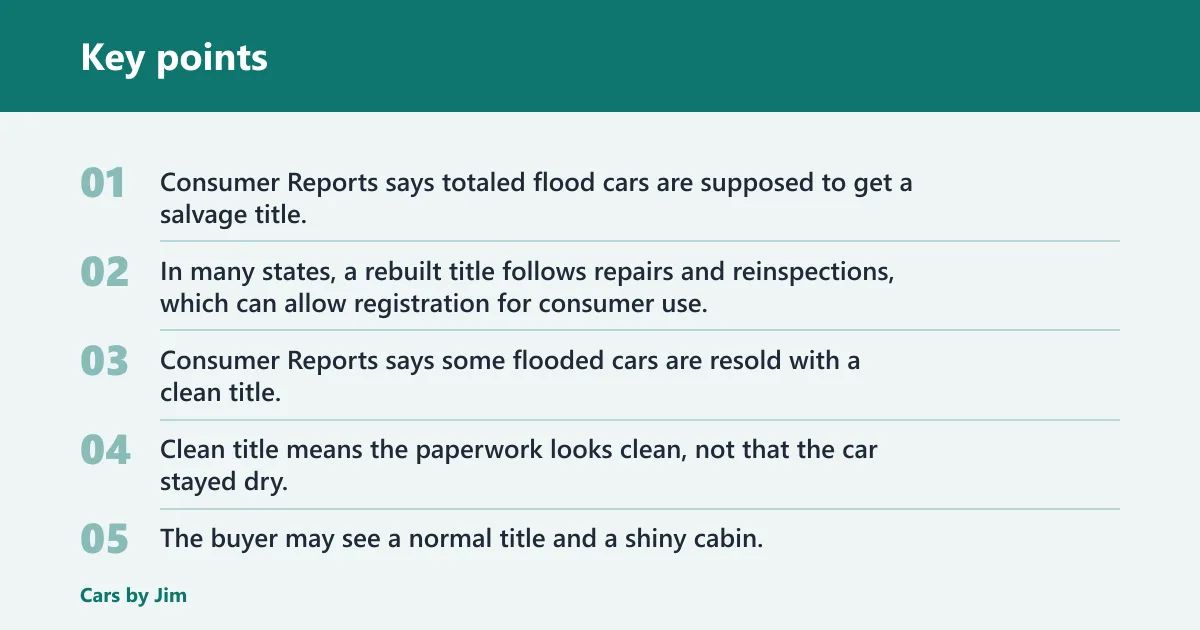
The same source says totaled flood cars are supposed to get a salvage title. In many states, a rebuilt title follows repairs and reinspections, which can allow registration for consumer use. That does not guarantee the car is free of hidden damage; it only means the vehicle passed the state’s required steps.
Why clean title does not rule out flood damage
The same source says some flooded cars are resold with a clean title. That can happen when records are incomplete, the vehicle is moved, or the branding never follows the car across state lines. Clean title means the paperwork looks clean, not that the car stayed dry.
Suppose a pickup is flooded in one state, cleaned up, and sold several hundred miles away with fresh plates and no obvious stain. The buyer may see a normal title and a shiny cabin. The wiring under the carpet can still be damaged.
How title washing hides the trail
Title washing can hide salvage or flood branding by moving a vehicle through different jurisdictions, which may make the record look less concerning. The same source notes this risk directly. That is why paperwork checks should support, not replace, a physical inspection.
How to check history and inspect the car
Use documents first, then inspection, then a yes-or-no decision. Vehicle history reports can reveal title branding, salvage history, mileage issues, and ownership changes, but they can miss unreported or title-washed flood damage. That means history checks are necessary, not conclusive.
Vehicle history report and NMVTIS
The FTC recommends getting a vehicle history report from vehiclehistory.gov. Use the National Motor Vehicle Title Information System, or NMVTIS, as a government-approved title-history resource to help spot title washing. Compare the title record with the seller’s story and the car’s physical condition.
Carfax flood damage check
The same source notes Carfax offers a free flood damage check. Use it as one clue, especially when the car may have been registered in or moved from a storm area. A result that suggests flood possibility is a reason to inspect harder, not a final verdict by itself.
Independent mechanic inspection
The FTC says an independent mechanic can inspect for water damage. That inspection matters because flood signs hide under carpets, trim, seats, dash panels, and underhood covers. An independent mechanic can look for contamination, corrosion, and electrical faults that a casual buyer may miss.
Check the title history. Look for salvage, rebuilt, or flood branding, then compare it with the seller’s explanation. If the story changes, stop there and treat the car as higher risk.
Run a history report. Use vehiclehistory.gov and a separate vehicle-history report if available. Review salvage entries, ownership changes, and mileage issues together, because one clean-looking record can still miss a washed title.
Inspect the interior closely. Check for mud or sand under seats or dashboard, rust around doors, loose, stained, or mismatched carpet, and mold, decay, or strong cleaning-product odors. The FTC says signs may include mud or sand under seats or the dashboard, rust around doors, loose, stained, or mismatched carpet, and mold, decay, or strong cleaning-product odors.
Look for electrical oddities. Test windows, locks, gauges, lights, infotainment, and warning lamps. Intermittent behavior matters more than one failed feature, because moisture often creates faults that come and go.
Pay for a specialist inspection. Ask an independent mechanic to check under carpets, in connectors, around fuse boxes, and beneath the car for corrosion or trapped silt. If the seller refuses, treat that refusal as a serious warning.
What should make you walk away?
Walk away if the car has visible flood warning signs, unclear paperwork, or any sign that the seller is hiding the vehicle’s past. If the repair cost, inspection cost, and future risk do not fit the price, the deal is wrong even when the car starts and idles normally.
Visible flood warning signs
The FTC warns buyers to check for mud or sand under seats or dashboard, rust around doors, loose, stained, or mismatched carpet, and mold, decay, or strong cleaning-product odors. Any one of these deserves caution. Several together usually mean the car should be rejected.
When the numbers do not work
A low price does not rescue a bad vehicle. If a flood-damaged car needs electrical repair, interior replacement, corrosion cleanup, and module work, the bill can outrun the discount fast. That is why the decision should be based on risk, not sticker price.
Frequently asked questions
Is it safe to buy a flood damaged car?
Usually no. A flood-damaged car can appear normal while hiding electrical, safety, and corrosion problems that surface later. Buy only if the seller fully discloses the damage and an independent mechanic confirms the car is repairable, roadworthy, and free of water intrusion in critical systems.
How long does it take flood damage problems to show up?
Some problems show up right away, but many do not. The same source says flood-related failures may take months or years to appear. Heat, vibration, and moisture can slowly damage connectors, modules, and corrosion-prone parts, which is why a car can seem fine long after the flood.
Will a flood-damaged car always have a salvage title?
No. The same source says totaled flood cars are supposed to get a salvage title, but some flooded cars are later resold with a clean title. That is why paperwork alone is not enough. A title can be missing branding, while the car still carries flood damage underneath.
Can a flood-damaged car look fine but still be unsafe?
Yes. Water can hide under carpets, in connectors, inside modules, and around safety systems where a quick inspection will not reach. A car may start, run, and present well while still carrying delayed electrical failure or corrosion that makes ownership unsafe later.
Should I pay a mechanic to inspect a flood-damaged used car?
Yes. The FTC recommends an independent mechanic inspection, and that is especially important with flood risk. A specialist can look for water under trim, rust in hidden places, contaminated connectors, and signs that the car has been cleaned up after flooding. That money is small compared with a bad purchase.