KBB vs NADA: Which Used Car Value Is Better to Trust?
Neither guide is universally more accurate. Use KBB for consumer market context, and use what most people still call “NADA values” as the dealer-side benchmark now associated with J.D. Power’s consumer vehicle values. Use the figure that matches your sale channel and local comparable listings. Condition, mileage, trim, and options can shift either guide’s number significantly. Local market conditions can widen or shrink the gap between KBB and NADA. Relying on the wrong figure can leave money on the table in a sale or set an asking price that sits too high for the market. This guide explains how KBB and NADA differ, when each is useful, and how to pick a number you can defend.
| Decision factor | KBB | NADA | Winner |
|---|---|---|---|
| Consumer shopping context | Retail, private-party, and trade-in value types are built for shoppers and sellers comparing a used car against the market. | Consumer vehicle values include trade-in and book values, with a flow that also shows ratings, specs, and photos. | KBB |
| Dealer benchmarking | Useful as a reference, but it is still a consumer pricing guide. | Built to serve franchised dealers, so it is closer to a dealer-oriented benchmark. | NADA |
| Trade-in negotiation | Often helps set a realistic floor for a dealer offer. | Often tracks the dealer side of the deal more closely. | NADA |
| Private sale pricing | Private-party value is one of its main use cases. | Useful for reference, but less centered on person-to-person pricing. | KBB |
| Retail asking price context | Retail value shows what a dealer may ask, not what a seller receives. | Also useful as a book-value reference, but it is not the same as a seller payout. | Tie |
| Why spreads happen | Condition, mileage, trim, location, and options can move its numbers a lot. | Trade-in, book value, and dealer-focused inputs can also shift the result. | Tie |
Is KBB or NADA more accurate for used car value?
Neither guide is universally more accurate. KBB usually fits consumer shopping and selling better, while NADA fits dealer benchmarking better, especially for trade-in decisions. The right number is the one that matches your sale channel, your vehicle’s condition and mileage, and local comparable listings or dealer offers.
When KBB tends to fit consumer shopping
KBB is often a useful starting point when you want a market-facing range for retail, private-party, or trade-in value. Its three value types make it easier to compare what a dealer asks, what a private buyer might pay, and what a trade offer may land on.
That makes it useful when you are deciding whether a listing price is too high, too low, or about right. It also helps when the vehicle has normal wear, a standard trim, and no unusual history.
When NADA tends to fit dealer benchmarking
NADA was built to serve franchised new-car and -truck dealers, and its dealer focus still shapes how many shoppers use the values today. What readers often call “NADA values” are now found through J.D. Power’s consumer vehicle values flow, which is aimed at dealer-oriented benchmarking.
That dealer focus matters because a trade offer is shaped by reconditioning cost, auction wholesale pricing, and profit margin. If you are negotiating with a dealer, NADA is often the better benchmark for that channel.
Why do KBB and NADA show different values for the same car?
They can differ because they are not aiming at the same transaction. KBB often centers the consumer side of the market, while NADA leans toward dealer benchmarking. The gap also comes from condition, mileage, trim, options, and local supply and demand.
Trade-in value versus private-party value
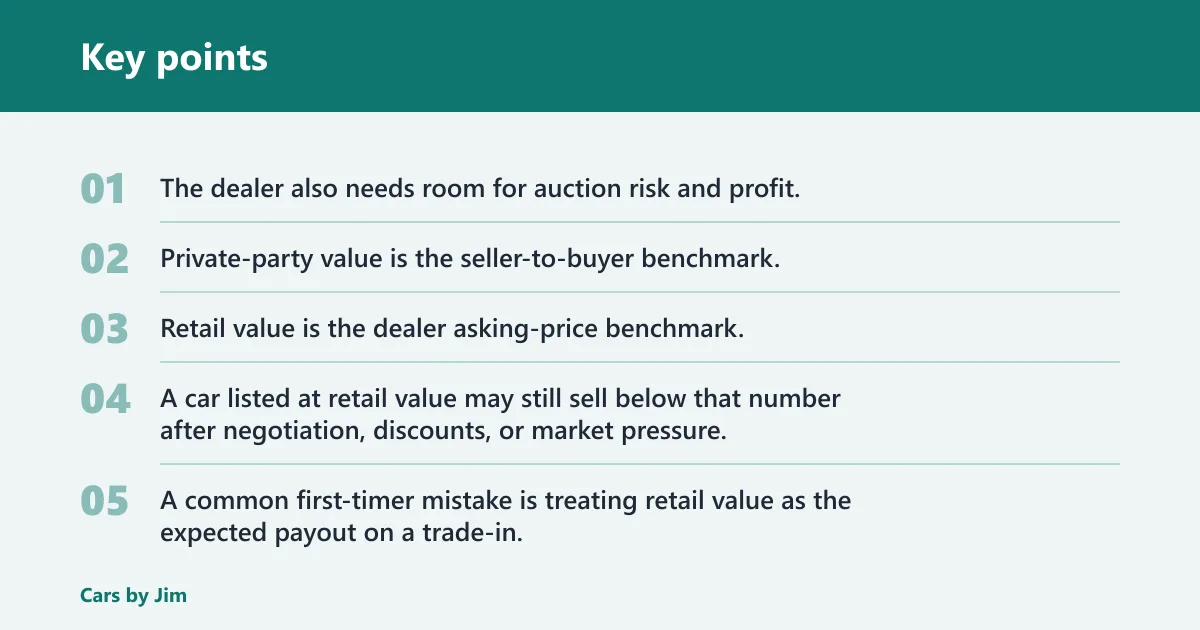
Trade-in value is usually lower than private-party value because the dealer has to inspect, recondition, store, and resell the car. The dealer also needs room for auction risk and profit. That is why a trade-in number should be treated as a dealer-offer benchmark, not a retail target.
Private-party value is the seller-to-buyer benchmark. It is usually higher than trade-in because the buyer is paying directly for the car, not for dealer overhead and reconditioning.
Retail value, dealer overhead, and profit
Retail value is the dealer asking-price benchmark. It includes overhead, reconditioning, and profit, so it is not what a seller receives. A car listed at retail value may still sell below that number after negotiation, discounts, or market pressure.
A common first-timer mistake is treating retail value as the expected payout on a trade-in. That usually overstates the amount you can actually receive.
Condition, mileage, trim, and options
Condition has a major effect on both guides. Poor-to-excellent grading changes value through body damage, mechanical issues, cosmetic wear, and maintenance history. A clean car with normal wear and complete service records will usually score higher than the same model with damaged paint, warning lights, or interior wear.
Mileage matters just as much. Below-average mileage can support a higher value, while above-average mileage usually pushes it down, especially on older cars. Trim and options matter too; a higher trim or factory package can change the price materially, while a base model often lands lower even if the year and mileage match.
Local market and VIN-based decoding
Local market conditions can move the spread between KBB and NADA. Regional supply, seasonal demand, and fuel-type preferences all affect what dealers and buyers will pay. A pickup in a rural area may price differently than the same truck in a dense city, and a hybrid may draw stronger interest in one market than another.
VIN-based valuation is the best way to reduce guessing on exact trim and options. A VIN helps decode factory equipment, which improves pricing accuracy versus a generic year-make-model lookup. If the guide does not know the exact package, the estimate can drift fast.
Which used car value is better for your sale channel?
The better value depends on how the car will change hands. For trade-in, focus on dealer-side benchmarks and compare several figures against local market conditions. For private sale, use the guide that better reflects what a buyer in your local market will actually pay.
Trade-in
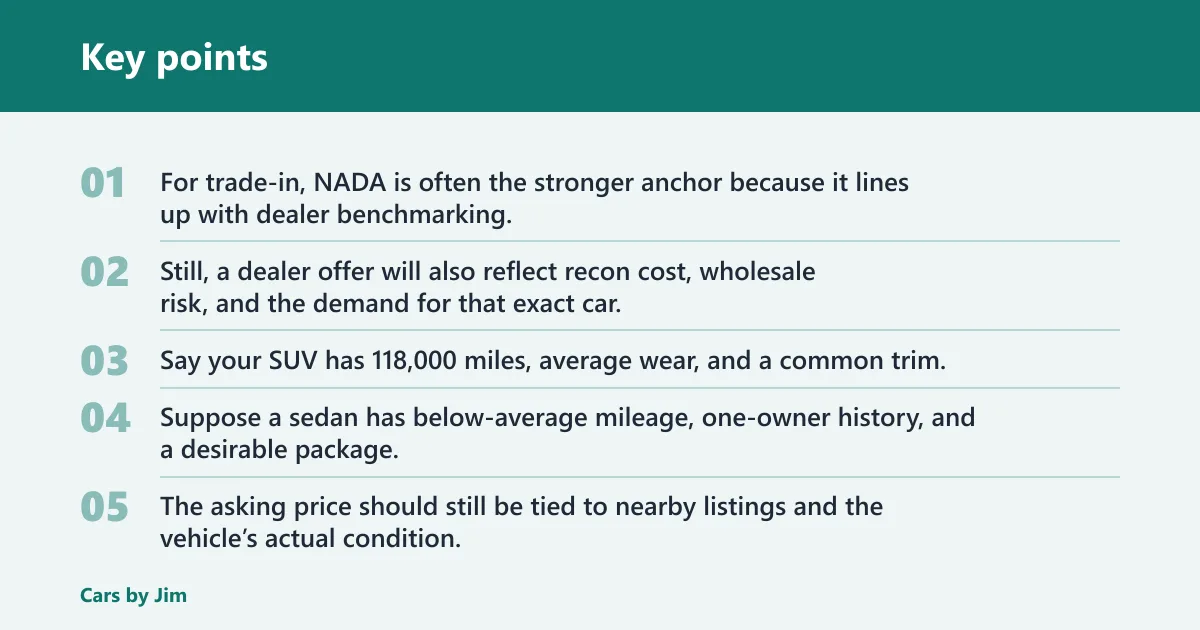
For trade-in, NADA is often the stronger anchor because it lines up with dealer benchmarking. Still, a dealer offer will also reflect recon cost, wholesale risk, and the demand for that exact car. If KBB and NADA disagree, use the figure that best matches the dealership’s channel and the car’s local demand, rather than defaulting to the highest number.
Say your SUV has 118,000 miles, average wear, and a common trim. Even if the guides disagree, the dealer may still lean toward the lower figure after accounting for tires, brakes, and cleanup.
Private sale
For private sale, KBB is often a useful starting point because its private-party value is intended for seller-to-buyer pricing. That said, you should still check comparable local listings, because one strong or weak market can move the real sale price above or below the book value.
Suppose a sedan has below-average mileage, one-owner history, and a desirable package. The asking price should still be tied to nearby listings and the vehicle’s actual condition.
Dealer retail comparison
For dealer retail, use the retail value as a comparison point, not as a promise of your sale price. Retail shows what a dealer may ask after recon and markup. If you are shopping, compare asking prices against both KBB and NADA, then adjust for mileage, condition, and equipment.
If the dealer’s asking price is close to the guide’s retail figure, that can be normal. If the car is rough, high-mileage, or missing options, the asking price should usually come down.
Insurance-like reference
For an insurance-like reference, use the higher benchmark only as a rough replacement-cost comparison, not as a direct payout number. Actual cash value, replacement cost, and insurer valuation methods are different, so a guide number is only a starting point for understanding what a comparable vehicle might cost. Policy language and the vehicle’s condition still control the settlement.
Choose KBB if you need consumer pricing; choose NADA if you need dealer benchmarking
Choose KBB when you want a consumer-facing market range for retail, private-party, or trade-in value. Choose NADA when you need a dealer-oriented book value, especially for trade-in talks. If you are deciding what to ask or what to accept, anchor the final number to the sale channel, then check local comps.
Trust KBB when you want a consumer-facing market range
KBB fits best when you are comparing a car against what shoppers see on the open market. Its retail, private-party, and trade-in labels make it easier to match the value to the transaction you actually want. That matters more than picking the highest number on the page.
Trust NADA when you want a dealer-oriented book value
NADA fits best when the decision is tied to dealer behavior. Its consumer vehicle values page offers used car book values and trade-in values, and it includes ratings, specs, and photos in the consumer flow. NADA also says that flow redirects users to a third-party website that is not affiliated with or controlled by NADA, and that it is not responsible for the external site’s content, security, or privacy practices.
NADA also provides a customer service phone number on the page. That makes it useful as a structured reference, but it still needs a reality check against the local market.
Use the lower benchmark for trade-in decisions
When you are trading in, the lower benchmark is usually the safer negotiating floor. It leaves room for recon costs, auction wholesale pricing, and dealer profit. If your goal is a quick sale to a dealer, do not start with the higher retail figure.
Use the higher benchmark only for retail comparisons
The higher benchmark belongs in retail comparisons, not in trade-in math. It helps you judge whether a dealer’s asking price is inflated or reasonable, but it should not be treated as the money you will receive. For a seller, that distinction is the whole point.
How to reconcile a wide spread
If KBB and NADA disagree a lot, do not pick the highest figure by default. A wide spread usually means one of the inputs is off, or the car sits in a market where one guide is reacting faster than the other. Recheck the VIN, condition, mileage, trim, and local comps before you trust either number.
Decode the VIN. Confirm the exact trim, drivetrain, and factory options before you compare values. A small equipment difference can move the price more than a casual look suggests.
Grade condition honestly. Score body, mechanical, and cosmetic condition from poor to excellent. One dented panel or one warning light can change the number more than a clean interior will.
Compare mileage to age. Check whether the vehicle is below-average or above-average mileage for its age and trim. Heavy use usually depresses value, but a rare trim can hold more of it than a base model.
Match the sale channel. Use trade-in numbers for dealer offers, private-party numbers for direct sales, and retail numbers for shopping comparisons. Do not mix channels, or the spread will look larger than it really is.
Check local comps. Compare nearby listings, recent sold examples where available, and the type of buyers in your area. If the local market is weak for your fuel type, body style, or mileage band, trust the lower end of the range.
Small, moderate, and large spreads
Use a simple rule: a small spread means the guides are close enough that local comps and condition should decide the final number; a moderate spread means you should verify the guide that best matches your channel before acting; a large spread means you should recheck the inputs and treat the lower end with caution until the car is fully decoded.
- Small spread. The guides are close enough that your local market and condition should settle the final price.
- Moderate spread. Use the guide that matches the sale channel, then compare three or four local comps.
- Large spread. Recheck VIN decoding, mileage, and condition first; then assume the lower number for trade-in and the higher number only for retail comparison.
Edge cases that move values faster
High-mileage vehicles often need a heavier adjustment than the guides imply at a glance. Modified cars can be harder to price because non-factory parts may help one buyer and repel another. Salvage-title vehicles and very old vehicles often need a local-comps approach first, because guide data can be thin and the market can be narrow.
For those edge cases, the guide is a starting point, not the final answer. The sale channel, title status, and actual buyer pool matter more than the printed number.
Frequently asked questions
Should I trust KBB trade-in or NADA trade-in value?
For a dealer trade, NADA is often the better benchmark because it tracks dealer behavior more closely. That said, a real offer still depends on recon costs and current demand. If the guides disagree, the lower figure is usually the safer expectation for trade-in planning.
Which used car value is better for private sale?
KBB is usually the better starting point for private sale because its private-party value is built for seller-to-buyer pricing. Use it as a guide, then verify the number against local listings with similar mileage, trim, and condition. The local market can move the final price up or down.
How does NADA get its used car values?
NADA offers consumer vehicle values, including used car book values and trade-in values, and its consumer flow also mentions ratings, specs, and photos. The page redirects users to a third-party website that NADA says is not affiliated with or controlled by NADA, so the displayed number should still be checked against your own vehicle details and market comps.
How do I choose between KBB and NADA when buying a used car?
Use KBB for a consumer-facing market view and NADA for dealer-oriented benchmarking. For a purchase, compare the asking price to both, then adjust for condition, mileage, options, and local supply. If the asking price sits above both guides without a clear reason, push back or walk away.
What should I use if KBB and NADA disagree a lot?
Start by checking the VIN, then verify condition, mileage, trim, and options. If the spread still looks wide, use the lower benchmark for trade-in decisions and the higher benchmark only for retail comparisons. Local comps should be the final tie-breaker, especially on older or unusual vehicles.