Title Problems on a Used Car: What Buyers Should Do
Do not pay until the title, the VIN on the car, and the seller’s legal identity all match; if any one does not, walk away or require a DMV-ready fix first. Miss a lien, brand, or VIN mismatch and you can end up unable to register the car, insure it properly, or prove ownership. This guide lays out the warning signs, which title problems are fixable, and the exact documents and escalation steps to use before money changes hands.
Which title problems should make you stop the deal?
Stop the deal when the seller cannot produce a transferable title, an unreleased lien has no verified payoff path, the VIN does not match across the car and paperwork, or the title looks altered. A branded title is not always fatal, but missing rebuild or loss records turns it into a high-risk purchase.
Missing title or seller cannot produce it
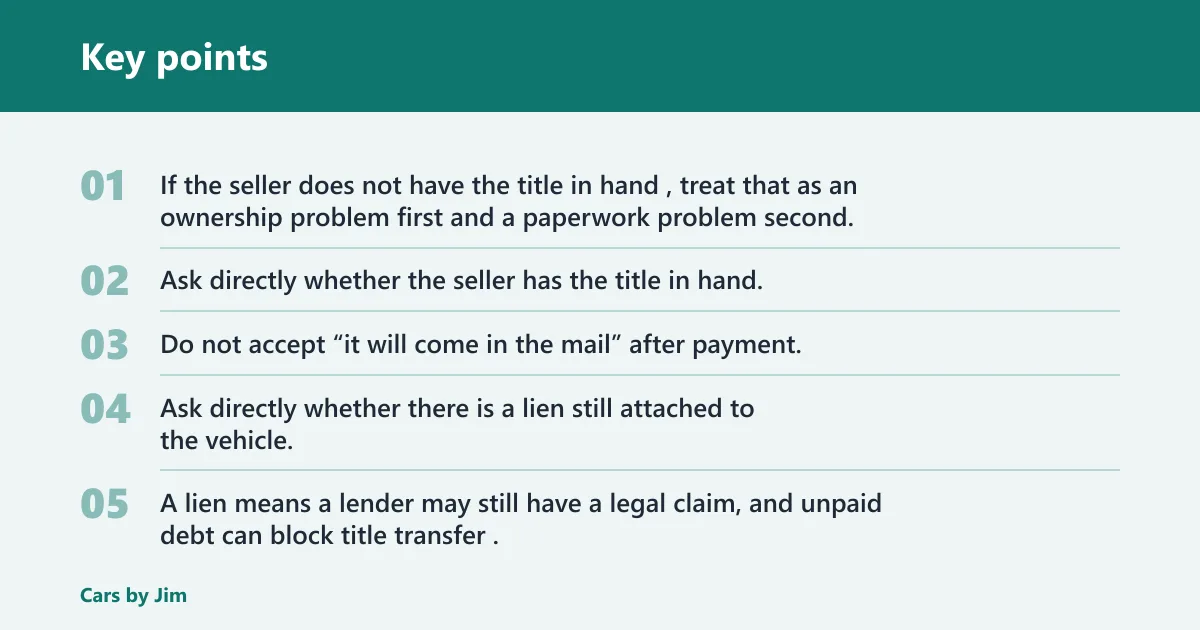
If the seller does not have the title in hand, treat that as an ownership problem first and a paperwork problem second. Ask directly whether the seller has the title in hand. If the answer is no, the seller must explain why, who holds it, and what exact state process will produce a replacement or transferable title before sale.
Do not accept “it will come in the mail” after payment. You should refuse to pay, sign, or take possession until the replacement title is issued or the DMV confirms a transfer method that works in that state.
Open lien with no clear payoff path
Ask directly whether there is a lien still attached to the vehicle. A lien means a lender may still have a legal claim, and unpaid debt can block title transfer. A recorded lien can be workable if the lender provides a payoff letter and a release process tied to payment, but a vague promise from the seller is not enough.
If the lender will not speak, the payoff figure is missing, or the release timing is unclear, walk away.
VIN mismatch, cloning signs, or altered paperwork
The VIN should match on the dashboard, door label, title, registration, bill of sale, and history reports. Any mismatch means the seller, DMV, or lender must fix the record before money changes hands.
A ten-year-old car showing only new history information can indicate VIN cloning. VIN cloning may hide an accident or salvaged title. That is a stop-sign issue, not a bargaining issue.
Branded title with missing rebuild or loss records
Vehicle history reports should show the current title status and prior brand events, including salvage, rebuilt, flood, junk, or lemon-law buyback entries recorded by states, insurers, or salvage yards. If the title says rebuilt but the seller cannot produce repair receipts, inspection paperwork, or photos of the prior damage, you cannot judge whether the car is merely hard to finance or unsafe to own.
Picture a rebuilt pickup with a straight body, fresh paint, and a clean interior. If the undercarriage still shows kinked frame rails and replacement welds with no supporting repair records, the brand matters less than the missing proof. Walk.
How do you check a car title before buying?
Check the title by matching the seller’s ID to the owner name, reviewing whether the title is clear or branded, confirming any lienholder is released, and making sure the assignment section is properly completed. Then compare the VIN on the dashboard tag, driver-door label, title, registration, bill of sale, insurance card if shown, and history report, and confirm your state DMV transfer rules before you pay.
Match the seller, title, and ID
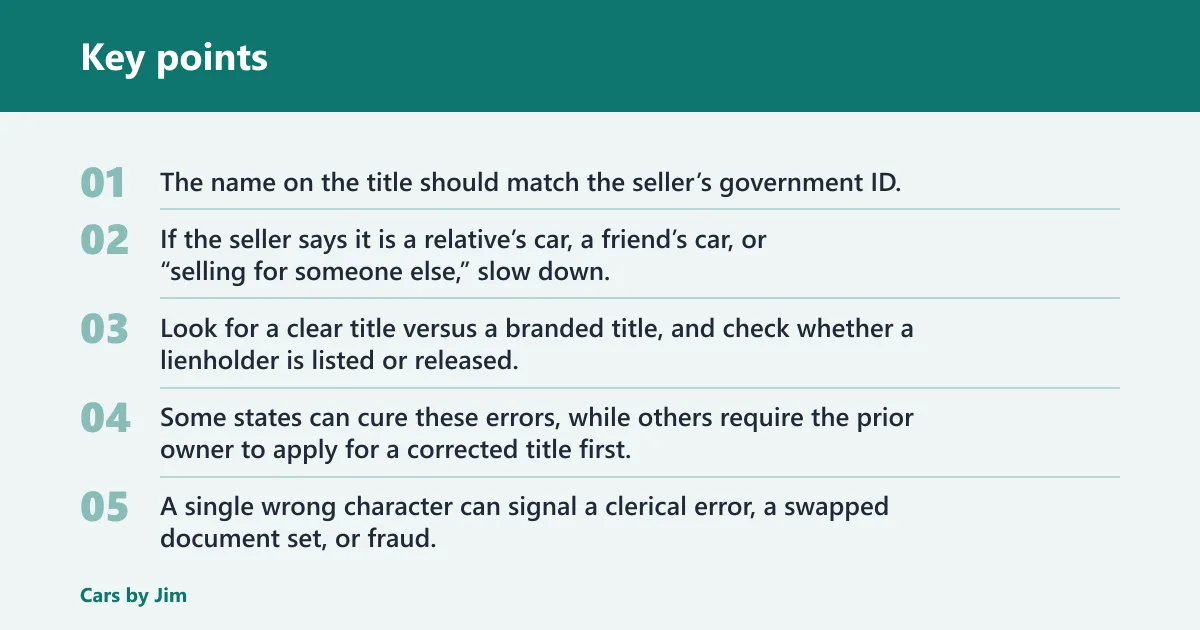
The name on the title should match the seller’s government ID. If a business is selling the car, the business name on the title should match the selling entity on the bill of sale and registration records.
If the seller says it is a relative’s car, a friend’s car, or “selling for someone else,” slow down. Unless that person has legal authority and the paperwork matches, you are dealing with a title defect, not a harmless convenience.
Check title status, assignment, and lien fields
Read the face of the title. Look for a clear title versus a branded title, and check whether a lienholder is listed or released. The assignment area should be completed as your state requires, with no erasures, overwritten names, or skipped buyer lines.
An unsigned title, a title signed in the wrong place, or a title assigned to someone who never transferred it can all block registration. Some states can cure these errors, while others require the prior owner to apply for a corrected title first.
Compare the VIN on the car and every document
Use the VIN as the common thread. Compare the VIN on the dashboard, driver-side door label, title, registration, insurance card if shown, bill of sale, and any service or rebuild records.
If one digit differs, do not assume typo. A single wrong character can signal a clerical error, a swapped document set, or fraud. You need the seller or DMV to reconcile it before purchase.
Confirm state DMV transfer requirements
State transfer rules differ in specific ways that can stop a deal at the counter. Some states require an odometer disclosure on a separate federal or state form, some require notarized seller signatures on the title, some may require emissions or smog paperwork, and some may require rebuilt-vehicle inspection records or lien-release forms before transfer. A title that looks complete can still fail if one state-specific form is missing. (WA)
What does a title brand actually mean?
A title brand tells you that a state recorded a status affecting ownership history or damage disclosure, such as salvage, rebuilt, flood, or lemon-law buyback. That does not always make the car unsellable, but it usually changes financing, insurance, resale value, and the documents you need before buying.
Salvage and rebuilt
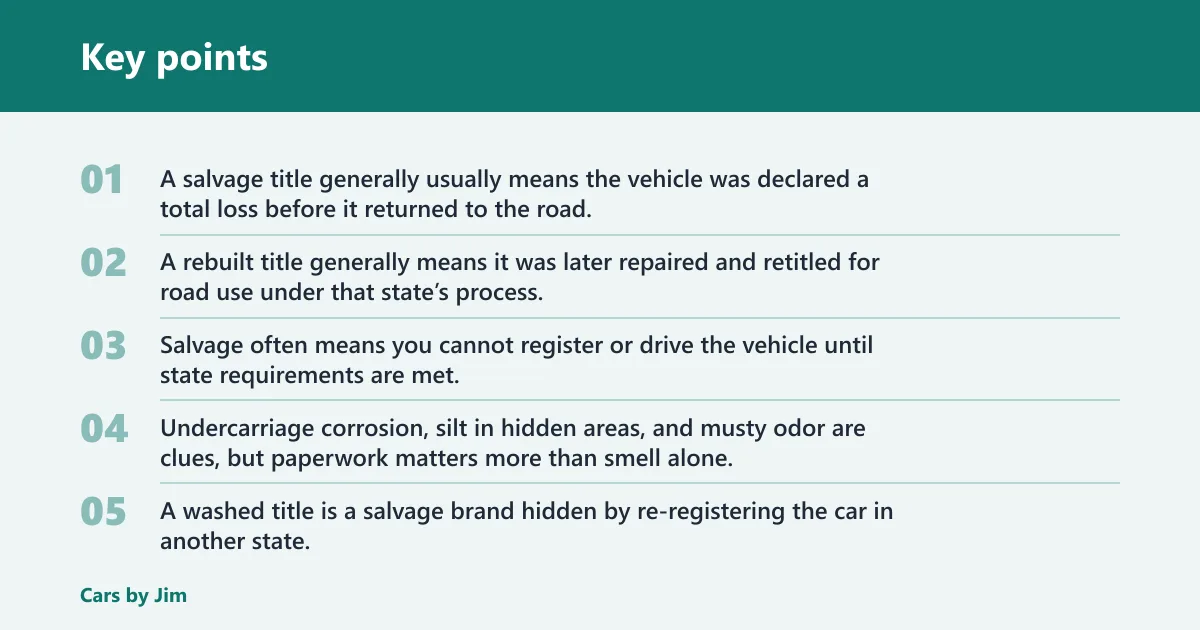
A salvage title generally usually means the vehicle was declared a total loss before it returned to the road. A rebuilt title generally means it was later repaired and retitled for road use under that state’s process.
Those are very different buying situations. Salvage often means you cannot register or drive the vehicle until state requirements are met. Rebuilt means you still need proof of the repair path and a careful inspection for structural or airbag-related shortcuts.
Flood and other damage brands
Flood branding deserves extra skepticism because water damage can affect wiring, connectors, restraints, and control modules long after cosmetic cleanup. Undercarriage corrosion, silt in hidden areas, and musty odor are clues, but paperwork matters more than smell alone.
A washed title is a salvage brand hidden by re-registering the car in another state. That is why the title itself, the history report, and federal title-brand data all need to agree.
Lemon-law buyback and similar disclosure brands
Lemon-law buyback and similar manufacturer-disclosure brands do not always mean crash damage. They do mean the car carries a recorded consumer-history issue that many future buyers, lenders, and insurers will treat with caution.
How brands affect financing, insurance, and resale
A branded title can cut resale value by 20–40%. The hit varies by brand type, repair quality, insurer appetite, and local demand, but the direction is the same: fewer buyers, more lender hesitation, and more questions at trade-in time.
Say your lender approves clean-title compact cars from a private seller but will not finance rebuilt-title cars over a certain age. Even if the repair work looks solid, the brand can turn a normal purchase into a cash-only transaction with thinner insurance options.
Can you buy a used car with a lien on it?
You can buy a used car with a lien on it only when the payoff amount, payment path, and lien-release process are documented before sale. The lender or seller must clear the debt and produce release paperwork that lets the DMV transfer title without delay or guesswork.
When an existing loan can be paid off safely
A lien sale is most manageable when the lender provides a current payoff letter, identifies where funds must go, and confirms how the lien release or title will be issued after payoff. That keeps the debt and the title tied to one verified process.
If the seller wants full payment first and promises to clear the lien later, you are taking on someone else’s debt risk.
Documents to require from the lender and seller
- Current payoff letter with the account identified to the lender
- Written lien-release process or lender letter stating how release will be issued
- Copy of the current title or state title record showing the lienholder
- Seller ID matching the title owner name
- Registration matching the vehicle and VIN
- Bill of sale prepared with exact VIN, sale price, date, and both parties
Red flags in private-party lien sales
Red flags include a seller who cannot name the lender, an expired payoff letter, a title copy that omits the lien while the history report shows one, or pressure to wire money to the seller instead of the lender. Those are reasons to stop.
How do you verify the VIN and title history?
Verify the VIN by matching the number on the vehicle to every title and sale document, then use history tools to test whether the records make sense together. Reports can confirm title status and past flags, but they are not complete proof of clean ownership or identity.
Where to find the VIN and what must match
Check the VIN plate at the dashboard, the certification label at the driver-side door area, the title, registration, bill of sale, and any history report. The same VIN should appear in all places without transposed characters.
If a door label looks replaced or unreadable, that does not automatically prove fraud. It does mean you should rely more heavily on the dashboard VIN, paperwork consistency, and an inspection that looks for repair or theft clues.
What vehicle history reports can and cannot confirm
A vehicle history report can help confirm title status, prior owners, accident or theft notifications, state registrations, and service history where available. It is useful because it puts records from several channels in one place.
It cannot prove the physical title is genuine, and it cannot erase a mismatch between the VIN on the car and the VIN on the documents. If the seller’s story says “one-owner local car” but the report shows several registered states and a title-brand event, trust the paper trail over the pitch.
How to use NMVTIS when records conflict
NMVTIS is described as a federal database that tracks title brands. NMVTIS also tracks insurance total-loss claims and salvage history across all 50 states. Use it when the title, the history report, and the seller’s explanation do not line up.
If a commercial history report looks clean but NMVTIS shows salvage or total-loss history, treat the federal record as a serious warning and ask the seller to explain the gap with state-issued documents.
What should you do before any money changes hands?
Before any money changes hands, gather the title, VIN evidence, lien documents, and any brand-related repair records into one file, then compare them line by line. If a seller, lender, or DMV still owes the next action, wait. Payment should come after the title is transferable, not before.
Buyer actions in order
- Request the core file. Ask for a title copy, registration, seller ID, bill of sale draft, VIN photos, and any lien release or payoff letter. For branded cars, ask for rebuild receipts, inspection approvals, and prior loss paperwork before you travel or leave a deposit.
- Compare every identifier. Match the VIN across the dashboard, door label, title, registration, bill of sale, and reports. Match the seller name to ID and to the owner listed on the title. Any conflict gets resolved first, not explained away later.
- Run both record checks. Pull a vehicle history report and a NMVTIS check. Compare title status, brands, registered states, theft or accident flags, and salvage or total-loss history. Use differences between the two to drive follow-up questions.
- Shift the inspection focus. If the records show salvage, rebuilt, flood, or accident history, tell the independent mechanic to do a paperwork-aware inspection, not a routine used-car once-over. Ask for undercarriage review, accident-repair clues, wiring or corrosion checks, and signs of structural reconstruction.
- Confirm DMV readiness. Call or check the state DMV transfer requirements for that exact title status. Verify whether you need notarization, emissions paperwork, odometer forms, lien-release forms, or rebuilt-vehicle documents. A car can be mechanically fine and still fail transfer.
- Refuse premature payment. Do not send a deposit, final payment, or signed transfer packet while waiting for a missing title, future lien release, or corrected VIN record. The party who controls the defect should cure it first.
Title problem decision table
| Problem type | Buyer risk level | Documents to request | Who must act next | Whether to walk away | Most likely follow-up action |
|---|---|---|---|---|---|
| Missing title | High | Title application receipt, seller ID, registration, state replacement-title instructions | Seller | Walk unless replacement process is already underway and verifiable | Seller applies for duplicate or corrected title through DMV |
| Unsigned or improperly assigned title | Medium to high | Current title copy, seller ID, corrected bill of sale, any required state correction forms | Seller or prior titled owner | Walk if a prior owner must be found and cannot be reached | DMV correction or reissue before transfer |
| Open lien with verified payoff | Medium | Payoff letter, title copy, lender contact details, lien-release method in writing | Lender and seller | Proceed only if payment path is documented | Lender releases lien and sends title or electronic release |
| Open lien with no payoff proof | High | Current payoff letter and release process, which the seller does not have | Seller | Yes | Seller must obtain payoff terms before any sale |
| Salvage title | High | Loss history, repair plan, state inspection requirements, insurer willingness if applicable | Seller | Usually yes for a normal road-use buyer unless the state process is complete | DMV and inspection process before legal transfer for road use |
| Rebuilt title with full records | Medium | Rebuild receipts, inspection approvals, before/after damage evidence, title-brand records | Buyer and seller | Only if records or inspection findings do not support the repair | Buyer confirms insurability, financing, and state transfer paperwork |
| Flood brand | High | Brand record, repair records, inspection notes, insurance history | Seller | Often yes | Buyer verifies insurability and hidden-damage risk before any deal |
| VIN mismatch or cloning signs | Very high | VIN photos, title, registration, history reports, NMVTIS result | Seller or law enforcement/DMV if fraud suspected | Yes | DMV or police verification before any lawful transfer |
| Suspected fake or altered title | Very high | Original title, seller ID, DMV verification, supporting registration record | Seller and DMV | Yes | DMV title authentication or fraud referral |
| Title-history conflict | High | History report, NMVTIS result, title copy, state record printout if available | Seller | Walk if conflict cannot be resolved with official records | Seller obtains corrected state record or explains brand/history discrepancy |
What documents fixable title issues usually require
Fixable title issues usually need official records from the party that controls the defect: the seller for ownership problems, the lender for lien problems, and the DMV for transfer or correction forms. Your job is to demand a complete paper trail and refuse gaps that shift risk onto the purchase.
Seller-side paperwork fixes
- Current title copy
- Seller government ID matching the titled owner name
- Current registration
- Completed bill of sale with exact VIN
- Corrected assignment or odometer disclosure forms if your state requires them
- VIN photos showing the dashboard VIN and door label
Lender-side payoff and lien-release documents
- Current payoff letter
- Lender contact information that matches the lienholder name
- Written release procedure and expected timing
- Proof the lien is electronic or paper, if your state treats them differently
DMV forms and state transfer records
State-specific paperwork can include duplicate-title applications, correction forms, release-of-lien forms, branded-title inspection records, and registration-transfer documents. You should know exactly which office records the brand and what the transfer counter will require.
Repair, inspection, and rebuild records for branded cars
For salvage, rebuilt, or flood-history vehicles, ask for body-shop invoices, parts receipts, alignment or frame-measurement records if available, inspection approvals, and photos showing damage before repair. Without those, a branded title leaves too much unanswered.
Suppose a seller shows a rebuilt sedan with only one invoice for paint and a battery. That does not explain airbags, suspension, wiring, or structural repair. The missing records matter more than the polished exterior.
How much do title problems affect value?
Title problems affect value by shrinking the pool of buyers who can finance, insure, register, and later resell the vehicle with confidence. Permanent brands usually cause the biggest discount, while unresolved liens, missing titles, and VIN issues can make the car effectively unmarketable until corrected.
Why branded titles trade below clean-title comps
Branding follows the car in future listings, appraisals, and trade discussions. Even when the repairs are sound, the next buyer has to absorb uncertainty about damage severity, parts used, and insurer or lender limits.
How liens and missing paperwork shrink buyer demand
Many buyers will not even view a car with an open lien or missing title because the transfer risk is immediate. That lost demand reduces value before negotiation starts. A car that cannot be titled promptly is worth less because it cannot be used normally.
When financing and insurance drive the discount
The market discount often widens when lenders will not finance the car or insurers restrict coverage options. A clean-title car can be compared against many funded buyers, while a branded or unresolved-title car may be limited to cash buyers willing to handle extra paperwork and future resale drag.
If you already bought from a dealer and later discover a legal title-related defect or undisclosed problem, general consumer guidance can allow repair, repair cost, or money back, but not for issues the buyer was told about when buying the car or faults normal for the car’s age and use. The practical point here is simpler: get the title issue documented before purchase, not argued after.
Frequently asked questions
What should I do if a used car has title problems?
Identify the exact problem first: missing title, lien, brand, VIN mismatch, or possible fraud. Then require the party who controls that defect to fix it with DMV-ready documents before payment. If the seller cannot produce official proof or the records conflict, walk away.
How do I check a car title before buying it?
Match the seller’s ID to the owner name on the title, read the title status and lien fields, and compare the VIN on the car to the title, registration, bill of sale, and history reports. Then confirm your state DMV transfer requirements so the paperwork will actually clear.
Can I buy a car with a lien on the title?
Yes, but only if the payoff amount, payment destination, and lien-release process are documented by the lender before sale. Do not hand full payment to the seller and hope the lien disappears later. The lender or seller must provide a verified path to a transferable title.
What is a salvage or rebuilt title?
A salvage title usually means the vehicle was declared a total loss. A rebuilt title usually means it was later repaired and passed the state process to return to road use. Rebuilt is generally less restrictive than salvage, but both can affect insurance, financing, and resale.
How do I tell if a car title is fake or altered?
Watch for mismatched VINs, overwritten entries, missing lien details, incorrect owner names, unusual erasures, or a seller story that does not fit the state records. If the physical title, the VIN on the car, and the database records do not agree, stop and require DMV verification.
How much less is a car worth with title problems?
It depends on the problem. A permanent brand often has the biggest effect, and a branded title can cut resale value by 20–40%. Unreleased liens, missing titles, and VIN problems may reduce value even more in practice because many buyers cannot register or finance the car at all.