Out-the-door Price vs MSRP: Which Number Should You Negotiate?
Use MSRP to start the conversation on a new car. Judge the deal by out-the-door price, because that is the number you actually pay. If you anchor on the wrong figure, fees, taxes, and add-ons can lift the total without warning. This guide shows when each number matters and how to compare offers correctly.
| Decision factor | Out-the-door price | MSRP | Winner |
|---|---|---|---|
| What it measures | Total drive-off amount, including vehicle price, taxes, title, registration, and fees | Factory suggested starting price on the Monroney sticker | Out-the-door price |
| Use in dealer comparison | Best for comparing one dealer’s total against another dealer’s total | Useful as a starting point, but incomplete for comparing final offers | Out-the-door price |
| Risk of hidden cost | Lower, because the quote should expose fees and taxes before signing | Higher, because taxes, title, registration, and dealer add-ons are still outside the number | Out-the-door price |
| Best use case | Shoppers who want the real total across dealers and ZIP codes | Shoppers opening a new-car negotiation or checking whether a price is near sticker | Out-the-door price |
| Ability to compare across states | Strong, because it includes local tax and fee differences | Weak, because the sticker leaves out location-based charges | Out-the-door price |
What each price includes
MSRP is the factory suggested starting price on the Monroney sticker. It typically includes the base price and factory options, plus the manufacturer-set destination charge, but it excludes taxes, title, registration, and dealer add-ons. Out-the-door price is the total amount you pay to drive off the lot, so it captures the real final bill.
The Monroney Act requires every new passenger vehicle to display a window sticker with pricing details. That sticker gives you the starting point, but it does not tell you what the car will cost after taxes, fees, and local charges are added.
What MSRP includes
MSRP gives you the automaker’s recommended starting number. It usually reflects the base vehicle and any factory-installed options, along with the destination charge that appears on the Monroney sticker. It is a benchmark, not a fixed sale price.
That is why MSRP can help without being enough. It tells you whether a dealer’s selling price is above, below, or near the manufacturer’s suggested amount, but it does not show the full amount you need to bring to closing.
What out-the-door price includes
Out-the-door price includes the vehicle price plus taxes and fees needed to complete the purchase. In practice, that means sales tax, title, registration, documentation fee, and any dealer add-ons or market adjustments that remain in the deal. It is the total number that matters at signing.
A quoted sticker can look attractive while the final total jumps because the tax rate changes by ZIP code or because one store charges a much higher doc fee than another. That is why the same car can cost different amounts at two dealers even when the selling price looks close.
Which number should you negotiate?
Use MSRP to start the conversation on a new car, then switch to out-the-door price as soon as the dealer starts quoting a real deal. MSRP is the right opening anchor because it gives you a clean reference point. Out-the-door price becomes the better number once fees, taxes, and add-ons enter the conversation.
For a marked-up hot model, a dealer-add-on bundle, or any deal where the advertised price looks low but the paperwork grows fast, out-the-door price should take over immediately. If the final totals are what vary from one store to the next, the sticker is no longer the right comparison tool.
When MSRP is the right opening anchor
MSRP works best when you are negotiating a normal new-car purchase at or near sticker and the dealer has not yet layered in extra charges. It is also useful when you want to check whether the selling price is below the manufacturer’s suggested starting point or above it.
It stays useful as context. It just should not be the only number you use when the deal includes location-based taxes, a large doc fee, or dealer-installed equipment.
When out-the-door price should replace MSRP
Out-the-door price should replace MSRP the moment you need to compare one dealer’s offer with another dealer’s offer. It is also the better anchor when a sales quote includes a market adjustment, mandatory add-ons, or a large documentation fee that changes the total enough to erase a discount.
Say a quote is about $1,000 below MSRP, but the dealer adds about a $799 protection package and about a $695 doc fee. The sticker discount no longer tells you much. The real question is whether the final out-the-door figure beats another dealer’s total.
Why a below-MSRP deal can still cost more

A lower sticker price does not guarantee a lower final bill. Sales tax, title, registration, and dealer fees can add enough to erase the discount, especially when another dealer quotes a higher selling price but fewer extras. That is why a below-MSRP offer can still lose on total cost.
This is the failure case shoppers miss most often. A cheap advertised price can hide charges that appear later in the paperwork, while a higher sticker at another store may come with lower fees and a better out-the-door number. The total is what you should compare.
Taxes and registration that change by location
Sales tax varies by state and locality, so two identical offers can end up with different totals. Registration and title fees also change by jurisdiction, which means the same MSRP can produce different out-the-door amounts even before a dealer adds any extras.
CarWise LA notes that the gap between MSRP and OTD price could range from $3,000 to $7,000. That gap grows fastest when local taxes are high or when the dealer quote leaves out fees until the last page of the contract.
Dealer fees and add-ons that close the gap
Documentation fees are dealer-set administrative charges, and they can range from a few hundred dollars to over $1,000 depending on state. Some states regulate or cap them. Dealer add-ons such as paint protection, nitrogen tires, and VIN etching can also turn a good sticker price into a mediocre total.
These charges matter because they are often presented as if they were fixed parts of the deal. Some are negotiable, some are removable, and some are partially fixed by policy or state law. Either way, they belong in the total you compare.
What fees belong in out-the-door price?
Out-the-door price should include every amount needed to complete the purchase, not just the car’s stickered selling price. That means destination, documentation, taxes, title, registration, and any dealer add-ons or market adjustments that will appear on the final contract. If a line item changes the amount you pay, it belongs in the total.
Destination charge
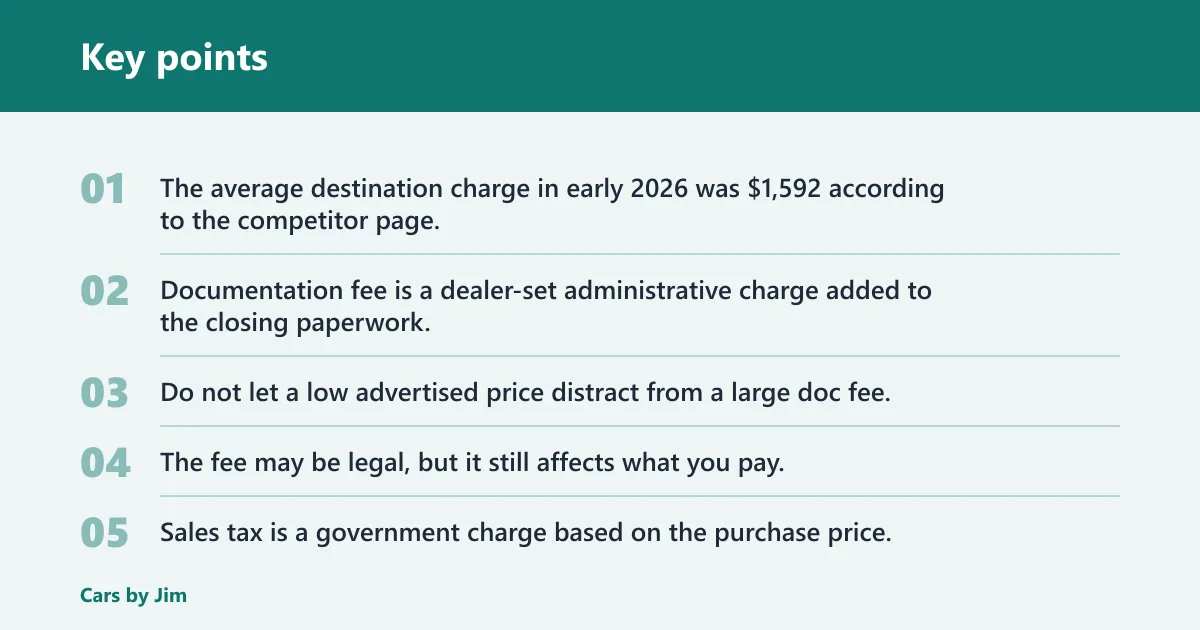
Destination charge is commonly described as a manufacturer-set freight or shipping fee that appears on the Monroney sticker. It is not a dealer markup. The average destination charge in early 2026 was $1,592 according to the competitor page.
This fee belongs in the starting math because it is part of the new-car price structure from the factory. It is usually fixed for a given model, so one dealer should not present it as an optional extra.
Documentation fee
Documentation fee is a dealer-set administrative charge added to the closing paperwork. It may be capped or regulated in some states, but in others it can still vary by store and materially change the total. That is why two dealers with the same selling price can still produce different out-the-door numbers.
Do not let a low advertised price distract from a large doc fee. The fee may be legal, but it still affects what you pay.
Sales tax
Sales tax is a government charge based on the purchase price. It varies by state and locality, so it is part of out-the-door price but not a dealer-negotiable item. A lower selling price can still yield a higher total if the tax rate or taxable base differs.
That matters most when you compare offers across counties or across state lines. The sticker can be identical while the final bill changes enough to alter which offer is best.
Title and registration
Title and registration fees cover the legal paperwork needed to put the vehicle in your name and register it for road use. They belong in out-the-door price because you cannot drive away without them. They are not the same as a dealer fee, even if a dealer collects them at signing.
When a quote leaves these charges vague, ask for a line-item breakdown. A lumped-together “fees” line hides the real total.
Dealer add-ons and market adjustments
Dealer add-ons and market adjustments can include paint protection, nitrogen, VIN etching, or a markup added because the model is in demand. These items can be presented as mandatory even when they are negotiable or removable. They can also make an advertised low price misleading.
If the seller will not remove an add-on, fold it into the out-the-door number and compare that total against other dealers. The fact that the price is below MSRP does not matter if the extras put the final total above a cleaner offer.
Where invoice price fits in the deal
Invoice price is useful context, but it is not the target number you should anchor the final negotiation to. It is commonly described as the dealership’s wholesale cost reference, which can help you judge whether a price is near the dealer’s likely floor. It does not tell you the real total you will pay.
Invoice can help you understand a dealer’s room to move, especially on a standard new-car purchase. But once taxes, fees, and add-ons enter the deal, the invoice number stops being the main reference point. The complete out-the-door total still matters more.
How invoice compares with MSRP and OTD
Invoice is usually below MSRP, which is why shoppers like to bring it into the discussion. The problem is that invoice does not include the charges that often separate a decent deal from a better one. OTD is the number that shows those charges.
Used listings may show a selling price, a reference MSRP, and a savings number, but used-car shoppers should pay attention to out-the-door cost rather than badge savings. A cheaper sticker can hide maintenance costs such as tires and brakes, and the badge savings do not tell you what the full transaction will cost.
Out-the-door deal matrix
This decision matrix shows which number should anchor the negotiation in common new-car scenarios. Use it to decide whether MSRP is enough to start the talk or whether out-the-door price should be the only number that counts.
| Scenario | Asking price | Unavoidable fees | Negotiable fees | Correct number to counter with | Red flags that make MSRP unusable |
|---|---|---|---|---|---|
| New car at sticker | MSRP | Tax, title, registration, destination | Documentation fee, small dealer add-ons | Out-the-door price | Quote leaves out doc fee or taxes; dealer will not itemize the full total |
| New car below MSRP | Below MSRP by $1,000 | Tax, title, registration, destination | Doc fee, add-on package, market adjustment | Out-the-door price | Discount is erased by a $799 package or a high doc fee |
| Marked-up hot model | Above MSRP by market adjustment | Tax, title, registration, destination | Market adjustment, add-ons | Out-the-door price | Dealer says markup is mandatory or refuses a line-item breakdown |
| Dealer add-on bundle | Sticker plus bundled protection items | Tax, title, registration, destination | Paint protection, nitrogen, VIN etching, doc fee | Out-the-door price | Bundle is presented as non-removable without proof |
| Financed purchase | Any quoted selling price | Tax, title, registration, destination | Doc fee, add-ons, loan products | Out-the-door price | Dealer focuses on monthly payment and hides the total term cost |
| Out-of-state purchase | Cross-border advertised price | Tax, title, registration, destination | Doc fee, delivery fee, add-ons | Out-the-door price | Taxes and registration are not shown for your state, so MSRP is incomplete |
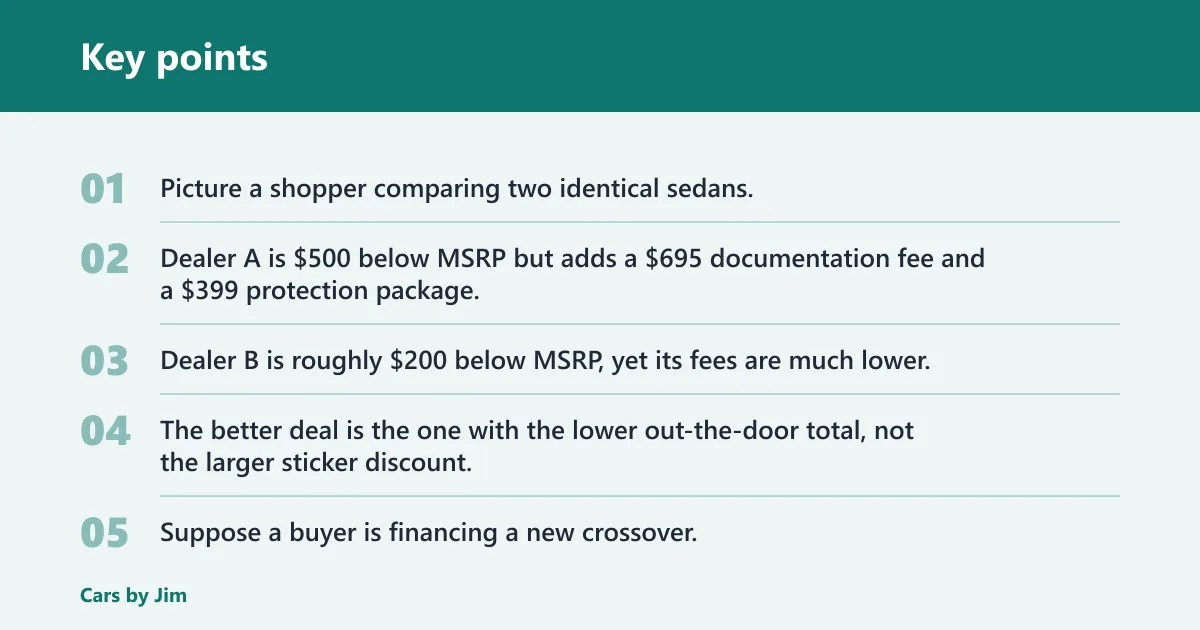
Picture a shopper comparing two identical sedans. Dealer A is $500 below MSRP but adds a $695 documentation fee and a $399 protection package. Dealer B is roughly $200 below MSRP, yet its fees are much lower. The better deal is the one with the lower out-the-door total, not the larger sticker discount.
Suppose a buyer is financing a new crossover. The salesperson pushes a lower monthly payment by extending the loan term, while the selling price remains near MSRP. The monthly figure looks friendly, but the out-the-door total still tells the truth about what the car costs.
How to ask for a written quote
Ask for a written out-the-door quote before you agree to any price. A written quote lets you compare dealers on the same terms and keeps taxes, fees, and add-ons visible before you sign. It also makes it easier to spot a quote that looks cheap on the sticker but expensive at closing.
Request the full itemization. Ask the dealer to list the vehicle price, destination charge, documentation fee, taxes, title, registration, and every add-on. You need each line separately so you can see what is fixed, what is negotiable, and what is simply being passed through.
Ask for the out-the-door total. Tell the dealer you want the total amount due at signing, not a monthly payment estimate. That number is the only clean way to compare one offer with another across ZIP codes and fee structures.
Compare identical line items. Put the written quotes side by side and check whether both include the same taxes, fees, and add-ons. If one quote omits a doc fee or delivery charge, treat it as incomplete until the dealer fills it in.
Challenge the extras. Ask whether paint protection, nitrogen, VIN etching, or other add-ons can be removed or priced separately. If the dealer will not remove them, count them in the total and decide whether another store offers a cleaner number.
Tell the dealer you are comparing total out-the-door numbers across dealers and that you want the quote in writing before you sign. That approach keeps the conversation on the real purchase price instead of the smallest-looking monthly payment.
Choose Out-the-door price if…
Choose Out-the-door price if you are comparing dealers, buying in a state with meaningful tax or fee differences, or facing any quote with add-ons, markups, or financing terms. It is the better number whenever the total you pay matters more than the starting sticker.
Choose MSRP if you are opening a new-car negotiation, checking whether the price is above or below the manufacturer’s suggested starting point, or trying to understand the sticker before fees appear. Use it as the opening reference, then shift to the full total before you commit.
Frequently asked questions
Should I negotiate from MSRP or out-the-door price?
Start from MSRP, then move to out-the-door price as soon as you are talking about the real deal. MSRP is a useful reference on a new car, but out-the-door price is the number that tells you what the purchase will actually cost after taxes, title, registration, and fees.
Why is the out-the-door price sometimes higher than MSRP?
Because MSRP excludes taxes, title, registration, dealer documentation fees, and any add-ons or market adjustments. Sales tax alone can create a large gap, and a high doc fee or bundled extras can widen it further. That is why the final total can be thousands above the sticker.
Can a dealer sell below MSRP but still have a worse total price?
Yes. A dealer can discount the selling price and still end up with a higher out-the-door total if the doc fee is high, the taxes are different, or the deal includes expensive add-ons. A discount on the sticker does not guarantee the cheapest final number.
What fees are included in out-the-door price?
Out-the-door price should include vehicle price, destination charge, documentation fee, sales tax, title, registration, and any dealer add-ons or market adjustments that remain in the contract. If a charge affects the amount you pay to leave the lot, it belongs in the total.
Which charges can I negotiate besides the sticker price?
You may be able to negotiate dealer add-ons, market adjustments, and sometimes the documentation fee if local rules and dealer policy allow it. Taxes and government title or registration charges are generally not negotiable. Destination is a manufacturer-set charge and is not a dealer markup.
How do destination, doc fees, and taxes change the final number?
Destination is built into the new-car pricing structure and usually appears on the Monroney sticker. Doc fees are dealer-set and can range from a few hundred dollars to over $1,000 depending on state. Sales tax changes by ZIP code, so it can materially alter the final out-the-door total.