What Dealership Fees Should I Not Pay?
You should refuse any dealership fee that is not required by law or clearly itemized on the buyer’s order. That usually means skipping add-ons, dealer prep, VIN etching, nitrogen, paint protection, and market-adjustment fees. Those charges can add hundreds or thousands of dollars, and they often appear in the fine print near the end. This guide separates mandatory charges from dealer profit lines and shows you how to verify each one on the buyer’s order.
Which dealership fees should you refuse?
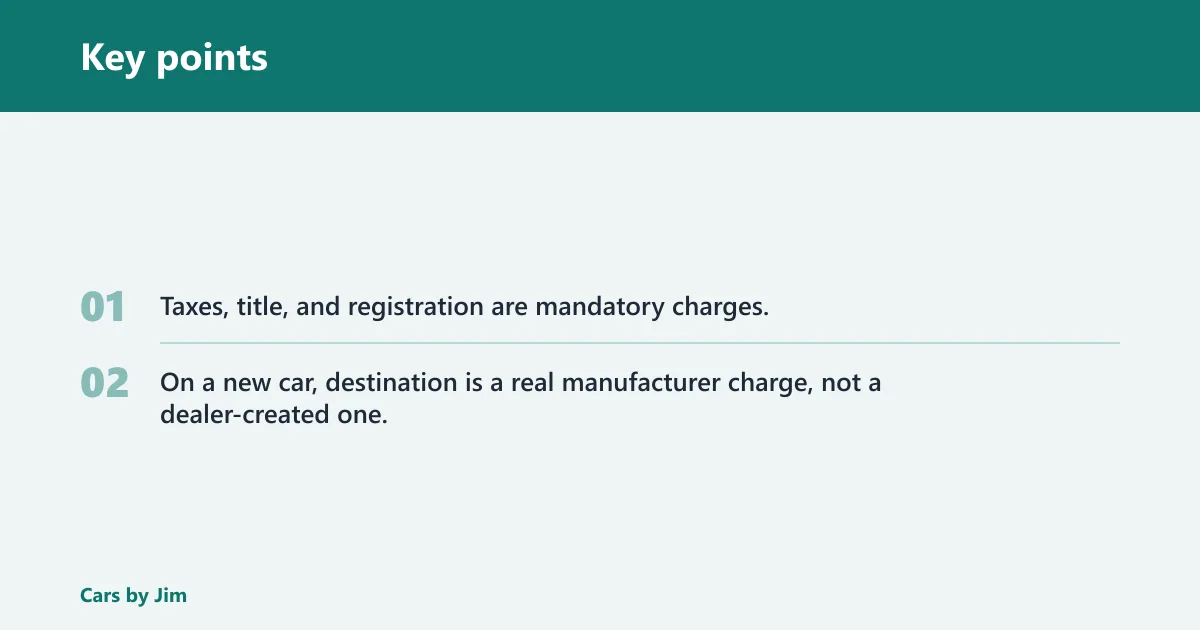
The short version is simple. Taxes, title, and registration are mandatory charges. On a new car, destination is a real manufacturer charge, not a dealer-created one. Most other fee lines deserve scrutiny, and some should be refused outright if they were never part of the deal you agreed to.
Fee matrix
| Fee | Who sets it | Belongs in advertised price? | Legal or negotiable? | Exact question to ask |
|---|---|---|---|---|
| Sales tax | Government | No; it is added to the taxable sale | Legal and mandatory | “Is this the state sales tax rate, or did you add anything extra?” |
| Title fee | Government | No | Legal and mandatory | “Is the title fee the actual state filing charge?” |
| Registration fee | Government | No | Legal and mandatory | “Does this registration amount match the DMV charge?” |
| Destination fee | Manufacturer | Yes on new cars | Legal and usually fixed | “Is this the manufacturer destination charge from the Monroney label?” |
| Documentation fee | Dealer, often state-capped | Sometimes, but it should be disclosed | Legal in many states; often negotiable or capped | “What is your doc fee, and is it capped by state law here?” |
| Dealer prep fee | Dealer | No if it was not disclosed in advance | Challenge or refuse | “What specific work does this prep fee pay for?” |
| Reconditioning fee | Dealer | No | Challenge or refuse | “Was this work already included in your used-car pricing?” |
| VIN etching | Dealer or vendor | No | Optional and often declined | “I do not want VIN etching. Please remove it.” |
| Nitrogen, paint protection, theft etch, sealant, market adjustment | Dealer | No | Usually optional or negotiable | “Is this an optional add-on or a condition of sale?” |
A useful rule is to separate three buckets. Pay government charges. Verify manufacturer charges. Refuse dealer-created lines unless the dealer can show that the charge was disclosed in advance and you accepted it in writing.
What should the out-the-door price include?
The out-the-door price should include the vehicle price, taxes, title, registration, and all dealer fees in writing. It is the best comparison number across dealerships because it shows the full amount you must bring to close the deal, not a stripped-down advertised price or a monthly payment.
Ask for the out-the-door figure before you discuss financing. A low payment can hide a larger total through a longer term, a higher APR, or a late-added fee. The payment matters only after the full price is fixed.
How to compare written quotes
-
Request the full breakdown.
Ask each dealer for the out-the-door total in writing. Make sure the quote lists the vehicle price, taxes, title, registration, and every fee line. -
Match the line items.
Compare the same categories across every quote. If one quote skips a fee, ask whether it is missing or just hidden in the vehicle price. -
Compare the final total.
Use the out-the-door number, not the monthly payment, as the main comparison point. That is the cleanest way to spot a hidden add-on.
Suppose one used SUV is advertised at $21,900 and another at $22,400. If the first dealer adds a $895 documentation fee and a $399 prep fee, the second deal may actually be cheaper once you compare the out-the-door total.
Which fees are mandatory?
Sales tax, title, and registration are mandatory government charges. They are not negotiable in the normal sense because the dealer is collecting them on behalf of the state or local agency, not padding the sale. If a dealer labels one of these items incorrectly, ask for the exact agency charge.
Sales tax
Sales tax is a government charge collected by the dealer on behalf of the state. It is not negotiable. In Florida, dealer fees sit inside the taxable sales price, so a fee added by the dealer can also increase the tax you pay.
That tax treatment matters. A $900 doc fee adds $54 in Florida state sales tax if the rate is 6%. The fee itself may be dealer-set, but the tax effect is real and immediate.
Title fee
The title fee covers transfer of ownership. It is a government charge and should reflect the actual title filing cost, not a dealer profit line. If the amount looks inflated, ask for the state title filing amount on paper.
Registration fee
The registration fee covers plate or road registration. It is also a government charge. Dealers often collect it for convenience, but the money is meant for the state system, not for the store’s overhead.
Do not let a dealer blur these charges together. If the contract lumps title and registration under a vague “fees” line, ask for the exact breakdown before you sign.
Which dealer fees are optional or negotiable?

Documentation fees, dealer prep, reconditioning, and many add-ons are dealer-created charges, not fixed legal payments. Some doc fees are capped by state law, some are disclosed in advance, and some are negotiable. Add-ons such as VIN etching are usually optional and should be declined if you do not want them.
State law can change the answer here. Florida has no numeric doc-fee cap in Statute 501.976, but mandatory dealer fees must be included in advertised prices, predelivery charges need disclosure, and dealer fees are part of the taxable sales price. California can cap a doc fee at $85 with a DMV partner agreement. New York’s doc-fee cap is $175.
Documentation fee
The documentation fee may also be called a doc fee, processing fee, or conveyance fee. It is often dealer-set, may be capped by state law, and can be negotiable at some stores. Treat it as a real fee, but not as a fixed law-of-nature charge.
Ask whether the doc fee is already built into the advertised price. If it appears only at signing, the dealer may be shifting the price late in the process. That is a warning sign, especially if the fee was never mentioned in earlier quotes.
Dealer prep fee
The dealer prep fee should be challenged. It is often framed as vehicle-ready work, but some of that work may already be covered by the manufacturer or already reflected in the sale price. If the dealer cannot explain the specific service, ask to remove it.
Reconditioning fee
The reconditioning fee should be questioned or refused. Used cars often need cleaning, inspection, or minor repair before sale, but a dealer should not treat ordinary retail prep as a surprise add-on after the price is quoted.
Say your quoted used-car price changes by about $650 at the finance desk because of a “reconditioning” line. Ask what was repaired, when it was approved, and whether that work was already part of the advertised price. If there was no prior disclosure, push back.
VIN etching
VIN etching is a dealer add-on with low value for most shoppers and should be declined if unwanted. It is not the same as a government charge, and it is not required to register or title the car. If you did not ask for it, do not pay for it.
Other add-ons to decline
- Paint protection packages.
- Nitrogen tire fills.
- Theft etching packages.
- Market adjustment fees.
- Door-edge guards or pinstriping added without consent.
These items are classic last-minute add-ons. The FTC warned 97 dealership groups in March, which is a reminder that fee disclosures and add-on practices remain under close scrutiny. A later settlement involving Manchester City Nissan was for $4 million, showing that fee disputes can become expensive for dealers.
How do new-car fees differ from used-car fees?
New-car deals can include a manufacturer destination fee, while used-car deals usually do not. On a new car, destination is a real manufacturer charge shown on the Monroney label. On a used car, focus instead on whether the dealer is trying to add prep, reconditioning, or other overlap charges that were already part of the prior sale.
Used-car buyers should be especially careful about overlap. A dealer may say a car needs “prep” even though the selling price already includes the work needed to put it on the lot. That is why you should ask what the fee covers and whether it was already built into the advertised price.
Destination fee on new cars
Destination fee belongs on a new-car window sticker and is set by the manufacturer. It is not a dealer-imposed fee. If you see a destination charge on a used car, ask why it is present, because used vehicles normally do not carry that manufacturer charge as a fresh line item.
Why used-car buyers should question overlap charges
A used-car buyer should challenge any fee that sounds like routine dealership overhead. Sales tax, title, and registration are one thing. A second layer of “prep” or “conditioning” is different. That kind of charge can often be refused, offset, or negotiated away.
How should you read the buyer’s order?
Read the buyer’s order line by line before signing. The form should match the deal you agreed to, especially the out-the-door total. If a fee appears late, disappears and reappears under a different name, or changes the final amount, stop and ask for a corrected copy.
A common first-timer mistake is to focus on the monthly payment while the dealer changes a fee line at the bottom of the contract. The payment may stay close to the same, but the total amount financed can still rise. That is how a bad fee slips through.
Line items that need a second look
-
Check the fee names.
Look for vague labels such as “admin,” “service,” “dealer handling,” or “miscellaneous.” Ask what each one covers and whether it was disclosed earlier. -
Match the written quote.
Compare the buyer’s order against the emailed quote or printed worksheet. Any new fee should be explained before you sign. -
Confirm the total stays fixed.
Make sure the out-the-door total is identical to the agreed deal. If a fee is removed but the total stays the same, the dealer likely shifted the amount elsewhere.
That last point matters. If a dealer removes a prep fee of about $395 but raises the vehicle price by the same amount, the out-the-door total does not improve. You have not saved money; the fee just moved.
What to do if the total changes at signing
If the total changes, ask for a fresh buyer’s order and stop the process until every line matches your agreement. Do not sign a form that does not reflect the full price you negotiated. If the dealer will not correct it, walk away.
Used-car buyers in high-fee states should be especially careful. Florida’s disclosure rules are stricter than many shoppers expect, while states such as California and New York cap or limit certain doc fees. In lower-fee states, the same dealer might still try to add extras unless you challenge them directly.
Frequently asked questions
What dealership fees should I not pay?
You should not pay dealer prep, reconditioning, VIN etching, nitrogen, paint protection, market adjustments, or any fee that was not disclosed and agreed to in writing. Government charges like tax, title, and registration are different. On a new car, destination is also a real manufacturer charge.
Which dealer fees are optional versus mandatory?
Mandatory fees are government charges such as sales tax, title, and registration. Optional or negotiable fees are dealer-created lines such as documentation, prep, reconditioning, and add-ons. If a fee is not required by law or the manufacturer, ask whether you can remove it before signing.
Can I refuse dealer prep, reconditioning, or add-on fees?
Yes. Dealer prep, reconditioning, and most add-ons can be challenged, offset, or refused if you did not agree to them in advance. The dealer may try to keep the deal alive by moving the amount elsewhere, so check the final out-the-door total before you sign.
Are doc fees negotiable at a dealership?
Often, yes, or at least partially. Doc fees may be dealer-set, capped by state law, or disclosed as a fixed store policy. Ask whether the fee is mandatory in your state, whether it is already included in the advertised price, and whether it can be reduced.
What happens if a fee is removed but the total price stays the same?
Then the dealer likely shifted the money into another line item, such as the vehicle price or a different fee. That is not a price cut. Ask for a revised buyer’s order showing a lower out-the-door total, and do not sign until the full amount changes.