Flood Damage on a Used Car: Spot It and Avoid It
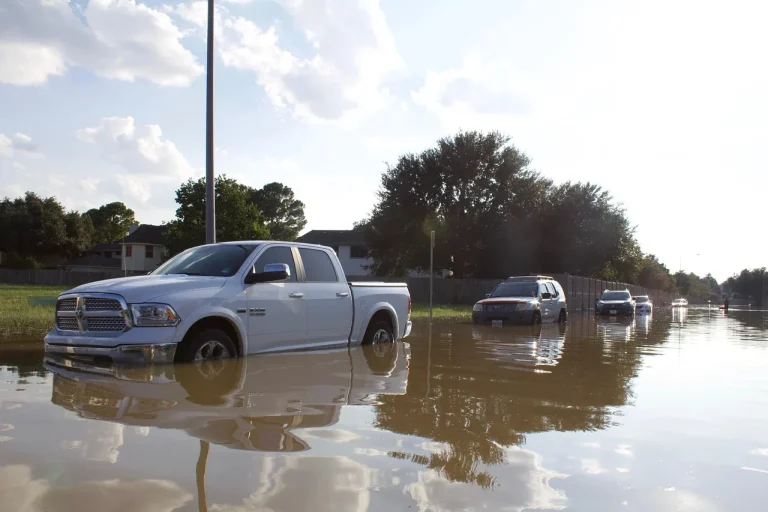
Spot flood damage on a used car by checking several systems first, including electronics, interior, hidden cavities, and fluids; if two or more show water signs, walk away unless a specialist inspection suggests the damage was minor. Miss it, and you can inherit corrosion, airbag faults, mold, and electrical failures that show up months later. This guide covers the red flags that matter, where to look, and when a deeper inspection is worth paying for.
Why flood damage is easy to miss
Fresh detailing can cover up flood evidence
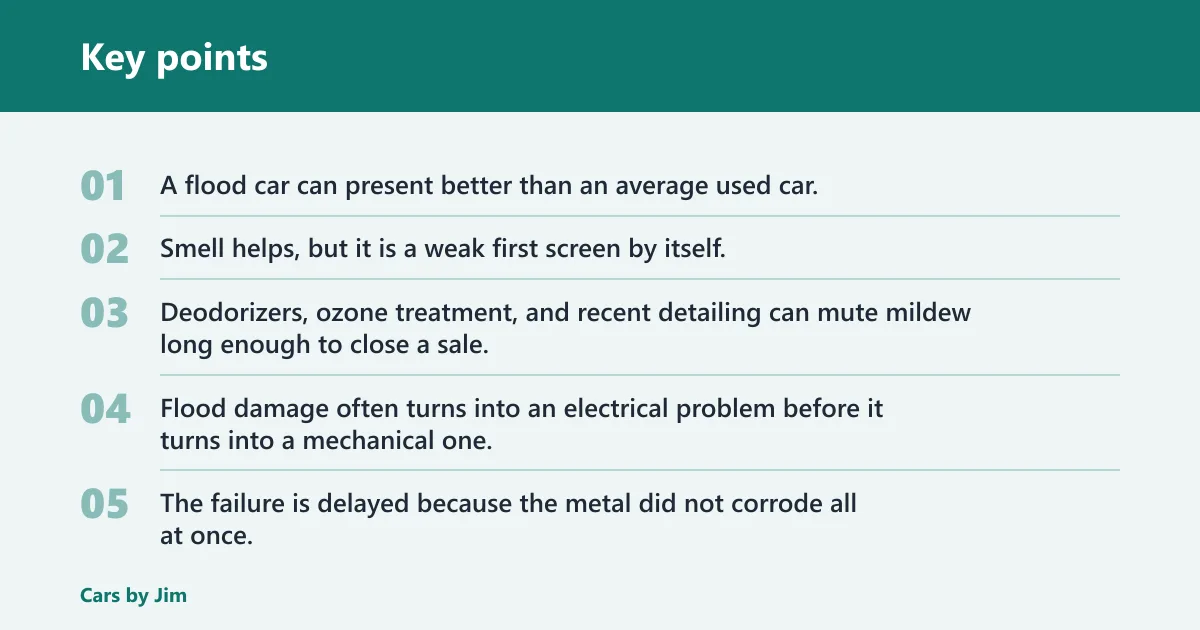
A flood car can present better than an average used car. Fresh shampooed carpet, heavy deodorizer, new floor mats, cleaned seat fabric, and glossy trim can distract from what matters more: soaked padding, rusty seat hardware, silt in cavities, and corrosion starting inside connectors.
Smell helps, but it is a weak first screen by itself. Deodorizers, ozone treatment, and recent detailing can mute mildew long enough to close a sale. Water often stays where quick cleanup does not reach: under carpet backing, inside seat foam, in the spare-tire well, behind kick panels, and around wiring grounds.
Latent electrical and corrosion failures develop later
Flood damage often turns into an electrical problem before it turns into a mechanical one. Water gets into connectors, modules, fuse boxes, seat motors, sensor plugs, and body grounds; later, corrosion raises resistance, weakens contact, and triggers intermittent faults.
That is why a car can pass a casual drive today and still develop airbag lights, power-window glitches, no-start issues, repeated blown fuses, or unstable sensor readings weeks or months later. The failure is delayed because the metal did not corrode all at once. It degraded over time.
A normal test drive does not clear the car
A 15-minute loop on city streets mainly checks whether the engine, transmission, steering, and brakes work right now, not whether hidden flood damage is present. It does not prove the carpet padding is dry, the seat-track bolts are clean, or the airbag connector under the passenger seat escaped water.
Picture a crossover that starts instantly, shifts cleanly, and tracks straight. The cabin smells like citrus cleaner, and every warning light is off at startup. Later, you lift the trunk floor and find a rusted jack, white corrosion on a ground point, and dried silt in the spare-tire well. That is a flood-risk pattern even though the test drive felt normal.
Will a vehicle history report always show flood damage?
A vehicle history report can reveal flood branding, insurance loss records, salvage or rebuilt status, and suspicious registration gaps, but it may not catch every flooded car. If damage was never reported to an insurer, was repaired privately, or moved through title laundering, the report may look clean.
What to look for in the report
Start with title-brand language. Flood, salvage, rebuilt, reconstructed, and similar labels matter, especially when paired with abrupt odometer-report gaps or a move between states after a major weather event. Insurance total-loss records also help because many flooded cars are written off by insurers before resale.
Registration history matters too. If a car drops out of one state and reappears in another with a fresh title sequence, ask why. A gap does not prove fraud, but it can fit a title-laundering pattern where branding is altered or delayed as the vehicle changes jurisdictions.
What reports miss
Reports depend on data being created and shared. If an owner never filed an insurance claim, if the car was cleaned and sold wholesale quickly, or if flood exposure happened without a branded title event, the history can stay silent.
That is why a clean report should lower suspicion only slightly. It should never outweigh physical evidence in the cabin, trunk, engine bay, or underbody.
How to use history without overtrusting it
- Check title status first. Read the title brand line and the current status, then compare it with prior-state records for flood, salvage, rebuilt, or reconstructed branding. Any flood brand is a high-risk signal because it means the damage was serious enough to be recorded.
- Review insurance entries. Look for insurer total-loss entries, severe-damage records, payout activity, or claim dates that line up with known storm or hurricane periods. A total loss without a clear repair record deserves extra scrutiny.
- Scan registration gaps. Note any unexplained period where the car drops out of state registration records, then reappears elsewhere. That pattern does not prove flooding, but it can support other warning signs.
- Compare report to the car. If the report looks clean but the spare-tire well has water residue and the seat bolts are rusty, trust the physical evidence. History reports are screening tools, not proof of a dry past.
How can you tell if the cabin has flood damage?
Check the cabin as a set of separate failure zones, not as one general smell test. The strongest clues are mildew that changes when the HVAC runs, damp or reinstalled carpet padding, rusty seat tracks and bolts, mud in seat crevices, and water residue in the trunk or spare-tire well.
Odor clues, HVAC smell, and deodorizer masking
Musty, swampy, and wet-dog odors still matter, especially after the car sits closed in the sun. So does the opposite: an unusually strong deodorizer or fresh-detail scent that seems intended to bury something else.
Run the HVAC on low, then medium, with outside air first and recirculation second. If the smell gets worse a minute or two after airflow starts, moisture may be trapped in ducts, insulation, or cabin materials. A pleasant fragrance at the door is not a pass.
Carpet and underlayment checks
Carpet dries faster than the foam or fiber padding beneath it. The underlayment is the real moisture reservoir, and it can hold dampness, silt, and mold after the visible carpet feels normal.
Look for silt lines at the edge of the carpet near the firewall, rocker panels, and seat mounts. Check for staining around seat brackets, kick-panel edges, and rear footwells. Also watch for recent removal signs: loose trim clips, uneven carpet fit, missing fasteners, or carpet that does not sit flat around console mounts.
Seats, tracks, and hidden corrosion
Seats trap flood evidence in hardware and foam. Rust on seat rails, track gears, mounting bolts, and exposed springs is more suspicious than light age-consistent surface oxidation elsewhere because those parts sit low in the cabin where water pools.
Mud can lodge in seat creases, plastic trim gaps, and rail channels. Power-seat functions should move smoothly in every direction. Hesitation, clicking, or one dead movement can point to corrosion at a motor, switch, or connector.
Trunk and spare-tire well clues
The spare-tire well often tells the truth because sellers clean it less often than the cabin floor. Lift the trunk mat and inspect the metal well, jack, lug wrench, tie-down points, and insulation.
Waterline residue, dried dirt, rusty tools, damp insulation, and corrosion on bare metal all matter. Also check trunk seals and body seams for clues that water entered and sat there rather than splashing in briefly from normal use.
How to check carpet, seats, and trunk
- Smell before touching. Open the doors after the car has been closed for several minutes. Then switch on the HVAC and note whether mildew, swamp, or wet-dog odor appears or intensifies after airflow starts.
- Lift carpet edges. At the front and rear footwells, gently raise a corner or edge where it can move without damage. Feel the backing and padding for dampness, stiffness from dried silt, or fresh disturbance from recent removal.
- Inspect seat hardware. Slide each seat fully forward and back, then look at rails, bolts, and wiring under the seat with a light. Rust blooms, white corrosion, and mud in track channels are stronger evidence than a stained seat cover.
- Test seat functions. Run every power-seat adjustment, including height, recline, lumbar, and memory if fitted. Slow travel, clicking, or a dead direction can mean corrosion in a switch, motor, or connector.
- Open the trunk floor. Remove the mat and lift the spare-tire cover. Inspect the well, jack, tools, tire sidewall, and insulation for residue lines, corrosion, trapped dirt, or signs of standing water.
Suppose the front carpet feels dry, but the rear footwell padding is cool and slightly heavy to the touch while the trunk well shows a faint brown line an inch above the spare-tire center. That combination says more than one musty odor alone. It suggests water settled in multiple low points.
How flood damage shows up in the interior and paperwork
Start with the easiest red flags: a flood title, stale musty smells, water lines, stained upholstery, and rust or mud tucked into seams, seat tracks, and connector pins. If you find two or more of these together, the safest move is usually to walk away, even when the car looks clean at first glance. This flood damage guide explains which clues are most reliable and which ones can be misleading.
That matters because flood-damaged cars can develop electrical issues, mold, and hidden failures long after the sale. The article also shows how to compare visible clues with the paperwork so you can judge risk before you commit.
What should you check in the engine bay?
Focus on places that trap dirty water: the airbox, intake tract, fuse and relay areas, electrical connectors, and grounding points. Fluids can add context, but clean oil does not clear a car of flood exposure. A flood car may show contamination in the intake and wiring long before fluids look abnormal.
Airbox, intake tract, and filter contamination
Open the airbox and inspect the filter and lower housing. Mud, dried silt, leaf residue, or a water line inside the airbox is a serious clue because floodwater can enter through the intake path before a seller thinks to clean it.
Check the intake snorkel and nearby cavities too. Debris in a lower airbox corner often survives a quick rinse because that spot traps sediment.
Connectors, fuse areas, relays, and grounds
Look at visible connectors near the firewall, battery, headlights, fuse box, and radiator support. Corrosion may appear green, white, or powdery. Grounds deserve special attention because poor grounding causes erratic electrical faults that can be hard to trace.
Relay and fuse covers can hide moisture marks or silt. A shiny engine bay with untouched corrosion on connector pins or ground lugs is a bad sign. Cosmetic cleaning and electrical preservation are different jobs.
Fluids: what they can and cannot tell you
Milky oil, contaminated brake fluid, or cloudy differential or transmission fluid can support a flood diagnosis, but many flood-damaged cars will not show any of those symptoms. Water exposure may never reach lubricated components, or fluids may have been changed before sale.
So use fluids as one checkpoint, not the deciding one. The absence of fluid contamination does not outweigh silt in the airbox or corrosion in electrical hardware.
How to spot flood damage in the engine bay and fluids
- Open the airbox. Remove the clips or fasteners needed to inspect the filter and lower housing. Look for silt, muddy residue, leaf fragments, or a visible waterline, especially in the bottom corners.
- Check fuse areas. Open the main fuse and relay covers if access is straightforward. White or green corrosion, dirt residue, or moisture staining around terminals can raise the risk of later electrical faults.
- Inspect major grounds. Find visible ground straps or body-ground lugs near the battery, inner fenders, or firewall. Rust staining or crusty buildup there can create intermittent warning lights and sensor issues.
- Read fluids carefully. Check engine oil on the dipstick and visible reservoirs where level and clarity can be seen safely. Treat milky or contaminated fluid as a warning sign, but do not treat clean fluid as proof the car was never flooded.
How do electrical problems reveal past flooding?
Electrical symptoms often reveal flood damage through inconsistency rather than complete failure. Warning lights that come and go, switches that work only sometimes, sensor faults with no obvious mechanical cause, and repeated bulb or fuse issues can all point to connector, ground, or module corrosion left by water intrusion.
Intermittent warning lights
Watch the cluster at startup and during the drive. Airbag, ABS, traction-control, charging, and check-engine lights that flicker, reset, or return after bumps or after the cabin warms up deserve attention.
A seller may clear codes before showing the car. That can hide a fault long enough for a short test drive, especially if the issue needs time, vibration, or heat to return.
Switches, sensors, and accessories
Flooded wiring often shows up as small annoyances first. One window switch works slowly. A door lock misses one cycle. A reverse camera cuts out. A seat heater stays dead. Parking sensors chirp randomly. These are not harmless if they stack up.
A common first-timer mistake is treating three minor electrical quirks as normal aging. On a dry older car, maybe one switch is lazy. On a suspect flood car, several unrelated electrical faults at once point toward shared corrosion in low-mounted connectors or grounds.
Why late failures are common
Water intrusion starts a process. Connector pins oxidize, terminal tension weakens, and modules can trap moisture internally. The car may still run because the damaged circuit is not yet open enough to fail all the time.
That delayed pattern is what makes flood damage expensive. Diagnosis takes time, and repairs often mean tracing multiple circuits rather than replacing one clearly broken part.
What underbody signs should make you suspicious?
Be suspicious when rust patterns, trapped debris, or residue look inconsistent with the car’s age, mileage, and region. Flood evidence under the car often appears as silt caught in seams, scale rust on suspension hardware, or corrosion concentrated in low pockets rather than evenly spread surface oxidation.
Rust patterns that do and do not matter
Some surface rust on exhaust parts, bare fasteners, and cast suspension components is normal in many climates. What matters is where the rust sits and how it looks compared with surrounding parts.
Suspicious patterns include a horizontal waterline on brackets, heavy rust on seat-floor bolts from below, flaky scale on suspension hardware that seems advanced for the vehicle’s age, and corrosion inside boxed or protected areas where road spray alone is less likely to explain it.
Debris, silt, and residue in seams
Floodwater carries dirt. Check pinch welds, subframe pockets, underbody seams, shield edges, and cavities near body plugs for dried residue or plant debris. Mud in protected ledges is more meaningful than road grime on exposed surfaces.
Also compare left and right sides. A random splash pattern is normal. Similar residue packed into low seams across the car points more toward immersion.
What a lift inspection can reveal
A lift makes the underbody check far more useful. It exposes the tops of crossmembers, hidden cavities around fuel and brake lines, body plugs, and the floor above suspension pickup points where sediment and corrosion can linger out of sight.
That is one reason an independent pre-purchase inspection matters on any borderline case. Ground-level viewing misses too much.
Flood inspection scorecard
Scorecard rules
Use this scorecard during the showing, not after memory starts filling gaps. Mark each checkpoint pass or fail. One fail does not always condemn a car, but clustered fails do. The decision rule below keeps a buyer from rationalizing away several medium-strength warnings.
| Checkpoint | Pass if | Fail if |
|---|---|---|
| Title/history | No flood, salvage, or rebuilt branding; no suspicious registration gap that lacks an explanation | Flood brand, salvage/rebuilt with unclear cause, or unexplained state/title gap after storm period |
| Odor | No mildew, swamp, or wet-dog smell with cabin closed or HVAC running | Persistent mildew or strong deodorizer masking smell, especially stronger after HVAC use |
| Carpet padding | Dry carpet backing and underlayment; no silt lines; no signs of recent removal | Damp, stiff, stained, silty, or recently disturbed carpet or padding |
| Seat tracks | Clean rails, bolts, and under-seat wiring; all seat functions work normally | Rust, mud, corrosion, or weak/nonworking power-seat movement |
| Trunk well | Dry spare-tire well; clean jack and tools; no waterline residue | Standing-water evidence, rusted tools, damp insulation, or residue line |
| Airbox | Clean filter housing and intake tract with no mud or waterline | Silt, leaf debris, muddy residue, or visible waterline inside airbox |
| Connectors | Visible connectors and fuse areas are clean and dry | White, green, or powdery corrosion; dirt or moisture in fuse/relay areas |
| Grounds | Ground lugs and straps appear clean and secure | Corroded ground points, rust staining, or crusty buildup |
| Warning lights | No abnormal lights at startup or during drive | Intermittent airbag, ABS, traction, charging, or check-engine light behavior |
| Test drive behavior | No odd electrical glitches, no flickering displays, no accessory dropouts | Random chimes, dead accessories, flicker, sensor glitches, or repeated fuse issues |
| Underbody rust | Rust appears age-consistent with no trapped debris or waterline pattern | Scale rust, silt in seams, packed debris, or corrosion inconsistent with age |
| Proof of remediation | Dated invoices list disassembly, drying, replaced insulation/components, and follow-up scan checks | Only fresh detailing, odor treatment, carpet shampooing, or vague verbal assurances |
Decision rule
- Red: walk away. Two or more fails in different systems, any flood-branded title, or one major fail paired with vague remediation records.
- Yellow: mechanic review. One fail, or two closely related minor concerns, with no title red flags. Get an independent inspection with a scan tool and lift before negotiating.
- Green: proceed. All twelve checkpoints pass, or one minor cosmetic concern is clearly explained and supported by dry, corrosion-free inspection results.
How to use the scorecard at a showing
- Start with history. Read the title and report before driving. If branding or registration gaps already raise the scorecard to red, there is little value in talking yourself into the car.
- Check low points first. Inspect carpet edges, seat tracks, trunk well, and airbox before a seller has time to redirect you. These zones hold water evidence better than painted exterior panels.
- Drive and recheck. During the test drive, use the HVAC, cycle accessories, and watch the warning lights. Then revisit the odor and electrical categories because some symptoms appear only after vibration or heat.
- Classify the result. Mark the car red, yellow, or green on the spot. A written threshold helps stop emotion from overruling evidence.
When should you walk away or call a mechanic?
Walk away when flood signs appear in two or more systems, when the title is flood-branded, or when physical evidence conflicts with the seller’s story. Call an independent mechanic when the car has one isolated warning sign, no clear branding, and enough value to justify a scan-tool and lift inspection.
Immediate walk-away signs
Flood title branding is enough by itself for many buyers. So is a cluster such as mildew plus rusty seat bolts plus trunk waterline residue. Mud in the airbox is another major red flag because it points to dirty water entering a critical intake path.
Fresh detailing paired with deodorizer, newly installed floor mats, and resistance to lifting trunk trim or carpet edges should also move a car quickly toward no-sale territory.
What a mechanic should inspect
The inspection should be independent, not arranged through the seller’s preferred shop if alternatives exist. The mechanic should scan all available modules, not only the engine computer, and should look for stored, pending, and history faults.
A proper check includes a lift inspection, underbody seam review, visible connector and ground inspection, airbox opening, warning-light verification, and a water-intrusion assessment in the cabin and trunk. Those specifics matter more than a generic “used-car inspection.”
What proof of remediation should include
Credible flood remediation records name parts and labor. Look for dated invoices showing interior disassembly, drying, replacement of soaked padding or insulation, cleaning of connectors, replacement of damaged modules or seat motors, fluid service where needed, and post-repair scan results.
What does not count as proof: a shampoo invoice, an odor treatment receipt, or a seller saying the car “just had some water in the carpet.” Cosmetic cleanup addresses appearance. It does not prove low-mounted electronics and hidden padding were handled correctly.
Say your scorecard shows one fail for trunk-well residue, but the seller has invoices for replacing the trunk seal, removing the interior trim, drying the well, replacing insulation, and scanning for body-control faults afterward. That is a yellow case worth a mechanic review, not an automatic red.
Frequently asked questions
How can I tell if a used car has flood damage?
Check four systems together: history, cabin low points, engine-bay hidden areas, and electrical behavior. The strongest signs are damp underlayment, rusty seat tracks, trunk-well residue, silt in the airbox, corroded connectors or grounds, and intermittent warning lights. One clue can mislead; clustered clues rarely do.
Can a car run fine and still have hidden flood damage?
Yes. Flood damage often hides in carpet padding, seat hardware, connectors, grounds, and modules that do not fail right away. The car can drive normally today while corrosion develops inside electrical parts, leading later to warning lights, sensor faults, airbag problems, and accessory failures.
What flood damage signs should make me walk away?
Walk away from any flood-branded title, mud or silt in the airbox, or evidence in two or more systems at once, such as mildew plus rusty seat bolts plus trunk waterline residue. Also leave if fresh detailing appears to mask odor and the seller resists inspection of carpet edges or the spare-tire well.
How do mechanics inspect a used car for flood damage?
An effective inspection uses a scan tool for all modules, a lift for underbody seams and rust patterns, and hands-on checks of the airbox, fuse areas, connectors, grounds, carpet padding, seat tracks, and trunk well. The goal is to find hidden moisture, corrosion, and stored fault evidence.
Is it safe to buy or drive a flood damaged car?
Sometimes, but it depends on severity, systems affected, and the quality of repairs. Minor water intrusion with documented remediation may be manageable. A car with hidden corrosion, airbag faults, or multiple electrical issues is a poor risk even if it runs normally now, because late failures are common and expensive.