Where Can You Sell Your Car Online Safely? Route by Route
Reviewed by an automotive compliance editor and updated with official U.S. and U.K. transfer guidance. The safest way to sell your car online is usually a dealer offer or a reputable instant-buy service; a private sale on a trusted marketplace is safer only if you control payment, title transfer, and pickup. Bad steps can cost you money, your car, or both through fake payments, title fraud, or chargebacks. This guide ranks online selling routes by risk, control, and convenience, then matches each one to the seller type it fits best.
Safe car sale matrix
The safest route depends on what you are trading off. Dealer networks and instant-offer sites reduce buyer contact and handover risk. Private listings can return a better price, but they put more of the screening, payment checking, and meeting setup on you.
| Sell route | Buyer interaction | Payment risk | Listing cost | Speed | Handover risk |
|---|---|---|---|---|---|
| Dealer network offer | Low; usually one verified buyer side | Low if funds clear before release | Usually none | Fast | Low |
| Instant-offer site | Very low; limited direct buyer contact | Low if payout is confirmed in account | Usually none | Fastest | Low |
| Reputable marketplace listing | High; you screen each enquiry | Medium to high | Free or paid, depending on channel | Typical private online sale takes 4–14 days from listing to closed sale | Medium to high |
| Free social listing | Very high; lots of unknown contacts | High | Free | Can be quick, but less predictable | High |
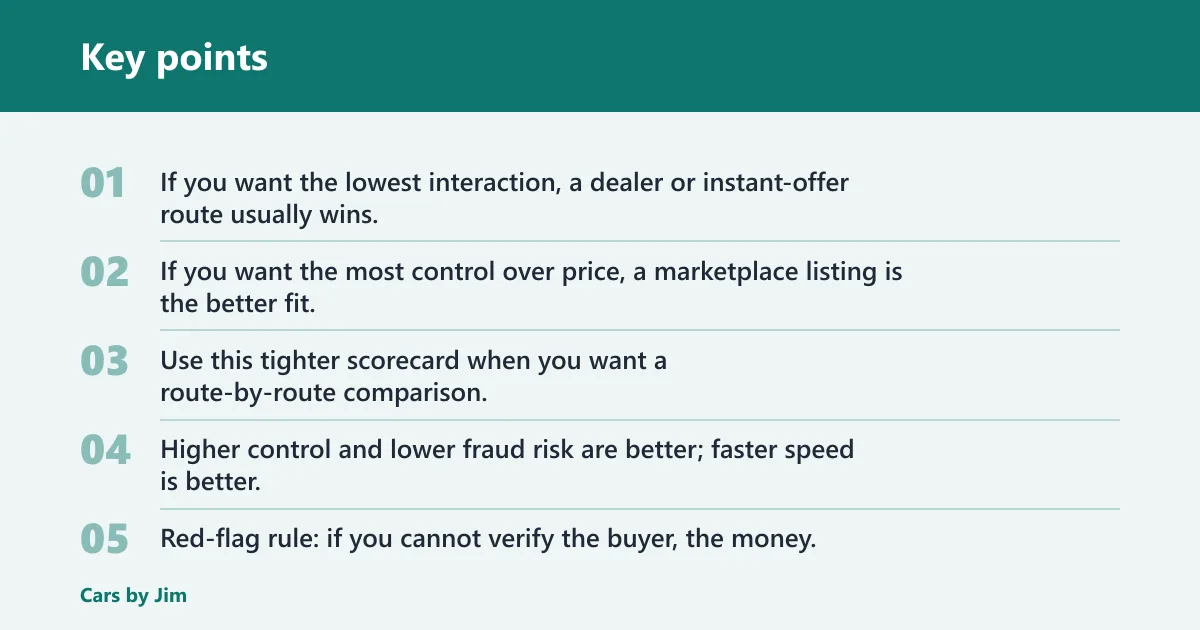
If you want the lowest interaction, a dealer or instant-offer route usually wins. If you want the most control over price, a marketplace listing is the better fit, but only if you can handle screening, payment checks, and a careful handover.
Best-in-class online sale routes at a glance
Use this tighter scorecard when you want a route-by-route comparison. Higher control and lower fraud risk are better; faster speed is better; lower cost is better.
| Route | Major platform / route examples | Fraud risk | Seller control | Speed | Cost | Best for |
|---|---|---|---|---|---|---|
| Dealer network offer | Dealer-bid marketplaces and national dealer-buying networks | Low | Medium | Fast | Usually free | Sellers who want a managed sale and fewer buyer contacts |
| Instant-offer / cash-offer service | Instant valuation and collection services | Low | Medium | Fastest | Usually free | Sellers who prioritize speed and reduced handover risk |
| Marketplace listing | Large consumer marketplaces and classified ads | Medium to high | High | Medium | Free or low fee | Sellers chasing a better private-sale price and willing to screen buyers |
| Social listing | Free social platforms and local groups | High | Low to medium | Unpredictable | Free | Only if you can filter aggressively and ignore weak leads |
| Consignment or brokered sale | Dealer broker, sale-on-your-behalf service | Low to medium | Low | Medium | Fee-based | Sellers who want less work and are comfortable paying for convenience |
| Decision trigger | Go | No-go |
|---|---|---|
| Buyer asks for a phone or video call first | Proceed to verification | Do not meet if they refuse all direct contact |
| Name, photo, and licence all match | Proceed to a public meeting | Stop if the details do not align |
| Funds are visible and cleared in your bank account | Release the car after paperwork | Do not hand over keys on a pending transfer |
| Buyer wants to overpay and “refund the difference” | Never | Always stop; this is a classic scam pattern |
| Buyer requests a remote handover, courier, or escrow you did not choose | Never | Stop and verify independently |
| Test drive is in a public place and you remain present | Proceed | No solo test drives, no isolated routes |
Red-flag rule: if you cannot verify the buyer, the money, and the paperwork in that order, the answer is no-go.
Which online route fits you best?
The right route depends on your tolerance for risk and how much work you want to do. A dealer offer suits sellers who want a simple handoff. A marketplace listing suits sellers who can wait longer and manage buyers. An instant-offer site suits people who want speed and a fixed process.
Private marketplace listings
Choose this route if you want wider reach and are willing to do the screening yourself. Facebook Marketplace is free and the default first listing on some platforms, but free also means more unknown contacts, more low-quality messages, and more scam attempts.
Use a trusted marketplace when you can reply fast, meet in person, and reject any offer that does not clear in your account. If your car is older, lower value, or common, this route can work well because buyers are already comparing local options. For related setup help, see bill of sale templates and car valuation guidance.
Dealer networks and trade-in offers
This route suits sellers who value reduced contact and fewer steps over maximum sale price. Motorway says it works with over 8,000 verified dealers nationwide, which is useful if you want a wide dealer pool without handling every buyer yourself.
Trade-in and dealer-network routes also work well for financed cars and cars with awkward histories, because the buyer side is built to handle paperwork. You still need to check the final settlement and confirm the handover details before you release the keys. If your car has a finance balance, compare options with instant-offer reviews before you commit.
Instant-offer sites
This is the best fit for sellers who want speed and a lower-risk process. You usually deal with one buyer side, fewer messages, and a more fixed collection or payment process. That said, you should still verify the payout method and ownership paperwork before release.
For high-value cars, the lower interaction can cut down fraud attempts. For non-running cars, an instant-offer or dealer route can also be easier because collection and condition checks are often more structured than a private meetup. If you need title-transfer specifics, use title transfer by state/country before you list.
How do you verify a buyer?
Start with a phone call or video call before meeting. Match the person to the profile, ask for a driving licence, and look for consistency between the name, photo, phone number, and the account they contacted you from. If anything does not line up, stop there.
Phone and video checks
A real buyer should be able to speak on the phone and, when needed, join a short video call. The same source recommends a phone or video call before meeting the buyer. That extra step filters out many fake accounts and time-wasters before you arrange a handover.
Keep the call simple. Ask which car they want, when they can meet, and how they plan to pay. Clear answers are better than evasive ones. If they refuse a call and only want to chat through changing usernames, treat that as a warning sign.
Profile matching and licence checks
The same source says to keep control by asking to see the buyer’s driving licence. The name on the profile, the voice on the call, and the name on the licence should all match the person in front of you. If they say they are buying for someone else, ask for that person to attend or confirm the arrangement directly.
Suppose a buyer says they will send a friend with cash and asks you to hand over the car to that friend. That is a poor setup unless the buyer is present, the payment is confirmed, and the paperwork names the correct person. Otherwise, walk away.
What to do when details do not match
If the phone number, account name, or licence details do not match, do not meet. If they say they can only pay later, do not hand over the keys. If they push for a quick pickup before checks are complete, end the exchange. A safe sale is one you can verify step by step.
How should you handle payment?
The safest payment method is a bank transfer that has fully cleared in your account before you hand over the keys. Do not accept a cheque or bank draft unless the funds have been verified and cleared in a way your bank confirms. If the buyer asks for money back, stop and check for an overpayment scam.
Bank transfer and cleared funds
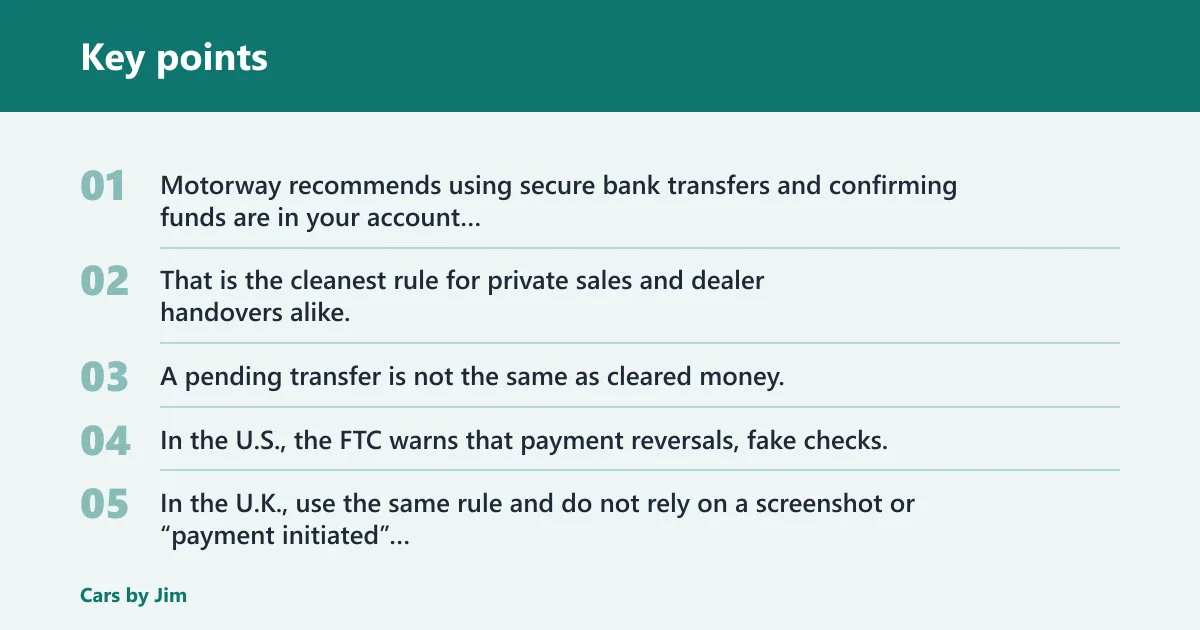
The same source recommends using secure bank transfers and confirming funds are in your account before handing over the keys. That is the cleanest rule for private sales and dealer handovers alike. A pending transfer is not the same as cleared money.
In the U.S., the FTC warns that payment reversals, fake checks, and overpayment scams are common in vehicle sales, so only release the car after your bank confirms the money is genuinely available. In the U.K., use the same rule and do not rely on a screenshot or “payment initiated” message. If the buyer says the payment is “processing,” wait. If the funds are not visible and cleared in your online banking, keep the car, the keys, and the paperwork. The buyer can return when the money is actually there. For more payment-safety context, see test-drive insurance.
Why to avoid cheques and drafts without verification
Motorway warns that fake cheques or bank drafts may look genuine. That is why a paper document is not enough. A bank should confirm the funds as cleared, not merely pending or “under review,” before you release the car.
If a buyer offers a cheque, ask for another payment method. If they insist that their draft is “as good as cash,” that is not your problem to solve. Your job is to avoid a loss, not to explain their banking process.
Overpayment scam warning signs
Motorway warns against overpayment scams where the buyer asks for a refund. The pattern is simple: they “accidentally” send too much, then request the difference back before the original payment fails or reverses. That refund is what exposes you.
Red flags include rushed messages, extra fees, and a request to send money to a different account. Do not refund anything from a payment you cannot verify. If the buyer says their assistant or shipper will sort it out, pause and verify the full story first.
Safe meeting and test drive steps
Meet in a public, well-lit place and keep the exchange short and controlled. A busy car park, shopping centre, bank location, or police station safe zone gives you witnesses and less privacy for pressure tactics. Never let the buyer take the car away alone.
Pick a public meeting point
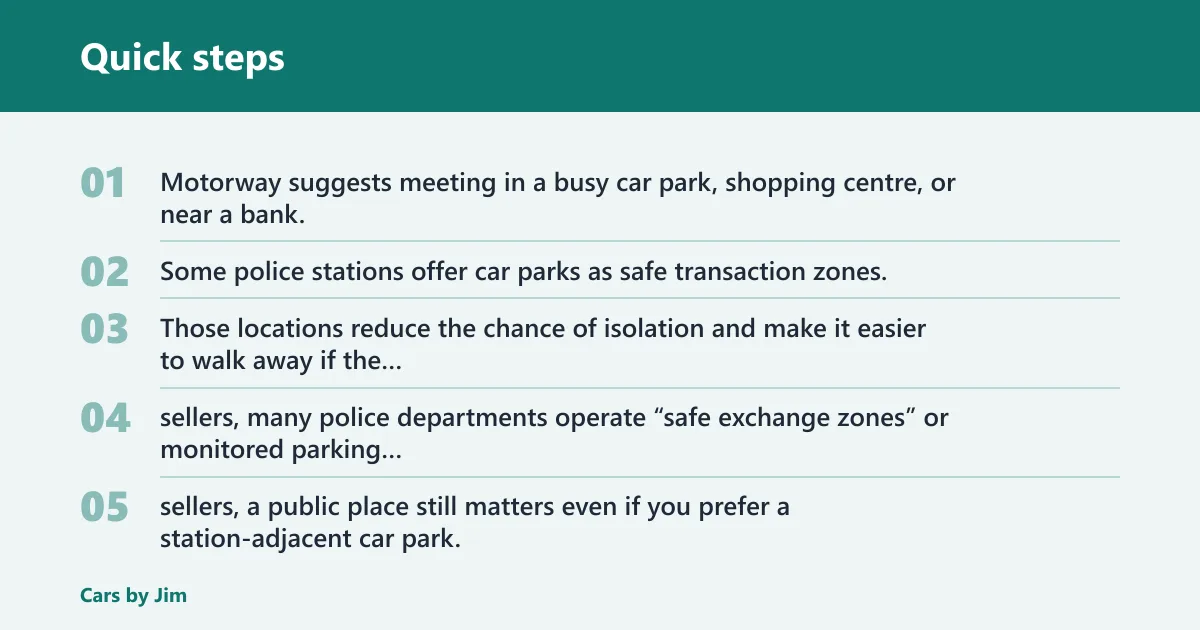
The same source suggests meeting in a busy car park, shopping centre, or near a bank. Some police stations offer car parks as safe transaction zones. Those locations reduce the chance of isolation and make it easier to walk away if the buyer changes the terms.
For U.S. sellers, many police departments operate “safe exchange zones” or monitored parking areas; use your local department’s official page to confirm the location before you agree to meet there. For U.K. sellers, a public place still matters even if you prefer a station-adjacent car park. Choose daylight when possible. Keep your phone charged. Tell someone where you are going and what time you expect to be back. A safe sale should not depend on guesswork.
Keep the seller present
The same source says never let a buyer take a solo test drive. Stay in the car for the drive, or arrange a route that keeps the buyer with you at all times. Leaving the buyer alone with the vehicle gives too much control to the other side.
Confirm insurance coverage before any drive. In the U.K., the buyer should have appropriate cover for driving another car; in the U.S., confirm in advance whether your policy permits a prospective buyer to drive and whether their own policy is primary. If the answer is unclear, do not hand over the wheel. Official guidance on test-drive coverage varies, so verify it with your insurer before the meeting.
Control the route and confirm insurance
Choose the route yourself. Keep it short. Avoid remote roads, long detours, and any request to “just pop over here first.” Tell someone else the meeting point and route before you leave.
A common first-timer mistake is to let the buyer suggest the route because it seems polite. That can create a delay, a secluded stop, or a reason to separate you from the car. Keep control from the start.
Honest listing and sale papers
Your listing should be clear, accurate, and boring in the best way. State the condition, mileage, service history, known faults, and why you are selling. Use clean photos and avoid showing your home address, driveway layout, or any document with personal details in the frame.
Listing hygiene that lowers risk
Write what a buyer needs to know, not what would make the ad sound perfect. Mention paint scuffs, warning lights, worn tyres, missing service stamps, and recent maintenance. Honest detail weeds out the wrong buyers and reduces late-stage disputes.
Include interior, exterior, tyres, dashboard, and boot photos. If the car has issues, show them. Hidden defects create arguments later, and arguments create pressure at handover. A straightforward listing is safer than a polished one.
Bill of sale and title transfer
After the payment clears, complete the title transfer and bill of sale. Make sure the buyer’s name, the vehicle identification details, the sale price, and the date are correct. Keep a copy for your records.
For the U.S., title transfer rules are state-specific; check your state DMV before the sale and confirm any required title assignment or release-of-liability filing. For the U.K., the DVLA says you should tell them as soon as you sell, transfer, or part-exchange the vehicle, and you can do it online at GOV.UK. For official guidance, see the DVLA service at https://www.gov.uk/sold-bought-vehicle and the U.S. vehicle-title overview at https://www.usa.gov/buy-sell-vehicle. For financed cars, confirm with the lender how payoff and title release work before you meet. For non-running cars, the bill of sale should still record the condition clearly and state whether collection, towing, or pickup is included.
Release of liability and same-day filing
File the release of liability or ownership transfer as soon as the sale is complete. The same source says to notify the DVLA immediately after the sale. If your local process allows same-day filing, do it the same day so the car is no longer tied to you.
Do not leave this step until later. Delayed filing can leave you exposed to parking fines, tolls, or notices tied to a car you no longer own.
Can you sell your car online without getting scammed?
Yes, but only if you treat every deal as unverified until the money clears and the paperwork is done. Common risks include sight-unseen offers, pressure to act fast, and fake payment claims. If the buyer will not slow down for checks, that is the signal to stop.
Sight-unseen offers
The same source says a sight-unseen offer is a red flag. That usually means the buyer wants to agree a price without seeing the car properly, then change the terms later or use the offer to push you into a rushed handover.
Say your car is a 2018 estate with a cracked rear lamp and a service light on. A buyer who still offers full price without asking for photos of the damage may be trying to get you to commit before they inspect it. That is not a safety win.
Pressure tactics and rushed timing
Pressure usually appears as a deadline, a cash shortage, or a claim that another seller is waiting. Do not let urgency replace checks. If they want the keys before the transfer clears, the answer is no.
Be wary of messages that say “someone else is ready to buy now” or “I need this today, so send the details immediately.” Fast is fine. Rushed is not.
Fake escrow and fake payment claims
Be careful with third-party escrow claims that you did not choose and cannot verify. Fake escrow services are common in scam messages because they sound official. So do fake payment screenshots, fake receipts, and claims that the transfer is “already on the way.”
Only trust what your bank confirms. If the buyer says their agent, courier, or escrow handler will release the funds after pickup, treat that as a hard stop. No confirmed funds, no car.
7-step checklist before you hand over the car
Use this checklist in order. If any step fails, stop the sale and do not release the vehicle.
- Screen the buyer by phone or video call.
- Check the profile name against the person and ask for a driving licence.
- Meet in a public, busy place.
- Keep the buyer with you for any test drive.
- Confirm cleared funds in your account.
- Complete the title transfer and bill of sale.
- Notify the DVLA or file ownership transfer immediately.
Frequently asked questions
How do I sell my car online safely?
Start with a reputable platform, verify the buyer by phone or video call, meet in a public place, and keep control of the test drive. Accept only a bank transfer that has cleared in your account, then finish the title transfer and release of liability before the buyer leaves. In the U.S., follow your state DMV process; in the U.K., file with the DVLA right away.
Where can I sell my car online for free?
Free options usually include large marketplace listings, which are a common free starting point. Free is convenient, but it can bring more unknown buyers, more messages, and more scam attempts, so the screening steps matter even more than on a paid channel. If you want a simpler route, compare that with an instant offer or dealer-buying service first.
What is the safest payment method when selling a car online?
A secure bank transfer with funds confirmed in your account is the safest common method. Do not rely on cheques, bank drafts, screenshots, or “pending” transfers. If the buyer overpays and asks for a refund, stop and verify the original payment before doing anything else.
Should I meet the buyer in person or use an instant offer site?
If you want the least contact and a lower handover risk, an instant-offer site or dealer network is usually the safer route. If you want a higher private-sale price and can manage checks yourself, meet in person only in a public place with payment confirmed first.
What paperwork do I need after selling my car online?
You usually need the title transfer, a bill of sale, and a release of liability or ownership filing. File the change immediately after the sale, and keep copies of everything. If your local authority uses same-day digital filing, do it before you leave the meeting point.