How to Check for Title Problems Before Buying a Used Car
Check the title first. Match the VIN on the title, dashboard, door sticker, and seller ID, confirm the title is in the seller’s name, and stop if you see a mismatch, salvage branding, or a missing lien release. That is the fastest way to avoid a car you cannot register, insure, or resell.
What title problems should you check first?
Start with ownership, identity, and branding. A clean-looking car is not proof of a clean title. The title, registration, and seller identity should all point to the same vehicle, with any lender claim cleared in writing. If the paper trail does not line up, pause before you inspect the car.
- Match the VIN on the vehicle to the title or registration certificate.
- Confirm the seller’s name matches the owner name on the paperwork.
- Check for salvage, rebuilt, flood, theft, or write-off branding.
- Look for any unpaid finance or lien that still needs release paperwork.
What you’ll need before you inspect the car
- The full VIN from the seller or listing
- The title or registration certificate
- V5C, where used
- A vehicle history report from a recognized provider
- Phone or notepad for matching details
How do you check for title problems before buying a used car?
Use a title-first sequence: collect the VIN, compare it against the car and paperwork, verify the seller’s identity, then read the vehicle history report for salvage, rebuilt, theft, flood, or write-off clues. If any step fails, do not move to payment or inspection booking until the mismatch is explained in writing.
- Ask for the VIN before anything else.
- Check the VIN on the dashboard plate, driver’s door sticker, title, and listing.
- Run a history report to check owners, mileage, theft, accident, and title status.
- Compare the seller’s name and address to the registration certificate or V5C.
- Check for salvage, rebuilt, or insurance write-off status before discussing price.
- Ask for lien release paperwork if the record suggests finance or a prior lender.
- Arrange a third-party pre-purchase inspection if the car is out of town or the paperwork is unclear.
How do you know if the seller actually has the right to sell the car?
Check whether the seller’s ID matches the title or registration certificate and whether the name sequence makes sense across every document. If the title is in another person’s name, the seller should be able to explain the relationship and show authority to sell. If the story changes, the risk rises fast.
The safest threshold is simple: if the seller cannot connect their identity to the vehicle’s paperwork, do not treat the deal as routine. Ask for release paperwork, not promises.
Watch for name and address gaps
The seller’s details should match the registration document, and the V5C should be present and unaltered where used. If the address changed recently, ask for a clear paper trail. A seller who cannot connect their ID to the car should not be treated as a normal private sale.
- Proceed only if the seller’s name matches the title or registration document.
- Verify any address change with supporting paperwork.
- Stop if the seller is vague about how they acquired the car.
- Verify before paying a deposit if the name sequence is inconsistent.
What title red flags should you look for in a vehicle history report?
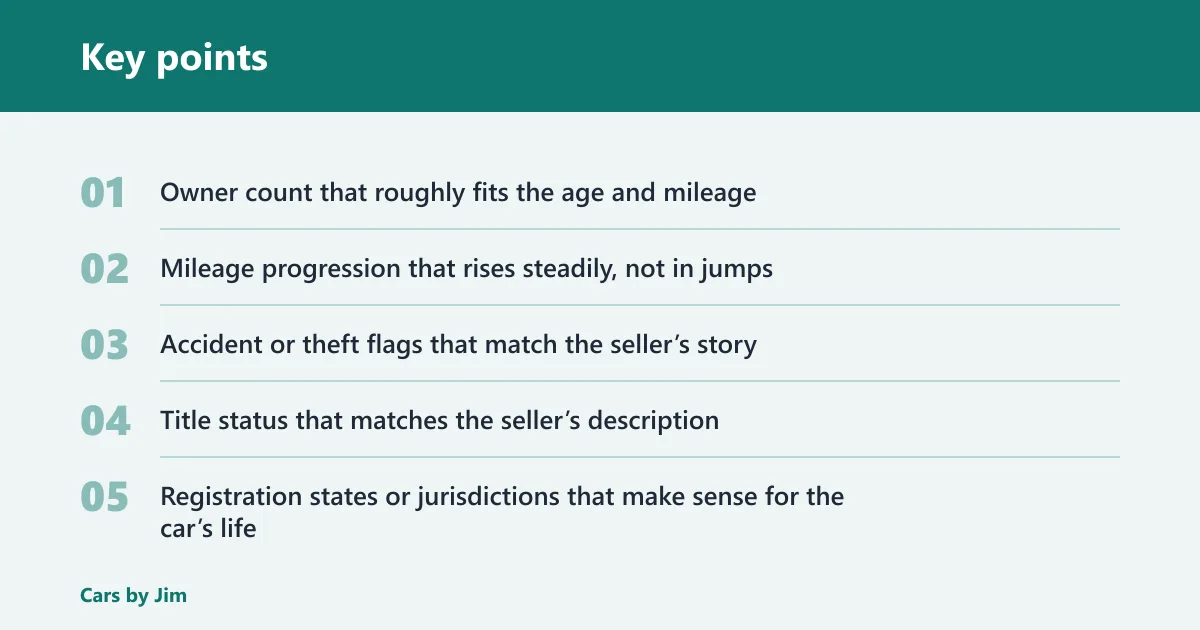
Look for salvage, rebuilt, flood, theft, and write-off markers first. A vehicle history report should show the number of owners and mileage, and it can also flag accident or theft notifications plus title status such as salvaged or flooded. A clean report does not prove the car is fine, but a bad one changes the deal immediately.
For U.S. vehicles, authoritative sources such as your state DMV and the National Insurance Crime Bureau (NICB) are the right places to verify title branding and theft-related concerns. For UK cars, gov.uk guidance and the DVLA are the primary references for V5C and title-related paperwork.
What to connect in the report
- Owner count that roughly fits the age and mileage
- Mileage progression that rises steadily, not in jumps
- Accident or theft flags that match the seller’s story
- Title status that matches the seller’s description
- Registration states or jurisdictions that make sense for the car’s life
For write-off categories, use the terms that apply in the market where the car is registered. In the UK, gov.uk and the DVLA use Cat S and Cat N for insurance write-offs. In the U.S., title branding is state-based and can include salvage, rebuilt, flood, or junk designations depending on the DMV.
Title risk checklist
| Check | What a clean result looks like | What a red-flag result looks like | What to do next |
|---|---|---|---|
| VIN match | VIN matches the car, title, and listing exactly | One digit off, removed plate, mismatched listing, or missing VIN | Stop and verify every document before any deposit. Proceed only when all VINs match exactly. |
| Seller ID match | Name and address line up with the title or V5C | Different name, vague ownership story, or ID that does not fit | Pause and request proof of ownership or authority to sell. Proceed only if the seller can document the link. |
| Title branding | No salvage, rebuilt, flood, theft, or write-off brand | Salvage title, rebuilt title, or Cat C, Cat D, Cat S, Cat N history | Verify with the DMV, state title record, or gov.uk/DVLA context. Proceed only with full disclosure and pricing that reflects the brand. |
| Lien release | Clear proof that a lender released its claim | No release document, unpaid finance clue, or “seller will sort it later” | Stop until you see lien release paperwork. Do not pay or take delivery without a written release. |
| Duplicate-title clues | Paper trail is consistent and current | Duplicate copies, altered dates, crossed-out details, or thin history | Verify with the issuing DMV or licensing office. Proceed only after the duplicate issue is explained and documented. |
| Registration history | Owner count and mileage progress logically through the report | Sudden mileage gaps, odd state changes, or a very short paper trail | Stop and cross-check the history report with the seller’s paperwork. Proceed only if the timeline makes sense. |
| Follow-up actions | Proceed to inspection or negotiate with the full paper trail | Pause, verify, or walk away if answers stay vague | Use a hard stop on any unresolved mismatch. Proceed only after every red flag is cleared in writing. |
How do I spot VIN cloning or a fake title?
Look for a VIN that appears too new, too clean, or too thin for the vehicle’s age. A short or missing history on an older car can be a warning sign, especially if the body, trim, or wear does not fit the record. VIN cloning often shows up as paperwork that looks tidy but does not fit the vehicle.
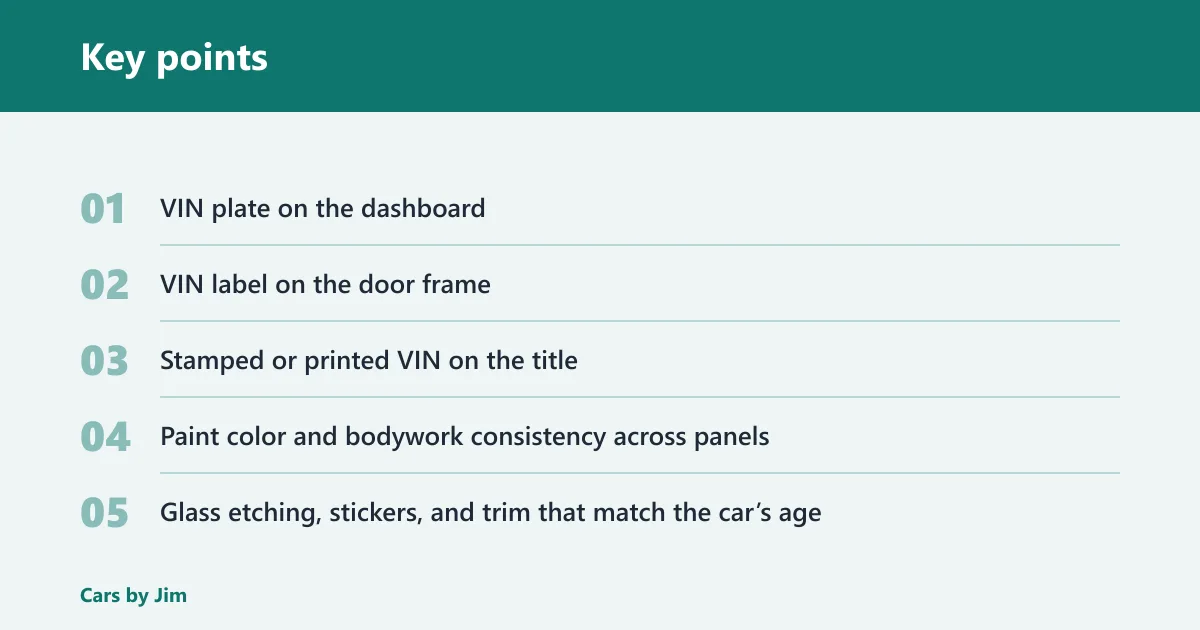
Compare the VIN plate, the door-frame label, and the title record with the car’s physical condition. Uneven panel gaps, mismatched paint, inconsistent trim, or signs of removed labels can point to a swapped identity, prior damage, or a cloned vehicle.
What to compare on the car itself
- VIN plate on the dashboard
- VIN label on the door frame
- Stamped or printed VIN on the title
- Paint color and bodywork consistency across panels
- Glass etching, stickers, and trim that match the car’s age
If the history report is unusually short for the age of the car, verify the VIN with the issuing agency or the seller’s paperwork before you go farther. A clean-looking title page is not enough on its own.
Should I get a third-party inspection before buying a used car?
Yes, if the car is far away, the seller is private, or the title story is not fully clean. A third-party pre-purchase inspection from an independent mechanic or body shop can uncover hidden damage not shown in paperwork. Use it after the title checks, not before them.
- Use an inspection for out-of-state purchases.
- Use an inspection for private sales with thin paperwork.
- Use an inspection for rebuilt or salvage title vehicles.
- Use an inspection when the report shows prior damage or theft flags.
- Use an inspection when bodywork mismatch suggests hidden repairs.
What should you know about UK and US title paperwork?
Keep UK and U.S. paperwork rules separate. The UK uses the V5C registration document and insurance write-off categories such as Cat S and Cat N. The U.S. uses state-issued title records, and brand names can vary by DMV. Do not mix the systems when you are checking a specific car.
UK paperwork basics
- Use the V5C to confirm the registered keeper details.
- Check gov.uk guidance for write-off categories and transfer steps.
- Verify any changes against DVLA records where available.
US paperwork basics
- Use the title issued by the state DMV or motor vehicle agency.
- Check for branded title status such as salvage, rebuilt, flood, or junk where applicable.
- Confirm lien status before purchase if the title lists a lender.
What common mistakes do buyers make with title checks?
The biggest mistake is skipping paperwork because the car looks clean. A straight body does not prove title status, owner count, or lien status. The paperwork can be the only place a problem shows up before money changes hands, so the title check should happen before the test drive turns into a purchase decision.
- Do not accept “the title is coming later” without proof.
- Do not assume a clean exterior means a clean record.
- Do not rely on the seller’s verbal explanation alone.
- Do not pay a deposit until the VIN and ownership details match.
- Do not treat a rebuilt or write-off car as a normal clean-title deal.
Separate negotiable issues from deal-breakers. A rebuild history can sometimes be priced fairly if the repair records are complete and the inspection is strong. A mismatch in VIN, seller identity, or ownership documents is different. That should stop the purchase.
Frequently asked questions
What documents should I verify before buying a used car?
Check the title, V5C or registration certificate, any lien release document, and the vehicle history report. The VIN should be identical across all of them. Missing, altered, or crossed-out paperwork is a warning sign, especially in a private sale.
Can a car history check show if the title is salvaged or rebuilt?
Yes. A vehicle history report can show title status such as salvaged or flooded, and it can flag rebuilt title information. Use that report together with the car’s VIN and the seller’s documents, because a clean-looking title page alone is not enough.
Sources
- National Insurance Crime Bureau (NICB) vehicle theft and title-related guidance
- State Department of Motor Vehicles / motor vehicle agency title and lien records
- National Highway Traffic Safety Administration (NHTSA) VIN-related consumer guidance
- gov.uk guidance on vehicle registration and insurance write-offs
- DVLA guidance on the V5C registration certificate