Should You Sell Your Car or Keep It?
Sell the car if its equity is strong, the next 12 months of repairs will top its value, or a replacement costs less than keeping it on the road. Skip that math and you can pour money into a car that still leaves you stranded, or sell too early and absorb a loss you did not need. This guide weighs equity, repair runway, and replacement cost so you can choose the next move with numbers, not attachment.
How do you make the quick decision?
Start with three checks: current value, loan payoff, and what the next year of ownership will cost. If the car is safe, dependable, and cheap to keep, holding on is often the better move. If repair risk, negative equity, or replacement math turns against you, selling now can be the smarter call.
When should you keep the car?
Keep it when the vehicle is paid off or nearly paid off, runs well, and the next 12 months of tires, brakes, oil, and flagged work stay below the cost of replacement. A car that still fits your commute and family needs can be worth keeping even when it is older, as long as repairs stay predictable.
When should you sell now?
Sell now when safety is weak, dependability is slipping, or the repair forecast is about to jump. A simple rule is this: if the next 12 months of maintenance and likely repairs will approach or exceed the cost of replacing the car, the ownership math has already turned against you.
When should you get offers before deciding?
Get offers before you decide if the car is financed, if the market value feels uncertain, or if you may want to trade before another repair lands. The car’s value should come from a real offer, not the highest guide figure. That matters because instant-offer pricing, trade-in value, and private sale value often differ.
How should you read the car equity decision table
Equity changes the sell decision because it tells you whether the loan payoff can be covered by the car’s current value. Positive equity gives you room to sell. Negative equity narrows your choices, especially if the gap is large or repairs are coming soon.
| Owner scenario | Recommended choice | 12-month cost logic | Key warning sign | Next action |
|---|---|---|---|---|
| Paid off and reliable | Keep it | No monthly payoff remains, and routine maintenance is usually cheaper than replacement payments. | Repairs stay minor and infrequent. | Set aside a repair reserve and recheck value at the next service interval. |
| Financed with positive equity | Get offers and compare | The current value can cover the loan payoff and leave room for a clean exit if replacement costs make sense. | The payoff quote is below current offer value. | Request the lender payoff quote and compare trade-in, private sale, and instant offers. |
| Underwater on the loan | Usually keep it unless repair risk rises fast | Negative equity means the payoff is higher than value, so selling now can create a cash shortfall. | The payoff quote exceeds value by more than $1,000. | Keep the car if it is still safe and usable; selling usually makes sense only if the repair picture worsens or you can cover the gap. |
| High-repair-risk | Sell now if offers are workable | Big repairs can outrun the next 12 months of ownership and make replacement cheaper than continued fixes. | Repeat shop visits, major flagged work, or safety problems. | Price the repair, price the replacement, then decide before the next failure. |
Can negative equity still justify selling?
Yes, but only when the reason to sell is strong enough. Negative equity can still make sense if the car is unsafe, the repairs are piling up, or a replacement is materially cheaper over 12 months. If the gap is modest and the car is dependable, keeping it is usually safer financially.
How much equity do you have?
Equity is the car’s current value minus the loan payoff quote. Positive equity means the car is worth more than you owe. Negative equity means you owe more than the car is worth, which makes selling harder because the sale has to clear the lender first.
How do you find the current value?
Use a real offer, not the highest guide number. That is the clearest way to see what the market will pay today. Compare trade-in, private sale, and instant-offer numbers, because each can land in a different band. Used-vehicle pricing sources such as Kelley Blue Book, Edmunds, and J.D. Power are useful starting points, but an actual offer is the best check.
How do you get the lender payoff quote?
Ask for the exact lender payoff quote, not just the statement balance. The payoff quote is the amount needed to clear the title, and it can differ from the regular balance shown on your monthly bill. That number is what matters if you plan to sell, trade, or refinance.
What is the difference between positive and negative equity?
Positive equity gives you room to sell without writing a check at closing. Negative equity does the opposite. Experian and Edmunds have both reported that negative equity remains common in trade-ins, which matters because it can trap owners in a car that is still usable but financially weak to replace.
Suppose your car is worth $14,000 and the payoff quote is $11,500. That leaves $2,500 of positive equity, which gives you options. If the same car is worth $14,000 but the payoff quote is $15,400, selling becomes a cash problem, not a simple yes-or-no decision.
Is your next year of ownership affordable?
The next 12 months matter more than the last 12. Add expected repairs, tires, brakes, oil, and any flagged work, then compare that total to the cost of replacing the car. If the repair side keeps climbing, the car can be safe yet still too expensive to keep.
How do you build a 12-month repair forecast?
Start with basic service, then add the items already on the horizon. Tires, brakes, oil changes, and any inspection notes should go into the total. If the mechanic has already flagged suspension work, leaks, cooling issues, or electrical faults, include those too. A forecast that ignores known work is not useful.
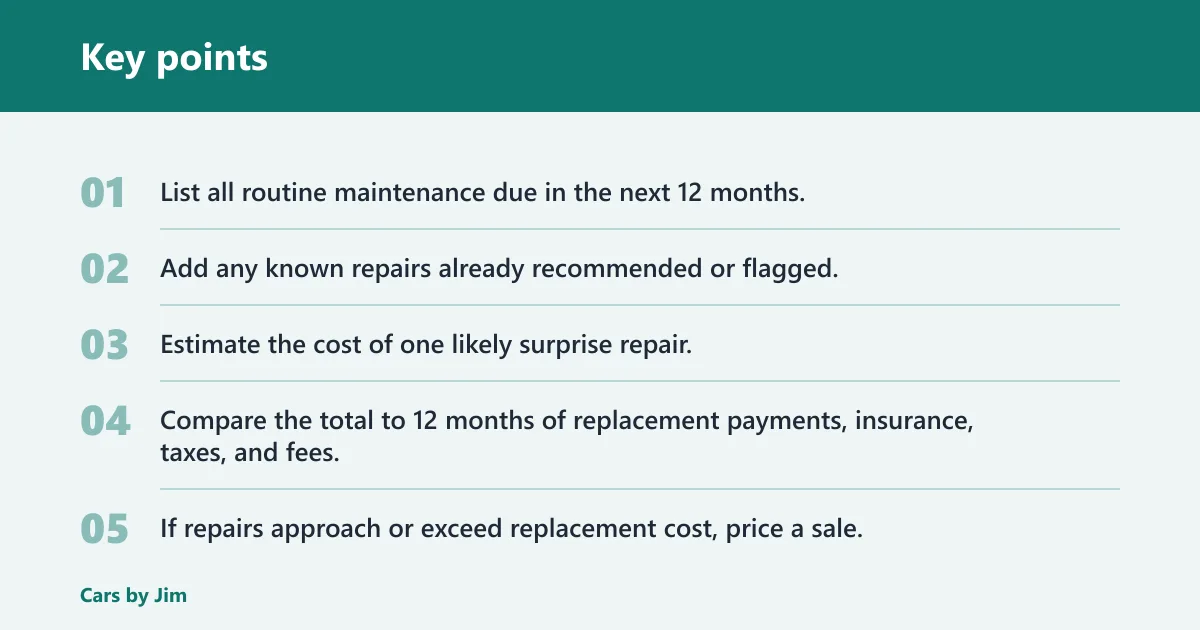
- List all routine maintenance due in the next 12 months.
- Add any known repairs already recommended or flagged.
- Estimate the cost of one likely surprise repair.
- Compare the total to 12 months of replacement payments, insurance, taxes, and fees.
- If repairs approach or exceed replacement cost, price a sale.
What should you compare repairs against?
Replacement cost is more than the sticker price of another car. Add the payment, insurance, taxes, registration, and fees. Then compare that total to the repair forecast. A paid-off car can still win if repairs stay modest. A financed replacement can lose if the new monthly bill creates more strain than the old car’s repairs.
When is a car too expensive to fix?
A car is too expensive to keep fixing when the next 12 months of repairs, routine maintenance, and downtime are likely to meet or exceed the cost of replacing it. A practical rule is simple: if repair spending is climbing toward replacement cost, and the car is not delivering dependable transportation in return, sell it.
How should age affect the decision?
Age is a signal, not a verdict. Older cars usually need closer monitoring and more frequent maintenance, but condition still matters more than the calendar. Industry depreciation data from sources like Black Book and Manheim show that vehicles lose value fastest early on, then flatten out, which is why age alone should not drive the sell decision.
When does age and mileage tip the scale?
Age and mileage matter because they change both value and risk. Higher mileage can cut resale value, while older cars usually need more maintenance and closer monitoring. That does not mean every older car should go. It means the margin for surprise repairs gets thinner.
What does five to seven years old usually mean?
This is often the best balance point for reliability and resale. The car is old enough to have taken its steepest depreciation hit, but young enough that major systems may still be in good shape. If repair history is clean and safety features still meet your needs, keeping it can make sense.
What does eight to 12 years old usually mean?
Many owners keep cars around 8 to 12 years. That can be a solid ownership window if maintenance stays orderly. At this age, the question is less about age alone and more about whether repeat repairs are starting to stack up faster than the car’s value.
What should you know about 150,000 miles and beyond?
Many vehicles can run well past 150,000 miles, but depreciation and repair risk can rise. Mileage is not a hard cutoff; condition and maintenance matter more. Cars with high mileage often lose resale value faster, especially if service records are incomplete or major systems are aging at the same time.
What market value can you actually get?
Market value is not one number. Wholesale trends, instant-offer pricing, trade-in quotes, and private sale offers all point to different outcomes. If you need speed, convenience may cost money. If you want top dollar, time and effort usually increase.
What do wholesale trends tell you?
Wholesale values set the floor for many dealer offers. Manheim’s Used Vehicle Value Index and similar wholesale benchmarks matter because they help explain why dealer and instant-buy offers move up or down. When wholesale conditions weaken, trade-in and resale offers often soften too.
How does trade-in compare with private sale?
A trade-in is usually faster and simpler, but a private sale may bring more money. The gap can be meaningful when equity is thin. If you owe money on the car, a stronger private-sale number can be the difference between walking away cleanly and rolling negative equity into the next loan.
How should you use instant-offer pricing?
Instant offers are useful when you want a fast, concrete number. They also help when you are deciding whether to sell now or wait. If the offer is strong enough to clear the payoff and leave room for your next move, you have a practical exit point. If it is weak, keeping the car another year may be the better value.
What does a 12-month decision worksheet say?
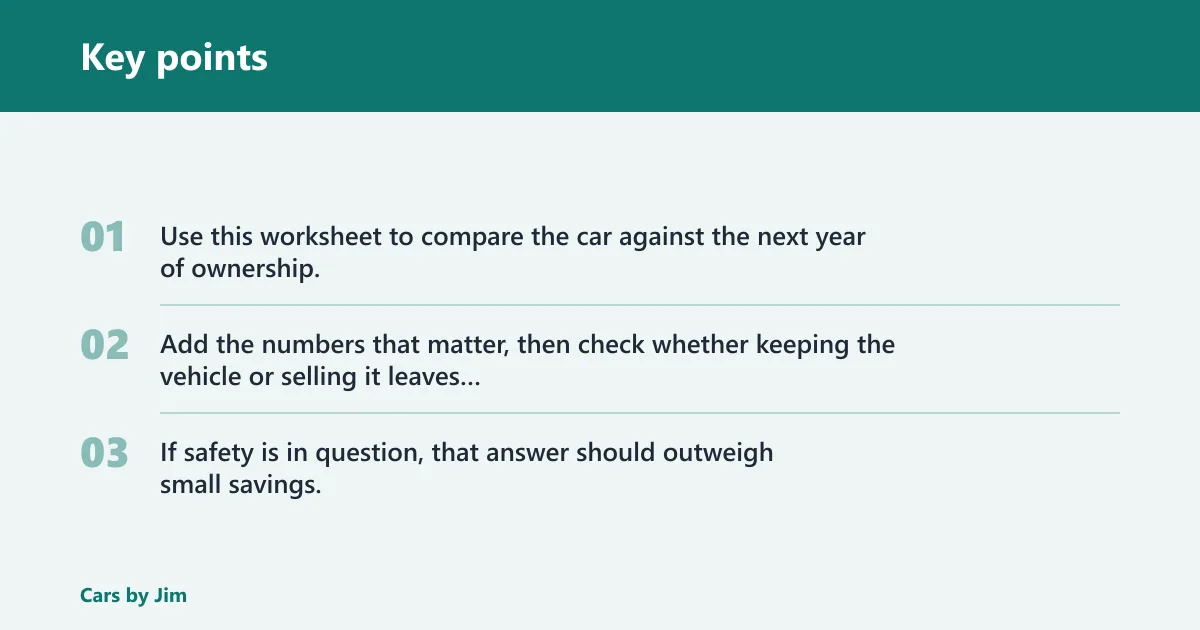
Use this worksheet to compare the car against the next year of ownership. Add the numbers that matter, then check whether keeping the vehicle or selling it leaves you with the lower overall cost and the lower risk. If safety is in question, that answer should outweigh small savings.
| 12-month item | Amount | Notes |
|---|---|---|
| Current offer | $ | Use trade-in, private sale, or instant-offer value. |
| Loan payoff quote | $ | Use the exact payoff amount from the lender. |
| Expected maintenance | $ | Oil, filters, tires, brakes, and routine service. |
| Likely repairs | $ | Known or probable work from inspection notes. |
| Replacement payment | $ | Monthly payment on the next car for 12 months. |
| Insurance | $ | Estimated annual premium difference versus the current car. |
| Taxes and fees | $ | Sales tax, registration, title, and dealer fees if applicable. |
| Final keep/sell outcome | Keep / Sell | Choose the lower-cost option that also meets your safety needs. |
Should you keep fixing it or let it go?
Keep fixing it when the car is safe, the repairs are predictable, and the total for the next year still beats replacement. Let it go when reliability falls, the repair list gets longer, or the car no longer feels safe enough for daily use. A car can be mechanically drivable and still be the wrong car to keep.
What safety and reliability red flags matter most?
An unsafe or unreliable vehicle is a sell trigger. Chronic overheating, brake problems, stalling, steering faults, and repeated no-start issues all point in the same direction. If the car leaves you uncertain about getting to work, school, or family obligations, the ownership math has already gotten worse.
When do outdated safety features matter enough?
Outdated safety features matter more when the car is aging and the commute is longer. Missing modern driver-assist systems is not by itself a reason to sell, but outdated crash protection, weak lighting, poor visibility, or missing stability features can tilt the decision if the car is already expensive to maintain.
Say your car needs $1,400 in tires and brakes now, then another $2,200 repair is likely within a year. If replacement would cost about the same as one year of ownership, the old car is no longer the cheaper path. If the same car only needs tires and an oil change, keeping it may still be the better call.
Frequently asked questions
Should I sell my car or keep it?
Sell it if the car has strong equity, the next 12 months of repairs are likely to top its value, or a replacement will cost less than keeping it. Keep it if it is safe, dependable, and the repair forecast stays below what replacement would cost over the same period.
Should I sell my old car or keep it?
Age alone is not enough. Many owners keep cars around 8 to 12 years, and 5 to 7 years can still be a strong resale window. If the car is older but still reliable and affordable to maintain, keeping it may make more sense than replacing it early.
How much equity should I have before selling my car?
Positive equity is the cleanest position because the sale can cover the lender payoff quote. If equity is negative, especially by more than $1,000, keeping the car is often the safer financial move unless safety or repair costs make the car a poor bet to keep.
When is a car too expensive to keep fixing?
A car is too expensive to keep fixing when the next 12 months of repairs, routine maintenance, and downtime start to rival replacement payments. If a major repair lands on top of tired tires, weak brakes, or repeat faults, the car can still be drivable and still be the wrong car to keep.
Can I sell a car I still owe money on?
Yes, if the sale covers the lender payoff quote. The payoff quote is the exact amount needed to clear the title, and it can differ from the statement balance. If the car is underwater, you may need to bring cash to closing or wait until equity improves.
How long should you keep your car?
There is no fixed deadline. Many owners keep cars for a long ownership cycle, and the right time to sell depends on safety, maintenance, and value. Keep it as long as the car remains dependable, affordable, and well matched to your needs.
Should I sell my car now or wait?
Sell now if the car is safe but financially weak to keep, if repair risk is rising, or if current market offers are strong enough to clear the loan and fund the next move. Wait if the car is paid off, dependable, and the next year looks cheaper than replacing it.