Is There a Free Accident History Report for a Car?
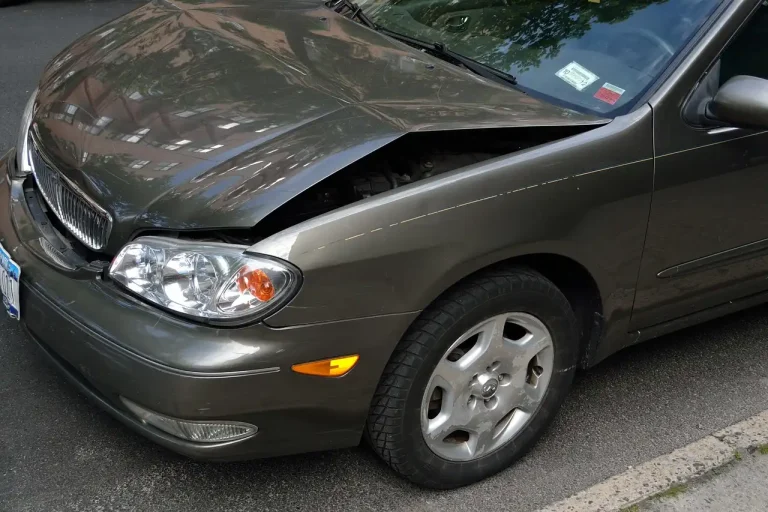
Yes, you can confirm some accident clues for free, but a complete, trustworthy accident history usually requires a paid report. Missed damage can leave bad repairs on the car, cut resale value at trade-in, and hide safety faults in airbags, frame rails, or suspension parts. This guide shows what free checks can verify, what free sources cannot be trusted for, and when paying for a report is worth it.
Free accident check basics
A free VIN lookup can surface title brands, some auction damage clues, and recall status. It does not give you a full accident record. A clean free result still leaves gaps, especially when events were never reported, were recorded only in one database, or fell below a state’s branding threshold.
What a free VIN lookup can show
Free tools may flag a salvage title, a rebuilt title, airbag deployment, or auction damage codes. Some free checks also show open safety recalls through the free accident-related checks workflow. That is useful, but it is not the same thing as a complete vehicle history report.
What a free lookup cannot prove
A free result cannot prove that a car has never been damaged. Private cash repairs may never enter any database. Dealer-lot damage, small insurance claims, and some state-only records can also be missing. A clean result only means the tool did not find reportable issues in its available sources.
Where the free data usually comes
Free accident checks often pull from NMVTIS title data, insurance claims feeds, police-report aggregators, and auction records. NMVTIS is the U.S. Department of Justice vehicle information system used to centralize title-related data from participating sources, while recall status comes from the National Highway Traffic Safety Administration’s VIN-based recall lookup. State DMV branding rules can also affect what appears; for example, California DMV and many other state agencies apply their own title-branding standards, so the same event may be treated differently across states.
Is there a free accident history report?
Yes, there are Accident records checks you can access for free, but they are usually partial. You can often confirm title problems and some damage signals without paying. If you need a dependable answer about crash history, repair severity, or total-loss status, a paid report is usually the better buy.
Short answer for used-car buyers
If the car shows a salvage title, rebuilt title, airbag deployment, or auction damage, stop treating it like a normal clean-title car. Free checks can uncover those red flags fast. They cannot reliably tell you the whole story behind a clean-looking listing.
When free checks are enough
A free check is enough when you are screening a long list of cars and want to eliminate obvious problems first. It is also enough when you only need to confirm whether a vehicle has an open recall, or whether the title history already contains a major warning.
When you should pay for a full report
Pay when the car is expensive, the seller is vague, the price sits near market value despite suspicious photos, or you see any damage clue at all. Paying is also worth it when you are choosing between two similar cars and one has a cleaner paper trail.
Picture two sedans with the same mileage. One has a clean free result and no red flags. The other shows an auction damage code and a rebuilt title. The second car deserves a paid report first, because the free clues already point to a past major event.
VIN and free data sources
A VIN is the 17-character Vehicle Identification Number used to identify a specific car.
VIN basics and where to find it
Any free check starts with the VIN, not the model name or trim guess. A valid VIN has 17 characters, and that exact string is what ties the car to title data, insurance files, police records, and auction history. If the VIN is wrong, the lookup is wrong.
NMVTIS title data
NMVTIS is the U.S. Department of Justice vehicle title system. It helps connect title brands and total-loss-related records reported by participating states, insurers, and junk/salvage yards. It is one of the main back-end layers behind title warnings, especially salvage and rebuilt branding, but it is not a complete accident database.
A salvage title usually means a state branded the vehicle as salvage after a serious loss event, but the exact threshold and wording vary by state and by damage type. A rebuilt title means the car was previously salvage branded, repaired, and passed state inspection. Those are not small footnotes. They are major signals that the car has been through a serious event.
Police, insurance, and auction records
Police crash reports can add crash location, contributing factors, and tow-away details. They may show that the car was towed from the scene, which usually signals more than a minor bump. But not every crash is recorded, and not every report is tied cleanly to the VIN.
Insurance total-loss records often create or support a salvage brand, but they do not capture every accident. That makes them important, while still incomplete in a free tool. Auction damage records can add damage codes, condition grades, and sale prices, which are especially useful when a car passed through a salvage or rebuilt lane.
Airbag deployment is often a strong free clue because it can point to a significant collision. Frame or structural damage is even more serious. It can affect handling, crash protection, and resale value, and it usually deserves a specialist inspection.
Open safety recalls
Open safety recalls are separate from accident history. They are free, government-sourced, matched to the VIN, and can usually be handled at a dealer using the NHTSA recall lookup. A recall tells you about a safety defect. It does not tell you whether the car was in a crash.
Free check or pay for the full report?
The decision turns on the strength of the signal. If the free check only confirms the VIN and shows no red flags, that is not enough to trust the car’s accident history. If the free check shows title branding, airbag deployment, or auction damage, paying for the full report is usually worth it.
| Signal found | What it likely means | Confidence level | Likely source layer | Next action |
|---|---|---|---|---|
| Salvage title | State-branded loss event, often tied to major damage | High | NMVTIS / state DMV / insurer | Pay for the full report and inspect the car closely |
| Rebuilt title | The car was once salvage branded, repaired, and re-inspected | High | State DMV / NMVTIS | Pay for the full report and get a mechanic inspection |
| Airbag deployment | Strong collision clue, often linked to a significant impact | High | Insurance / police / auction | Pay for the full report and verify repair quality |
| Auction damage codes | Evidence of reported damage, sometimes with sale and condition details | Medium to high | Auction | Pay for the full report if the car is worth serious consideration |
| Police report | Recorded crash details, possibly including tow-away or location data | Medium | Police | Use it as a clue, then confirm with a paid report |
| Missing accident data | The car may still have damage that was never reported | Low | Unknown / missing from all layers | Do not assume it is clean; check deeper or pay for the report |
| Clean free results with no red flags | No reportable issues were found in the free sources | Low | Limited free sources only | Do not stop here; pay if the car matters or the price is high |
| Rank | Free accident signal | Why it ranks here |
|---|---|---|
| 1 | Salvage title | Strongest paper trail of a total-loss event |
| 2 | Rebuilt title | Confirms a prior salvage brand and repair path |
| 3 | Airbag deployment | Strong indicator of a serious collision |
| 4 | Auction damage code | Often points to a documented loss or repair issue |
| 5 | Police crash report | Helpful detail, but often incomplete and not universal |
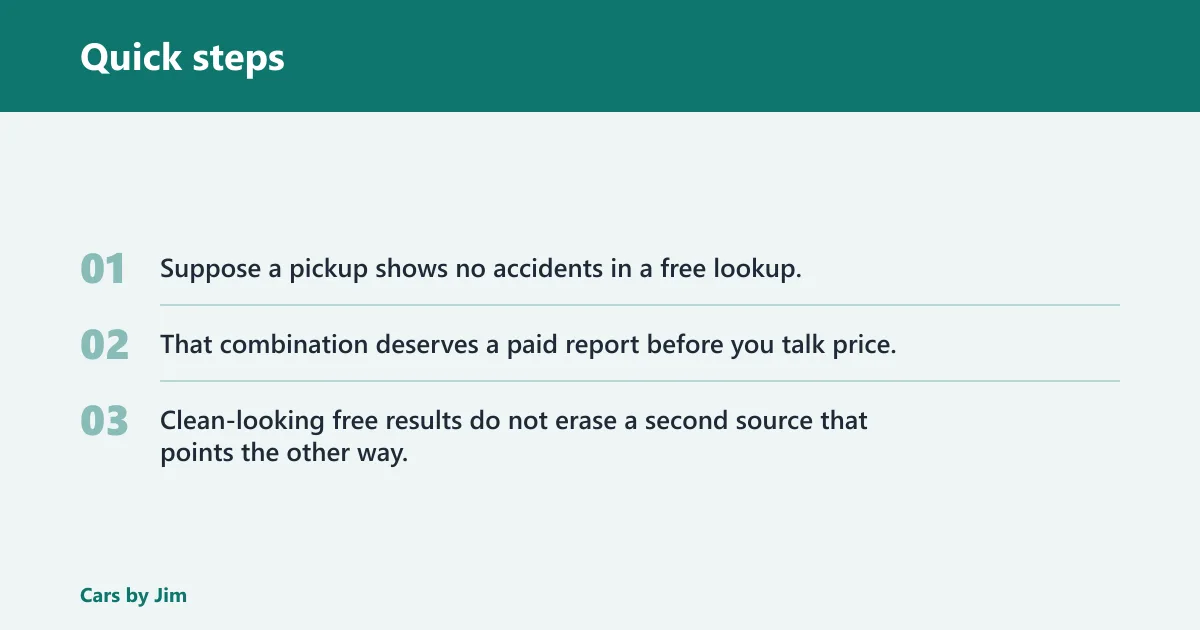
Suppose a pickup shows no accidents in a free lookup, but the auction record lists a damage code and a low condition grade. That combination deserves a paid report before you talk price. Clean-looking free results do not erase a second source that points the other way.
Why accident records go missing
Accident records go missing for a few common reasons. A crash may never reach a database, or it may be recorded in one source and not another. That is why a clean free check cannot prove the car is accident-free.
Private repairs and cash damage fixes
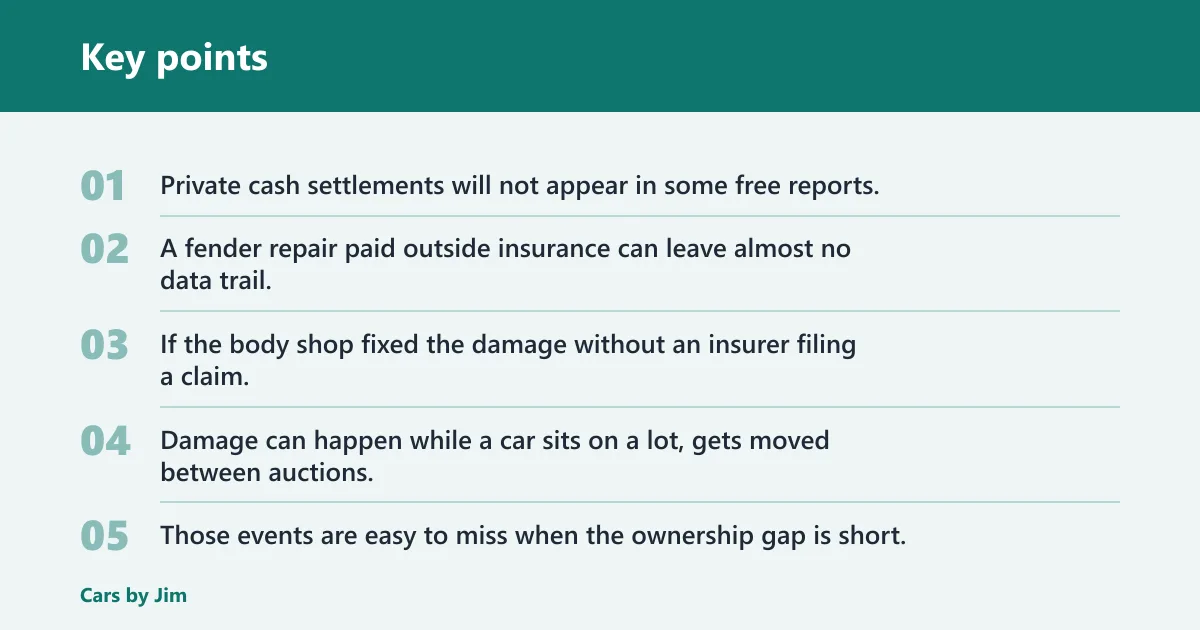
Private cash settlements will not appear in some free reports. A fender repair paid outside insurance can leave almost no data trail. If the body shop fixed the damage without an insurer filing a claim, the free report may stay silent.
Dealer-lot damage and short ownership gaps
Damage can happen while a car sits on a lot, gets moved between auctions, or changes hands quickly. Those events are easy to miss when the ownership gap is short. A vehicle can look fine in a listing while the repair history remains thin.
State and source reporting differences
States do not report the same way, and not every agency sends data at the same speed. One database may flag the event while another never does. That is why police, DMV, insurer, and auction data should be read as separate clues, not as a complete record on their own.
What to do with salvage or rebuilt titles
A salvage title is a major red flag because it usually reflects a state-branded total-loss event. A rebuilt title is better than salvage, but it still tells you the car was damaged enough to need repair and reinspection. In both cases, the burden shifts to you.
Why salvage is a major red flag
A salvage brand often means repair costs or loss conditions crossed a state-specific threshold tied to the vehicle’s value, but that threshold is not uniform nationwide. Some states use percentage rules, others use different event definitions, and some separate flood, theft, and collision branding. That is not light damage. It usually means the car had major structural, mechanical, or safety-related problems at some point.
Why rebuilt still needs a close inspection
A rebuilt title only means the car passed a state inspection after repair. It does not prove the repairs were thorough, or that every safety concern was corrected. A clean-looking repaint can still hide poor structural work underneath.
Why a mechanic inspection still matters
Have a mechanic inspect any salvage or rebuilt car before you buy it. Ask for a close look at frame rails, welds, airbag status, suspension wear, and signs of uneven body repairs. A paid report narrows the risk. A physical inspection confirms whether the repairs were done well.
Frequently asked questions
Can I check a car’s accident history for free?
You can check for free accident clues, but not a complete accident history. Free tools can reveal salvage titles, rebuilt titles, some auction damage, and sometimes airbag deployment. They cannot reliably prove the car has never been damaged or repaired.
What free accident information can I actually see on a VIN report?
Free VIN checks may show title branding, auction damage codes, airbag deployment signals, and open safety recalls. They may also show police or insurance clues if those records are in the tool. The missing piece is completeness, which is why a paid report still matters.
Why don’t all accidents show up on a vehicle history report?
Some crashes never get reported to insurers or police. Others are repaired with cash, handled privately, or recorded in only one state or database. Minor cosmetic repairs are especially easy to miss, and a clean report does not mean the car never had damage.
Are free accident history reports reliable enough to trust?
They are reliable for spotting red flags, not for clearing a car. A free report is useful when it shows something bad. It is weak evidence when it shows nothing at all, because missing data is common across private repairs, dealer damage, and reporting differences.
What should I do if a free report shows a salvage or rebuilt title?
Pause and verify the car with a full paid report and a mechanic inspection. Salvage usually means the vehicle was branded by a state after a major loss event. Rebuilt means it was repaired and re-inspected, but that does not guarantee the repairs were thorough or safe.
Can I check accident history without paying for CARFAX?
Yes, you can check some accident clues without paying for CARFAX. Free tools may surface title brands, auction damage, and recall data. If the car is valuable or the free check raises any concern, a paid report is usually worth the cost.
What is the difference between a free VIN check and a paid vehicle history report?
A free VIN check usually shows limited, high-level data such as title branding, recall status, or a few auction and damage clues. A paid vehicle history report usually pulls from more source layers and gives a fuller timeline, which makes it better for judging accident severity and missing records.
| Check type | Typical data shown | Confidence | Best use case |
|---|---|---|---|
| Free VIN check | Title brand hints, recall status, limited damage or auction clues | Low to medium | Quick screening and red-flag detection |
| Paid vehicle history report | Broader title timeline, more auction detail, insurance and loss signals, ownership context | Medium to high | Buying decisions, pricing, and deeper accident verification |