How Do Dealers Calculate Trade-in Value?
Dealers calculate trade-in value as a live bid: current wholesale market data minus reconditioning, transport, financing, and profit reserve, then adjusted for local demand and the car’s condition. Miss that math, and you can accept thousands less than your car is worth or misread a low offer as unfair. This guide shows the inputs dealers use, how they price condition, and how you can estimate your own trade-in range before you visit.
What trade-in value means
Trade-in value is the amount a dealer is willing to credit toward your next purchase for your current car. It is usually lower than private-party value because the dealer must inspect the car, recondition it, assume some risk, and still leave room to profit when it resells the vehicle. The amount is an offer, not a fixed quote.
Trade-in value versus private-party value
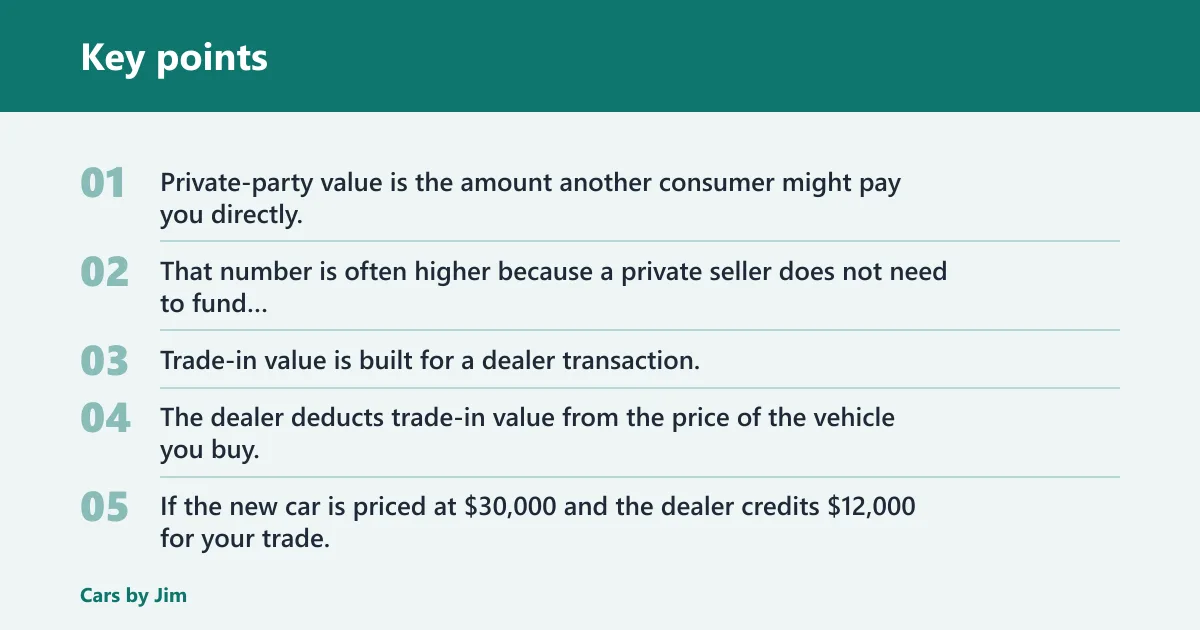
Private-party value is the amount another consumer might pay you directly. That number is often higher because a private seller does not need to fund reconditioning, lot overhead, or resale margin. Trade-in value is built for a dealer transaction, so it reflects what the dealer thinks the car can wholesale for, or retail for after work is done.
How the trade-in reduces the purchase price
The dealer deducts trade-in value from the price of the vehicle you buy. If the new car is priced at $30,000 and the dealer credits $12,000 for your trade, your trade reduces the amount you must finance or pay in cash. That does not mean the trade is worth $12,000 to everyone in every market. It means that dealer is willing to apply that credit in that deal.
Why the number is a live bid
A trade-in offer changes with wholesale prices, regional demand, and the dealer’s current stock needs. A car that is scarce on the used lot can draw a stronger bid than the same car at a store already full of similar inventory. Online estimates can point you toward a range based on current market data, but the final figure is set after the in-person review.
How dealers build the offer
Dealers usually start with wholesale market data, then subtract the costs they expect to absorb before the car can be sold again. Black Book valuation data is widely used by dealerships for vehicle appraisal. It is updated daily and draws from wholesale auctions and actual vehicle sales nationwide, which makes it a common reference point for trade-in estimates. (Motortrend)
Wholesale, auction, and retail anchors
Dealer math starts near wholesale because that is the price level where cars move between dealers and at auction. Retail asking prices sit higher because they include a seller’s margin and room for negotiation. The appraiser is trying to land between those two anchors, while leaving space for transportation, inspection findings, and the cost of putting the car on the lot.
Reconditioning, risk, and margin
After the market anchor is set, the dealer estimates what the car needs to be sale-ready. Tires, brakes, windshield chips, missing keys, warning lights, stains, odors, bodywork, and wheel damage can all lower the offer. The dealer also prices risk, such as hidden mechanical issues, title problems, or slower-than-expected resale time.
What dealers inspect first
Dealers usually start with mileage, overall condition, and any visible signs of wear or damage. Mileage is a key appraisal input because lower or higher mileage changes what the car should bring in the market. They also look at title status, accident history, options, warning lights, and whether the car is missing equipment or keys.
Mileage and model year context
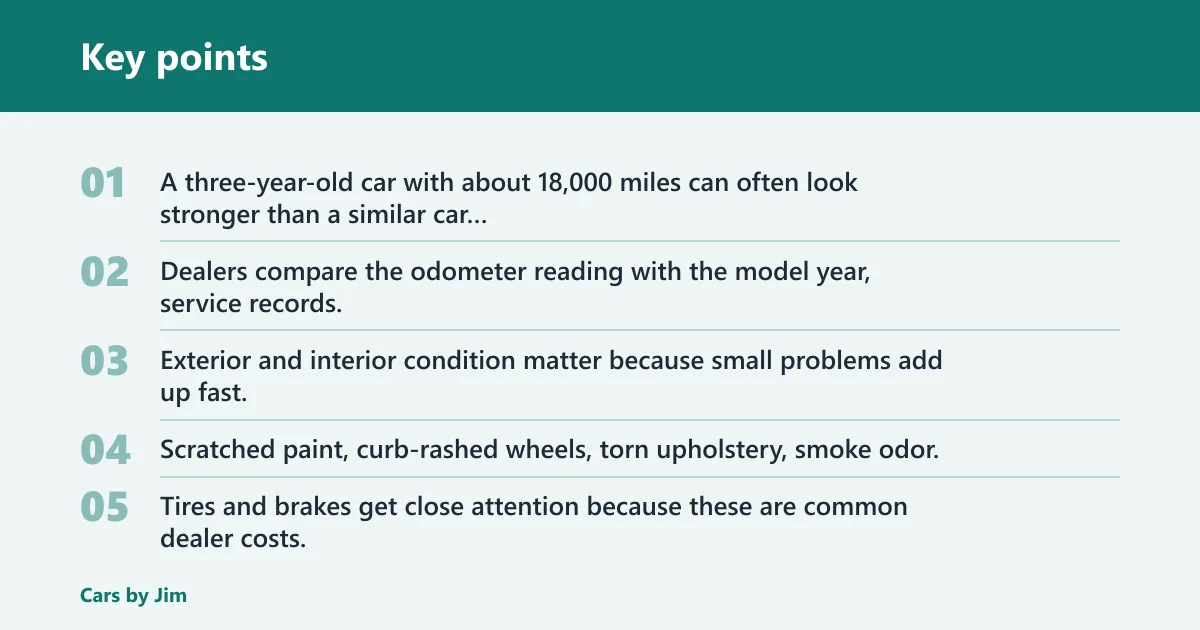
Mileage is not judged in a vacuum. A three-year-old car with about 18,000 miles can often look stronger than a similar car with about 54,000 miles, while an older commuter with high mileage may still be acceptable if the wear fits the age. Dealers compare the odometer reading with the model year, service records, and what similar cars are bringing in the market.
Condition, tire wear, and brake wear
Exterior and interior condition matter because small problems add up fast. Scratched paint, curb-rashed wheels, torn upholstery, smoke odor, and stained carpets all reduce value. Tires and brakes get close attention because these are common dealer costs. A car with worn tread or thin brake pads can get a lower offer even if it runs well.
Accident history, title status, keys, odors, and warning lights
A clean title usually helps. A salvage, rebuilt, or branded title can cut value sharply because the next buyer may face financing or insurance limits. Accident history can also reduce the bid, especially if body panels do not line up or paint shades do not match. Missing keys, warning lights, and strong odors are other common deductions because they point to extra expense or buyer hesitation.
Say your compact SUV has 42,000 miles, decent paint, and one tire near the wear bars. A dealer may value the car reasonably well on the market side, then subtract the cost of a full tire set and any brake work that shows up during inspection. The result can be a noticeably lower number than the online estimate, even though the car drives normally.
How options and market data affect value
Trim level and optional equipment change the offer because dealers need to know exactly which car they are pricing. A base trim and a higher trim can differ in seats, safety tech, wheels, and infotainment, and those features affect demand. Market trends and regional demand can move the number quickly, especially for fuel-efficient cars, trucks, and seasonal vehicles.
Trim level and equipment
Base versus higher trim matters because equipment changes resale appeal. Leather seats, a factory tow package, advanced driver aids, and larger wheels can add value if local buyers want them. On the other hand, some options have little payoff in trade because the dealer may not recover their full cost at resale.
Optional equipment and VIN accuracy
Factory options and added features can improve appraisal accuracy because they help the dealer identify the exact build. A VIN is not necessary to get a car value estimate from MotorTrend, but a VIN can tighten the match because it reveals trim and equipment details. MotorTrend says its tool provides both private-party and dealership trade-in estimates, and its values are updated daily.
Seasonality and local demand
Regional pricing can swing with seasonality. A four-wheel-drive truck may bring more in a snowy region during winter, while a convertible may look stronger when warm weather demand rises. Dealers watch what similar cars are selling for nearby, because a strong national guide can still miss a local shortage or glut.
Dealer checklist table
This table shows how a dealer usually turns appraisal inputs into a bid. Use it to sanity-check each line before you accept the number.
| Valuation factor | Typical dealer adjustment logic | Shopper evidence to bring | Questions to ask |
|---|---|---|---|
| Mileage | Lower mileage usually supports a stronger offer; high mileage can reduce value, especially above peers in the same model year. | Photo of the odometer, service records, prior inspection reports. | What mileage band are you comparing this car to? |
| Condition | Interior wear, exterior damage, smoke odor, stains, dents, and paint issues lower the bid by estimated repair cost plus margin. | Clear photos of the body, seats, dash, carpet, and any damage before arrival. | Which condition items are actual deductions versus normal wear? |
| Tires and brakes | Worn tread, uneven wear, warped rotors, or thin pads usually trigger a reconditioning deduction. | Tire tread photos, recent brake invoices, alignment paperwork. | Are you deducting for parts, labor, or both? |
| Accidents | Accident history can lower value, with the size of the hit depending on repair quality and visible fit-and-finish issues. | Repair invoices, body shop estimates, photos before and after repair. | Is the deduction based on disclosed history or visible damage? |
| Title status | Clean title is preferred; branded, salvage, or rebuilt titles can sharply reduce usable trade value. | Title document, payoff statement if there is a loan, prior title paperwork. | Does the title status change how you can retail the car? |
| Options and equipment | Higher trim, factory options, and desirable packages can increase value if the dealer expects resale demand. | Window sticker, build sheet, VIN report, option list from the seller app or registration packet. | Which options actually affect your offer? |
| Market demand | Local demand, season, and inventory levels can move the bid up or down quickly. | Competing listings from local dealers, screenshots of similar vehicles for sale. | How does local demand change this offer today? |
| Loan payoff and negative equity | If the payoff exceeds the trade value, the shortfall must be rolled, paid, or otherwise handled in the deal structure. | Current payoff quote from the lender, account number, lienholder contact details. | How much negative equity is separate from the vehicle’s value? |
Why your estimate and offer differ
Online estimates are useful, but they are not final offers. They rely on market data and your input, and they may not capture fresh damage, missing equipment, odors, or a title issue that appears during inspection. Dealers also adjust for timing, local inventory, and what it will cost to recondition and resell the car.
Online estimator limits
Some tools can work without a VIN, which makes them quick, but that also means they may rely on rough trim and equipment assumptions. That is why the number can move once the dealer sees the exact car. Car and Driver also uses Black Book data for valuation, and it notes that trade-in value can affect how much car you can afford.
Dealer inspection adjustments
A dealer may lower the initial estimate after seeing tire wear, brake wear, warning lights, stained upholstery, or body damage that was not visible in the form you filled out. Missing floor mats, a second key, or a cargo cover can matter too. These are small items individually, but together they can change the live bid.
Regional and timing differences
Market trends change quickly. A car that looks strong in one region can bring a weaker offer in another if supply is heavy or demand is thin. That is why the same car can generate different trade figures at different stores, or even at the same store a few weeks apart.
Suppose a midsize sedan has an online estimate of $14,200, but the dealer finds two tires near replacement and a persistent check-engine light. The offer may fall by the expected repair cost plus a buffer for risk. That is not the dealer changing the value at random. It is the dealer pricing the car as it sits.
How to negotiate a better trade-in
You can improve the odds of a stronger offer by bringing proof, comparing bids, and keeping the trade number separate from the purchase price. The cleanest negotiation starts with records that reduce the dealer’s uncertainty. If you can show how the car was maintained, you make it easier for the appraiser to justify a better bid.
Bring service records and photos
Maintenance receipts, tire invoices, brake work, and recent inspection reports help show that the car was cared for. Clear photos of the car before any detailing or repairs also help if a dealer questions condition. If you recently replaced a major item, bring the invoice.
Get competing offers
Another dealer may place a different value on the same car because its inventory needs are different. Getting more than one offer gives you a better sense of the range. It also helps separate a real market result from one store’s aggressive margin target.
Separate trade value from purchase price
Dealers sometimes blur the new-car price and the trade number into one payment figure. Keep them separate. A stronger trade number is useful, but so is a lower purchase price. Look at both lines before you decide, because a padded new-car price can erase a better trade credit.
Start with a market estimate from a valuation tool, then refine it with your car’s exact mileage, trim, options, and condition. Next, subtract any likely reconditioning costs you can see from the outside, such as tires, brakes, or cosmetic damage. Finally, compare that range to local offers and your loan payoff if you still owe money.
A simple way to sanity-check the number
- Look up a trade-in estimate from a valuation tool that uses current market data.
- Confirm the exact trim, major options, and mileage.
- List visible repair items, including tires, brakes, glass, body damage, warning lights, and odors.
- Ask the dealer which deductions are from market value and which are reconditioning.
- Compare the trade credit with the purchase price and your payoff quote.
How dealerships determine trade in value
Dealerships determine trade-in value by starting with wholesale-based market data, then adjusting for the specific car in front of them. They look at condition, mileage, trim, accident history, title status, options, and current demand, then subtract reconditioning and resale risk. The final figure is the dealer’s live bid, not a universal value.
What trade in value do dealers use
Dealers usually use wholesale and auction-based references rather than retail asking prices. Black Book data is widely used by dealerships for vehicle appraisal, and it is built from wholesale auctions and actual vehicle sales nationwide. That gives the dealer a market anchor, but the in-person inspection still decides the final adjustment.
Use a trade-in estimate as a starting point, then adjust for mileage, condition, options, and likely reconditioning costs. If the car has negative equity, treat the payoff gap separately from the car’s value. The simplest formula is market estimate minus deductions, with the final number shaped by local demand and dealer margin.
Frequently asked questions
How accurate are online trade-in estimates?
Online estimates are best treated as ranges, not final offers. They can be fairly useful when the car is standard and the information you enter is accurate. They become less precise when the car has unusual wear, missing equipment, accident history, or a trim and option mix the tool cannot identify well.
Can I negotiate using an online trade-in estimate?
Yes. An online estimate can support your ask, especially if it comes from a valuation source tied to current market data. Bring the estimate with service records, photos, and competing offers. A dealer may still adjust the number after inspection, but the estimate gives you a reference point for the conversation.
Why is the dealership offer different from my online estimate?
The dealer sees the car in person and prices what it will cost to resell it. That means tires, brakes, warning lights, odors, body damage, title issues, and missing items can reduce the offer. Regional demand and the dealer’s current inventory can also move the bid away from the online number.
What factors lower a dealer’s offer?
Common deductions include high mileage, worn tires, thin brakes, accident history, title brands, cosmetic damage, warning lights, odors, and missing keys or equipment. Negative equity does not lower the car’s actual value, but it can change the final deal structure because the payoff exceeds the trade amount.
Do dealers use wholesale or retail pricing?
For trade-ins, dealers usually start with wholesale logic and then work toward a number they can defend after reconditioning and resale. Retail asking prices are higher and leave room for negotiation, so they are not the right baseline for a dealer’s offer. Wholesale data is the cleaner reference point.
How do dealerships determine trade in value?
They begin with market data, often from wholesale-based sources, then inspect the car and adjust for the specific unit. Mileage, trim, options, condition, accident history, title status, tires, brakes, and local demand all affect the bid. The number is a dealer offer, not a published constant.