How Do I Find the Value of a Used Vehicle for Free?
Start with one free valuation tool, then check it against a VIN history report and at least three local comparable listings. If the results stay within about 10% to 15%, the estimate is usually considered credible. Skip those checks, and you can overpay, price too low, or miss damage and title issues that can change value fast. This guide shows how to triangulate a free used-vehicle value in minutes.
Free car value in 3 checks
Enter year, make, model, trim, mileage, ZIP code, and condition. If you have the VIN, add it too. The result should show a trade-in estimate, a private-party estimate, or both, plus a market benchmark you can compare with local listings.
- Run one free valuation tool and capture the value type you need.
- Check the VIN for exact trim, equipment, accident, and title history.
- Compare the result with at least three similar local listings to confirm the range.
What value number do you need?
Pick the number that matches your goal before you compare tools. Trade-in value is the dealer’s offer toward another car, private-party value fits a sale between two consumers, and market value is the benchmark you use to judge whether the asking price looks normal.
Trade-in value vs. private-party value
Trade-in value is usually closer to wholesale and auction pricing, so it is the right number if you plan to leave the car with a dealer. Private-party value is usually higher because the buyer pays closer to retail, and the sale does not include dealer overhead, financing, or warranty support.
Where market value fits
Market value helps you pressure-test the other two numbers. It reflects current pricing for comparable vehicles and can move with region and demand, so it works well when you want a fast benchmark rather than a selling strategy.
Which number to use for your goal?
If you are trading in, focus on trade-in value. If you are selling privately, focus on private-party value. If you are deciding whether a listing looks inflated or too cheap, compare the market value against local ads and recent comparable vehicles.
What details do you need first?
You can get a rough estimate with basic vehicle details, but the more complete the input, the better the result. At minimum, gather year, make, model, trim, mileage, and condition. If you have the VIN, use it, because it can improve exactness and expose equipment and history details.
VIN, year, make, model, and trim
Consumer Reports asks for year, make, model, and trimline, and the VIN can narrow the vehicle to an exact configuration. A modern VIN has 17 characters and can often help reveal history, recalls, specs, and value data. That matters when two vehicles look similar but are not built the same.
Mileage and condition
Mileage is a major value driver, and higher mileage usually lowers the estimate. Condition matters just as much. Damage, worn interiors, mechanical issues, and reconditioning costs can pull the number down fast if you rate the vehicle honestly. (Consumerreports)
Options, packages, and accident history
Options and packages may add little or no resale value unless they are verified equipment that buyers actually want. Accident history can reduce value substantially, especially with flood, fire, salvage, or total-loss records. Be exact, because valuation tools use what you enter.
How do you get a free estimate?
Use one free valuation tool first, then check the result against a vehicle history report and local ads. Some tools give a useful estimate without payment or account creation. Others ask for an email or signup before showing the number, so choose a source that lets you see the estimate before you commit.
Use a valuation site
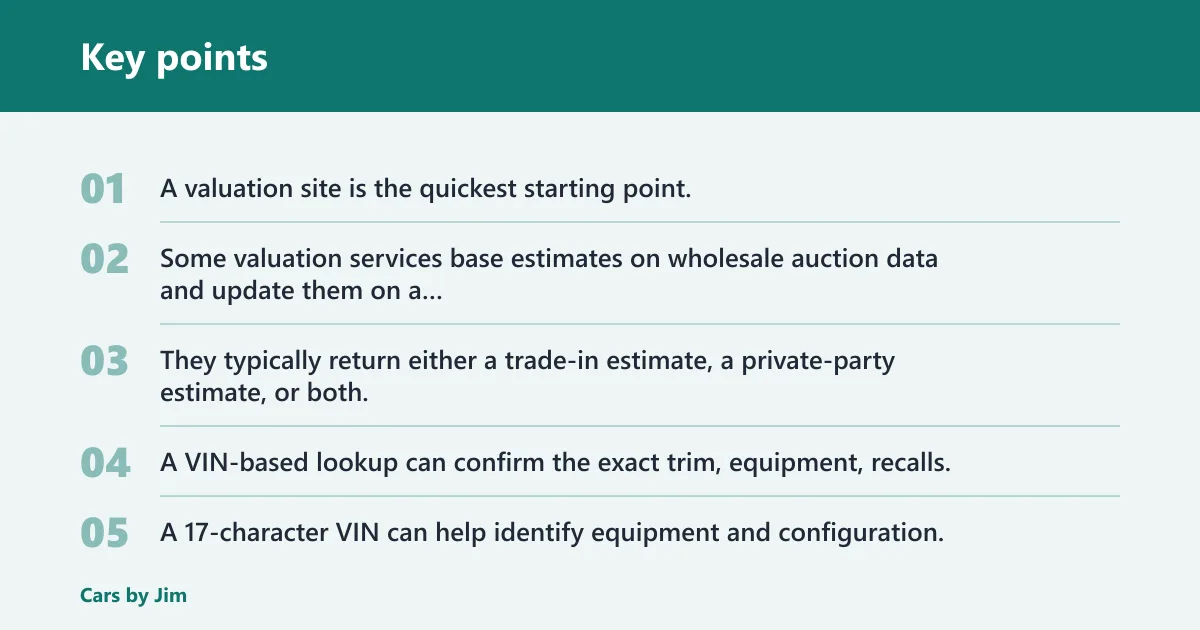
A valuation site is the quickest starting point. Some valuation services base estimates on wholesale auction data and update them on a regular schedule, which is why they can be useful for dealer-style pricing rather than just retail asking prices. They typically return either a trade-in estimate, a private-party estimate, or both, based on age, mileage, condition, options, and comparable market data.
Try a VIN and history lookup
A VIN-based lookup can confirm the exact trim, equipment, recalls, and history before you trust a price. A 17-character VIN can help identify equipment and configuration, while title and accident records can explain why a vehicle is worth less than a similar clean-title car. Those checks matter because hidden history can change value fast.
Compare local comparable listings
Look up at least three nearby vehicles with the same body style and close mileage. Match trim first, then condition, then equipment. Local market conditions can move value up or down, and dealer inventory can change offers quickly. A vehicle that is common in one area may command less in another.
Picture a 2019 midsize SUV with 68,000 miles and no visible damage. If the free estimate is close to nearby listings for similar trim and mileage, that is a better sign than any single site’s number. Suppose the same SUV has a flood record. The value should fall sharply, and the history check will explain why.
What changes the number most?
Mileage and condition usually move the estimate more than options. Accident and title history can cut value hard, especially when the record shows flood, fire, salvage, or total loss. Local demand and dealer inventory then push the number up or down around that baseline.
Mileage and condition: high mileage usually lowers value
High mileage usually lowers value because it increases wear and expected reconditioning costs. Condition works the same way: visible wear, mechanical faults, and deferred service make the vehicle harder to resell. The more repairs a buyer or dealer expects, the lower the number tends to go.
Accident and title history
Accident history matters when damage is more than cosmetic. A clean title and a minor repair are very different from a flood or salvage record. Free history tools can surface those issues, and the valuation should drop if the record suggests hidden risk.
Local demand and dealer inventory
Two identical cars can price differently in different cities. A dealer short on compact SUVs may offer more for one, while a market flooded with the same model may push offers down. Pricing guides that refresh on a weekly basis can still lag fast-moving local conditions, so nearby listings matter too.
Free value triage table
| Source | Input needed | What it tells you | When to trust it | Red flags |
|---|---|---|---|---|
| Valuation tool | Year, make, model, trim, mileage, condition | Trade-in, private-party, or market estimate | When trim and mileage match your car closely | Missing trim, vague condition, no local adjustment |
| VIN history lookup | 17-character VIN | Exact configuration, recalls, title and accident clues | When you need the exact vehicle and history | No VIN match, mismatched trim, missing title data |
| Local comparable listings | ZIP code, similar model, mileage, and condition | What nearby sellers are asking now | When at least three close matches exist | Far-away listings, rebuilt titles, dealer add-ons, odd mileage gaps |
| Dealer offer | Vehicle inspection and appraisal | Actual trade-in number | When you are ready to replace the car | Pressure to buy first, vague deductions, missing inspection notes |
What to do with a low or high result
If the estimate comes back low, check for missed damage, a bad trim match, or a history record that the tool may have found. If it comes back high, compare it against local ads and a second valuation source. A number that sits far outside the rest usually needs another look.
How accurate are free value tools?
Free tools are usually good enough for a fast estimate, not a final offer. Different sites can disagree because they use different data, different update schedules, and different assumptions about condition and local demand. A number that stays close across sources is more believable than a single perfect-looking result.
Why different sites differ
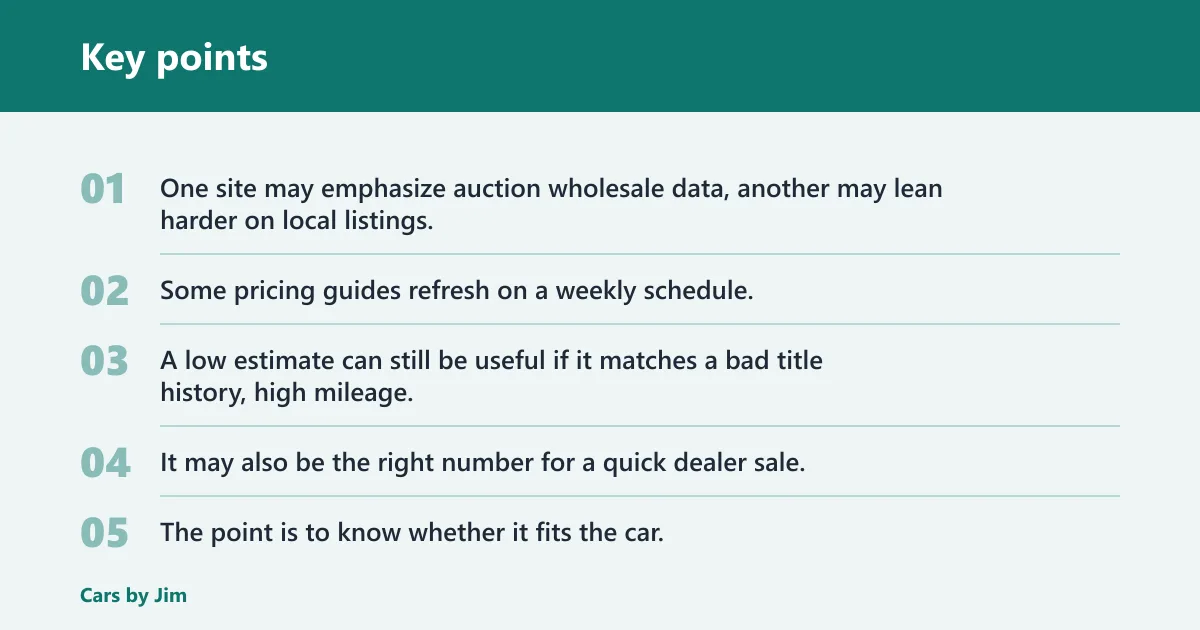
One site may emphasize auction wholesale data, another may lean harder on local listings, and another may weight condition differently. Some pricing guides refresh on a weekly schedule, while others update at different intervals. That timing alone can create a gap.
When a low estimate is still useful
A low estimate can still be useful if it matches a bad title history, high mileage, or heavy wear. It may also be the right number for a quick dealer sale. The point is not to like the number. The point is to know whether it fits the car.
When to double-check the result
Double-check any estimate that is much higher or lower than nearby comparable listings. Also double-check if the tool allowed a guess for trim or condition. A free estimate without a VIN can still help, but it is less specific than a VIN-based check.
How do you compare prices in 10 minutes?
Use three screens: a trade-in estimate, a private-party estimate, and nearby listings. Match trim, mileage, and condition first. If the listing prices are far above the estimates, look for a reason such as unusually low miles, upgraded equipment, or a seller who is overpricing the car.
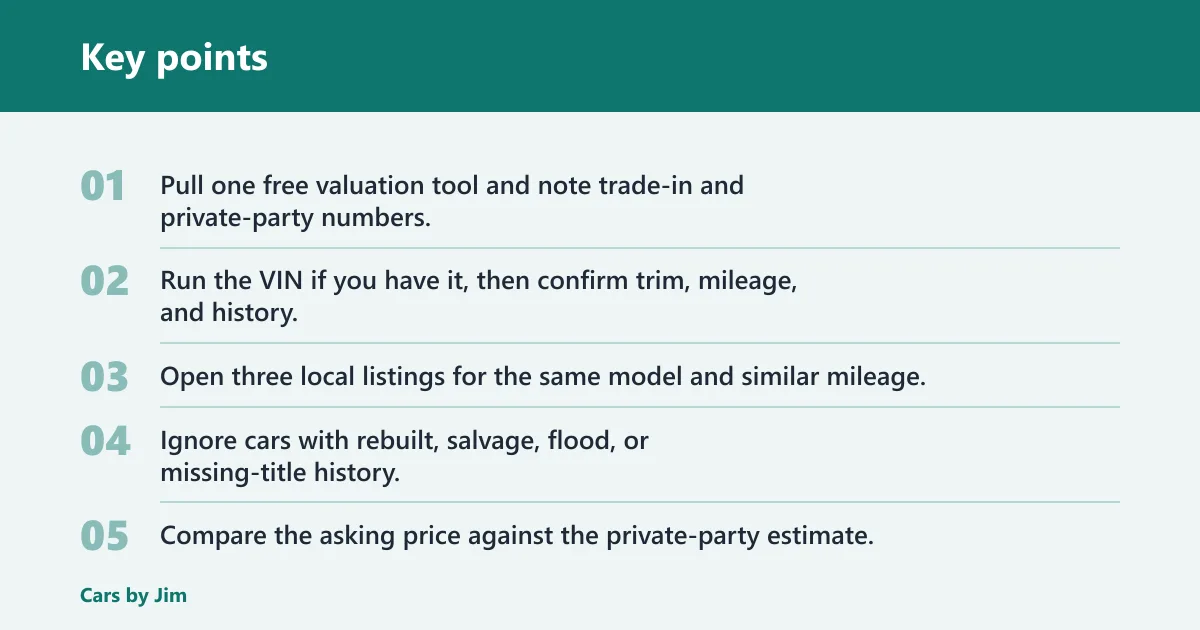
- Pull one free valuation tool and note trade-in and private-party numbers.
- Run the VIN if you have it, then confirm trim, mileage, and history.
- Open three local listings for the same model and similar mileage.
- Ignore cars with rebuilt, salvage, flood, or missing-title history.
- Compare the asking price against the private-party estimate, then check whether it is within about 10% to 15%.
- If one source is far off, recheck condition, trim, and accident records before you trust the number.
A common first-timer mistake is comparing a base trim against a loaded trim and calling the difference a “bad estimate.” That is usually a bad match. Options and packages only help if they are verified equipment that buyers in your area actually want.
Say your sedan has 92,000 miles, a clean history, and average wear. If one site returns a strong trade-in number but the local dealer lots are full of similar cars, the dealer offer may still land lower. The lot may not need another copy of that car.
Triangulation example: how to reconcile a 10% to 15% spread
Suppose a midsize SUV shows $18,000 as trade-in value, $21,000 as private-party value, and $20,200 in comparable local listings. That spread is normal. The trade-in number is lowest because it tracks wholesale-style pricing, the private-party number is higher because it includes consumer-to-consumer retail value, and the local listings sit between them because they reflect current asking prices. If the three are within about 10% to 15%, the estimate is usually in the right zone.
Frequently asked questions
How do I find the value of my car for free?
Use one free valuation tool, then check the result against a VIN history lookup and at least three local comparable listings. That gives you a quick estimate and a reality check. If the three sources cluster closely, the number is usually believable enough for a trade-in or private sale decision.
What is the best site for used car values?
The best site depends on what you need. Use a tool that gives trade-in and private-party values if you are selling, and pick one that uses current market data if you want a pricing benchmark. A good tool should also let you verify trim, mileage, and history before you rely on the result.
Can I check my car’s value without paying or signing up?
Yes, sometimes. Some valuation pages show an estimate before payment or account creation. If a site blocks the number behind a signup, move to another free source and compare. The goal is to get a believable estimate quickly, not to hand over information just to see a number.
What details do I need to estimate a used vehicle’s value?
Have the year, make, model, trim, mileage, and condition ready. If possible, add the VIN, options, accident history, and title status. Consumer Reports asks for year, make, model, trimline, mileage, condition, and additional options, which shows how much detail improves the estimate.
How accurate are free car value tools?
They are accurate enough for a starting point, not for a final sale price. Different tools use different data and may weight mileage, condition, and local demand differently. If the estimate is supported by the VIN history and nearby listings, it is far more credible than a number that stands alone.
What’s the difference between trade-in, private party, and market value?
Trade-in value is the dealer’s offer toward another car and is usually closer to wholesale. Private-party value is the price between two consumers and is often higher than trade-in. Market value is the benchmark price for comparable vehicles, which helps you judge whether a listing is realistic.