How to Negotiate Dealer Fees at a Used Car Dealership
Negotiate dealer fees by asking for the out-the-door price, then split out taxes, title, registration, and dealer add-ons. If a fee is optional, ask to have it removed or offset in the sale price. Skip this, and you can pay hundreds more for charges that did nothing to change the car itself. This guide gives you a line-by-line script for challenging fees, comparing quotes, and locking the deal to the out-the-door number.
What dealer fees actually cover
Dealer fees show up near the end because they are added after the advertised price, and that is where the final number can jump fast. The right comparison number is the out-the-door price, which includes the vehicle price plus taxes, title, registration, and dealer fees. Ask for it in writing before you visit.
Out-the-door price versus sticker price
The sticker price is only the starting point. The out-the-door price is the number that matters because it folds in sales tax, title, registration, and any dealer fees into one figure you can compare across stores.
That matters more than a lower headline price that later grows by a few hundred dollars in paperwork charges, prep charges, or a package you did not ask for. The Manual recommends getting written quotes from several dealers by email first.
Government charges versus dealer add-ons
Sales tax, title, and registration are set by the state. Those charges are usually non-negotiable, and they should be separated from anything the dealer adds on its own.
Dealer add-ons are a different category. Documentation fees, prep fees, protection packages, market adjustments, extended warranties, and GAP insurance need to be judged on whether they are required, optional, or simply padded into the deal.
📊 Some dealers charge less than $100 in doc fees, while others charge hundreds. Source: Caranddriver.
Which fees are non-negotiable?
Sales tax, title, and registration are the charges that usually stay fixed because they are government or state-related. Documentation fees are different: they vary by dealer and state, may be capped by law, and are often hard to change, but they are still worth comparing before you sign.
Sales tax, title, and registration
Sales tax is government-mandated and varies by state and purchase price. Title fee and registration fee are also state charges tied to ownership transfer and plates, and the dealer may collect them on your behalf.
Those items belong in the out-the-door price, but they are not the place to haggle. If a dealer tries to bundle them with add-ons, ask for each charge to be listed separately.
Documentation fees and state caps
The doc fee is the dealer’s processing charge for paperwork. Some dealers charge less than $100 in doc fees, while others charge hundreds, and state law may cap the amount.
California has doc fee limits capped at $80, though another public listing puts California’s dealer doc fee limit at $85. That mismatch is exactly why you should ask the dealer for its current doc fee in writing, not rely on a general range. (Caranddriver)
State variation changes your approach. In a high-doc-fee state, compare the full out-the-door number and look for a lower vehicle price to offset the fee. In a capped-fee state, the doc fee is easier to verify, so the conversation shifts to other add-ons.
Which fees can you challenge?
Dealer prep fees, protection packages, market adjustments, extended warranties, and GAP insurance are the charges most worth pressing on. Some can be removed, some can be lowered, and some should be treated as optional products you buy only if they fit your budget and loan terms.
Dealer prep fees
Dealer prep fees may cover a car wash or professional cleaning, and some dealers may add a dealer preparation fee in addition to the destination fee. Destination fees apply when a new car needs to be delivered from another dealership, so a prep fee is not the same thing.
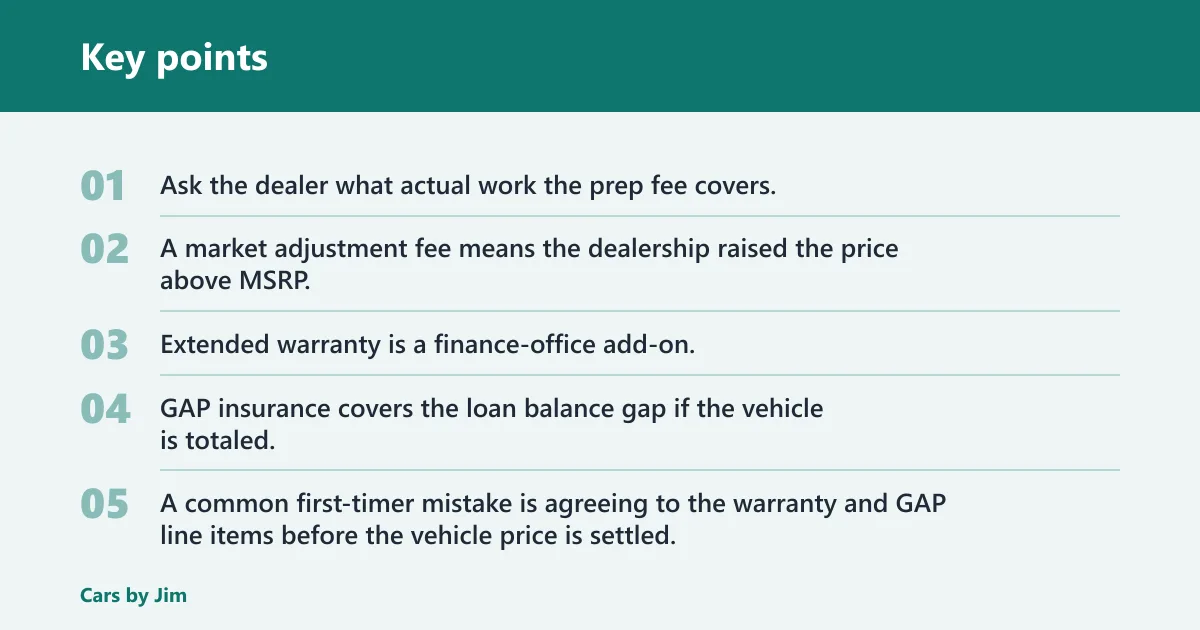
Ask the dealer what actual work the prep fee covers. If the answer sounds like routine cleaning or a reconditioning charge already covered elsewhere, ask for it to be removed or folded into a lower vehicle price.
Protection packages and market adjustments
A protection package is an add-on profit item that may bundle fabric protection, VIN etching, nitrogen tires, or sealant. It is usually optional, so the question is simple: what is it, is it installed already, and can it be removed from the deal?
A market adjustment fee means the dealership raised the price above MSRP. That is not tied to a real service, so you should treat it as a price markup, not a required charge.
Suppose a used SUV is advertised at about $24,900, then the desk adds about a $595 market adjustment and about a $399 protection package. The answer is not a vague complaint about “fees.” Ask for both charges to be removed or offset by reducing the vehicle price by the same amount.
Extended warranty and GAP insurance
Extended warranty is a finance-office add-on. It is optional, the price can sometimes be negotiated, and in many cases you can buy coverage later after you compare terms.
GAP insurance covers the loan balance gap if the vehicle is totaled. It may be necessary if you buy an expensive car, but whether you need it depends on the loan structure and down payment. That makes it a financing decision, not a dealer-fee default.
A common first-timer mistake is agreeing to the warranty and GAP line items before the vehicle price is settled. Keep them out of the first round of negotiation so the dealer cannot hide extra profit inside the monthly payment.
Dealer fee worksheet
Use this as a line-by-line script. The goal is not to argue about every dollar at once. The goal is to separate what is fixed from what can be removed, reduced, or offset with a lower sale price.
| Fee name | Mandatory or negotiable | What to say | What concession to ask for |
|---|---|---|---|
| Documentation fee | Usually mandatory or hard to change, but compare it | “Please send the doc fee in writing with the full out-the-door price. If your fee is higher than the next quote, match the lower fee or lower the vehicle price by the difference.” | Lower doc fee, or an equal reduction in vehicle price |
| Dealer prep fee | Negotiable | “What service does the prep fee cover? If it is just cleaning or routine prep, remove it from the deal.” | Fee removed or full offset in sale price |
| Market adjustment | Negotiable | “The market adjustment is a markup, not a service. Remove it or reduce the asking price by the same amount.” | Fee deleted from the quote |
| Protection package | Usually negotiable | “I am not buying the package unless you can itemize each part and remove it entirely.” | Package removed, or lower price equal to the package cost |
| Title / registration | Non-negotiable | “List these separately so I can verify the state charges in the out-the-door total.” | Not a concession target; verify only |
| Extended warranty | Optional | “Take the warranty off for now. If I want coverage, I will compare it after the car price is settled.” | Remove it, or lower the price if it stays |
| GAP insurance | Optional, sometimes lender-required | “Show the cost separately. If GAP is needed for this loan, I want the rate in writing before I agree.” | Lower price or separate lender comparison |
How to ask for the out-the-door number
Use the same request by email, phone, and in person: ask for the full out-the-door number, broken out by line item. The Manual says to negotiate the out-the-door price, never the monthly payment, because a low payment can hide extra fees or a longer loan term.
The email request
Ask for the full quote. Request the vehicle price, doc fee, sales tax, title, registration, and every dealer fee in one written out-the-door quote. That makes it easier to compare stores line by line.
Set a clear limit. Tell the dealer that you will only consider the car if the quoted out-the-door price matches the figure in writing. That keeps the conversation on total cost, not on monthly payment tricks.
Compare before visiting. Use written quotes from several dealers and compare the same fields. If one dealer buries a prep fee or package, you will see it before you spend time in the showroom.
Email template: “Please send your best out-the-door price for the vehicle listed below. Include the vehicle price, documentation fee, sales tax, title, registration, and every dealer-added charge in separate lines. If any fee is required, identify it now. I will compare written quotes and decide based on the total out-the-door price.”
The phone script
Say, “I am comparing out-the-door quotes only. Please read me the total and list each fee separately, including doc fee, prep fee, taxes, title, and registration.” If the response is vague, repeat the request once and move on.
The in-person line to use
“Before you talk monthly payment, get the out-the-door price in writing with every fee listed separately.” That short line changes the frame of the deal and makes it harder for the desk to hide add-ons in the back end.
What to do when fees appear late
Late-stage fees are a warning sign. If the dealer says a fee is mandatory, the right response is to ask for the legal basis or the written policy behind it. If a charge appears after the advertised price, you need the dealer to either remove it or justify it in the final written quote.
Preprinted mandatory-fee claims
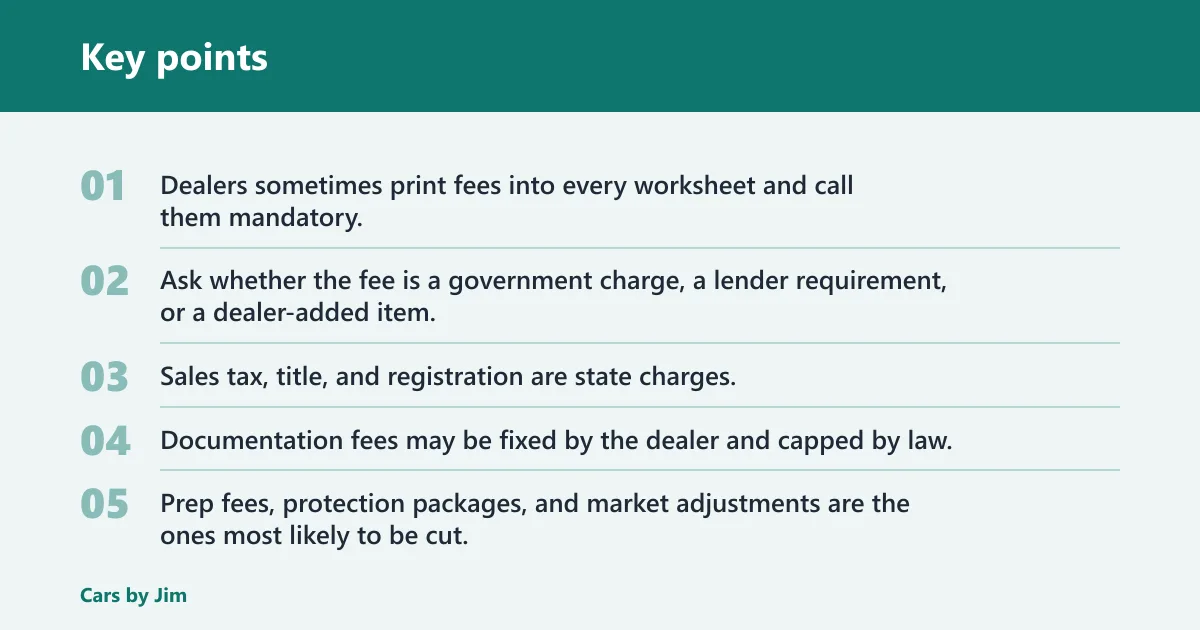
Dealers sometimes print fees into every worksheet and call them mandatory. That does not make them non-negotiable; it only means the fee is part of their starting position.
Ask whether the fee is a government charge, a lender requirement, or a dealer-added item. Sales tax, title, and registration are state charges. Documentation fees may be fixed by the dealer and capped by law. Prep fees, protection packages, and market adjustments are the ones most likely to be cut.
Added charges after the advertised price
If the dealer adds a fee after the advertised price, stop the deal until the quote is rewritten. Ask for the advertised price, every add-on, and the full out-the-door total in one document.
Picture a sedan listed online at about $18,500, then the desk adds about a $289 documentation fee, about a $695 prep fee, and about a $995 protection package. Peterson Auto Sales says its advertised price already includes a flat $289 documentation fee, which is why you should ask whether a quoted price already contains any fee before you show up.
When to walk away
Walk away when the dealer refuses to separate state charges from add-ons, will not remove junk fees, or keeps changing the number after agreeing to a quote. If the store will not lock the out-the-door price in writing, the risk is on you.
That does not mean every fee must disappear. It means the dealer should either delete the charge, lower the vehicle price to offset it, or prove the charge is truly mandatory.
How to turn fee removal into a price concession
If a fee stays on the sheet, ask for a matching price cut. That keeps the discussion on the same total number and stops the dealer from saying the fee is “fixed” while still moving money from one box to another.
If the dealer will not delete a fee
Say, “If you cannot remove that fee, reduce the vehicle price by the same amount.” This works best with dealer prep fees, protection packages, and market adjustments because those charges do not change the car itself.
A common first-timer mistake is accepting a fee because the dealer says the price is already “discounted.” If the discount disappears when the fee appears, the deal is not really discounted.
If the dealer says the fee is fixed
Ask whether the fee is fixed by law, by lender requirement, or only by dealership policy. If it is dealership policy, you can still ask for the vehicle price to be lowered by the same amount or for the dealership to absorb the cost in another line item.
Use this test: mandatory government charge, compare only; dealer-imposed add-on, challenge it; optional product, decline it unless the price and terms make sense.
Frequently asked questions
Are dealer fees negotiable on a used car?
Some are, some are not. Sales tax, title, and registration are usually fixed state charges, while doc fees vary by dealer and state. Dealer prep fees, protection packages, market adjustments, extended warranties, and often GAP insurance are the items most worth challenging or removing.
Which dealer fees can I ask to remove when buying a used car?
Ask to remove dealer prep fees, protection packages, market adjustments, and any dealer-installed add-on that does not change the car’s condition or legal status. You can also decline extended warranty and GAP insurance if they are optional or if the lender does not require them.
How do I negotiate a documentation fee at a used car dealership?
Start by asking for the doc fee in writing before you visit. If the number is high, compare it with other written quotes, then ask the dealer to match the lower fee or cut the vehicle price by the difference. In capped-fee states, verify the cap first.
What fees are non-negotiable at a dealership?
Sales tax, title fee, and registration fee are the main non-negotiable charges because they are government or state-related. They still belong in the out-the-door price, but they are not the part of the deal to haggle over.
Should I negotiate the out-the-door price instead of each fee?
Yes. The out-the-door price is the best comparison number because it bundles the vehicle price, taxes, title, registration, and dealer fees into one figure. If you negotiate only one fee, the dealer may simply move the money into another line.
What should I do if the dealer adds fees after the advertised price?
Stop and demand a rewritten out-the-door quote that lists every charge separately. If the added fee is a dealer add-on, ask to remove it or lower the vehicle price by the same amount. If the dealer will not fix the quote, walk away.